

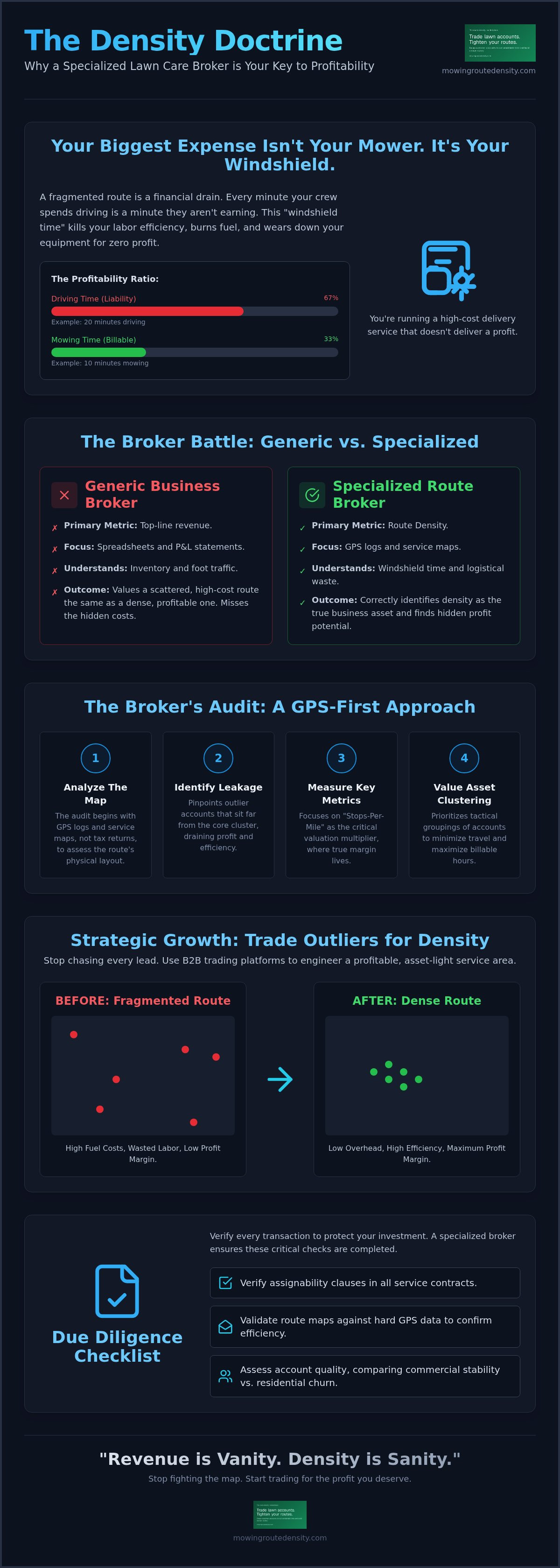
Your biggest expense isn't your equipment. It's the windshield time between jobs. If your crew spends twenty minutes driving for every ten minutes of mowing, you're running a high-cost delivery service that doesn't deliver a profit. A fragmented route is a financial drain that eats your fuel budget and kills your labor efficiency. This is exactly why a specialized lawn care route broker is a necessary partner for any serious contractor. They don't just sell names on a list. They provide the logistical strategy you need to stop the bleeding and start scaling properly.
It's time to stop chasing every lead and start engineering for density. Growth without concentration is just a faster way to go broke. By leveraging a B2B trading platform, you can swap your outliers for accounts that sit right next to your existing stops. You will learn how a specialized broker optimizes your portfolio through strategic account trading and density-focused acquisitions. We will explore how to maximize your liquidity for an eventual exit and why tight routes are the only way to protect your margins. Stop fighting the map. Start trading for the profit you deserve.
Key Takeaways
- Generic brokers value top-line revenue, but a specialized lawn care route broker values density. Revenue without concentration is a liability, not a business asset.
- Audit your route’s true profit potential by treating windshield time as a balance sheet liability. Stop letting logistical waste eat your margins.
- Move beyond traditional acquisitions by using an account trading platform to swap outliers for local stops. Tighten your service area for asset-light growth.
- Verify every transaction through a strict due diligence process. Check for assignability clauses in contracts and validate route maps against hard GPS data.
- Secure maximum liquidity for your business by leveraging a B2B marketplace. Use a service provider locator to find qualified partners for strategic account trading.
Why Generic Business Brokers Fail the Landscaping Industry
Generic brokers are great at selling bakeries. They understand inventory and foot traffic. But they fail landscaping contractors because they treat revenue as a universal metric. A specialized lawn care route broker knows better. They understand that in this industry, revenue is just a number; density is the actual asset. A Business broker might see a profitable P&L, but a route strategist sees a logistical nightmare. They see the hidden costs of fuel, the unpaid labor of windshield time, and the accelerated depreciation of equipment. If your broker isn't looking at your GPS data, they aren't valuing your business correctly.
The Problem with Revenue-Based Valuations
Revenue is vanity; density is sanity. This is the golden rule of the green industry. A generic broker will tell you that a $500,000 route is worth a certain multiple. They don't care if those accounts are five minutes apart or fifty. Scattered routes kill profit through labor leakage. Every minute your crew spends behind a steering wheel is a minute they aren't billable. With the IRS mileage rate at 76 cents per mile in late 2026, those long drives between stops are expensive. A specialized lawn care route broker audits the map, not just the spreadsheet. They look for clusters. They value the tightness of the route because that is where the margin lives.
Industry-Specific Due Diligence
Not all accounts are created equal. Commercial contracts offer stability and predictable cash flow, while residential routes often suffer from higher churn. A generalist broker won't dig into the assignability clauses of your service contracts. They won't assess the true equipment longevity based on the miles driven versus the hours mowed. High-value route acquisition requires deep B2B networking. You need to know which competitors are overextended and which neighborhoods are ripe for a tuck-in acquisition. This isn't about buying a business; it's about optimizing a territory. You want an asset-light growth strategy that prioritizes billable hours over total headcount. Stop buying revenue. Start buying density.
The Broker’s Audit: Evaluating Route Density and Profit Potential
A professional lawn care route broker doesn't start with your tax returns. They start with your GPS logs and service maps. Why? Because a business with high revenue spread across three counties is often worth less than a smaller operation contained within four zip codes. In the landscaping industry, windshield time is a liability on your balance sheet. It increases fuel consumption, accelerates truck wear, and burns billable labor hours. If your crew spends 30% of their day in traffic, you are losing 30% of your potential gross profit. A specialized audit identifies this "leakage" before it ruins your valuation.
Brokers prioritize the concept of "Asset Clustering." This is the tactical grouping of accounts so tightly that a crew can finish multiple properties before the truck needs to move again. This reduces operational overhead and protects your equipment longevity. Identifying leakage is the primary goal of a logistical audit. Leakage is any account that sits outside your core cluster, dragging down the average profit per hour. If an account is ten miles away from your nearest stop, it's not an asset. It's a distraction that costs more to service than it's worth.
Auditing the Logistics Map
The most critical metric in any acquisition is stops-per-mile. High lawn care route density acts as a valuation multiplier. When accounts are clustered, your profit per man-hour spikes. You aren't paying for travel; you're paying for production. This is the foundation of lawn care profit margin optimization. If a route requires a trailer to move every two stops, it's inefficient. A broker will discount the value of those scattered accounts because they require more fuel and more labor to maintain. Before you commit to a deal, you can use a lawn account trading platform to swap these outliers for stops that actually fit your map.
Evaluating Account Churn and Quality
Revenue from a one-off residential client is fragile. A broker prioritizes stable commercial contracts with multi-year service histories. Longevity proves reliability. They verify the client list by looking at how many seasons each account has stayed with the company. Service history matters more than current billables. A client who has paid consistently for five years is a predictable asset. A new client is just a lead until they survive a full season. Brokers also look for "assignability" in contracts. If a contract can't be legally transferred to a new owner, it has zero value in an acquisition. You must audit the fine print to ensure the revenue you're buying is actually yours to keep.
Strategic Acquisition: Buying Accounts vs. Trading for Density
Traditional route acquisition is often a brute-force method. You pay a multiple for a list, but you inherit the previous owner's logistical mess. If 15% of those accounts are 10 miles away from your core service area, you're paying to lose money. A professional lawn care route broker helps you move beyond this all-or-nothing approach. They look for opportunities to prune the dead weight and replace it with high-density stops. The goal isn't just to add more work; it's to add more profitable work.
Growth through acquisition is significantly faster than organic marketing. While organic leads might take months to convert, a strategic purchase puts crews on the ground immediately. However, you must be careful not to overextend. A broker facilitates asset-light growth by identifying routes that fit your existing footprint. This prevents the need for additional trucks or crews that you can't yet support. You aren't just buying revenue. You're buying a more efficient version of your own company.
The Power of the Account Swap
Trading is the ultimate efficiency play. Imagine swapping your furthest account for one that sits directly next to your current Friday route. You've just eliminated travel time and fuel costs without losing gross revenue. This is the core value of a lawn account trading platform. It allows you to negotiate with local contractors to fix each other's maps. A broker acts as the neutral third party in these transactions. They ensure the contracts are valid and the revenue values are equal. It's a win-win that turns logistical waste into bottom-line profit.
Acquisition vs. Organic Growth
Organic growth is slow. It requires marketing spend, lead follow-up, and a high failure rate. Strategic acquisition is instant. You buy the route, and the revenue starts on day one. However, scaling too fast can strain your cash flow and your fleet. This is where you pivot to an asset-light model. Instead of buying new trucks and mowers outright, you can leverage commercial lawn mower lease options to handle the increased load. You get the newest equipment with a predictable monthly cost. This preserves your capital for more acquisitions. A lawn care route broker helps you balance these growth levers. They ensure you aren't just getting bigger, but getting tighter.
Due Diligence: Navigating the Transaction Without Losing Your Shirt
Due diligence isn't a formality. It's your defense against buying someone else's failures. A professional lawn care route broker ensures you aren't just buying a list of names, but a functioning cash-flow machine. You must verify every claim the seller makes. Don't trust a handshake or a verbal agreement. If the logistical data doesn't match the asking price, walk away. There are five non-negotiable steps to protect your capital and your sanity.
- Audit assignability clauses: Check the fine print in every service agreement. Ensure the contracts can legally transfer to your entity. A contract that dies with the seller is worthless.
- Verify GPS data: Confirm the actual route tightness. If the map shows scattered stops and long drive times, the profit potential is a fabrication.
- Inspect equipment: Don't inherit a fleet of mowers held together by duct tape and hope. Check service logs, engine hours, and blade conditions.
- Analyze the seller's lawn care business exit strategy: Are they retiring with a clean reputation, or are they fleeing a trail of bad service and broken promises?
- Finalize the handoff: Create a clear transition period. The seller should introduce you to high-value commercial accounts to ensure continuity.
Verifying the Financials
Tax returns show what the IRS sees. You need to see the job-costing data. Look for a 12-month rolling revenue report to identify seasonal dips and churn rates. Are they spending too much on labor? Is the fuel consumption spiking because of poor routing? Check for hidden liabilities like equipment debt or pending labor disputes. If the profit per stop isn't documented, it doesn't exist. You are buying a future cash flow, not a history book. Tighten your requirements and demand hard numbers before signing any paperwork. If you want to find routes that have already been vetted for density, explore our B2B marketplace for secure account trading.
The Handoff Process
Retention is the only goal during a transition. If you lose 20% of the clients in the first month, you overpaid for the route. A lawn care route broker manages the "introduction" phase to keep these relationships stable. You need a face-to-face handoff for commercial accounts. Your new employees also need a reason to stay. If you're buying a larger route with staff, treat the transition with clinical precision. Map out the first 90 days. Keep the service schedule identical to minimize disruption. Consistency is the only way to protect the asset you just bought.
Leveraging the Mowing Route Density Marketplace
Mowing Route Density isn't a social club. It's a logistical weapon for contractors who are tired of leaving money on the pavement. Most operators struggle to scale because they're trapped in a local mindset. They take every lead that calls, regardless of the map. We provide the infrastructure to fix that. By serving as your digital lawn care route broker, our platform facilitates secure, B2B account trading that prioritizes your bottom line. You don't need more customers; you need better ones.
Success in this industry requires a two-pronged approach: density and flexibility. You can use the lawn mowing service provider locator to identify partners who own the neighborhoods you want to enter. Instead of fighting for scraps, you trade for territory. To support this growth without drowning in debt, smart contractors integrate professional lawn equipment rental into their operations. This allows you to scale your fleet as you acquire new routes, keeping your business lean and your capital liquid. High-density routes plus asset-light equipment management equals maximum profit.
A Network for Scaling Contractors
Scaling means moving from the mower seat to the strategist's desk. You can't grow if you're micromanaging a single truck. Our national network allows you to list your outliers for trade or sale, turning logistical liabilities into tradeable assets. If you secure a large commercial contract that exceeds your current capacity, don't turn it down. Find vetted lawn care subcontractors within our marketplace to handle the overflow. You maintain the contract and the relationship while the work gets done efficiently. This is how you build a national footprint without the overhead of a national corporation.
Next Steps for Your Business
Action beats intent every time. Start with an internal route audit. Open your map and circle every account that sits more than ten minutes away from your core clusters. These are your primary trade assets. Once you've identified the waste, set up your profile on our account trading platform. Don't wait until you're ready to retire to start thinking about your valuation. A lawn care route broker can help you structure your routes for maximum liquidity today. Tighten your service area. Cut your fuel spend. Build a business that someone actually wants to buy. The tools are here. Use them.
Stop Chasing Revenue and Start Engineering Profit
Windshield time is a choice, not a necessity. If you continue to service scattered accounts, you are choosing to burn fuel and labor for zero return. A specialized lawn care route broker provides the strategic oversight needed to turn a fragmented map into a high-density portfolio. By focusing on specialized route density audits and leveraging a national B2B contractor network, you can finally stop the logistical leakage that kills your margins. Revenue is vanity; density is sanity.
Success in the 2026 market belongs to the contractors who embrace asset-light growth solutions. Trading outliers for local stops isn't just a convenience; it's a financial imperative. You now have the framework to audit your financials and navigate due diligence without losing your shirt. It is time to stop fighting the logistics and start trading for the concentration your business deserves. Build a tighter route today to ensure a more liquid exit tomorrow.
Optimize your route density on our account trading platform and start scaling with precision.
Frequently Asked Questions
What does a lawn care route broker actually do?
A lawn care route broker acts as a logistical strategist for your business. They don't just list a company for sale; they audit maps and GPS data to verify profit potential. Their job is to facilitate B2B transactions where contractors buy, sell, or swap accounts to improve operational efficiency. They focus on finding qualified buyers who understand that density is more valuable than raw revenue.
How much does it cost to buy a lawn care route in 2026?
Prices in 2026 are driven by route density and contract stability. You generally pay a multiple based on annual gross revenue or monthly billables. High-density routes command a premium because they have lower overhead. You aren't just buying a customer list; you're buying a territory with established cash flow. Always audit the stops-per-mile before agreeing to a price to ensure you aren't buying a logistical nightmare.
Is it better to buy a route or grow organically through marketing?
Buying a route is the faster path to scaling. Organic marketing is slow and requires constant spending on lead generation. Acquisition allows you to put crews on the ground and generate revenue on day one. However, organic growth allows for more control over where your accounts are located. If you have the capital, buying a route and then pruning it for density is the most efficient way to grow.
What is an account swap and how does it improve density?
An account swap is a tactical trade between two contractors. You exchange a distant account for one that is closer to your existing route. It improves density by eliminating travel time and reducing fuel consumption. This turn-based strategy allows you to tighten your service area without losing gross revenue. It's the fastest way to turn logistical waste into bottom-line profit without adding new labor costs.
How do I value my landscaping business for an exit?
Stop looking at your tax returns and start looking at your profit per man-hour. A buyer wants to see tight routes and low equipment depreciation. Calculate your stops-per-mile and provide a 12-month rolling revenue report to prove stability. A specialized lawn care route broker will help you identify these metrics. High liquidity comes from showing a buyer that your routes are engineered for maximum efficiency and minimal waste.
Can I rent equipment for a newly acquired route instead of buying it?
Yes, and it is a superior strategy for asset-light growth. Utilizing lawn mower rental allows you to scale your fleet without taking on long-term debt. It preserves your cash flow for more account acquisitions. This approach ensures your crews have reliable equipment while you stabilize the new route. Scaling through rental prevents you from overextending your balance sheet during a critical growth phase.
What are the biggest risks when buying existing lawn care contracts?
The primary risks are high client churn and non-assignable contracts. If a contract cannot legally transfer to your business, the revenue has zero value. You must also verify the service history of each account. Clients who have been with a company for years are predictable assets; new clients are high-risk leads. Always audit GPS logs to ensure the drive times provided by the seller match reality.
How do I find a specialized broker for the landscaping industry?
Avoid generalists who sell retail shops or restaurants. You need a platform that understands the specific logistics of the green industry. Look for a dedicated lawn account trading platform that connects B2B contractors directly. These specialized networks focus on route density and asset-light scaling. Use a service provider locator to find other professionals in your region who are open to strategic account trading or acquisition deals.


