
Your trailer full of zero-turns is a liability, not an asset. Professional buyers don't care about your used steel. They're paying for the recurring cash flow your routes generate while you're off the clock. If your phone rings every time a belt snaps, you don't own a company; you own a high-stress job. Developing a professional lawn care business exit strategy is the only way to stop the daily grind and finally get paid for the equity you've built.
You've likely spent years worrying that the business is too dependent on your personal presence. You see equipment depreciation eating your profits and feel confused about how to value a service route accurately. We understand the logistical frustrations of the service industry. This guide will show you how to transform those operations into a liquid asset that commands top dollar from serious investors.
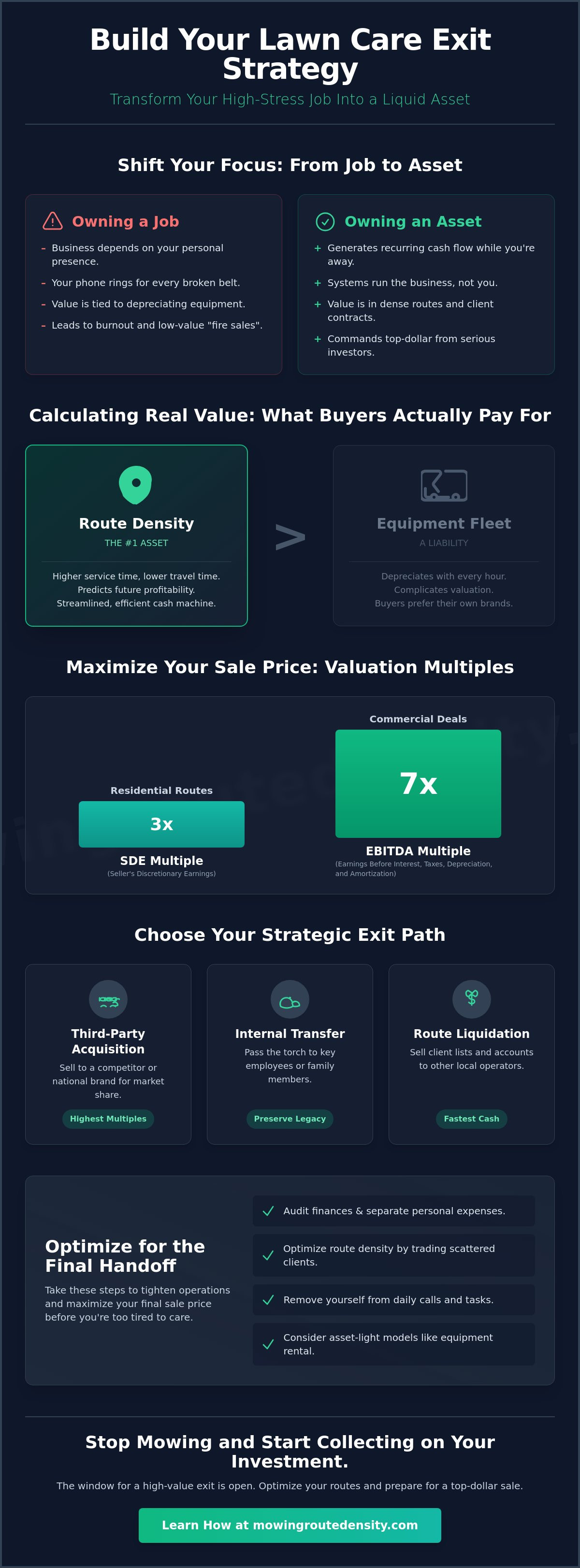
We're providing a clear roadmap to maximize your final sale price, whether you're aiming for a 3x SDE residential multiple or a 7x EBITDA commercial deal. You'll learn how to tighten your overhead, optimize route density, and minimize post-sale liability. It's time to stop mowing and start collecting on your investment.
Key Takeaways
- Stop treating your business like a job and start building a liquid asset. A professional lawn care business exit strategy prevents "fire sales" and ensures you get paid for your built equity.
- Shift your focus from equipment to route density. Learn why buyers prioritize geographic clusters and recurring cash flow over a fleet of depreciating trailers.
- Audit your operations to command higher valuation multiples. Separating personal expenses and removing yourself from daily calls can drastically increase your business's market value.
- Evaluate the strategic differences between total buyouts and partial account liquidation. Choose the path that maximizes your cash payout while minimizing post-sale liability.
- Optimize your margins before the final handoff. Use account trading to swap scattered clients for high-density routes that attract serious, top-dollar buyers.
What Is a Lawn Care Business Exit Strategy?
An exit strategy is not a white flag of surrender. It's a proactive roadmap designed to transfer ownership while extracting the maximum equity you've built through years of sweat equity. Most owners treat their business like a job they'll do forever. Then burnout hits. Or a back injury occurs. Suddenly, they're forced into a "fire sale" where they accept pennies on the dollar. A professional lawn care business exit strategy ensures you sell on your terms, not out of desperation. It's the difference between walking away with a retirement fund or just a pile of used equipment.
True value isn't found in your old mowers or rusty trailers. Those are depreciating liabilities that lose value every time the hour meter clicks forward. Real liquidity comes from recurring revenue and operational independence. A successful exit means your business runs profitably without your daily presence. If you're still the one answering every customer complaint or fixing every broken belt, you don't have an asset. You have a high-stress job. Buyers want a machine that makes money, not a phone that won't stop ringing. They pay for the systems, the routes, and the contracts.
The Three Main Types of Exits
Every exit follows a different path toward liquidity. Your choice depends on your timeline and your goals for the brand's future.
- Third-party acquisition: Selling to a competitor or a national brand. These buyers are looking for market share and established crews. They often pay the highest multiples for well-organized operations.
- Internal transfer: Passing the torch to key employees or family members. This keeps your legacy intact but requires a long-term plan to ensure the new owners have the capital and the training to succeed.
- Route liquidation: Selling off client lists and accounts to local operators. This is the fastest path to cash. It's ideal for owners who want to downsize or exit quickly without selling the entire brand.
Why 2026 Is the Year to Plan Your Move
The landscaping industry is seeing unprecedented consolidation. Private equity firms are actively buying smaller companies to build regional platforms. With the industry projected to exceed $200 billion by 2030, the window for a high-value exit is wide open. Waiting for burnout reduces your negotiation leverage. In 2026, high fuel costs and labor shortages have made "dense" routes the ultimate prize. Buyers want efficiency. They want routes where mowers stay on the ground and off the trailer. If your accounts are scattered across three counties, your value is leaking out of your gas tank. Planning now allows you to tighten those routes and maximize your final sale price before you're too tired to care.
Calculating Real Value: Why Route Density Trumps Equipment
Stop obsessing over the shine on your zero-turn mowers. Buyers don't pay for your used trailers or your mechanic's skill set. They pay for profit margins. In a professional lawn care business exit strategy, route density is the primary predictor of future profitability. Route density is the ratio of service time to travel time. The higher this ratio, the lower your fuel waste and the higher your billable labor hours. If your crews spend half the day sitting in traffic, you're burning your eventual sale price in the gas tank. An acquirer looks at your service map and sees either a streamlined cash machine or a logistical nightmare. Every minute spent driving is a minute you aren't getting paid.
The Problem with Heavy Equipment Assets
Heavy equipment is often a burden during a sale. Used mowers are depreciating liabilities that clutter your balance sheet and complicate your valuation. Most serious acquirers already have their own preferred brands and fleet standards. They don't want your five-year-old gear; they want your recurring revenue. By utilizing professional lawn equipment rental, you keep your operations lean and your capital fluid. This asset-light approach makes your business "exit-ready" because the buyer isn't forced to take on your equipment debt or maintenance backlog. It proves your profitability comes from your systems, not just your tools.
Valuing Your Client List
Not all accounts are equal. There's a massive gap between "junk" leads and "dense" contracts. A junk lead is a single residential yard twenty minutes away from your core territory. A dense contract is the house next door to an existing client. Research from June 2026 shows that businesses with over 60% of revenue from recurring maintenance contracts can command a 1x to 2x higher multiple than those relying on one-off jobs. If you're an owner-operator who still mows, you'll likely see a multiple of 3x to 5x Seller's Discretionary Earnings (SDE). However, if you've built a managed business that runs without you, you're looking at 5x to 7x EBITDA. For larger firms with a strong management team, exploring an Employee Stock Ownership Plan (ESOP) can be a sophisticated way to exit while rewarding your staff. You can start trading your scattered accounts today to build the high-density clusters that buyers crave. This shift in focus ensures you get paid for the business you built, not just the hours you worked.
Preparing for Sale: Auditing Your Operations for Maximum Multiples
Buyers don't want to buy your personal stress. If your business requires you to answer every call and micromanage every crew, it's a liability. A sophisticated lawn care business exit strategy requires a brutal audit of how you spend your time and where you send your trucks. You must stop chasing every lead and start building geographic clusters. Density is the only metric that truly scales. If an account is more than five minutes from your next stop, it's likely dragging down your valuation. Documentation is your next priority. Every process, from morning load-outs to client billing, must be written down. If a stranger can't step in and run the crew using your manual, your business isn't ready for market.
The "Route Cleanup" Strategy
Identify your "outlier" accounts immediately. These are the customers who live on the edge of your service map, draining fuel and killing billable labor hours. Keeping them "just for the revenue" is a rookie mistake that lowers your overall profit margin. Instead, use a lawn account trading platform to swap these outliers for accounts within your core territory. Industry data suggests that increasing your route density by 20% can increase your final sale value by as much as 40%. Density reduces wear on vehicles, cuts fuel consumption, and allows your crews to complete more billable work in less time. An acquirer will pay a premium for a "tight" route because it guarantees immediate efficiency on day one.
Financial Hygiene for Sellers
Your tax returns are designed to show as little profit as possible. A buyer's audit is the exact opposite. You need to "recast" your earnings to show the true profit potential of the operation. This means separating your personal cell phone, truck payments, and family health insurance from the business overhead. Buyers typically demand at least three years of clean, professional P&L statements. If your books are a mess of mixed expenses, you'll face a "transparency discount" that slashes your multiple. Focus on lawn care profit margin optimization at least 12 to 24 months before your first meeting. Clean financials prove that your margins are sustainable and that the cash flow is real. Don't wait until you're ready to sign a letter of intent to start acting like a professional corporation.
Strategic Exit Paths: Total Buyouts vs. Account Liquidation
Stop romanticizing your brand name. Most buyers don't want your logo; they want your density. A total buyout involves selling the entire entity, including staff, contracts, and physical assets. If your exit includes selling the land or shop property associated with your business in the western region of Wisconsin, couleelandcompany.com can assist in valuing and listing those real estate assets. This process is often complex and slow. For many operators, account liquidation is the superior lawn care business exit strategy. It's the fastest path to cash because you're selling revenue without the legal baggage of a corporate entity. You can often net more by selling high-density routes to hungry competitors than by trying to sell a whole business burdened by debt and aging trucks. Selling the accounts is cleaner; selling the entity is a marathon.
The "Partial Exit" offers a strategic middle ground. You sell off the outlier routes that are logistical drains while keeping a core, high-density territory for yourself. This allows you to downsize into a lifestyle business while pocketing a significant lump sum. It turns your operation into a modular system where accounts can be added or subtracted based on profitability. You're no longer trapped by the size of your company. You're empowered by the value of your contracts.
Selling Your Client List to Competitors
Pricing a client list requires looking at Annual Contract Value (ACV). Don't guess at the number. Buyers will pay a percentage of that ACV based on how well the accounts are clustered. To find the right buyer, use a lawn mowing service provider locator to identify operators already working in your target zones. A competitor with an existing route on the same block will pay a premium for your accounts because their incremental cost to service them is nearly zero. Manage the handoff by introducing the new owner personally. This ensures client retention and protects your final payout. If the clients leave, your payout often leaves with them.
The Asset-Light Advantage
Friction kills deals. If your business is tied to heavy equipment debt, the sale becomes a mess of bank approvals and lien releases. Buyers prefer asset-light operations. When you use lawn mower rental for your fleet, you remove the burden of maintenance backlogs and depreciating steel from the negotiation table. You aren't selling a mowing crew with old trucks; you're selling a logistics machine that generates cash. This makes the transfer of ownership seamless. Position your company as a lean, revenue-generating system that can be plugged into any existing infrastructure. It’s about selling the flow, not the tools. You can find local buyers for your high-density routes today and exit on your own terms.
Optimizing for the Final Handoff with Mowing Route Density
The final twelve months of your operation determine the size of your retirement. Stop coasting. A successful lawn care business exit strategy requires a sprint to the finish line, not a slow fade into burnout. This is the period where you trim the fat and polish the gears. Every dollar of waste you cut now results in a 3x to 5x increase in your final payout. You must focus on maximizing your net profit margins by shedding every logistical inefficiency. If an account doesn't fit your density model, it's a drag on your valuation. Trade it. If your equipment is costing more in maintenance than it's worth in billable hours, dump it. You're no longer a mower; you're an asset manager preparing a high-performance machine for its next owner.
Buyers look at the last four quarters of performance with a microscope. They want to see rising margins and falling overhead. By utilizing our lawn account trading platform, you can swap your scattered, low-margin accounts for high-density clusters that instantly improve your route efficiency. This isn't just about cleaning up the map. It's about proving to a buyer that your business is a streamlined logistics operation. You're providing them with a turnkey system where the travel time is minimized and the profit is maximized. This level of preparation separates the hobbyists from the professionals who walk away with significant liquidity.
Steps to Take Right Now
Execution starts today. Don't wait for a buyer to tell you your routes are inefficient. Take these steps to harden your business for sale:
- Audit your current route density: Use our tools to visualize your service clusters. Identify every account that forces a truck to drive more than five minutes between stops.
- List your outlier accounts for trade: Get those distant accounts off your books. Swap them for accounts in your core territory to tighten your service area and lower fuel consumption.
- Convert equipment debt into rentals: Debt is a deal-killer. Use lawn mower rental to replace aging, debt-heavy gear. This improves your balance sheet and proves you can scale without massive capital expenditures.
The Mowing Route Density Difference
Most consultants give you a list of things to do and then walk away. We provide the infrastructure to actually execute your lawn care business exit strategy. We bridge the gap between "working in the business" and "selling the asset." Our marketplace allows you to find local buyers who specifically value the density you've built. We don't just talk about exit plans; we provide the platform to liquidate your accounts or sell your entire operation to the right operator. Ready to tighten your routes and prep for exit? Explore our marketplace today. Stop working for the business and make the business work for you one last time.
Secure Your Legacy with a Liquid Asset
You've spent years building a company. Don't let it dissolve into a pile of scrap metal and lost accounts. Real liquidity is the result of strategic planning and operational tightening. You now know that route density is the engine of your valuation. You understand that asset-light models and clean books are the keys to a smooth handoff. A successful lawn care business exit strategy isn't a single event; it's a deliberate process of transforming a high-stress job into a sellable asset.
It's time to stop guessing and start optimizing. Use our specialized lawn account trading platform to swap your outliers for high-density clusters. Leverage our national network of commercial contractors and pragmatic tools for route density optimization to harden your business for market. Maximize your business value by optimizing your routes today. You've done the hard work of growing the business. Now, do the smart work of cashing out. Your future self will thank you for the strategic foresight you show today.
Frequently Asked Questions
How much is my lawn care business actually worth?
Your business value is determined by a multiple of your Seller's Discretionary Earnings (SDE) or EBITDA, not the replacement cost of your mowers. Buyers prioritize recurring maintenance revenue and route density over one-off landscaping projects. If your company requires your daily presence to function, expect a lower multiple. Managed operations that run independently always command a premium price.
Can I sell my lawn care accounts without selling my trucks?
Yes, you can execute an account liquidation to exit quickly without the burden of asset transfers. This is often the most profitable path for smaller operators because competitors want your density, not your used trailers. Selling the client list alone removes the logistical friction of equipment inspections and lien releases. It allows you to walk away with cash while keeping or selling your gear separately.
What is a typical multiple for a landscaping business sale in 2026?
Residential-focused businesses currently sell for 3x to 5x SDE. Commercial maintenance operations command higher multiples, typically ranging from 5x to 7x EBITDA. If your revenue is over 60% recurring maintenance, you can often add a 1x to 2x premium to those figures. Market data from June 2026 shows that multi-state platforms can even reach multiples of 6x to 8x EBITDA.
How long does it take to execute a lawn care exit strategy?
A professional lawn care business exit strategy requires 12 to 24 months of preparation for maximum liquidity. You need this time to clean up three years of financial records and optimize your route density. Rushing the process usually results in a "fire sale" where you leave significant equity on the table. Start documenting your processes now to prove the business can survive without you.
Do I need a business broker to sell my mowing route?
You don't necessarily need a broker for a simple route sale or account trade. Brokers for small businesses typically charge a success fee of 8% to 12% for deals under $1 million. For many operators, using a specialized account marketplace or a service provider locator to find local competitors is more efficient. This allows you to negotiate directly with buyers who already understand your local market.
What happens to my employees when I sell my lawn care business?
Most buyers want your crew because labor is the industry's primary bottleneck. In a typical asset sale, the buyer will offer your existing employees new contracts under the new ownership. You must manage this handoff carefully to ensure staff retention, as your final payout often depends on the business maintaining its performance post-sale. Clear communication prevents the "rumor mill" from driving your best workers to competitors.
Should I pay off my equipment before selling the business?
Clearing equipment debt simplifies the sale by removing the need for lien releases and bank approvals. Buyers prefer an asset-light balance sheet that doesn't include high-interest truck payments or aging mowers. If you have significant debt, consider converting to equipment rentals in the months leading up to the sale. This keeps your capital fluid and makes the transfer of ownership seamless for the acquirer.
How can I increase my business value in less than six months?
Tighten your route density immediately to boost your profit margins. Use an account trading platform to swap your distant, low-margin "outlier" accounts for clients in your core service area. Every mile you cut from your daily route increases your billable labor hours and reduces fuel waste. This creates an instant spike in profitability that directly increases the multiple a buyer is willing to pay.


