

Why buy another $60,000 mower when your current fleet is already bleeding fuel on scattered routes? Most owners think scaling requires more iron and more debt. They're wrong. Learning how to find lawn care subcontractors is the strategic move to expand your footprint without crushing your margins under the weight of equipment maintenance. You've likely dealt with "no-show" crews or small teams with failing gear that ruins your reputation. It's a waste of billable hours. It's a drain on your sanity.
We agree that the search for reliable partners is often a frustrating cycle of trial and error. This guide provides a blueprint to break that cycle. You'll learn how to source, vet, and manage subcontractors to increase capacity while keeping your operations lean. We'll cover everything from equipment quality standards to tightening route density for maximum profit. It's time to stop managing machines and start managing a high-performance, asset-light network that actually scales.
Key Takeaways
- Scaling doesn't require more debt. Learn why subcontracting is the strategic alternative to buying more trucks and equipment.
- Stop wasting time on general job boards. Discover how to find lawn care subcontractors through specialized B2B marketplaces and account trading platforms.
- Protect your brand from "no-show" crews. Follow a non-negotiable vetting protocol that verifies insurance and equipment standards before you sign.
- Boost your margins through route density. Learn the clustering techniques that eliminate wasted fuel and maximize billable hours for every partner.
- Scale into new territories instantly. Use service provider locators to identify vetted capacity in new markets without the logistical friction.
The Capacity Trap: Why Finding Lawn Care Subcontractors is a Strategic Necessity
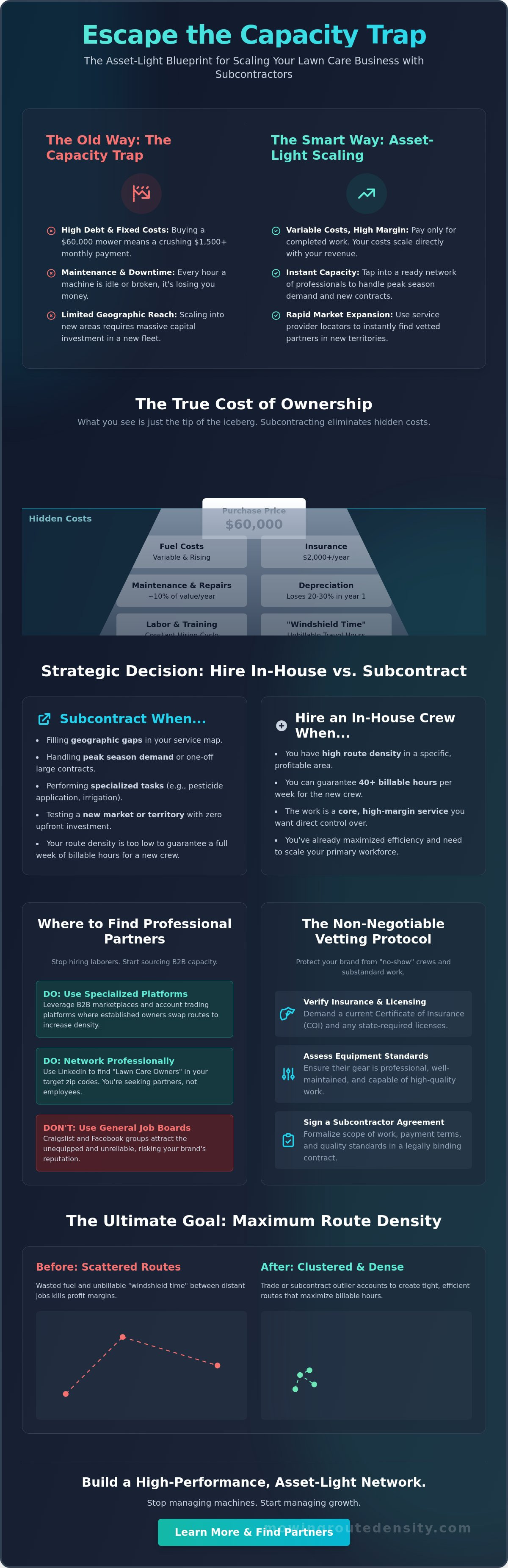
Growth usually feels like a victory until you see the bill. Most owners think scaling requires more iron, more debt, and more headaches. They land a commercial contract and immediately buy a new zero-turn and a heavy-duty truck. Now they have a $1,500 monthly payment and a crew that might quit by Friday. This is the "organic" growth trap. It's a cycle of increasing overhead that kills profit margins before the first blade of grass is cut. Buying iron doesn't guarantee profit; it guarantees a higher break-even point.
To scale without the bloat, you must understand what is a subcontractor in a professional, B2B context. We aren't talking about a 1099 individual using your weed whacker and driving your truck. A true subcontractor is an independent business partner with their own insurance, gear, and payroll. When you find lawn care subcontractors who operate at this level, you aren't just hiring labor. You're buying immediate capacity. You're offloading the risk of equipment failure and labor shortages onto a partner who is already equipped for the job.
This approach protects your cash flow during the volatile seasonal surges of the U.S. lawn care market. Industry data shows that 61% of lawn care businesses already use subcontractors to handle peak season demand. It's a common-sense remedy for the labor shortages and rising equipment costs that define the current market. Instead of owning the machine and the maintenance schedule, you own the contract and the customer relationship. It is a shift from a "worker" mindset to a "strategist" mindset.
Asset-Light Scaling in 2026
Scaling in 2026 requires a lean mindset. Every truck in your lot is a liability that depreciates every hour it sits idle. Subcontracting shifts your financial model from fixed costs to variable costs. You only pay for the work that gets finished. The math is simple. When you factor in insurance, fuel, maintenance, and depreciation, the total cost of ownership often exceeds the rate of a reliable partner. It's about tightening the ship and cutting waste.
When to Sub Out vs. When to Hire
There is a specific tipping point where adding an internal crew becomes a liability. If your route density isn't high enough to keep a new truck billable for a full week, you're bleeding money on windshield time. Use subcontractors to fill geographic holes in your service map. They are also the perfect solution for specialized tasks like pesticide application or professional tree maintenance; for example, partnering with CDA TREE AND UTILITY allows you to offer expert tree services without investing in specialized rigging or bucket trucks. Capacity management is the strategic balancing of service demand against available labor hours to maximize profit without increasing fixed overhead.
Where to Find Reliable Lawn Care Subcontractors Nationally
Stop posting on Craigslist. You aren't looking for a laborer who needs a ride. You're looking for a business owner who needs more work. General job boards attract the desperate and the unequipped. To find lawn care subcontractors who actually show up, you need to go where the professionals hang out. Shift your focus. Stop hiring. Start sourcing capacity. You want partners who view their business with the same logistical rigor that you do.
The U.S. Small Business Administration guide on subcontracting outlines how these B2B relationships should function. While often cited for federal work, these principles of prime and sub-contractor alignment are essential for your local routes. You are the prime; they are the sub. This requires a level of professional maturity you won't find in a Facebook "help wanted" group. Look for established firms that are looking to fill gaps in their schedule rather than individuals looking for a paycheck.
Leveraging Account Trading Platforms
The most efficient way to source is through a specialized lawn account trading platform. These marketplaces allow you to swap accounts with other owners to increase local density. Why drive 20 miles for one yard? Trade it to a partner who is already in that neighborhood. It's a win-win. You shed the travel time. They gain a dense route. This is how you find lawn care subcontractors who are already operationally ready and geographically aligned with your goals.
Digital Sourcing Strategies
Use LinkedIn. Search for "lawn care owner" or "landscaping proprietor" in your specific zip codes. These are your targets. They have the equipment. They have the insurance. They might have a gap in their schedule that fits your overflow perfectly. Look at their online reviews. If a crew has dozens of five-star ratings, they won't ruin your reputation. Check their digital portfolio. Clean trucks. Sharp blades. Professional uniforms. These are the only resume points that matter in a high-stakes service environment.
Get out of the office and scout the field. When you see a crew with high-end gear or well-maintained gas fleets, stop and talk. A "Reverse Search" means finding the quality first and the business owner second. Talk to your local equipment dealers too. They know which crews pay their bills on time and keep their mowers in top shape. If you need to fill capacity gaps quickly, our service provider locator can connect you with vetted firms in your area without the manual search.
The Vetting Protocol: Cutting Through Substandard Candidates
A resume is just a list of claims. In the service industry, the only proof of quality is a clean cut and a valid insurance certificate. Once you find lawn care subcontractors who look good on paper, you must move into a clinical vetting phase. Most owners skip this step because they're desperate for capacity. That's a mistake. A single "no-show" crew or a liability claim from an uninsured partner can wipe out a month of profit. You aren't just hiring a helper. You're auditing a business partner.
Verification of insurance is your first filter. General liability and workers' comp are non-negotiable requirements. If a candidate cannot produce a current certificate of insurance (COI) that names your business as additionally insured, the conversation ends. It's that simple. Without these protections, you are personally liable for every broken window and every twisted ankle on the job site. Don't gamble with your company's future for the sake of a cheap labor rate.
The "Test Plot" is your final safeguard. Never award a full route to an unproven crew. Start with a trial run on a single, non-critical account. Watch their technique. Check their edging precision. Verify their arrival time. If they can't handle one lawn with perfection, they certainly won't handle a 50-stop route when the summer heat kicks in. This trial run reveals the truth about their work ethic and equipment reliability before you commit your reputation to their hands.
Equipment Standards and Reliability
Professional-grade mowers are a prerequisite for subcontracting. Residential gear cannot handle the daily abuse of commercial routes. It breaks. It slows down. It produces a substandard cut that triggers customer complaints. If you find lawn care subcontractors who have the skill but lack the capital for high-end gear, consider professional lawn equipment rental as a bridge. This allows your partners to access reliable, commercial-grade machines without the long-term debt, ensuring your brand standards remain consistent across every route.
The Legal and Financial Framework
Contractual alignment prevents disputes. Your subcontractor agreement must define the "scope of work" with clinical precision. Specify the height of cut, the frequency of edging, and the exact protocol for debris removal. Payment terms should incentivize quality and punctuality. Consider a "hold-back" period or a performance bonus to keep crews focused on the result. Finally, ensure your contract clearly defines the B2B relationship to avoid the employee misclassification trap with the IRS. They use their own tools. They set their own schedules. They are a separate business entity.
Operationalizing Subcontractors for Maximum Route Density
Windshield time is profit suicide. You didn't work this hard to spend your day paying technicians to sit in traffic. Once you find lawn care subcontractors with the right gear, you must deploy them with surgical precision. The goal isn't just to get the grass cut. The goal is to tighten your service map until every stop is a few blocks from the next. Subcontractors are the tool that makes this possible without adding another truck to your fleet.
Clustering is the only way to survive rising fuel costs. Assign your partners to specific neighborhoods where your internal crews have low density. If you have three "one-off" stops that are 20 minutes apart, you're losing money on every visit. By offloading these outliers to a subcontractor who is already working that zip code, you turn a logistical nightmare into a passive revenue stream. This "Density Swap" approach allows you to focus your internal resources on your most profitable, high-density corridors.
Reducing Logistics Waste
Every minute spent driving is a minute you aren't billing. On a standard 1/4-acre lot priced at $55 per visit, losing just 15 minutes to inefficient routing can slash your hourly yield by over 20% due to the compounding costs of fuel and labor. These "leakages" are the primary reason for failing margins. Use subcontractors to eliminate these gaps and drive your lawn care profit margin optimization. For every mile you cut from your daily route, you reduce wear on your assets and put cash back into your bottom line. Stop chasing scattered accounts and start building a fortress in your core service area.
Quality Control at Scale
You can't manage what you don't measure. Stop micromanaging and start auditing. Require every subcontractor to provide digital "proof of work" via photos and GPS timestamps for every completed stop. This creates a paper trail that protects you from customer disputes. Conduct random spot-checks on 10% of subcontractor-managed yards each week. It's about trust, but it's also about verification. If a partner isn't meeting your edging standards, coach them immediately. If they don't improve, cut them. Your reputation is the only thing you can't replace.
Managing the customer experience is the final hurdle. Your clients don't care who cuts the grass; they care that it's cut correctly and on time. Ensure your subcontractors represent your brand with professional conduct. If a customer sees a beat-up truck or a crew without PPE, it reflects on you. Set these expectations in your initial agreement and enforce them through regular feedback loops. High-performance partners appreciate the clarity; the low-performers will weed themselves out. To simplify this process, use our lawn account trading platform to find partners who already understand these professional standards.
Leveraging the Mowing Route Density Network for Scalable Growth
Scaling a landscaping business shouldn't feel like a gamble. You need a centralized hub to manage your expansion without the overhead of a corporate headquarters. Our platform is designed to help you find lawn care subcontractors who operate as professional business entities. We don't deal in casual labor. We deal in route density and operational efficiency. By using our service provider locator, you can identify vetted capacity in new geographic markets instantly. It's the difference between guessing where you can grow and knowing where you have the support to scale. It is a math problem. Solve it with the right tools.
The platform allows you to move beyond the limitations of your own fleet. If you have underperforming routes that are scattered across three different zip codes, you are bleeding money on fuel and labor. Our lawn account trading platform gives you the ability to trade those distant stops for high-density account clusters closer to your core. You tighten your routes. You increase your billable hours. You cut your waste. This is the only way to achieve asset-light growth in a market where equipment costs continue to climb. When you find lawn care subcontractors through a professional network, you're buying a solution, not a new set of problems.
The Mowing Route Density Advantage
We talk business, not just grass cutting. Our network is built for owners who understand that every minute on the road is a minute of lost profit. We prioritize B2B relationships. Every account on our platform is verified. Every transaction is secured. This focus on professional standards provides the peace of mind you won't find on general job boards. We also provide access to commercial-grade lawn mower rental services. This ensures that even if your subcontractor is a smaller firm, they can still operate with the high-performance gear your brand standards require. We provide the infrastructure; you provide the strategy.
Next Steps for Strategic Expansion
Your first step is a clinical audit of your current operations. Look at your service map. Find the density gaps. Identify the stops that are eating your fuel and time. Once you know where you're weak, you can register as a provider on our national network to offload those outliers. Stop managing machines and start managing a high-performance network that scales with your ambition. Your reputation depends on reliability. Our network provides it.
The status quo is a recipe for stagnation. If you keep buying trucks to solve a capacity problem, you'll eventually run out of cash. Use our tools to build a leaner, more profitable operation. Find your next professional partner on the Mowing Route Density marketplace today.
Scale Your Operations Without the Overhead
Scaling your landscaping operations shouldn't mean drowning in equipment debt. You've learned that true growth comes from tightening your routes and offloading the burden of fixed assets. By moving outliers to professional partners, you protect your billable hours and eliminate fuel waste. The ability to find lawn care subcontractors who meet your commercial standards is the difference between a bloated business and a high-margin machine. It requires a shift from being a technician to being a strategist who prioritizes the bottom line.
Part of this strategic shift involves understanding the technical and regulatory requirements of the commercial properties you service; for example, you can visit ML Traffic Engineers Australia to learn about driveway grade standards and disabled access compliance.
Stop letting scattered routes eat your profit. You need a national B2B marketplace that understands the specific logic of route density. Whether you need to swap underperforming accounts through specialized route trading logic or access commercial-grade equipment rental options to empower your partners, the right infrastructure is already built. It's time to stop working for your machines and start making your network work for you. You have the blueprint for a leaner, more resilient business model.
Optimize your route density and find vetted partners now. Take control of your margins and build the asset-light business you deserve today.
Frequently Asked Questions
How much should I pay a lawn care subcontractor?
Pay your subcontractors a flat rate per property that preserves your target net profit margin after accounting for your own customer acquisition costs. This rate must be high enough to cover their labor and fuel but low enough to leave room for your overhead. If you don't know your exact break-even point for every route, you're just guessing at numbers that could sink your profitability.
What insurance does a lawn care subcontractor need?
Every partner must carry general liability and workers' compensation insurance to shield your business from litigation. You must require a Certificate of Insurance (COI) that names your company as an additional insured before they touch a single blade of grass. This is a non-negotiable step to ensure you aren't personally liable for property damage or on-site injuries.
Can I prevent a subcontractor from stealing my clients?
Implement a clear non-solicitation clause in your B2B agreement to protect your book of business. This legal safeguard prevents partners from bidding on your accounts for a specific duration after the contract ends. Professionals understand that you've done the hard work of client acquisition; they should be focused on the execution of the service.
How do I handle customer complaints regarding a subcontractor?
You own the relationship with the client, so you must resolve the complaint personally and immediately. Require the subcontractor to return and fix the issue within 24 hours at their own expense to maintain your brand standards. If you find lawn care subcontractors who consistently trigger complaints, cut them from your network to protect your market reputation.
Is it better to pay subcontractors by the hour or by the job?
Pay by the job to align the subcontractor's incentives with your goal of maximum efficiency. Hourly pay rewards slow work and creates a financial drain on your billable hours. Job-based pricing ensures your costs are fixed and predictable, which allows you to maintain tight control over your margins while encouraging crews to move through routes quickly.
What equipment should a professional subcontractor own?
A professional partner should own commercial-grade zero-turn mowers, trimmers, and blowers designed for high-volume use. Residential gear is a liability; it breaks down too often and produces a substandard cut that ruins your density. If you find lawn care subcontractors with the right skills but aging gear, they should use commercial rentals to meet your quality requirements.
How do I find subcontractors for snow removal during the off-season?
Leverage your existing service provider locator to identify mowing partners who pivot to snow and ice management in the winter. Many firms use the same crews for plowing and salting to stabilize their year-round cash flow. Securing these partners in the fall ensures you have reliable capacity before the first major storm disrupts your operations.
What is the difference between a 1099 subcontractor and a W2 employee?
The difference lies in the level of control you have over how the work is completed. A W2 employee follows your specific schedule and uses your equipment, while a 1099 subcontractor is an independent business that provides its own tools and decides its own methods. To maintain legal compliance, you must only dictate the final result of the service, not the minute-by-minute actions of the crew.


