
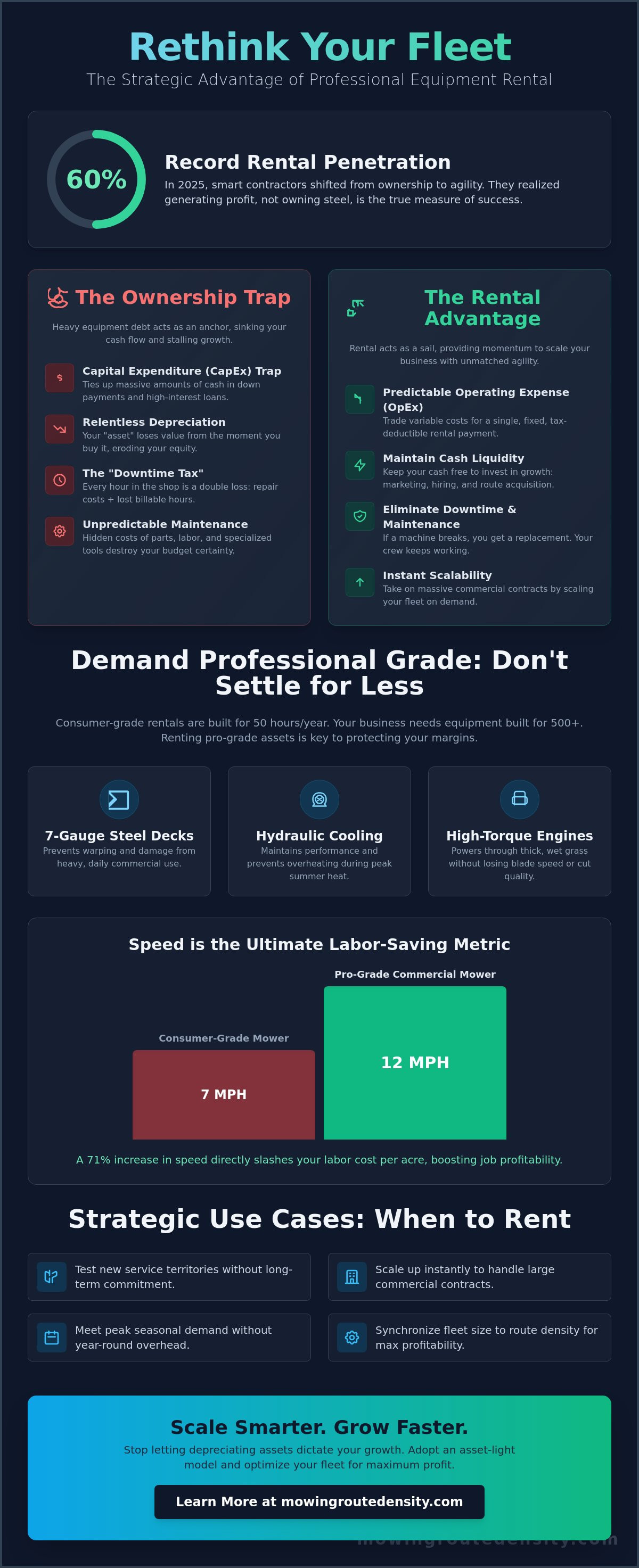
Ownership is the heaviest anchor dragging down a growing landscaping business. You've been told that buying a fleet is the only way to build equity. It's not. Equipment rental penetration hit a record 60% in 2025 because smart contractors realized that owning steel isn't the goal; generating profit is. Integrating professional lawn equipment rental into your business model isn't a backup plan for when a machine breaks down. It's a strategic move to eliminate the CapEx trap that suffocates your cash flow.
You know the frustration of watching a high-end mower sit in the shop while your crew stands idle. Maintenance downtime doesn't just cost parts. It kills billable hours. It destroys route density. This article will show you how to leverage rental as a tactical tool to protect your bottom line and gain the agility needed for large commercial contracts. We'll examine the financial logic of asset utilization, the impact of the March 2026 EPA DEF sensor guidance on equipment uptime, and how to scale your operation without the weight of unnecessary overhead.
Key Takeaways
- Stop viewing rental as an emergency fallback. It's a strategic tool to keep your cash liquid while avoiding the anchor of heavy equipment debt.
- Trade the hidden costs of depreciation and maintenance for predictable, tax-deductible operating expenses that protect your bottom line.
- Identify the commercial-grade specs required to handle 500+ hour seasons and avoid the costly trap of consumer-grade equipment.
- Scale your capacity for high-margin commercial contracts using professional lawn equipment rental without increasing your permanent overhead.
- Learn to synchronize your fleet size with route trading to ensure every machine on your site is generating maximum billable hours.
Professional Lawn Equipment Rental: A Strategic Asset, Not a Backup
Most contractors view owning a fleet as the ultimate mark of success. They're wrong. Ownership is often an anchor. It ties your capital to depreciating steel and locks you into high-interest debt. Professional lawn equipment rental is a sail. It provides the momentum to scale without the drag of massive monthly payments. Stop treating rental as a panic move when a mower dies in July. That's a reactive strategy that costs you money. Instead, use rental as a proactive tool to dominate your market.
Renting allows you to test new territories without committing $60,000 to a new trailer and set of zero-turns. If a new service area doesn't pan out, you return the gear. No harm done. This shifts your financial burden from risky Capital Expenditure (CapEx) to predictable Operating Expense (OpEx). You gain the ability to bid on massive commercial contracts that your current fleet can't handle. You scale up for the job and scale down when the season ends. It's about agility, not just availability.
The Asset-Light Growth Model
You can't grow a crew if your cash is suffocating under a massive equipment loan. Every dollar you send to a bank for interest is a dollar you can't spend on route acquisition or marketing. Focus on billable hours, not machine hours. A mower sitting in your shop over the weekend is a liability. A rented machine is a precise tool that only costs you money when it's on the clock. By leveraging the equipment rental industry, you maintain the liquidity needed to buy accounts or hire better talent. It's a smarter way to build a business that isn't built on a foundation of debt.
Why Professional Grade Matters
Don't confuse professional lawn equipment rental with the consumer-grade machines found at big-box hardware stores. Those mowers are built for 50 hours of use per year. You need machines built for 500. Commercial-grade assets offer the durability required for 8-hour daily run times without losing performance. Look for specific specs that drive efficiency:
- Deck Thickness: 7-gauge steel decks that won't warp under heavy commercial use.
- Hydraulic Cooling: Systems designed to prevent overheating during mid-summer heatwaves.
- Engine Displacement: High-torque engines that maintain blade speed in thick, wet grass.
Speed is the ultimate labor-saving metric. A commercial mower that cuts at 12 mph instead of 7 mph effectively slashes your labor cost per acre. If you're renting underpowered equipment, you're wasting fuel and payroll. Rent the best to get the best margins.
The Math of Scaling: Renting vs. Buying Commercial Mowers
Ownership feels like equity. It's usually just a liability in disguise. When you buy a commercial mower, you aren't just paying for the machine. You're paying for the depreciation, the interest on the loan, the insurance, and the specialized labor required to keep it running. Professional lawn equipment rental replaces these variables with a single, fixed number. This isn't just about convenience. It's about mathematical certainty. If you can't predict your costs, you can't protect your margins.
The equipment rental penetration rate hit nearly 60% in 2025 for a reason. Smart contractors are moving away from heavy debt. They've realized that a machine's value comes from its movement, not its presence in a shed. If your owned mower sits idle for two days a week, it's a drain on your cash flow. Renting ensures you only pay for the asset when it's generating revenue.
Hidden Costs of Equipment Ownership
Most contractors ignore the "downtime tax." If your owned mower breaks on a Tuesday, you lose billable hours and pay a mechanic. That's a double hit to your bottom line. Then there's the opportunity cost. That $15,000 down payment could have funded a marketing blitz to secure three new commercial routes. Beyond the machine, you have the logistics of trailers, secure storage, and higher insurance premiums. These are the financial drains that sink a service business. For those seeking deeper landscaping business management resources, the data clearly shows that underutilized assets are a primary cause of stagnant growth.
OpEx Advantages for Modern Contractors
Renting moves your equipment costs from the Capital Expenditure (CapEx) column to Operating Expenses (OpEx). This has immediate tax benefits. You can often deduct 100% of the rental payment in the year it's paid. You don't have to wait years for depreciation schedules to catch up with your spending. Fixed costs also make your bidding surgical. You know exactly what the equipment costs per day. There's no guessing on repair funds. You also eliminate the risk of technological obsolescence. As the industry moves toward robotic and battery-powered tools, renting allows you to pivot without being stuck with outdated, owned hardware.
Efficiency is the only metric that matters in a tight labor market. If you want to stop bleeding cash on underperforming assets, you need to optimize your fleet around route density. This strategy allows you to scale up for high-margin jobs without the permanent weight of a monthly payment holding you back.
Strategic Use Cases: When to Leverage Professional Rentals
Stop looking at professional lawn equipment rental as a panic button for when a mower throws a belt. That's a reactive mindset. It's a strategic scalpel you should use to cut out operational waste. Smart contractors use rental to solve specific logistical puzzles that ownership can't touch. Whether it's a sudden surge in growth or a specialized contract, rental provides the capacity without the long-term debt. If a machine isn't moving and cutting, it's costing you money. Rental ensures you only pay for the movement.
Managing Seasonal Capacity
The spring rush is a trap for the unprepared. You see the grass growing, the phone starts ringing, and you realize your current fleet can't keep up. Most contractors rush to the dealer and sign a five-year note on a new zero-turn. Then October hits. Now you're paying for a machine that's sitting idle in a shed for four months. That's a leak in your bottom line. Use rental to bridge the 8-week peak growth period. This strategy allows you to scale up to handle municipal bid wins or seasonal surges while keeping your year-round overhead lean. You maximize revenue when the demand is high and eliminate the "storage tax" when things go dormant.
Tactical Equipment Selection
Every property has a "right" machine, but you can't own every machine. You might win a high-margin contract for a series of gated residential properties where your 72-inch commercial mower won't fit. Don't turn down the work. Rent a 36-inch stand-on mower. You fulfill the contract, collect the margin, and return the asset. This tactical flexibility extends to "green" requirements. If a commercial client demands low-noise or electric operations, use professional lawn equipment rental to access battery-powered commercial mowers. You meet the client's sustainability goals without the massive upfront investment in unproven battery tech.
This agility is critical when you're aggressively building route density. If you acquire a new geographic cluster through a lawn account trading platform, your logistics change instantly. You need immediate capacity in that specific zone. Rental gives you the gear to service that cluster today while you analyze the long-term profitability of the route. It's also the perfect way to conduct equipment trials. Thinking about switching your entire fleet from zero-turns to stand-ons? Rent one for a week. Put it on your toughest terrain. Let your best operator tear it down. Real-world data from a rental trial beats a dealer's brochure every time. Use the gear, prove the profit, and return the risk.
Avoiding the Consumer-Grade Trap: Selecting Pro-Level Assets
Don't let a low daily rate blind you to a bad machine. A consumer-grade mower is built for a 50-hour season. You're running 500 hours or more. If you rent a residential-tier machine for a commercial route, you're inviting the "Downtime Death Spiral." This happens when a cheap rental fails mid-job. You pay a crew to sit in the truck. You miss your next three stops. You lose the client's trust. The money you saved on the rental rate is vaporized by lost billable hours. High-tier professional lawn equipment rental is about buying uptime, not just borrowing a tool.
Specs aren't just for brochures. They're the mechanical requirements for maintaining a profitable pace. You need a 7-gauge steel deck that won't buckle when it hits a hidden stump. You need separate hydraulic cooling systems to prevent thermal shutdown in 90-degree heat. You need engine displacement that maintains blade tip speed in tall, wet fescue. These features ensure the machine works as hard as your crew does. If the equipment can't handle an 8-hour daily run time, it has no place on your trailer.
The Professional Equipment Checklist
Tier 1 brands exist because they withstand the abuse of multiple operators and rough transport. When vetting a rental unit, demand the maintenance logs. Specifically, look for compliance with the March 2026 EPA guidance on NOx sensors. This update allows for more reliable sensors that reduce equipment downtime significantly. If the rental provider can't show you a clear service history, walk away. You should also check for ergonomic features like suspension seats and adjustable lap bars. A fatigued operator is an inefficient operator. Finally, ensure the rental partner provides rapid replacement. If a machine breaks, you need a substitute on-site immediately to protect your schedule.
Matching Equipment to Route Logistics
Your gear must match your geography. A 72-inch deck is a liability in a neighborhood of 48-inch gates. Choose deck sizes that optimize for your densest route clusters to minimize "trim time" and manual labor. Consider your transport logistics before you pick up the keys. A commercial zero-turn often weighs over 1,200 pounds. Verify that your current trailers and ramps can handle the weight safely. Fuel efficiency is another hidden cost. A thirsty, poorly maintained engine can add 15% to your daily operating expenses. Find high-density routes that allow you to maximize these commercial assets and turn every rental into a profit engine.
Optimizing Your Fleet with Mowing Route Density
A commercial mower earns nothing while it's strapped to a trailer. Windshield time is the silent killer of your profit margins. If you're driving 30 minutes between stops to justify the monthly payment on an owned machine, you've already lost. Ownership often creates a psychological trap where you take on low-margin work just to keep the equipment busy. Professional lawn equipment rental breaks this cycle. It allows you to deploy high-performance assets only where your route density justifies the cost. Stop chasing work across the county. Bring the gear to the cluster.
The math is simple. High density reduces the physical strain on your fleet and your crew. By syncing your rental strategy with active route trading, you ensure that every machine on your site is generating maximum billable hours. You don't need a massive, permanent fleet to dominate a market. You need a concentrated presence. Use rental to supplement your core equipment when you've successfully clustered your accounts. This approach keeps your overhead low and your agility high. If the machine isn't cutting, it's costing. Rental ensures you only pay for the cut.
The Power of Route Clustering
Clustering is the difference between a struggling owner-operator and a scaling contractor. When you have ten accounts on a single street, your labor cost per lawn drops significantly. You aren't wasting fuel. You aren't losing time to loading and unloading. Use the Mowing Route Density account trading platform to buy density by acquiring accounts in your existing service zones. Conversely, sell or trade your outliers that are draining your resources. Once you've secured a new geographic cluster, use professional lawn equipment rental to service it immediately. This allows you to scale your revenue without waiting for a bank's approval on a new equipment loan. You maintain liquidity while your competitors are drowning in debt.
Scaling with Mowing Route Density
Modern landscaping requires a multi-tool approach to business management. The Mowing Route Density ecosystem provides the framework you need to move from a reactive technician to a proactive strategist. By combining a lawn account trading platform with a service provider locator, you can identify partners and opportunities in real-time. This isn't just about finding work. It's about optimizing the work you already have. Use the locator tool to expand your B2B footprint and find reliable partners who can help you manage overflow during peak surges. Rental gear, traded routes, and strategic partnerships form a tripod of stability for your business. Stop letting your equipment own you. Start owning your strategy. Optimize your route density and scale your fleet today.
Stop Owning Waste and Start Owning the Route
You can't scale a business on hope and high-interest debt. Success in this industry belongs to the contractors who treat their fleet as a variable cost rather than a fixed burden. We've shown how professional lawn equipment rental allows you to bypass the CapEx trap and maintain the liquidity needed for aggressive growth. By focusing on asset utilization and avoiding the downtime inherent in ownership, you protect your billable hours and your sanity. Ownership is a choice; profit is the goal.
Efficiency is the only metric that matters. You can keep driving across town to service scattered accounts, or you can use a specialized route trading marketplace to build clusters that make sense. Our national B2B contractor network is designed for one thing: operational efficiency. Stop letting underutilized mowers sit in your shop while you bleed fuel and labor costs. Maximize your profit margins by optimizing your routes and equipment today. It's time to stop working for your machines and start making your machines work for you. You have the framework. Now go build the business you deserve.
Frequently Asked Questions
Is professional lawn equipment rental tax-deductible for my business?
Yes, rental payments are typically fully deductible as a business operating expense (OpEx) in the year they are paid. Unlike buying a machine, which requires following a multi-year depreciation schedule, renting allows you to write off the entire cost immediately. This keeps your cash flow liquid and reduces your taxable income. You should always consult with a tax professional to confirm how these deductions apply to your specific business structure.
How does renting mowers help with route density?
Renting provides the immediate capacity to service a new geographic cluster without the long-term debt of a fleet expansion. It allows you to "flood the zone" in a high-density neighborhood during peak growth periods. You can service more accounts in less time and return the gear when the route is stabilized. This strategy ensures you aren't paying for underutilized steel when you aren't cutting in that specific area.
What is the difference between commercial and residential mower rentals?
Commercial units are engineered for 8-hour daily run times and 500-plus hour seasons. Residential mowers are built for light, weekly use and will fail under the pressure of a professional route. Professional lawn equipment rental provides machines with 7-gauge steel decks, high-torque engines, and dedicated hydraulic cooling. Using pro-grade gear prevents the "downtime death spiral" that occurs when consumer-grade machines break down under commercial workloads.
Can I rent specialized landscaping equipment for just one day?
Yes, most rental providers offer daily, weekly, and monthly rates to match your project timeline. This is the most efficient way to handle high-margin, specialized contracts like aeration, stump grinding, or brush clearing. For projects that require expert intervention, you can learn more about We Love Trees and their specialized land clearing solutions. You collect the full profit from the job without the burden of year-round maintenance, storage, and insurance. It's about matching the tool to the task and returning the cost as soon as the billable hours end.
Should I rent or lease a commercial zero-turn mower?
Renting is superior if your priority is operational agility and avoiding long-term liabilities. Leasing is often just a different form of debt that sits on your balance sheet and limits your borrowing power. Professional lawn equipment rental allows you to walk away the moment a contract ends or a season slows down. It provides the flexibility to pivot your strategy without being locked into a multi-year financial contract.
What happens if a rented professional mower breaks down on the job?
Reputable rental partners offer rapid replacement or on-site repair services to minimize your crew's downtime. When you own a mower, a breakdown is your financial problem; when you rent, it's the provider's responsibility. This shift in risk is a major strategic advantage. You don't lose billable hours waiting for parts or a mechanic's availability. You get a working machine back on the trailer and keep your schedule on track.
How do I know if my route density justifies renting an extra mower?
Analyze your billable hours per stop within a specific geographic cluster. If you have enough accounts in one zone to keep a crew cutting for a full shift without significant travel time, you have the density to justify an extra machine. Use a route trading platform to acquire accounts and build this density first. Renting the extra mower allows you to test the profitability of that cluster before committing to a permanent fleet increase.
Do rental companies provide insurance for professional equipment?
Most rental companies offer a Damage Waiver to cover the machine itself, but they don't provide general liability for your business operations. You must verify that your current commercial insurance policy includes coverage for rented or non-owned equipment. Never assume you're covered. Check your policy for "hired and non-owned" clauses to ensure you're protected against theft or third-party damage while the gear is in your possession.


