
Owning a massive fleet of mowers is often the fastest way to bleed a landscaping business dry. You have been told that "owning your assets" is the hallmark of a serious contractor. In reality; you are likely sitting on a mountain of depreciating steel that demands constant maintenance and kills your margins before the first lawn is even cut. With equipment financing rates for some borrowers reaching 20% in 2026; the "buy and hold" strategy is becoming a financial anchor.
We agree that the old model is broken. It is time to stop collecting machines and start collecting profit. You will learn how to leverage professional lawn equipment rental as a tactical tool to maximize route density and eliminate ownership waste. We provide a framework for building an asset-light business; showing you how to scale your fleet based on seasonal volume and achieve higher profit margins per billable hour. This is about tightening your operations and cutting the dead weight from your balance sheet.
Key Takeaways
- Shift from asset-heavy ownership to a lean model that prioritizes business liquidity and operational flexibility.
- Leverage professional lawn equipment rental to scale your fleet capacity instantly during peak seasonal surges without long-term debt.
- Understand the strategic math of route density and how fleet agility directly impacts your profit per billable hour.
- Evaluate the 2026 rental versus lease models to determine the most cost-effective path for your specific growth stage.
- Integrate rental strategies with account trading platforms to expand your service area while keeping your overhead low.
Ownership is a Trap: Why Professional Lawn Equipment Rental Beats the Status Quo
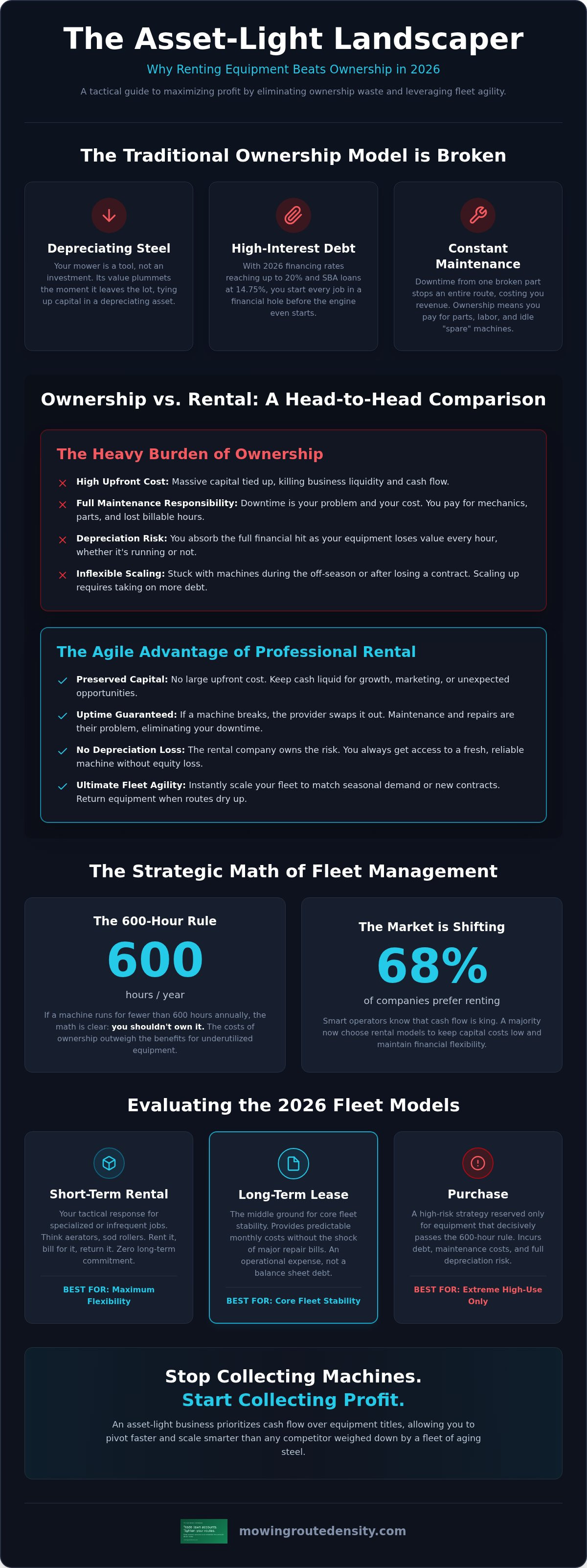
Ownership is a liability masquerading as an asset. Your mower is a tool; not an investment. If it isn't cutting; it's costing you money. Most contractors fall into the trap of prideful ownership. They want to see a row of shiny machines in the shop. They don't see the capital leakage. Every hour a machine sits idle; its value drops. Every day it spends in the shop; you lose billable hours. The equipment rental industry has evolved because smart operators realized that cash in the bank is more powerful than steel in the shed. Liquidity is your lifeline. Tying up $15,000 in a single zero-turn is a bet that the machine will pay for itself before it breaks. It's a bad bet.
The Depreciation Cliff for Commercial Mowers
Commercial zero-turns take a massive hit the moment they leave the dealer lot. After the first 500 hours; you've burned through the most reliable part of the machine's life. In 2026; the resale market for traditional internal combustion engines is tightening as buyers become wary of aging gas-powered fleets. Professional lawn equipment rental shifts this depreciation risk to the provider. You get a fresh machine with zero equity loss. Ownership ties your hands during the off-season. You end up paying for storage and insurance on a machine that isn't earning a cent. It is an anchor on your growth.
Maintenance: The Profit Killer You Aren’t Tracking
Do you know your true cost per hour? Most contractors don't. They count the fuel; but they ignore the mechanic's salary and the parts inventory. Maintenance is a silent profit killer. One broken deck belt or a blown hydraulic line can stop your entire route. That is lost revenue you never get back. Rental models prioritize uptime. If a machine breaks; the rental provider swaps it out. This eliminates the need for "spare" machines gathering dust in your shop. You don't need a full-time mechanic on the payroll when your fleet is always under a service guarantee. You need machines that work; not a workshop full of projects.
Scaling becomes a headache when you own everything. If you land a massive new contract; you have to buy more gear and take on more debt. If you lose a contract; you're stuck with the payments. Rental allows you to match your fleet size to your current route volume with clinical precision. It is about fleet agility. By keeping your business asset-light; you can pivot faster than any competitor weighed down by a fleet of aging; broken-down machines. Stop collecting machines. Start collecting profit.
Evaluating the 2026 Rental Models: Rental vs. Lease vs. Purchase
The choice between renting; leasing; and buying isn't about preference. It's about math. In September 2026; financing costs have climbed to punishing levels. SBA 7(a) loan rates now reach as high as 14.75%. If you're borrowing at those rates to buy a mower; you're starting every job in a financial hole. Professional lawn equipment rental offers a way to sidestep these high-interest traps. Short-term rentals are your tactical response to specialized tasks. You don't need to own a sod roller or a high-end aerator that only sees daylight twice a year. Rent it. Bill for it. Return it.
The "True Cost" of a machine is far more than the sticker price. It's the sum of acquisition; maintenance; insurance; and the eventual disposal loss. If your resale value is plummeting; your cost per billable hour skyrockets. According to Bureau of Labor Statistics data; the landscaping sector remains a massive employer with tight margins. You can't afford to lock your liquid cash into a depreciating shed. Research shows that 68% of companies now prefer renting to keep their capital costs low. They know that cash flow is the only metric that keeps the lights on.
When to Pull the Trigger on a Long-Term Rental
Billable hours dictate your strategy. If a machine runs fewer than 600 hours a year; you shouldn't own it. Period. For core fleet stability; exploring commercial lawn mower lease options provides a middle ground. It gives you predictable monthly costs without the sudden shock of a $5,000 engine replacement. Rental is an operational expense. It stays off your balance sheet as a debt. This keeps your credit clean for when you actually need it for real estate or major expansion. Flexibility is your hedge against market volatility. If a route dries up; you return the machine. You don't get stuck with a $15,000 note on a mower that has no grass to cut.
The Asset-Light Scaling Framework
An asset-light business prioritizes cash flow over equipment titles. It allows you to test a new zip code or a specialized service without a massive capital risk. You rent the gear; prove the route; and then decide. The "Agility Dividend" is the profit you keep because you didn't over-leverage during a growth spurt. It's the ability to scale up for the projected 3.6% industry revenue increase in 2026 without taking on debt. You can view our commercial rental inventory to see how we help contractors stay nimble. This framework ensures you're paying for equipment only when it's generating revenue. It's the difference between a business that survives and one that dominates.
Strategic Math: How Equipment Rental Feeds Route Density
Route density is the pulse of your profitability. If your crews spend more time behind a windshield than behind a mower; you're bleeding cash. Every mile driven between accounts is unbillable overhead. Most contractors try to solve this by buying more equipment to cover more ground. This is a mistake. You don't need more machines; you need more accounts in a smaller radius. Professional lawn equipment rental is the tactical lever that allows you to achieve peak lawn care route density without the capital drag of a massive fleet. It's about fleet agility. You match the machine to the cluster; not the other way around.
Clustering assets is the fastest way to dominate a market. By using rental; you can saturate a specific geographic zone with the exact tools needed for those properties. This reduces "dead time" between jobs. You aren't hauling a 72 inch deck into a neighborhood of gated backyards. You rent the right tool for the specific job site. This precision tightening of your operations ensures that every minute on the clock is a billable minute. Stop letting your equipment dictate your route. Let your route dictate your equipment.
Matching Mower Type to Route Profile
Efficiency requires the right tool for the terrain. Stand-on mowers are the gold standard for high-density residential clusters. They offer better visibility; faster mounting; and a smaller footprint on trailers. Conversely; wide-area zero-turns are essential for commercial account saturation where acreage is the primary challenge. Rental allows you to pivot your equipment mix as your account list evolves. If you trade away a commercial route for a residential cluster; you simply swap your rental units. You aren't stuck with a machine that no longer fits your business model.
Logistics Optimization and Equipment Placement
Hauling heavy equipment across the state is a logistical nightmare. It burns fuel. It wears down your trucks. It increases the risk of accidents. Strategic contractors use rental hubs to eliminate long-haul transport. You pick up the equipment near the route and drop it off when the cluster is finished. This "Route-First" mentality prioritizes the accounts over the assets. By reducing the weight on your trailers; you lower your fuel consumption and extend the life of your service vehicles. You are optimizing your logistics while your competitors are busy managing their repair schedules. Work smarter; not harder.
Building a Tactical Fleet: Selection Criteria for Professionals
Selection isn't about ego or engine displacement. It is about uptime. Most contractors fail because they treat equipment selection like a hobby instead of a clinical evaluation of revenue potential. "Pro-sumer" is a marketing term for homeowners with large yards. It has no place in a commercial fleet. You need heavy-duty steel; high-capacity hydraulics; and engines built for eight-hour shifts in 90-degree heat. Professional lawn equipment rental ensures you are fielding machines that meet these durability standards without the long-term maintenance headache. If the machine isn't earning; it shouldn't be in your shop.
Step 1: Audit Your Current Billable Hour Efficiency
Profit leaks are often hidden in your repair logs. Calculate the cost of downtime per crew. If a broken deck belt stops a three-man crew for two hours; you haven't just lost the repair cost. You've lost six billable hours and likely missed a service window for a high-priority account. You should set a hard target for 95% equipment uptime. Anything less is a signal that your current ownership model is failing. Rental eliminates these leaks by providing immediate replacements when a machine fails.
Step 2: Define Your Ideal Fleet Mix
Your fleet should be a reflection of your route profile. Stand-on mowers provide the speed and visibility needed for tight residential clusters. Wide-area zero-turns are for commercial saturation. Specialized gear like aerators and overseeders are perfect candidates for rental because they are high-maintenance machines with low annual utilization. For contractors taking on groundworks and site preparation alongside maintenance, you can also learn more about Rocket Rentals Ltd to see how hiring plant machinery and versatile attachments keeps capital expenditure down while boosting job-site productivity. Standardizing your fleet through a rental partner also improves operator safety. When every machine has the same control layout; operator error and training time drop significantly.
Step 3: Vet Your Rental Partner for B2B Reliability
Not all rental companies are built for contractors. A professional partner understands that their response time is your uptime. You must verify fleet age and maintenance logs before signing a long-term agreement. You don't want a machine that has been abused by DIY homeowners. Ensure your contract includes clear clauses for machine swaps and on-site support. You can browse our commercial rental inventory to see how we maintain professional standards for our B2B partners.
Safety is no longer optional. OSHA's federal heat rule remains in the proposed stage as of September 6, 2026; however; the General Duty Clause still requires you to address serious heat hazards. Modern rental fleets often include better ergonomic designs and newer safety tech that helps you stay compliant. By renting; you ensure your crew is always using the latest; safest equipment on the market. This protects your workers and your bottom line from regulatory fines.
Scaling Operations with Mowing Route Density
Scaling isn't about owning more machines. It's about owning the market. Most contractors think growth requires a massive capital outlay. They buy more trucks. They buy more trailers. They buy more mowers. Then they wonder why their profit margins are shrinking. Real scaling happens when you optimize your accounts and your assets simultaneously. The Mowing Route Density ecosystem is designed to facilitate this. By combining professional lawn equipment rental with strategic account management; you move from being a "mower operator" to a "logistics strategist." You stop fighting the equipment and start winning the route.
Acquiring Density Through Account Trading
Density is the only metric that matters. If you have accounts scattered across three counties; you aren't growing; you're just driving. You can use our lawn account trading platform to buy and sell routes with clinical precision. The goal is simple. You buy routes that fit your existing rental fleet. You swap far-flung accounts for ones that sit inside your high-density clusters. This minimizes drive time and maximizes billable hours. This strategy also builds a liquid business. When you are ready to move on; a high-density; asset-light company is far easier to sell than a pile of used; depreciating gear.
Your Next Move: Operational Efficiency
Waiting for the busy season to fix your fleet is a recipe for failure. You need to implement an audit of your 2026 fleet costs today. Look at your repair logs. Look at your fuel consumption. If your ownership costs are eating your profit; it's time to pivot. You can also leverage the lawn mowing service provider locator to find B2B sub-contracting opportunities. This allows you to handle seasonal surges without hiring more staff or buying more equipment. It's about tightening your operations and cutting the waste.
The path to a more profitable 2026 is clear. Stop tying your capital up in steel. Join a network that understands the logistical frustrations of the landscaping industry. Start utilizing professional lawn equipment rental to stay agile. Focus on route density. Work smarter. The contractors who survive the next five years will be the ones who prioritize logistics over ownership. Be the strategist; not the operator.
Tighten Your Operations for a More Profitable Season
The old model of collecting mowers is a financial drain you can no longer afford. Every machine in your shop is a depreciating asset that steals your cash flow and increases your overhead. To win in 2026; you must prioritize route density over fleet size. By leveraging professional lawn equipment rental; you gain the flexibility to scale your operations based on actual route volume rather than high-interest debt. You eliminate maintenance downtime and ensure your crew is always using the most efficient tools for the specific terrain they face.
This shift from operator to strategist is the only way to protect your margins. You need a partner that understands the logistical frustrations of the service industry. Our national B2B equipment rental network and integrated account trading platform were built by landscaping professionals specifically to help you dominate your market. Stop fighting your equipment and start optimizing your business. Optimize your fleet and grow your routes with Mowing Route Density. Your more profitable; leaner business starts with a single strategic decision today.
Frequently Asked Questions
Is long-term professional lawn equipment rental more expensive than financing a mower?
Long-term rental often proves cheaper when you factor in the total cost of ownership. Financing a mower in 2026 can carry interest rates near 15%; while rental payments are fully deductible operational expenses. You avoid the "depreciation cliff" and the hidden costs of parts and labor. When you rent; you only pay for the machine's productive hours. It's about preserving your liquidity for growth rather than sinking it into a depreciating asset.
What happens if a rented commercial mower breaks down on the job?
Uptime is the primary benefit of a rental agreement. If a machine fails; the provider swaps it for a functional unit immediately. This eliminates the "spare machine" overhead most contractors carry. You don't have to wait for a mechanic or search for backordered parts. Your crew stays on the route; and your billable hours remain intact. It's a proactive strategy to ensure a single mechanical failure doesn't derail your entire weekly schedule.
Can I rent specialized landscaping equipment like aerators or hydroseeders for B2B contracts?
Yes; renting specialized gear is a smart way to fulfill B2B contracts without capital risk. Machines like aerators or overseeders often have low annual utilization. Owning them means paying for storage and maintenance for equipment that only works two months a year. Professional lawn equipment rental allows you to acquire these tools only when the contract demands them. For heavier groundworks or arborist projects, niche providers such as Ayr Tracked Plant & Equipment Hire make it easy to access specialized tracked machinery and mini excavators on demand. You bill the client; use the gear; and return it once the job is complete.
Rental eliminates the financial burden of the off-season. When the growing season ends; you simply return the equipment. You aren't stuck paying for storage; insurance; or winterization on machines that aren't generating revenue. This "asset-light" approach keeps your bank balance healthy during the lean months. You don't have to worry about your fleet's value dropping while it sits in a shed. You start the next season with fresh; modern equipment.
Are insurance requirements different for rented professional equipment?
Insurance requirements for professional lawn equipment rental are generally straightforward but mandatory. Most providers require a certificate of insurance covering the replacement value of the machine. This is typically handled through an Inland Marine policy or a rider on your general liability. While the premiums are similar to insuring owned assets; you benefit from having a newer; safer fleet. This can sometimes lead to better risk profiles compared to running a fleet of aging machines.
What should I look for in a 2026 commercial mower rental contract?
Look for clear uptime guarantees and machine swap clauses. A 2026 contract should specify the maximum response time for equipment failures. You should also verify the maintenance schedule and the age of the machines in the fleet. Avoid contracts that don't allow for seasonal scaling or those with hidden fees for minor wear and tear. A professional agreement should feel like a partnership focused on your operational efficiency; not just a simple transaction.
How does route density affect my choice of rental equipment?
Route density dictates your equipment needs. If you've successfully clustered accounts in a residential area; you likely need nimble stand-on mowers. If you're managing large commercial properties; wide-area zero-turns are essential. Rental allows you to match your fleet to your current route profile with clinical precision. As you use an account trading platform to optimize your density; you can swap your rental units to ensure your crews always have the most efficient tools for their specific terrain.
Can I use a rental fleet to fulfill a large national landscaping contract?
Absolutely. Utilizing a national B2B rental network is the most efficient way to fulfill large-scale contracts. You can deploy equipment across multiple regions without the logistical nightmare of hauling trailers across state lines. This allows you to scale your capacity instantly to meet the demands of a national account. You maintain a consistent standard of service without the massive capital outlay required to buy a new fleet for every expansion project.


