

What if the mower that finishes a route faster still costs you money? A commercial zero turn mower rental makes operational sense only when the machine fits the properties on your schedule and the hours you can keep it working. Rent more capacity than a small or fragmented route needs, and you may pay for unused time. Rent too little, or misjudge transport, access, and job timing, and lost billable hours can erase the savings.
Renting can give lawn care contractors access to commercial equipment without a long-term ownership commitment, but it won’t fix a weak schedule. Start with the workload, then match the machine and rental window to it.
This guide explains when a zero-turn suits the job, which capacity and operating factors to assess, and how to schedule the mower around routes, crew labor, transport, and billable hours. You’ll also learn how to plan for productive use instead of paying for idle time. Define the jobs first, then choose equipment that can reach and handle them.
Key Takeaways
- Use a commercial zero turn mower rental when the workload and expected use justify temporary access to commercial equipment.
- Match deck width and maneuverability to each property’s layout, obstacles, access points, and mowing volume, not headline specs alone.
- Separate essential equipment requirements from preferences so you don’t pay for capacity or features the job won’t use.
- Plan route order, transport, operator readiness, site access, and weather contingencies before the rental period begins.
- Use Mowing Route Density’s lawn mower and equipment rental platform to connect equipment planning with your actual route workload.
When does commercial zero-turn mower rental make sense?
A commercial zero-turn mower rental gives professional contractors temporary access to equipment for mowing work. It can help cover a short-term capacity gap without adding another machine to the long-term fleet. The rental makes sense when the mower fits the properties and you can schedule enough productive work during the rental period. A large deck or impressive specification sheet won’t make a poor match work.
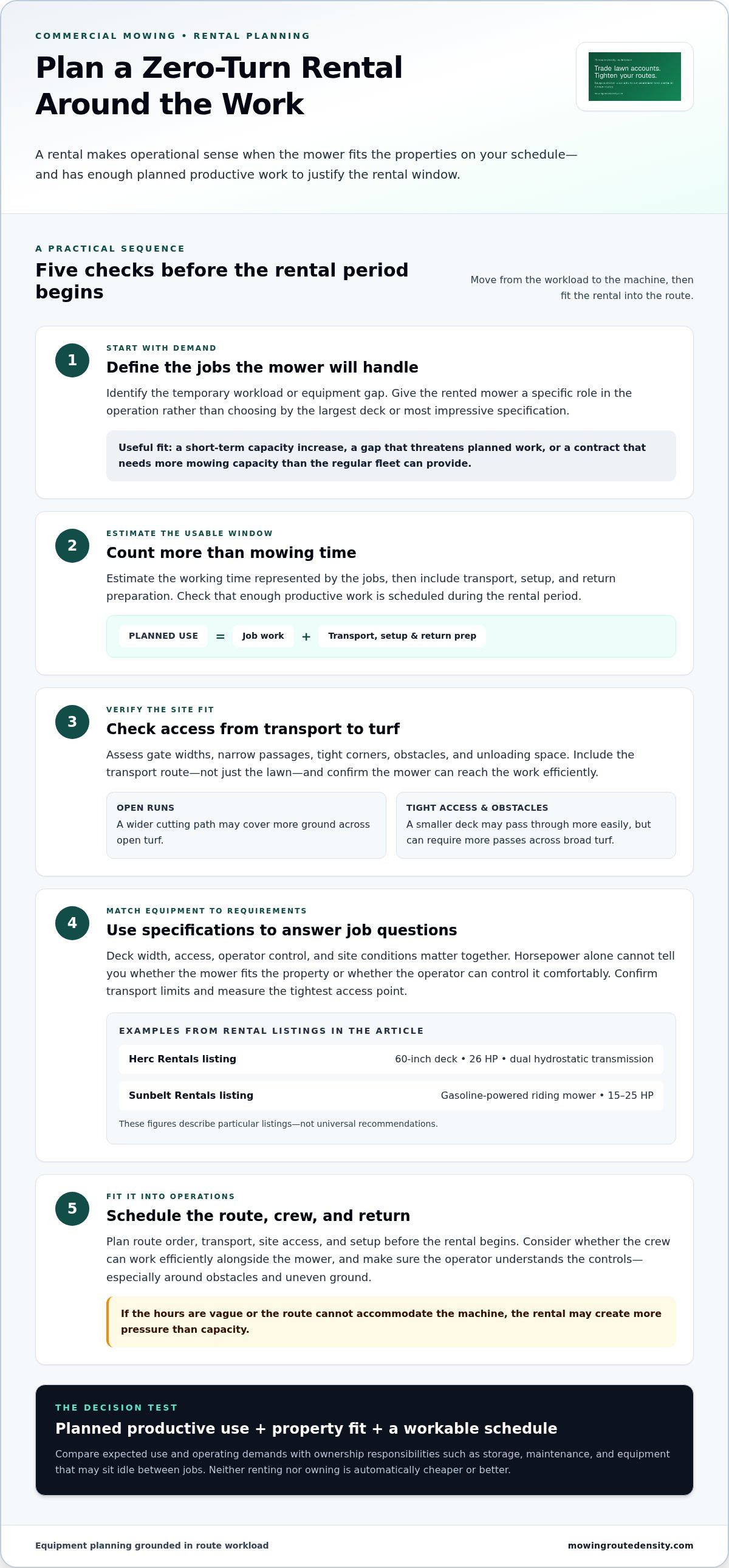
Start by listing the jobs the mower will handle. Estimate the working time they represent, then add transport, setup, and return preparation. Consider whether the machine can access each site and whether the rest of the crew can work efficiently alongside it. Make the decision based on planned use and site conditions, not the biggest option on paper.
Which commercial mowing jobs benefit from zero-turn maneuverability?
Zero-turn steering controls the drive wheels to make tight turns, helping the mower change direction with less repositioning. For a plain-language overview of the design and its characteristics, see Understanding Zero-Turn Mowers.
This design can suit properties with broad mowing areas interrupted by trees, landscaped beds, signs, or paths. Picture a commercial site where the operator turns around planted features before returning to open turf. The layout affects how many passes are needed, where the mower can turn, and whether crew members can work without getting in each other’s way. A zero-turn may simplify those movements, but the result depends on access, terrain, obstacles, and the mowing plan.
Before choosing one, check gate widths, narrow passages, tight corners, and places where the mower must be repositioned. If much of the property is difficult to reach, maneuverability alone won’t make the machine a good fit. Include the transport route and unloading space in the assessment, not just the lawn itself.
When might a rental be more practical than ownership?
Renting may fit a temporary workload increase, an equipment gap that threatens planned work, or a short-term contract that needs more mowing capacity than the regular fleet can provide. The added machine needs a defined role and enough scheduled use to justify bringing it into the operation.
Ownership gives a contractor ongoing access to a machine, but also brings responsibilities such as storage, maintenance, and managing equipment that may sit idle between jobs. Rental offers flexibility for a specific workload, while ownership may suit equipment used consistently across regular routes. Neither is automatically cheaper or better. Compare expected use, operating demands, and how the machine fits the business plan. The professional lawn equipment rental framework offers a broader way to assess rental as a scaling decision.
Use this rule before committing: estimate how much the mower will be used, confirm it fits the job layout, and schedule it around the work, transport, and return preparation. If the hours are vague or the route can’t accommodate the machine, the rental may create more pressure than capacity.
How zero-turn mower design affects commercial work
A zero-turn mower is a riding mower designed to turn within a very tight radius by controlling its drive wheels independently. That steering can help an operator change direction around obstacles without making a wide loop, but the benefit depends on the site. Tight turns do not remove the need to assess slopes, surface conditions, clearance, and safe operating practices.
For a commercial zero turn mower rental, design details matter in relation to the work. A wider deck may cover more ground in an open area, but it can be awkward at a narrow gate or between landscape features. A smaller deck may pass through tight access more easily, yet require more passes across broad turf. Neither is automatically the better choice.
What mower deck width fits the properties you service?
Start with the route, not the largest deck available. Check access-point widths, turning room around beds and trees, the amount of open mowing area, and how the mower will be transported. A property with long, open runs may make better use of a wider cutting path. A site split by narrow entrances and frequent obstacles may favor a machine that can get through and turn without repeated repositioning.
Measure the tightest access point and account for trailer or transport limits before settling on equipment. Also consider where the mower will be unloaded and how it will move from the transport setup to the turf. A deck that works on the lawn but cannot reach it efficiently is the wrong fit.
How should contractors interpret engine and transmission specifications?
Horsepower is one data point, not a verdict on suitability. It doesn’t tell you by itself whether the deck fits the site, the mower can access the work, or the operator can control it comfortably. Use specifications to answer a job requirement, not simply to decide which listing looks more impressive.
Transmission details matter too. A hydrostatic transmission uses hydraulic controls to vary drive speed and direction, allowing the operator to manage movement without shifting through traditional gears. On a zero-turn, the controls work with the separate drive wheels to steer the machine. The operator still needs to understand the controls, especially around obstacles and on uneven ground.
Listings offer examples, not universal recommendations. Herc Rentals describes a model with a 60-inch deck, 26 HP engine, and dual hydrostatic transmission. Sunbelt Rentals lists a gasoline-powered riding mower in a 15-25 HP range. Those figures describe particular listings, not a rule for choosing a mower for every route.
Before assigning a machine to a crew, consider operator readiness and safety features alongside cutting specifications. The CDC’s Zero-Turn Mower Safety and ROPS resource addresses rollover protective structures and seat belts, important considerations in commercial operation.
Define access, cutting, control, and safety requirements first. Then use Mowing Route Density’s lawn mower rental platform to align equipment planning with the jobs on your schedule.
Compare zero-turn rental options by job fit, not headline specs
A specification sheet tells you what a mower has. It doesn’t tell you whether the machine fits your route, reaches the work, or suits the operator. Compare options against booked jobs, then separate must-haves from preferences. A must-have addresses a real constraint. A preference is worthwhile only if it supports the work enough to justify selecting it.
| Job condition | What to prioritize | Why it matters |
|---|---|---|
| Broad, open mowing areas | Deck width suited to the available turning room and mowing volume | Coverage matters, but only if the machine can move through the site and turn efficiently. |
| Fragmented properties with obstacles | Maneuverability and operator familiarity | Tight turns may reduce repositioning, but control and clearance still shape the workflow. |
| Narrow gates or restricted transport | Machine and deck dimensions, plus trailer capacity | A mower that cannot get to the turf or travel safely is not a workable option. |
| High volume across a scheduled route | Planned use, crew coverage, and rental duration | The machine needs a defined place in the schedule, not just an attractive specification. |
| Less-experienced operator | Control familiarity and time for orientation | Unfamiliar controls can disrupt the day and increase the need for careful supervision. |
Which factors matter more than horsepower alone?
Start with site access, transport constraints, and the operator who’ll run the mower. Then assess deck fit, expected mowing volume, and how long the machine will be needed. Horsepower is one specification among several; it can’t independently predict job suitability. Manufacturer figures describe equipment, not guaranteed results in your working conditions.
Two contractors can reasonably choose different configurations for similar workloads. One may prioritize access through tight entrances; another may need a machine suited to larger, open sections. For a commercial zero turn mower rental, choose the configuration that meets the job’s essential requirements without paying for capacity or features that don’t solve a real constraint.
How does renting compare with owning or leasing equipment?
Rental can address a temporary capacity need without adding a long-term asset, making it useful for a defined workload or equipment gap. Ownership provides ongoing access but also leaves the business responsible for storage, maintenance, and managing idle equipment. Leasing sits between those choices: it can provide continuing access under a recurring commitment, while still requiring a careful look at expected utilization and obligations.
Compare each option against four factors: how regularly the mower will be used, how much working capital should remain available, who carries maintenance responsibilities, and how quickly the business needs to adjust capacity. There’s no universal winner. A seasonal workload may favor flexibility; steady, repeated use may support a longer-term equipment plan. This commercial mower lease options guide can help frame the lease-versus-rental decision. Keep the choice tied to forecasted work, not assumptions about which option is always cheaper.
Plan a commercial zero-turn mower rental around your route
A commercial zero-turn mower rental protects billable time only when the machine is working during the hours you need it. Build the plan backward from the jobs: identify the workload, map the route, prepare the crew, then account for transport, site conditions, and return preparation. If you don’t schedule those steps, the mower may sit idle while the rental period continues.
What should contractors prepare before the rental period?
Before the rental begins, estimate the mowing area and list each property’s access points, obstacles, and work requirements. Confirm which crew members will operate the machine and make sure the assigned operator understands its controls. Review operating and safety instructions before work starts, then identify where the mower will be unloaded and staged at each job.
How can route planning reduce wasted rental time?
Sequence compatible jobs to limit unnecessary travel and repositioning. Leave realistic time for loading, unloading, setup, and site-specific conditions. Weather can disrupt even a carefully planned route, so decide in advance how rain or unsuitable ground will affect job order and remaining work. Build a fallback into the schedule rather than assuming every stop will go as planned.
- Estimate the workload. List the properties that need the mower and the work planned at each. Separate tasks that require the zero-turn from work that existing equipment can handle.
- Check access and transport. Account for gates, narrow paths, obstacles, and turning space at each site. Plan how the mower will travel between jobs, and make sure the transport setup fits the equipment.
- Assign the operator and crew. Confirm who will run the mower, who handles other tasks, and when the crew needs to be on site. Build in time to review controls and safety instructions.
- Set the route order. Group nearby, compatible jobs where practical. Choose a sequence that avoids repeated travel and unnecessary loading, while leaving room for each property’s specific conditions.
- Allow for weather changes. Identify which jobs can move if conditions interrupt mowing. Keep the schedule flexible enough to adjust without leaving the machine idle for long stretches.
- Prepare for return. Reserve time after the final job for required return preparation and transport. Don’t schedule the last cut so tightly that cleanup or travel becomes an afterthought.
Track planned versus actual use. Note when the mower was working, moving, waiting, or delayed, then compare that record with the route after the rental period. If setup or deadhead travel repeatedly consumes the day, change job grouping or timing next time. If the machine sits idle, consider whether the next plan needs fewer jobs, a shorter rental window, or a different route sequence.
Once the workload and schedule are mapped, explore contractor equipment rental to match equipment planning to your route.
Use Mowing Route Density to support smarter equipment planning
Equipment decisions should follow the work already on your schedule, not a guess about what your business might need later. Start with the properties you service, the route they create, and the capacity your current crew and equipment can handle. If a temporary gap or added workload calls for another mower, rental can be one operational option. Match equipment access to real demand instead of building idle capacity into the plan.
Mowing Route Density serves lawn care professionals through a lawn mower and equipment rental platform. Once you’ve defined the work, equipment requirements, and schedule, the platform is a practical next step for planning a commercial zero turn mower rental. Mowing Route Density also provides a marketplace for contractors to buy, sell, or swap lawn care accounts, which can help make route and workload decisions part of the same business-planning process.
How does equipment rental fit a contractor's growth plan?
Workloads change. A contractor may add accounts, take on a concentrated stretch of mowing, or need extra capacity while regular equipment is unavailable. Rental can address a defined equipment need, but it doesn’t create crew time or make an overloaded schedule workable on its own. Match the machine to the properties, assign it to specific jobs, and make sure the route can absorb the added work.
Think through operating constraints before treating new capacity as growth: Who will run the mower? Which jobs will it cover? How will it fit into transport and the rest of the route? If those answers are unclear, adding equipment may shift the bottleneck rather than remove it.
Equipment planning also belongs in a wider review of operating costs and account workload. The lawn care profit margin optimization guide can help connect day-to-day decisions with the financial picture of the business. Keep the assessment grounded in your own route and workload; a rental decision should support work you can actually schedule.
What should a contractor do after defining equipment needs?
Turn the assessment into a short operating plan. Identify the jobs the mower will serve, confirm that its capacity and access fit those properties, and place the work in a realistic route sequence. Account for operator readiness, transport, and the time needed to complete the work. This gives you a basis for evaluating rental without assuming every increase in demand calls for another long-term asset.
Mowing Route Density’s rental platform supports contractors planning lawn mower and equipment rental. Match workload, schedule, and equipment requirements before changing capacity. Then explore Mowing Route Density to take the next step in your equipment planning.
Make your next equipment decision with confidence
Treat a commercial zero turn mower rental as a deliberate operating choice, not an automatic response to a busy week. Before committing, decide what the added capacity needs to accomplish and how you’ll judge whether it supported the work. Afterward, use what happened on the route to inform your next equipment decision: repeat the rental approach, adjust the plan, or consider a longer-term fleet change.
That discipline keeps growth tied to the work your crew can deliver, rather than adding equipment without a clear role. Mowing Route Density serves professional lawn care contractors through its lawn mower and equipment rental platform. Use it as a practical next step when you’re ready to explore rental options for your operation.
Explore equipment rental options with Mowing Route Density and take your next step with a plan built around the work ahead.
Frequently Asked Questions
Is a zero-turn mower suitable for commercial lawn care?
Yes, a zero-turn can suit commercial work when its steering and cutting setup fit the property and operator. For example, a contractor maintaining open turf around buildings may value the ability to turn around landscape features. It may be less suitable where access is restricted or site conditions call for a different machine. A commercial zero turn mower rental lets a contractor assess that fit for a defined workload before making a longer-term equipment decision.
What size zero-turn mower deck should a contractor rent?
Choose a deck that fits the tightest access points and the mowing area, rather than relying on one size recommendation. A wider deck may suit an open site with room to turn, while a narrower one may be easier to maneuver through limited access. Measure gates and account for transport dimensions before choosing. Also consider how much of the work involves uninterrupted mowing versus navigating around features.
How much does it cost to rent a commercial zero-turn mower?
Rental cost depends on equipment configuration and rental period, so one figure won’t apply to every job. Build an estimate around the planned work: account for how long the mower is needed, how it will reach each site, and how much scheduled mowing it will cover. Then assess the rental against the workload and billable hours it supports. Don’t compare a headline rate without considering the full plan.
Can a zero-turn mower handle slopes and uneven ground?
It depends on the machine, terrain, and operating conditions. Don’t assume a zero-turn is appropriate for every slope because it can turn tightly on level ground. Wet grass, uneven surfaces, and steep areas can change traction and control. Review the specific machine’s operating instructions, assess the site before mowing, and avoid terrain the operator cannot manage safely. If conditions vary across a property, plan a suitable approach for each section.
How should a lawn care contractor plan a zero-turn mower rental?
Begin with a written list of the jobs the mower will serve, including access details and the expected work sequence. Assign an operator, plan transport between properties, and allow time for setup and return preparation. Keep an alternative job order for weather disruptions so a delay at one site doesn’t leave the rest of the route unplanned. Afterward, compare actual working time with the schedule to improve future rental decisions.
Is renting a commercial zero-turn mower better than buying one?
Neither option is automatically better. Renting can suit a temporary workload increase or a short-term equipment gap. Buying may make sense when the machine has a consistent role across regular work and the business is prepared to manage ownership responsibilities, including storage and maintenance. Compare expected use, cash-flow needs, maintenance duties, and flexibility. Choose the option that fits the contractor’s actual workload, not an assumption that ownership always pays off.
What should an operator know before using a rented zero-turn mower?
The operator should understand the steering controls, starting and stopping procedures, and the machine’s safety instructions before beginning a job. Practice in a clear area first, away from people and obstacles, to get used to how the controls affect direction and speed. Review site hazards, including slopes and limited clearance, and know how to stop the mower safely. Don’t hand operation to someone unfamiliar with the controls without proper orientation.


