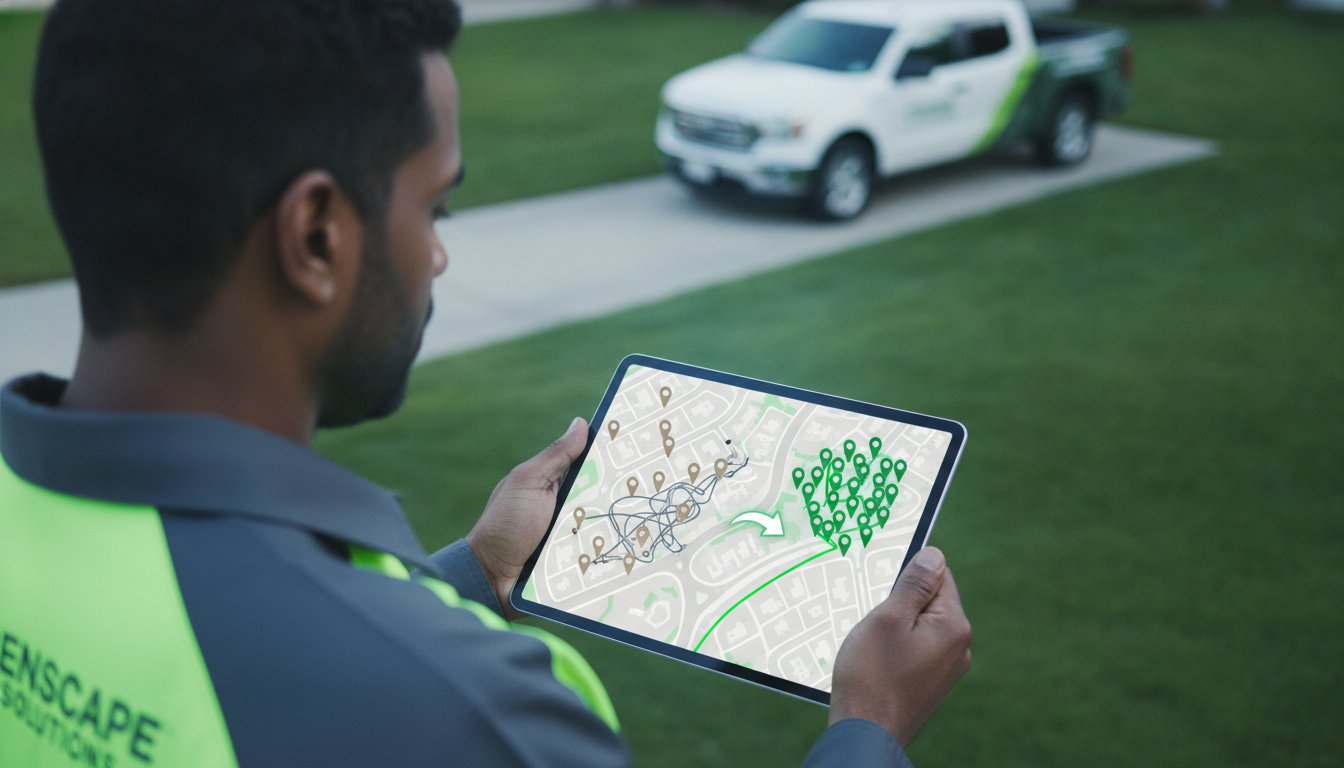
Is your business actually growing, or are you just getting busier at a loss? Revenue is vanity. Density is sanity. Every minute your crew spends on the highway is a minute they aren't billing. It's a systemic drain on your bottom line. Leveraging a lawn account trading platform isn't just a tech upgrade. It's a tactical necessity for any contractor tired of the drive-time trap.
You already know that density is the only path to real profitability in a market valued at over $62 billion. You're tired of the "Swiss cheese" schedules that limit your daily capacity. I'll show you how to stop the bleeding by using secure marketplaces to liquidate your outliers and consolidate your service area. We're going to compare the leading platforms so you can trade your way to a route where crews spend 90% of their time mowing. We'll look at how to swap far-flung accounts for high-density clusters that actually make sense for your map and your equipment.
Key Takeaways
- Learn why a dedicated lawn account trading platform is the only way to turn "Swiss cheese" logistics into a dense, profitable service area.
- Compare the security of digital marketplaces against high-risk handshake deals to protect your business during account transfers.
- Evaluate trade opportunities using a clinical framework that prioritizes contract longevity and profit per stop over vanity revenue.
- Eliminate capital risk by using commercial mower rentals to service newly acquired routes without heavy upfront investment.
The Hidden Cost of "Swiss Cheese" Routes and Why Density Matters
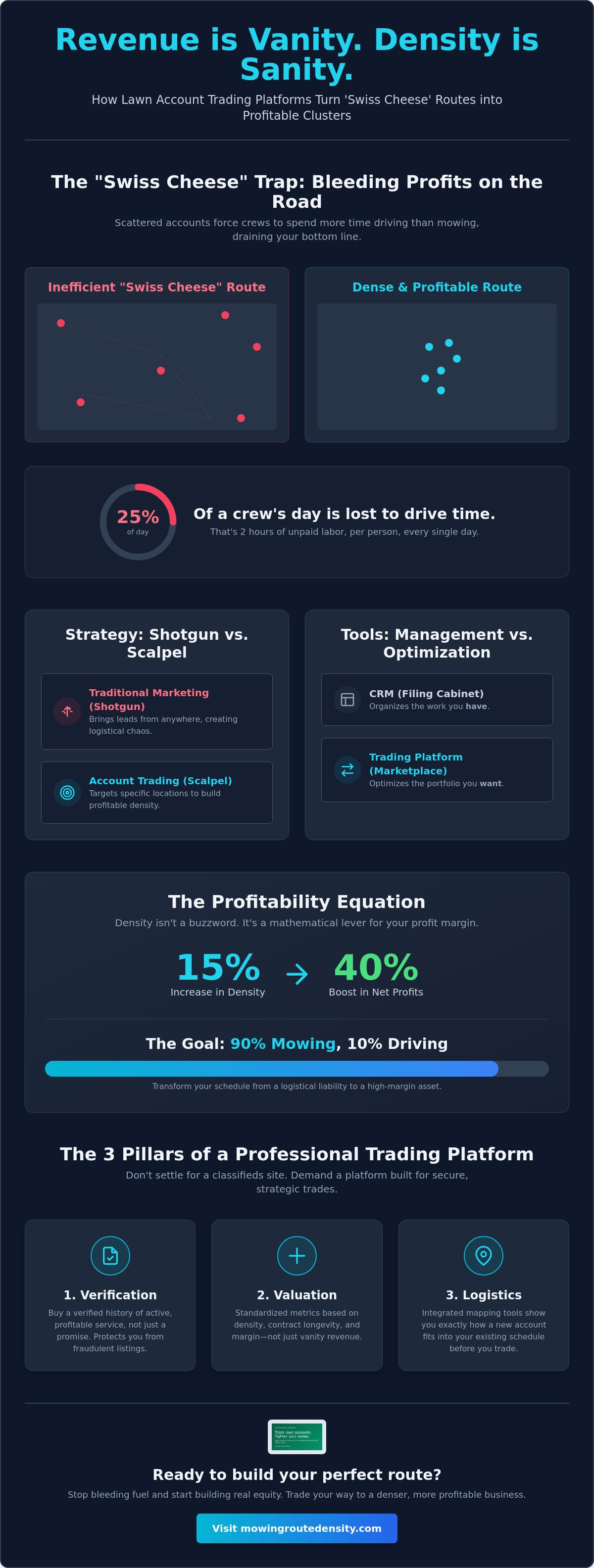
Growth is often a trap. Most contractors believe that a higher account count always equals a healthier bottom line. It's a lie. If your growth is scattered across three zip codes, you aren't scaling; you're just accelerating your overhead. This is "Swiss cheese" logistics. It's a pattern of service gaps that forces your crews to spend more time behind the wheel than behind a mower. In 2026, where labor is the most expensive line item on your P&L, every minute in the truck is a minute of lost billable labor. You're paying for transit. You're paying for idling. You're paying for zero revenue.
True profitability requires a ruthless tightening of your service radius. Organic growth rarely happens in a tight cluster. It's messy. It's accidental. You pick up a referral ten miles away because you want the revenue, but you ignore the logistical cost. Using a lawn account trading platform allows you to fix these mistakes. It gives you the power to liquidate the outliers and trade for proximity. If you don't control your map, your map will control your bank account.
The Math of Route Density: Fuel vs. Billable Hours
Density isn't just a buzzword. It's a mathematical lever. When you understand why route density matters, you stop looking at total revenue and start looking at revenue per man-hour. Consider the labor burden. If a crew spends 25% of their day driving, you've lost two hours of production per person. Some industry analysts suggest that increasing your density by just 15% can boost net profits by up to 40%. The math is simple. Your fixed costs, like insurance and truck payments, remain the same. The extra billable time is pure margin. Beyond the money, there's a psychological toll. Inefficient routes frustrate high-performing crews. They want to work, not sit in traffic. Tight routes keep morale high and turnover low.
Why Traditional Marketing Fails to Solve Density
Traditional marketing is a shotgun. It brings in leads from everywhere. You can't control where the next click comes from. Trading is a scalpel. While marketing attracts leads, a lawn account trading platform targets specific locations. You aren't just looking for "a customer." You're looking for "the customer next door." The cost-per-acquisition (CPA) of a traded account is often lower than a digital lead because the value is immediate and the location is guaranteed. Stop trying to market your way out of a logistical nightmare. Start trading for the density your business deserves. It's the only way to stop bleeding fuel and start building real equity.
Defining the Lawn Account Trading Platform: Marketplace vs. CRM
Your CRM is a filing cabinet. It organizes your schedule, tracks your billing, and stores your customer notes. It's essential for daily operations, but it's useless for optimization. A lawn account trading platform is different. It isn't just a management tool; it's a B2B marketplace. It turns your service contracts into liquid assets. If you have an account that doesn't fit your route, your CRM just tells you it’s there. A trading platform lets you sell it or swap it for something better.
Digital marketplaces are rapidly replacing local handshake deals. Why? Because handshakes don't come with escrow. They don't include contract verification. In 2026, relying on a "good ol' boy" network to fix your route density is a liability. You need a secure environment where funds are held until the transfer is verified. Professional trading provides immediate asset liquidity. It allows you to pivot your strategy in days, not months. If you're ready to stop managing mess and start trading for profit, exploring a specialized account marketplace is the logical next step.
The distinction between a Marketplace vs. CRM is critical for scaling. One manages the work you have; the other optimizes the portfolio you want. By using a dedicated marketplace, you avoid the stagnation of traditional growth. You stop being a slave to your original zip code. You start treating your route like a portfolio that can be traded for maximum efficiency. Every contract you own should be a strategic fit, not a geographical accident.
The Three Pillars of a Professional Trading Platform
A professional platform isn't just a classified ad site. It relies on three core pillars to ensure a clean trade. Verification is the first. You aren't buying a promise; you're buying a verified history of active, profitable service. Second is valuation. Standardized metrics replace guesswork. Accounts are valued based on density and margin, not just gross revenue. Finally, logistics. Integrated mapping tools show you exactly how a new account fits into your existing stops before you commit to the trade.
Marketplace vs. Traditional Brokerage
Brokers are overkill for route tightening. They want a massive cut of the sale. They move at a glacial pace. A self-service lawn account trading platform gives you the speed advantage. You can list an outlier and field offers the same afternoon. It reduces transaction fees by facilitating peer-to-peer swaps. You don't need a middleman to tell you that the account three blocks from your current stop is valuable. You just need the platform to make the trade happen. Speed wins in this industry. Don't let a broker slow down your optimization.
Manual Swaps vs. Digital Trading Platforms: A Tactical Comparison
Networking isn't a strategy. It's a distraction. Cold calling your local rivals to ask for their "leftover" accounts is a tactical error. It's awkward. It's inefficient. Most importantly, it reveals your operational gaps to the very people trying to outwork you. A professional lawn account trading platform eliminates this friction. It provides a neutral, anonymous marketplace where accounts are treated as assets, not favors. You get a paper trail. You get standardized due diligence. You get your time back.
Manual searches for new accounts take weeks of back and forth. Marketplace listings take minutes. In 2026, the speed of your route optimization determines your survival. Digital platforms allow you to browse verified contracts in real time. You can see the density before you make an offer. Handshake deals lack this transparency. They rely on "trust" in an industry where client lists are often inflated or outdated. Stop gambling with your growth. Use a system built for precision.
Security and Escrow in Account Acquisitions
Capital protection is the primary reason to ditch manual deals. When you buy a route via a handshake, your money is gone the moment you cut the check. If half the clients churn in the first month, you have no recourse. Modern Digital Trading Platforms solve this through secure escrow. Funds are held in a neutral account until the transition period is complete. If the revenue doesn't match the listing, the payout is adjusted. This automates the legal transfer of service agreements. It ensures you only pay for the billable labor you actually receive.
The "Swap" Strategy: Trading for Proximity
Cash sales are fine, but swapping is the ultimate density play. Why sell an outlier for a few hundred dollars when you can trade it for a neighbor? Swapping allows two contractors to fix their "Swiss cheese" routes simultaneously. It’s a win-win that doesn't require a massive capital outlay. You're trading a logistical headache for a high-density powerhouse. To ensure you’re getting a fair deal, use the lawn care profit margin optimization framework. This tool helps you evaluate the true trade value of an account based on margin, not just gross revenue. One well executed swap can do more for your bottom line than ten random leads. Tighten your route. Protect your margin. Stop wasting fuel on ego-driven manual networking.
Evaluating Account Quality: A Framework for Strategic Trading
Profitability per stop is the only metric that matters. If an account doesn't generate enough margin to cover 2026 labor rates and overhead, it’s a liability. You aren't just looking for revenue. You're looking for billable efficiency. When you use a lawn account trading platform, you must look past the gross numbers. Ask for the service history. Verify the frequency. If the work doesn't match your crew’s capabilities or equipment, the trade is a failure. Don't trade a headache for a nightmare.
Geographic fit is the second pillar. A high-margin account ten miles away is still an outlier. It doesn't solve your "Swiss cheese" problem. Use a buying lawn care contracts checklist to verify that every new stop increases your density. If it doesn't tighten your route, walk away. Your goal is to eliminate transit, not just fill the schedule. You can list your outlier accounts today to see how they stack up against the market average for your specific zip code.
Commercial vs. Residential Account Valuation
Commercial accounts aren't just bigger. They're more stable. They require a different "multiplier" in any trade negotiation. A multi-year commercial contract provides predictable cash flow that residential stops can't match. However, they also demand commercial-grade equipment and specialized insurance. Use service provider locators to find high-value commercial partners who are looking to offload residential clusters. This is the most efficient way to pivot your business toward high-margin commercial work without the slow crawl of organic bidding. It's about strategic positioning, not just volume.
Red Flags in a Route Listing
Don't buy someone else's problem. Inconsistent payment histories are a massive red flag. If a client didn't pay the last guy, they won't pay you. Watch out for routes that are too spread out to be saved. Some listings are just collections of "junk" accounts that no one can service profitably. Finally, check the pricing. If the account is still priced at 2023 rates, it won't cover your 2026 labor burden. You'll be losing money the moment you drop the gate. A professional lawn account trading platform should provide the transparency you need to spot these drains before you sign. If the data is missing, the deal is dead.
Mowing Route Density: The Integrated Solution for Account and Asset Management
You have fixed the map. Now you must fix the fleet. A lawn account trading platform solves your geographical nightmare, but it often creates a new logistical hurdle: equipment allocation. If you trade for a cluster of commercial properties, your residential zero-turns might not cut it. Don't let a lack of iron stall your expansion. We provide the marketplace to trade for density and the commercial-grade equipment to service it. This integrated approach is the only way to maintain liquidity while you scale. It allows you to move fast. It lets you pivot without the anchor of heavy debt.
Scaling your business in 2026 requires more than just a dense route. It requires a dynamic fleet. When your route density improves, your equipment needs change. You might move from a dozen scattered residential yards to three massive commercial complexes. Your equipment must follow the money. By linking account trading with asset management, you eliminate the friction of traditional growth. You stop being a mechanic and start being a strategist. Every trade you make should be supported by the right tools for the job.
Asset-Light Growth: Renting for New Routes
Don't buy a $15,000 mower for a route you just traded for. It's a capital risk you don't need to take. You haven't seen the terrain in a wet spring yet. You don't know the client churn. Rent it first. Using professional lawn equipment rental allows you to test new service areas without the long-term commitment. It gives you the flexibility to match the equipment type to specific route needs. If the new cluster requires stand-on mowers for tight gates, rent them. If it needs 72-inch zero-turns for open acreage, rent those. Keep your cash in the bank until the revenue is guaranteed and the route is stable.
Next Steps for Your Business
Audit your current route density today. Use our internal tools to identify the outliers that are bleeding your fuel budget and wasting your labor. Once you see the "Swiss cheese" on your map, take action. Stop the bleeding. List your outliers on the Mowing Route Density lawn account trading platform immediately. Turn those logistical headaches into liquid capital or trade them for accounts that fit your core service area. While your listing is live, browse available routes and commercial lawn mower lease options to prepare for your next move. Don't just get busier. Get more profitable. Tighten the route, optimize the asset, and protect your margin.
Stop Driving and Start Mowing: Your Path to Route Density
Scattered routes are a slow death for your profit margins. Every mile of transit is a billable minute you’ll never get back. You've learned that true scaling isn't about more accounts; it's about better clusters. By leveraging a professional lawn account trading platform, you can finally liquidate those outliers and consolidate your service area without the risk of handshake deals. You need a system that prioritizes density over vanity revenue. If your crews are spending more than 10% of their day in the truck, you're leaving money on the highway.
Our platform provides Secure Escrow Protection and access to a National Network of Professional Contractors to ensure your trades are clean and profitable. When you find that perfect cluster, use our Integrated Commercial Equipment Rental to service it without sinking cash into new mowers before the revenue is proven. It's time to stop fighting your map and start mastering it. Optimize Your Routes on Mowing Route Density today and build the efficient business your crews deserve. You have the strategy. Now go execute.
Frequently Asked Questions
What is a lawn account trading platform?
A lawn account trading platform is a secure digital marketplace where contractors buy, sell, or swap service contracts. It treats your client list as a liquid asset rather than a permanent obligation. Use it to offload far-flung accounts and acquire ones that sit directly on your existing routes. It’s the tactical alternative to waiting for organic referrals that might not fit your map.
How much does it cost to trade or swap lawn care accounts?
Costs vary based on the platform’s fee structure and the total revenue value of the contracts being moved. Most marketplaces charge a percentage of the transaction or a flat listing fee to facilitate the secure transfer. You’re paying for the verification of the data and the security of the escrow service. It’s a small investment to avoid the total loss of a bad handshake deal.
Is it better to buy a lawn care route or grow organically?
Buying for density is almost always faster and more profitable than organic growth. Organic leads are geographically random. They create "Swiss cheese" routes that drain fuel and labor. Buying a targeted cluster via a lawn account trading platform allows you to scale your billable hours without adding a single mile to your truck’s odometer. Density is the only metric that matters for 2026 profitability.
How do I value a lawn care account for a trade?
Value an account based on its net profit per stop and its proximity to your current route. Don't fall for vanity revenue numbers. An account with a high gross price but a 20-minute drive time is worth less than a smaller account next door. Factor in the contract longevity and the current service rates to ensure they cover your 2026 labor burden and overhead.
Can I sell just a portion of my lawn care route?
You can and should sell off the outliers that don't fit your map. A trading platform allows you to surgically remove the accounts that drive up your overhead. You aren't selling your entire business; you're optimizing your portfolio. Liquidating the far-flung stops frees up capacity for denser growth in your target neighborhoods where your crews are already working.
What happens if a client cancels after I buy the account?
Professional platforms protect you with a transition period and secure escrow. Funds aren't released to the seller until the accounts are verified and the first few services are completed. If a client cancels during this handoff, the purchase price is typically adjusted. This eliminates the risk of paying for "ghost" accounts that disappear the moment you drop the gate for the first time.
How does route density affect my business valuation?
Route density is a primary driver of your company’s multiplier. Investors and buyers want to see high margins and low non-billable transit time. A dense route requires less equipment wear and fewer man-hours to generate the same revenue. If your crews spend 90% of their day mowing, your business is a high-value asset. Drive time is just expensive waste that lowers your exit price.
Do I need a broker to sell my lawn care client list?
You don't need a broker for tactical route adjustments or account swaps. Brokers are slow. They want a massive cut of the deal. A self-service marketplace gives you the speed and control to fix your route today. Reserve brokers for the day you decide to sell your entire company and exit the industry. For route tightening, a digital platform is the more efficient tool.


