

Your most expensive employee isn't the one behind the mower; it's the one sitting behind the steering wheel. Every minute of windshield time is a direct hit to your bottom line. With diesel prices averaging $6.285 per gallon and labor costs climbing past $20.33 per hour, it's time to swap lawn care routes to stop the bleed. You aren't growing your business by chasing distant leads; you're just burning your profit in traffic.
You already know that route density is the only path to real profitability. We're going to show you how to trade your logistical headaches for profitable density without spending a dime on marketing. This tactical guide explains how to identify outlier accounts, negotiate fair trades with peers, and manage the legal handoffs required to protect your reputation. You'll learn the exact steps to tighten your footprint, slash your overhead per stop, and recover margins that are currently vanishing into thin air.
Key Takeaways
- Stop paying for windshield time. Identify the outlier accounts outside your core radius that drain fuel budgets and labor hours.
- Learn the tactical steps to swap lawn care routes with local peers. Build high-density clusters without spending a dime on marketing.
- Compare account trading against traditional acquisitions. Grow your bottom line without an immediate capital outlay.
- Execute a seamless transition. Use professional handoff protocols like simple MOUs and clear financial reconciliation.
- Optimize operations post-swap. Re-evaluate fleet requirements to maximize profit per stop and scale up using rented equipment once clusters are tight.
The High Cost of Geographic Drift: Why Swapping is Necessary
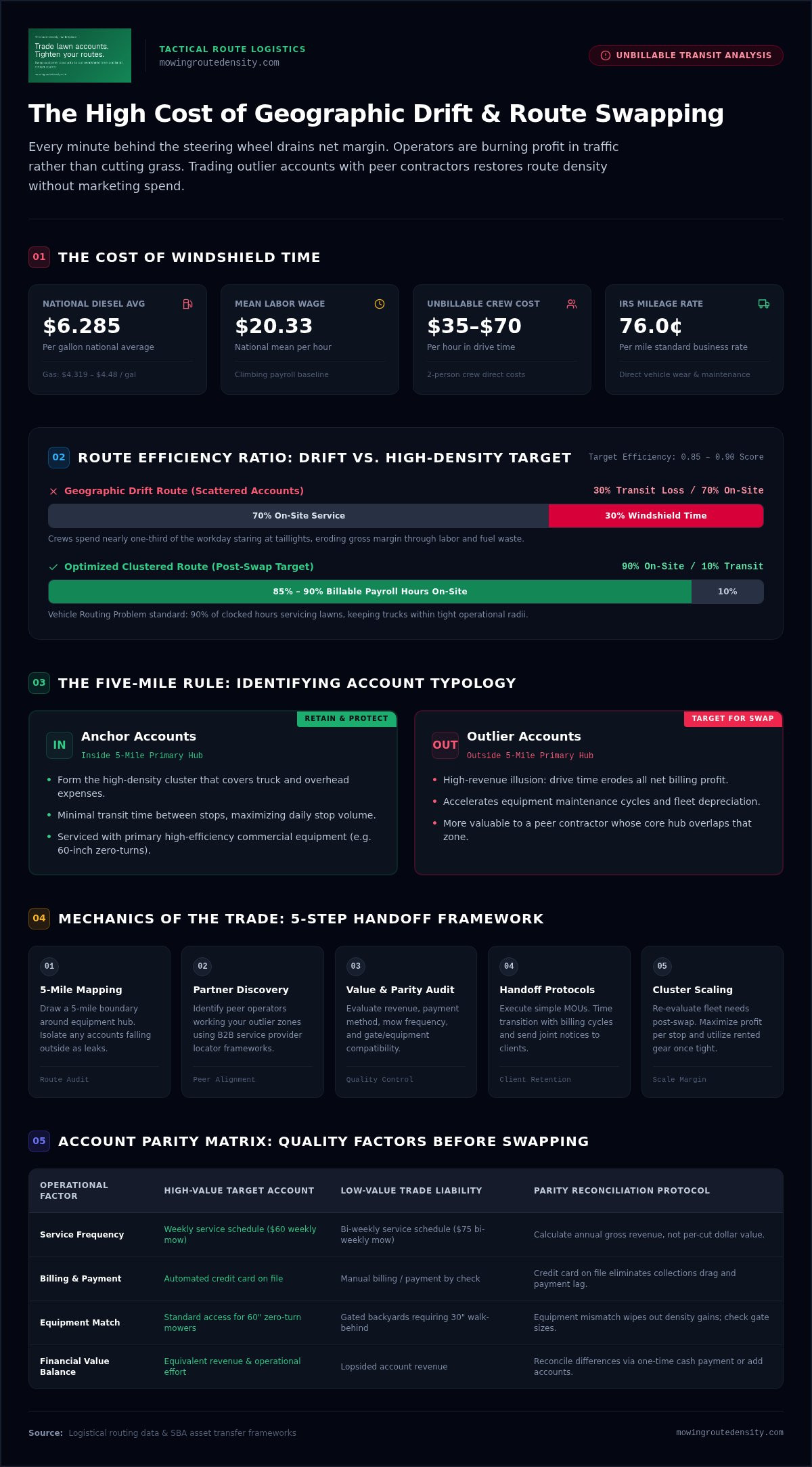
Geographic drift is the slow, silent erosion of your net profit. It happens when you prioritize top-line revenue over logistical sanity. You accept one "good" client ten miles outside your core area. Then you take another just five miles further. Eventually, your crews spend 30% of their day staring at taillights instead of cutting grass. This isn't growth; it's a slow leak. To stop it, you must learn to swap lawn care routes with competitors who are already working in those outlier neighborhoods. Trading accounts isn't about losing business. It's about recovering the billable hours you're currently gifting to the highway.
Organic growth often creates a scattered, inefficient map. You win a referral three towns over and send a truck. That truck is now a rolling overhead expense. Every mile driven is a "Windshield Time" Tax that eats your labor and fuel. High-density operations target an efficiency score of 0.85 to 0.90. This means 90% of your clocked payroll hours should be spent on-site, not in transit. By applying Vehicle Routing Problem principles, you can see that physical proximity is the only way to minimize fleet transit time and maximize daily stops.
Calculating Your Route Leakage
Stop guessing your costs. A standard two-person crew costs between $35 and $70 per hour in unbillable drive time. This figure includes direct wages, payroll taxes, and vehicle wear. When you add the IRS business standard mileage rate of 76.0 cents per mile, that "quick trip" across town becomes a financial liability. You need to identify your anchor accounts, the high-density clusters that pay for the truck, and separate them from your outlier accounts. Outliers don't just waste fuel. They accelerate equipment maintenance cycles and shorten the life of your fleet. If you aren't clustering, you're overpaying for every blade of grass you cut.
The 2026 Margin Crisis
The math of the landscaping industry changed in 2026. Diesel prices reached a national average of $6.285 per gallon. Regular gasoline sits between $4.319 and $4.48 per gallon. Combine these fuel costs with a national mean labor wage of $20.33 per hour, and the old "more accounts" strategy fails. You can't outwork a bad route. The modern operator must shift focus from total account volume to margin per stop. When you swap lawn care routes, you're shedding high-cost liabilities. You're trading a distant, isolated property for one that fits your existing cluster. This is the only way to recover lost margins without adding new labor or equipment.
How to Swap Lawn Care Routes: The Mechanics of the Trade
Execution starts with a map and a red pen. Open your routing software and draw a five-mile circle around your primary equipment hub. Any account sitting outside that line is a leak. It doesn't matter how well they pay; the drive time is killing the margin. To swap lawn care routes effectively, you must first acknowledge that these outliers are more valuable to someone else. Your goal is to find a contractor whose core cluster overlaps with your stragglers. This isn't about giving away business. It's about trading a low-margin liability for a high-density asset.
Finding that partner requires a shift in perspective. You aren't looking for an enemy; you're looking for a logistical ally. Use a lawn mowing service provider locator to identify peer operators working in your target zones. Once you have a shortlist, the real work begins. You must conduct a "Value Audit" for every property on the table. Traded accounts must have equivalent revenue potential, or the math won't work. You can find more detail on this in the SBA guidelines for transferring business assets, which helps ensure you value the goodwill and contracts correctly. Negotiate the handoff timing to coincide with the start of a billing cycle. Clear customer communication is non-negotiable; both parties should send a joint notice to ensure a warm transition.
Evaluating Account Quality Before the Swap
Revenue isn't the only metric that matters. You need to verify service frequency and payment history. A $60 weekly mow with a credit card on file is worth far more than a $75 bi-weekly mow that pays by check. Analyze site difficulty as well. If your fleet is built for 60-inch zero-turns, don't trade for a gated backyard that requires a 30-inch walk-behind. Equipment mismatch is a hidden cost that can wipe out the benefits of density. Account parity is the precise balance where the gross revenue of the new stop matches the operational effort required to service it. If the trade is lopsided, reconcile the difference with a one-time cash payment or additional accounts to keep the deal equitable for both contractors.
The "Peer-to-Peer" Mentality
Your competitors are your best logistical assets. They are already driving the streets you want to be on. Building a network of trusted contractors allows for recurring trades as your service areas shift. This isn't a handshake deal at a gas station. Use a secure lawn account trading platform to find vetted partners and document the transfer. Professionalism builds trust. Trust builds density. When you're ready to start pruning your map, you can find local partners who are already working in your target neighborhoods.
Swapping vs. Buying: Strategic Growth Frameworks
Scaling a landscaping business usually follows two paths: buying a competitor or waiting for organic growth. Buying is fast. It also requires immediate capital outlay, with residential routes currently trading between 0.3x and 0.70x annual recurring revenue. If you don't have the cash on hand, you're looking at debt with elevated interest rates. When you swap lawn care routes, you bypass the bank entirely. You're executing a revenue-neutral trade that yields an immediate increase in net profit. You aren't adding more work to the schedule; you're making the existing work cheaper to perform by slashing the overhead of every stop.
The decision to buy or swap depends on your current fleet capacity. If your trucks are sitting idle and your crew is underutilized, buy a route to fill the gaps. If your crews are maxed out but your margins are thin, swapping is the only logical move. A swap is a surgical strike on inefficiency. You're cutting the fat of geographic drift and replacing it with lean, profitable density. This is the difference between being a busy owner and being a profitable one. Stop chasing volume and start chasing proximity.
The Zero-Capital Growth Model
Swapping acts as a synthetic acquisition of density. You gain the benefits of a "tuck-in" purchase without the financial risk or the need for a capital injection. By tightening your clusters, you maximize the utility of your existing equipment. This strategy helps eliminate the immediate pressure to sign new commercial lawn mower leases just to keep up with a growing but scattered footprint. Your primary KPI should be billable hours per square mile. If that number isn't climbing, your business is losing ground. Density allows you to do more with less, turning transit time back into billable time.
Risk Mitigation in Account Trading
Any account transfer carries risk. Clients are sensitive to changes in service, and a botched handoff can tank your brand reputation. You must treat a trade with the same legal rigor as a sale. Use signed assignment agreements and mutual non-solicitation clauses to protect your territory for at least two to three years. This level of planning is a core component of professional lawn care business exit strategies. A high-density route is a liquid asset. When it's time to sell your company, a tight, optimized route map commands a much higher multiple than a collection of distant properties. You're building value today for a payday tomorrow.
Tactical Checklist: Executing a Seamless Route Handoff
A route swap isn't a handshake deal at a gas station. It's a strategic asset transfer. Treat it with the same clinical precision you'd use for a cash purchase. If you don't document the details, you're inviting chaos into your schedule. When you swap lawn care routes, you need a clear paper trail to protect your equity and your reputation. Stop treating your business like a hobby and start using professional protocols.
Start with a simple Memorandum of Understanding (MOU). This document should outline the specific properties, the duration of the non-solicitation period, and the protocol for handling pre-paid balances. Financial reconciliation is where most trades fail. If a customer paid you for the full month on the 1st, but the trade happens on the 15th, you owe that revenue to the new contractor. Reconcile the books before the switch date. Don't let sloppy accounting poison a new partnership.
Data is the currency of the handoff. Transfer every gate code, pet warning, and site map. If your crew uses specific service notes to avoid hitting a hidden irrigation head, share them. Logistical gaps lead to service failures. Service failures lead to churn. You can start building your density by using a secure lawn account trading platform to find your next partner and formalize the deal.
The Customer Retention Strategy
The "Warm Handoff" is your shield against attrition. Industry data shows that unmanaged transfers can lead to a 20% to 35% churn rate in the first year. You can reduce this below 12% with a structured introduction. Frame the swap as a service upgrade. Tell the client you've partnered with a local specialist to provide better scheduling reliability and a smaller carbon footprint. Match their current pricing for the remainder of the season to eliminate friction. If the client feels like they're gaining value, they won't go shopping for a new provider.
The Contractor Due Diligence List
Vetting your partner is mandatory. Verify their liability insurance and worker's comp coverage before the first mower hits the turf. Check for equipment compatibility. If the property has a narrow gate, ensure their walk-behind mowers can actually clear the opening. Use a hard switch date to avoid double-billing or missed service days. Professionalism prevents headaches. Ensure they match your service standards so your former clients don't end up calling you to complain about a botched job.
Optimizing the New Cluster: Scaling Post-Swap
The trade is done. The accounts are transferred. But if you don't re-engineer your operations to match your new density, you've wasted the effort. You can't run a high-density route with a low-density mindset. Now is the time to swap lawn care routes for a leaner, more aggressive schedule. Every mile you've shaved off the map is a minute you can put back into a billable service. If your crews are finishing two hours early because they aren't stuck in traffic, don't just let them go home. Add more stops or pull a truck off the road entirely.
Reducing fleet overhead is the ultimate win. If your route tightening is successful, you might find that three trucks can now do the work that previously required four. Sell the extra vehicle or keep it as a backup to avoid downtime. Use the lawn care profit margin optimization framework to track your recovery. You should see an immediate drop in fuel consumption and a spike in revenue per man-hour. If you need to scale up quickly within your new cluster, use professional lawn equipment rental to meet the demand without taking on long-term debt or interest-heavy leases.
Maximizing Asset Utilization
Density is the enemy of waste. When your stops are clustered, your equipment spends more time engaged and less time vibrating in a trailer. Clustering properties ensures your machines are actually cutting grass rather than idling during transit, effectively slashing unproductive engine hours that drive up depreciation. It also improves crew morale. Workers hate the "Windshield Time" Tax as much as you do. They want to be on the turf, not the highway. A tight route means less fatigue, fewer accidents, and higher labor retention. You aren't just optimizing a map; you're optimizing your human capital.
Leveraging Mowing Route Density
Optimization is an ongoing process, not a one-time event. As your business evolves, your geographic focus will shift again. Our platform is built to facilitate national contractor networking, making it easy to find partners for subcontracting or future account trades. Don't let geographic drift creep back into your operations. Stay lean. Stay profitable. Optimize your route density today on our trading platform and stop paying for the privilege of driving.
Stop Driving and Start Earning
Geographic drift isn't just a nuisance; it's a financial parasite. Every minute your crew spends in transit is a minute you aren't billing. You've learned that route density is the only sustainable path to high margins. By choosing to swap lawn care routes, you're executing a tactical strike on operational waste. You're trading away the outliers that drain your fuel budget and replacing them with high-density clusters that maximize your labor efficiency. This is how you grow a business without drowning in debt.
Success requires the right tools. Our B2B-only marketplace and national contractor locator provide the infrastructure you need to find trusted partners for strategic trades. Once you've tightened your map, use our equipment rental solutions to scale up within your new clusters. Don't let another season of unbillable drive time erode your success. Take control of your map and your bottom line. It's a common-sense remedy to a systemic industry flaw.
Start trading accounts and tightening your routes today. It's time to work smarter, cut the waste, and recover the profit you've already earned.
Frequently Asked Questions
Is swapping lawn care routes legal?
Swapping lawn care routes is legal across the United States, typically treated as a reciprocal asset purchase or customer contract assignment. You must check specific statutes regarding non-compete and non-solicitation agreements in your jurisdiction. While these are void in certain areas, they are generally enforceable when tied to a business asset transfer. Ensure you have explicit customer consent or opt-out notifications per local contract laws to maintain compliance throughout the transition.
How do I value a lawn care account for a swap?
Value is determined by gross revenue, service frequency, and profit margin rather than just the number of stops. Small residential routes typically trade at 0.3x to 0.70x annual recurring revenue. You must also account for payment integrity, such as auto-pay versus invoicing. A high-margin property that fits your existing cluster is always worth more than a distant, high-revenue account that requires excessive travel time and fuel consumption.
What happens if a customer refuses to switch to the new contractor?
Customer refusal is a risk that you can mitigate through a structured warm handoff. If a client opts out, the original contractor usually retains the responsibility or provides a replacement account of equal value to the swap partner. Industry benchmarks show that a joint introduction and price guarantees for the remainder of the season keep attrition below 12%. Without this continuity, you risk losing up to 35% of the account value in the first year.
Do I need a written contract for a route swap?
You absolutely need a written contract to protect your business equity and define the terms of the trade. A standard agreement should include a Signed Assignment and Assumption of Service Contracts along with mutual non-solicitation clauses. This prevents either party from marketing to the traded properties for a defined period, usually two to three years. Verbal agreements at a gas station offer zero legal protection and often lead to messy territorial disputes later.
How much windshield time is considered "too much" for a route?
Any transit time exceeding eight minutes between stops in a residential cluster is generally considered excessive. Unbillable windshield time costs between $35 and $70 per hour for a standard two-person crew when you factor in wages, taxes, and vehicle wear. High-density operations target an efficiency score of 0.85 or higher. If your team spends more than 15% of their day driving, it's time to swap lawn care routes to recover your margins.
Can I swap residential routes for commercial accounts?
You can trade residential stops for commercial contracts, but the valuation parity is different. Commercial maintenance contracts often command higher premiums, ranging between 5.0x and 9.0x EBITDA, compared to the lower multiples of residential lists. You must reconcile the difference in labor intensity and equipment requirements. Ensure your equipment fleet, perhaps supplemented by mower rentals, can handle the specific demands of the larger commercial properties before finalizing the trade.
What is the best way to find other contractors interested in swapping?
The most efficient method is using a dedicated B2B lawn account trading platform or a service provider locator. These tools allow you to identify peer contractors who are ready to swap lawn care routes to fix geographic drift. Networking through national contractor marketplaces ensures you connect with vetted professionals who understand route density. This beats cold-calling competitors who may not be open to the no-nonsense philosophy required for a successful trade.
How does route density affect my equipment maintenance costs?
Route density directly lowers maintenance costs by reducing unproductive engine hours and trailer vibration. When your stops are clustered, your mowers spend more time engaged on turf and less time bouncing in a trailer or idling during long transits. This extends the lifespan of your mowers and reduces the frequency of oil changes and part replacements. Tightening your route footprint ensures you get the maximum billable utility out of every piece of equipment you own.


