
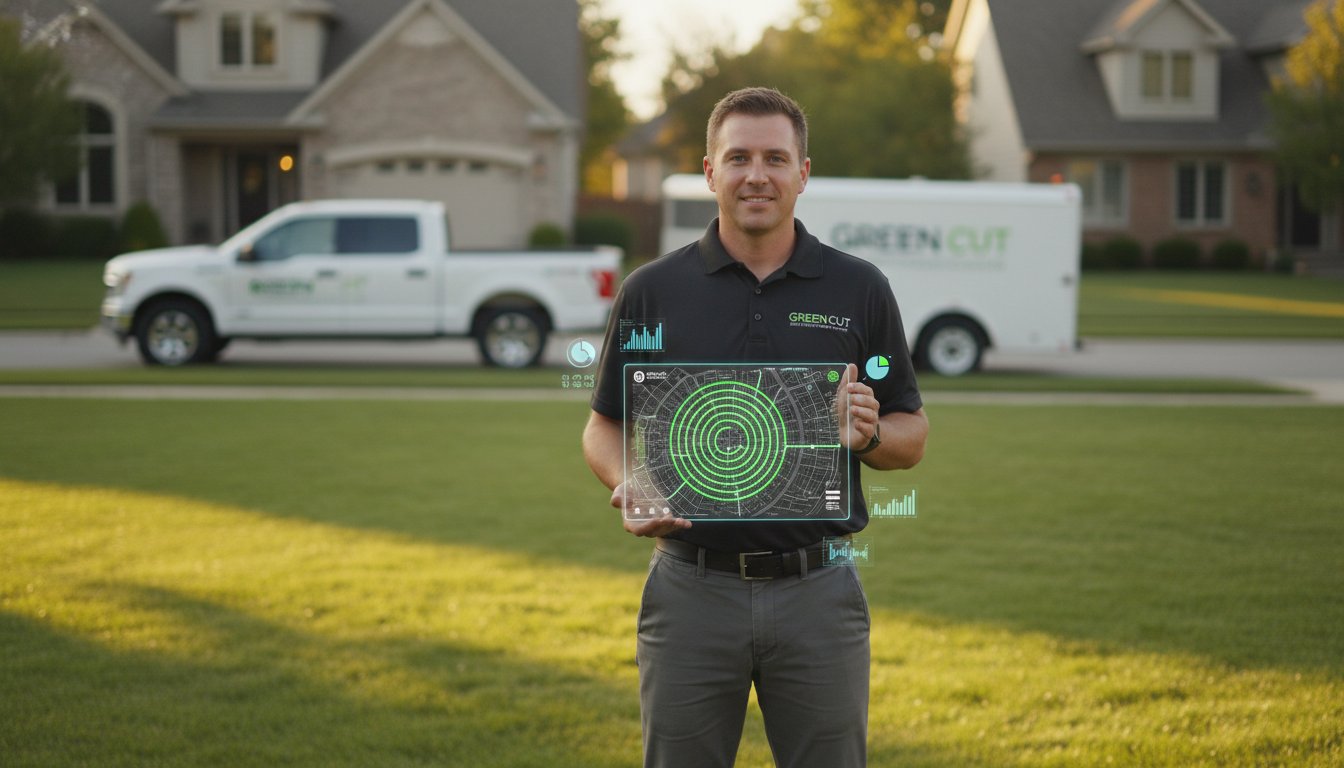
Revenue is a vanity metric; profit is the only number that defines your success. If you're grinding 60 hours a week just to service equipment debt and fuel bills, you don't have a business. You have a job that pays your overhead first and you last. Real lawn care profit margin optimization isn't about mowing faster. It's about tightening your logistics until the waste is gone. Stop being a high-priced volunteer for your own operation.
You're likely tired of seeing labor costs eat up to 40% of your revenue while fuel and fertilizer prices continue to climb. It's a common trap. We're going to show you how to stop working for your vendors and start keeping the cash you generate. This guide promises a path to reducing drive time by 30% and pushing your net margins toward the 20% mark. We'll examine route density, asset flexibility, and the lean strategies needed to scale your fleet without taking on massive debt. It's time to build a business that actually rewards your effort.
Key Takeaways
- Stop mistaking high revenue for success by learning to distinguish between gross job margins and the true net profitability of your business.
- Master lawn care profit margin optimization by slashing non-billable windshield time and prioritizing route density over total customer count.
- Build high-efficiency clusters around "Anchor Accounts" to maximize billable minutes and minimize travel expenses per square mile.
- Protect your cash flow with an asset-light strategy that utilizes equipment rentals to avoid the debt trap of underutilized machinery.
- Execute a structured 30-day pivot plan to audit your operations and purge the unprofitable outliers that are draining your bottom line.
The Profit Margin Reality Check: Why Busy Does Not Equal Profitable
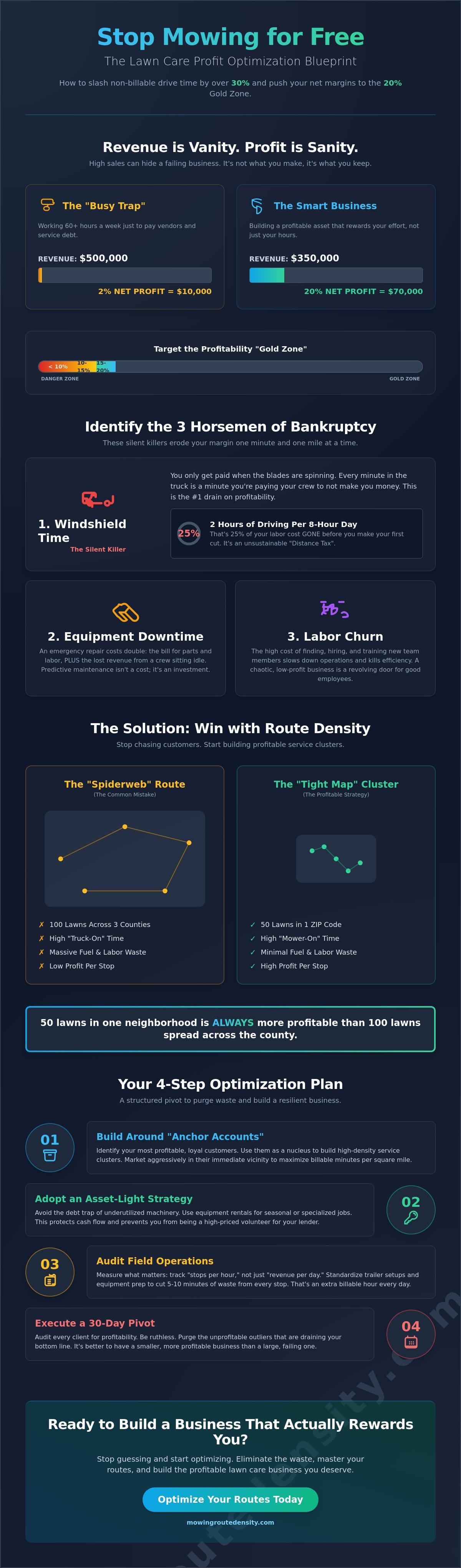
Revenue is a vanity metric. Many owners fall into the "Busy Trap." They see six figures in revenue and assume they're winning. They aren't. High revenue often hides a 2% net margin. That's not a business; it's a hobby that pays your gas station's mortgage. If you're doing $500,000 in sales but keeping $10,000 at the end of the year, you're just a middleman for your fuel supplier and equipment dealer. Revenue is vanity. Profit is sanity. Cash is king.
You must understand the difference between gross and net. Gross margin tells you if the job was worth the sweat. It covers labor and materials. Net margin tells you if the business is worth the stress. It covers everything else. If your gross margin is 50% but your net is 5%, your overhead is a parasite. It's eating your life. In 2026, a healthy lawn care business should keep 15-20% of every dollar earned. If you're below 10%, you're one broken transmission away from insolvency. Adding "more customers" is the wrong fix. If your routes are inefficient, more customers just scales the bleeding.
The Anatomy of a Profit Killer
Windshield time, equipment downtime, and labor churn are the three horsemen of bankruptcy. Windshield time is the silent killer. It's non-billable labor. The "Distance Tax" is the hidden fee you pay for poor planning. A customer five miles away might look profitable on paper, but the travel time erodes your hourly rate until you're paying them to cut their grass. Focus on optimizing route density to kill this tax. Every minute your crew spends in the truck is a minute they aren't generating revenue. Unprofitable growth is a systemic risk to your cash flow that can collapse your operation from the inside out.
Calculating Your True Margin
You need the numbers. Use the formula: (Total Revenue - Total Expenses) / Total Revenue. Here is the hard truth: your salary is an expense. If you aren't paying yourself a market rate before calculating profit, you're lying to yourself. You aren't "profitable" if you're working for free. Real lawn care profit margin optimization starts with honest accounting. Tighten your books. Cut the waste. Set your target in the "Gold Zone" of 15-20%. Anything less is just busy work. You're here to build a legacy, not a glorified job for yourself.
Optimizing the Field: Eliminating Windshield Time and Labor Waste
Windshield time is the silent thief of your bottom line. It's non-billable labor. You're paying a crew to sit in traffic while your equipment sits idle in the trailer. This is the single biggest drain on lawn care profit margin optimization. If your team spends two hours a day driving, that's 25% of their shift producing zero revenue. You can't charge a customer for the time you spend on the highway. You only get paid when the blades are spinning.
The "Tight Map" philosophy is the only way to kill this waste. 50 lawns in one ZIP code beats 100 lawns across three counties every single time. Why? Because the truck stays off and the mower stays on. Labor efficiency is a simple ratio: mower-on time versus truck-on time. If your truck-on time is high, you're running a transport company, not a lawn care business. You must prioritize strategic clustering over simple routing. If your current service area looks like a spiderweb, it is time to trade accounts for better route density to fix the leak.
Maximizing Billable Hours per Crew
Apply the 80/20 rule to your field operations. Usually, 80% of your profit comes from the 20% of your accounts that are tightly clustered. Audit your crew performance based on "stops per hour" rather than "revenue per day." A high-revenue day is a lie if it took 12 hours and 100 miles of fuel to achieve. Tighten your load and unload times. Standardize trailer setups so your team isn't fumbling with ramps and blowers. If a crew loses 10 minutes per stop to poor organization, you lose an hour of billable time every six houses. That is an unacceptable cost.
The Logistics of Fuel and Fleet Maintenance
The true cost of a gallon of gas isn't just the price at the pump. It includes the labor cost of the employee idling the engine. It includes the accelerated wear on the vehicle. Predictive maintenance is your shield against the "big break" that wipes out a month of profit. An emergency repair costs twice as much because of the lost billable hours. Use this weekly fleet efficiency audit to stay ahead:
- Tire Pressure: Check all trucks and trailers to maintain maximum MPG.
- Blade Sharpness: Dull blades slow down the cut and increase fuel consumption.
- Idle Reports: Review GPS data to identify drivers wasting fuel in park.
- Fluid Levels: Verify all small engine oils to prevent catastrophic failure.
- Air Filters: Clean filters ensure engines run lean and efficient.
Lawn Care Route Density: The Strategic Lever for 20% Margins
Efficiency isn't about how fast your crew mows. It's about how little they drive. Route density is the only metric that matters for lawn care profit margin optimization. We define it simply: the number of billable minutes spent per square mile of travel. If your team spends 20 minutes driving for every 40 minutes of cutting, your density is failing. You're paying for motion, not results. To hit a 20% net margin, you must flip that ratio. Every mile of road is a mile of lost profit.
Stop chasing every lead that calls. Use the "Anchor Account" strategy instead. Identify your most profitable, reliable stops and build clusters around them. If you have a high-value property on Oak Street, every marketing dollar and sales effort should target the houses within three blocks. If a lead comes in from the next town over, let a competitor have it. You should "fire" your outliers. The math is brutal but honest. A distant customer who pays well on paper is often a net loss once you factor in fuel, vehicle wear, and the opportunity cost of travel time. To further boost margins on high-end properties, utilizing expert resources from Verdant Tree Farm for specialized tree care can add value without requiring additional equipment investment. Efficiency is binary. You're either clustered or you're losing money.
Asset Clustering vs. Geographic Expansion
Geographic expansion is a margin killer disguised as growth. Most owners think a larger service area means a bigger business. It actually means a thinner bottom line. Use the "clumping" method. Own one neighborhood completely before moving to the next one. This minimizes the "dead zones" where your trucks are burning cash without earning it. You can identify these gaps quickly by using a lawn care route density calculator to visualize where your travel time is eroding your hourly rate. If the data shows a hole in your schedule, fill it with a local account or cut the route entirely.
The Market-Based Solution: Route Trading
Marketing for density is slow. It takes months to build a cluster through traditional ads. There is a faster way. Swapping accounts with other contractors allows you to instantly fix your map. If you have three customers in a neighborhood where a competitor has twenty, and they have three near your main cluster, swap them. It's a win-win. You can use a lawn account trading platform to consolidate your service area without spending a dime on lead generation. Remember the valuation rule: a $40 lawn next door is worth significantly more than a $60 lawn across town. The $40 lawn has zero travel cost. The $60 lawn is a logistical nightmare. Choose the profit, not the price tag.
Strategic Asset Allocation: Renting vs. Owning Equipment
Owning a massive fleet is a vanity project. It looks impressive in the shop, but it looks terrible on a balance sheet. Every machine you own is a liability disguised as an asset. It requires storage, insurance, and constant maintenance. Most importantly, it requires a monthly payment that doesn't stop when the grass stops growing. Real lawn care profit margin optimization requires a shift toward an "Asset-Light" model. You should only own the core equipment that stays busy every single day. Everything else is just a drain on your liquidity.
Consider the opportunity cost of a $15,000 mower purchase. That cash is now frozen in a depreciating piece of steel. What else could that money do? It could fund a marketing blitz to double your route density in a single ZIP code. It could pay for a seasoned crew leader who reduces your labor churn. Instead, it sits in your trailer, losing value every hour. If your equipment utilization is below 40%, you are losing the math game. Renting allows you to scale capacity for the spring rush without the burden of five-year loans. You get the machine when the revenue is there. You return it when the revenue stops. It's a clean, tactical strike on your overhead.
When to Rent vs. When to Buy
Follow the "80% Rule." If you don't use a piece of equipment 80% of the year, don't buy it. Industry data suggests that buying is only cost-effective if utilization exceeds 65% of available working days. For specialized or seasonal needs, professional lawn equipment rental is the smarter play. It protects your cash flow during peak seasons. You can take on larger contracts without the risk of permanent debt. If the contract ends, the expense ends. That is how you maintain a lean operation in a volatile market.
Depreciation and the Silent Margin Drain
Phantom costs are the margin killers no owner wants to face. A mower loses value the moment you turn the key. When it breaks, the cost isn't just the mechanic's bill. It's the four houses you didn't mow because the crew was sitting idle. Rental models shift the burden of depreciation and major repairs back to the provider. If a rental unit fails, you swap it and keep moving. Your billable hours remain intact. Additionally, a rental is a 100% tax-deductible operating expense, making it a much simpler line item than complex depreciation schedules. If you're ready to stop sinking cash into a depreciating fleet, you can check local mower rental availability to start your pivot toward a leaner model.
The 30-Day Optimization Plan: Executing the Pivot
Transformation doesn't happen by accident. It happens through cold-blooded execution. You've identified the leaks in your business; now you have to plug them. This 30-day plan is the blueprint for real lawn care profit margin optimization. No more talk. No more excuses. Just results.
- Week 1: The Route Audit. Print your service map. Circle your tightest clusters. Mark every outlier sitting alone on an island. If a customer is more than five miles from your nearest cluster, they are a liability.
- Week 2: The Equipment Audit. Stop romanticizing your gear. Review your repair logs. If a mower costs more in monthly maintenance and downtime than a rental payment, sell it. Liquidity is more valuable than old iron.
- Week 3: The Swap. Fix your map instantly. List those island accounts on a B2B lawn care marketplace. Trade them for accounts that fit your existing clusters. Consolidate your footprint.
- Week 4: The Pricing Correction. The accounts that remain must pay for the privilege of your service. Raise rates on any low-margin jobs that survived the audit. If they leave, you win back billable time. If they stay, you win back profit.
Firing Your Worst Customers
You must master the art of "The Cut." Your worst customers aren't just the ones who complain; they're the ones who kill your density. Use three criteria for termination: extreme distance, slow payment speed, and excessive property difficulty. If a client fails two of these, they have to go. Professionally offboard them by providing a 30-day notice and a referral to a contractor who already works in their area. You aren't being mean; you're being a steward of your business. Replace that low-margin revenue with high-density accounts that actually hit your 20% target.
Continuous Improvement and KPI Tracking
Profit is a choice made through disciplined logistics. Every Friday, you must review three vital metrics. First, Revenue per Man-Hour tells you if your labor is efficient. Second, Fuel as a percentage of Revenue tells you if your routes are tight. Third, Route Density tells you if your marketing is working. If these numbers aren't moving in the right direction, your strategy needs a pivot. Use a lawn care service provider locator to find local partners for subcontracting jobs that fall outside your "Gold Zone." Stop trying to be everywhere for everyone. Focus on being the most profitable operator in a five-mile radius. That is how you build a business that lasts.
Stop Working for Your Overhead and Start Owning Your Future
You've seen the math. High revenue is a distraction if your net margin is trapped in the single digits. True lawn care profit margin optimization isn't a theory; it's a series of hard choices. It means firing the outliers that drain your fuel tank. It means swapping distant accounts for neighborhood clusters. It means choosing high-performance rentals over the debt trap of a depreciating fleet. You now have the 30-day blueprint to stop the bleeding and start building a business that actually keeps the cash it generates.
For business owners looking to diversify or see how other high-end service providers maintain quality and safe operations, you can learn more about Poseidon Power Washing LLC and their professional approach to exterior property maintenance.
You don't have to navigate this pivot alone. Access a national account trading marketplace, high-performance commercial mower rentals, and a dedicated B2B contractor network designed for scaling. Optimize your route density and protect your margins with Mowing Route Density today. The waste in your operation is just profit waiting to be reclaimed. Take the first step and tighten your map. Success is waiting in the "Gold Zone."
Frequently Asked Questions
What is a good profit margin for a lawn care business?
A healthy net profit margin for a well-run operation sits between 15% and 20%. While the industry average often lingers between 10% and 14%, settling for those numbers means you're leaving money on the table. If you aren't hitting the 20% mark, your logistics are leaking cash. Focus on aggressive lawn care profit margin optimization to move from surviving to thriving. Don't let high revenue mask a weak bottom line.
How can I increase my lawn care profit without raising prices?
You increase profit by cutting waste, not just by charging more. Focus on route density to reduce non-billable windshield time. If you can fit one more house into an existing neighborhood cluster, your margin on that stop is significantly higher because travel costs are zero. Efficiency is the only lever you control entirely. Tighten your operations, reduce your fuel consumption, and watch your margins expand without losing a single customer to a price hike.
Is it better to own or rent lawn care equipment for a growing business?
It depends on your utilization rates. If you expect a machine to be used more than 65% of working days, buying is generally more cost-effective. For anything less, renting is the superior financial move. Renting protects your liquidity and shifts the burden of depreciation and maintenance back to the provider. Don't let a five-year loan on a mower kill your cash flow during the off-season. Asset flexibility is key to scaling without massive debt.
What is route density and why does it matter for profit?
Route density is the number of billable minutes your crew spends per square mile of travel. It matters because travel time is a pure expense that produces zero revenue. High density means more time with blades spinning and less time burning fuel in traffic. It is the single most important metric for a profitable service business. If you aren't measuring density, you aren't managing your profit. It's that simple.
How do I calculate the "windshield time" cost for my crews?
Multiply the crew's total hourly wage by the number of hours spent driving, then add fuel and vehicle wear costs. For example, if two employees earning $20 per hour spend 90 minutes driving daily, that's $60 in lost labor alone. When you factor in gas and depreciation, that "quick drive" is costing you a fortune. Every minute in the truck is a minute you aren't getting paid. Stop paying for motion and start paying for results.
Can I swap lawn care accounts with other contractors safely?
Yes, swapping accounts is a standard tactical move to consolidate routes and improve lawn care profit margin optimization. Using a dedicated trading platform ensures the transition is professional and transparent for both the contractors and the clients. It's much faster to trade for density than to wait for marketing to fill the gaps in your map. Trading allows you to shed your most expensive outliers and replace them with profitable, nearby stops.
What are the biggest hidden costs in a landscaping business?
Equipment downtime and non-billable labor are the silent killers of your margin. A mower in the shop doesn't just cost a repair bill; it costs the revenue of every house it didn't cut. Fuel wasted during engine idling and time lost to poor trailer organization are also massive drains that most owners ignore. These "phantom costs" erode your profit daily. You must track every minute and every gallon to maintain a lean operation.
How many accounts do I need to be profitable?
Total account volume is a vanity metric. You can be more profitable with 50 accounts in one ZIP code than with 150 accounts spread across a county. Focus on the quality and location of your stops rather than the quantity. Profitability is found in the tightness of the route, not the length of the customer list. If your accounts are too far apart, you're just running a transport business that happens to cut grass. Density beats volume every time.


