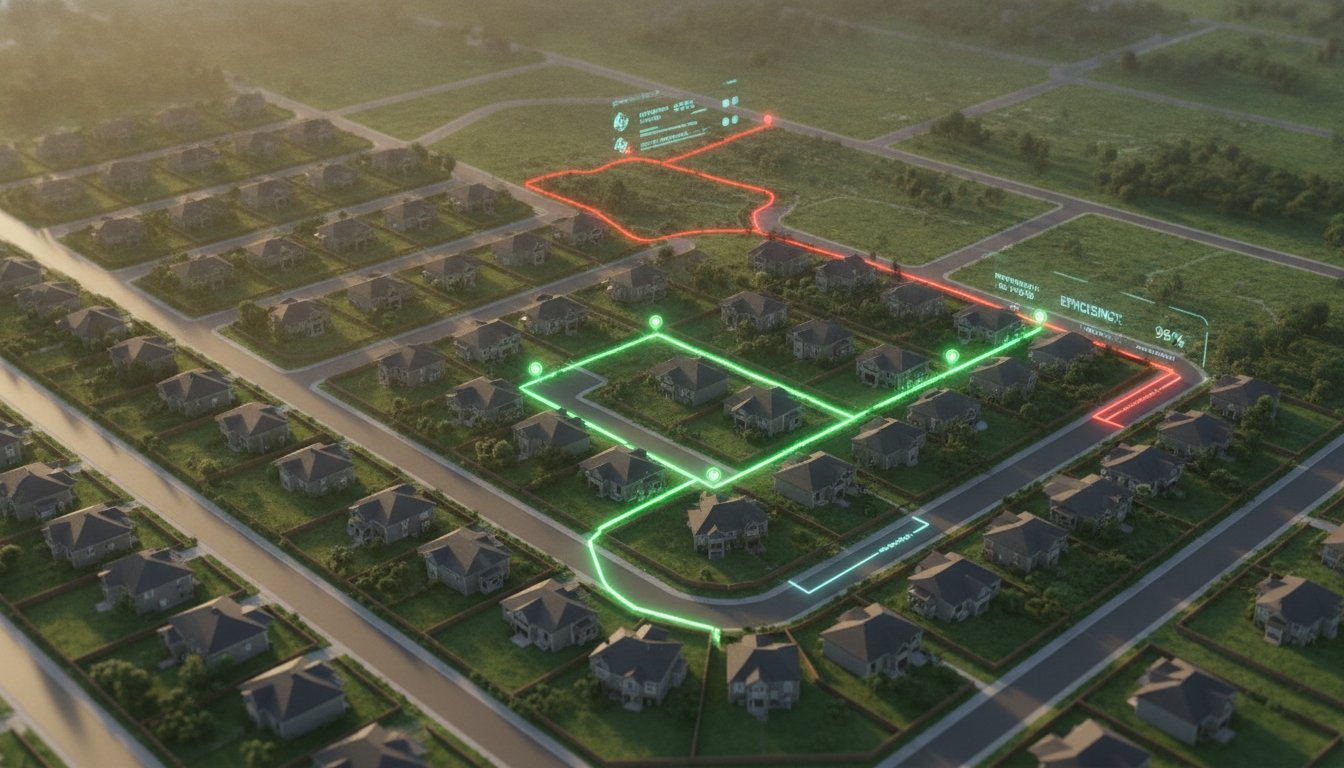
Your truck is not a mobile office. It is a depreciating asset that bleeds cash every second it sits in traffic. If your crews spend more time staring at brake lights than mowing turf, you aren't running a landscaping business; you're running an expensive logistics failure. Most owners think they need more trucks to scale. They're wrong. You need better lawn care route density.
You already feel the sting of exorbitant fuel costs and wasted labor hours. It's a systemic flaw that keeps your net profit margins trapped while your overhead climbs. You don't need more leads; you need more stops on the same block. This guide will show you how to eliminate "windshield time" and increase your revenue per truck-hour by mastering the mechanics of a tight service area. We'll break down the strategies for account trading and asset-light scaling that will help you reduce drive time by 30% or more by 2026.
Key Takeaways
- Shift your focus from total revenue to revenue per truck-hour to identify where your business is actually losing money.
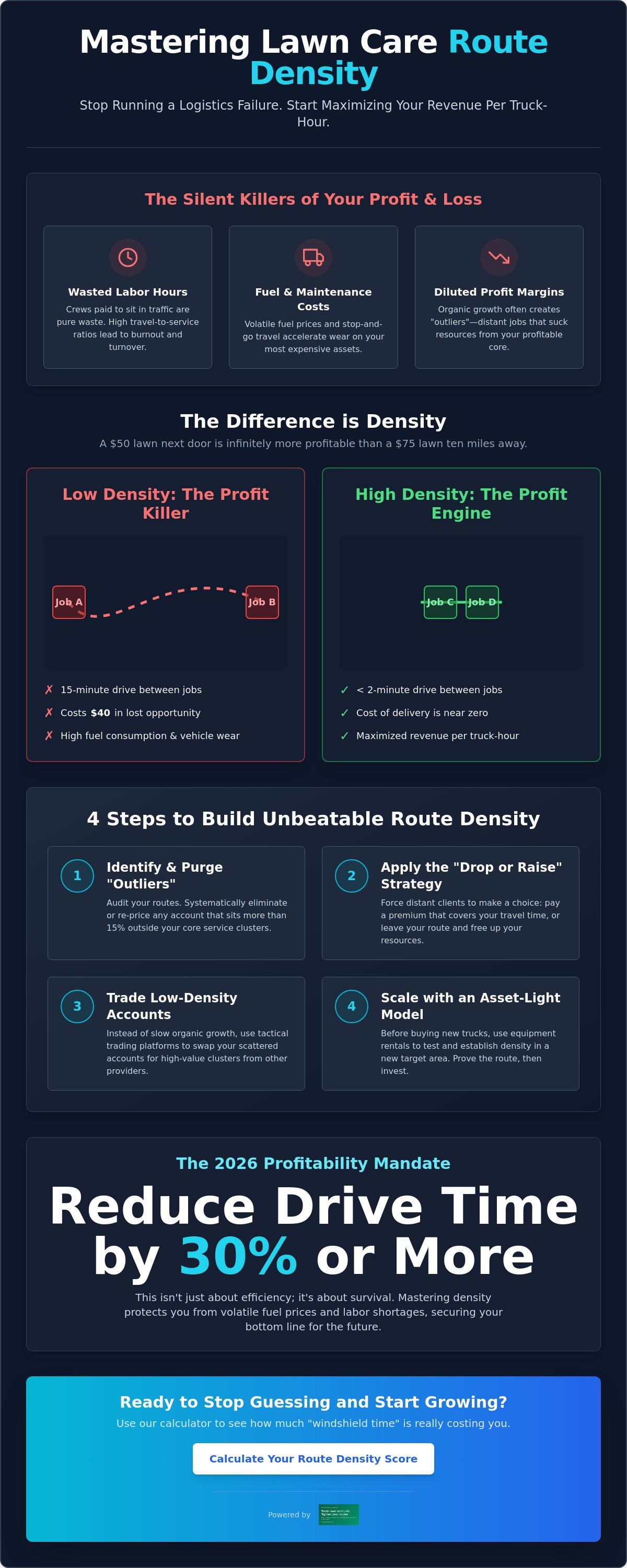
- Maximize your lawn care route density by identifying and eliminating "outliers" that sit more than 15% outside your core service clusters.
- Learn how to trade low-density accounts for high-value clusters using a tactical trading platform instead of relying on expensive organic growth.
- Apply the "Drop or Raise" strategy to force distant clients to either pay for your travel time or leave your route.
- Adopt an asset-light model by using equipment rentals to test and build new clusters before committing to heavy vehicle purchases.
What is Lawn Care Route Density and Why Does It Rule Your P&L?
Your Profit and Loss statement doesn't care how hard you work. It only cares how much time your equipment spends spinning. In the service industry, total revenue is a vanity metric that often hides a dying business. If you pull in $10,000 a week but spend 20 hours in a truck to get it, you're losing. Mastering lawn care route density is the only way to protect your bottom line. In simple terms, lawn care route density is the number of service accounts you maintain within a specific, tight geographic radius. It's the metric that separates the strategists from the hobbyists.
The 2026 reality is unforgiving. With fuel prices volatile and labor shortages impacting 18% of lawn care businesses, a five-mile gap between jobs is no longer a minor inconvenience; it's a financial leak. Every minute spent in "windshield time" is a minute of unrecovered labor cost. To better understand the logistical hurdles facing anyone behind the wheel of a commercial vehicle, you can learn more about The Truckermann. When you pay a crew to sit in traffic, you're paying for zero production. You can't out-mow a bad route. To survive, you must pivot from chasing "any client" to maximizing revenue per truck-hour.
The Math of the "Stop-to-Stop" Interval
Let's look at the cold numbers. A 15-minute drive between accounts isn't just a 15-minute delay. It's 15 minutes of wages for a two-man crew, plus fuel, plus vehicle wear. That's 30 minutes of billable potential gone. If your target rate is $80 per hour, that drive just cost you $40 in lost opportunity. A $50 lawn two doors down is infinitely more profitable than a $75 lawn ten miles away because the cost of delivery is near zero. This logistical challenge is a real-world application of the Vehicle Routing Problem, where the goal is to find the most efficient path to service a set of customers. Lawn care route density is the concentration of billable assets within a minimized travel perimeter.
Why Traditional Growth Often Destroys Density
Growth is usually the enemy of efficiency. Most owners fall into the "Referral Trap." You take a job six miles out because you want the revenue. Then that client refers a neighbor. Suddenly, you've built a permanent anchor in a low-density zone that sucks resources away from your core clusters. Organic growth naturally dilutes your route efficiency over time because you're following the lead instead of the map. You have to stop being a "yes man" to every lead. The shift from "any client" to "the right client" is the only way to build a scalable, dense service area that actually generates profit.
The Hidden Cost of Windshield Time: An Operational Audit
Windshield time is the silent killer of your P&L. It’s the gap between your crew clocking in and the first mower blade hitting the grass. To fix your margins, you need a blunt operational audit. Start by identifying your "Outliers." These are accounts that sit more than 15% outside your core service clusters. If you’re driving 20 minutes to service a single $50 lawn, you aren’t making money. You’re losing it on every turn of the key. You can find your current efficiency score using the lawn care route density calculator to see exactly how much your lawn care route density is suffering.
This isn’t just a scheduling annoyance. It’s a complex logistical hurdle known as the Vehicle Routing Problem. Every mile driven increases the probability of delays, accidents, and unrecovered costs. You’re paying for labor, fuel, and depreciation while providing zero value to the customer. It’s time to stop treating your trucks like mobile breakrooms. You can't manage what you don't measure.
Quantifying the Labor Loss
Labor is your biggest expense. It’s also your most wasted resource. When a two-man crew sits in traffic, you’re paying two salaries for zero production. Calculate your "Billable vs. Non-Billable" field hours. If your crew spends three hours a day driving, that’s 15 hours a week of pure waste. With 18% of lawn care businesses reporting labor shortages as their top challenge in 2026, you can’t afford to burn hours on the highway. Long drive times also take a psychological toll. Crews want to work, not sit in a hot cab. High travel-to-service ratios lead to burnout and turnover. Tightening your routes keeps your team on the mower and off the road.
Fuel and Maintenance Erosion
Fuel and maintenance costs in 2026 aren't getting any cheaper. Thin-margin routes are the first to get swallowed by rising pump prices. Stop-and-go travel accelerates wear on your trucks and mowers. Commercial equipment is designed for steady work, not idling in congestion. Effective lawn care logistics management reduces this fleet wear by tightening the perimeter. Higher density means shorter trips, lower engine hours, and better equipment longevity. If you want to scale without buying more trucks, you need to trade your outliers for profitable clusters. Every mile you cut is a direct deposit into your bottom line.
Organic Growth vs. Account Trading: A Tactical Comparison
Organic growth is a slow-motion drain on your capital. Most owners think printing door hangers or running Facebook ads is the only way to scale. They're wrong. These methods are scattershot. If you want to understand how search visibility impacts your local reach, check out KD Interactive. However, you might still spend $500 to acquire one customer who lives twelve miles away from your nearest cluster. That isn't growth. It's a logistical anchor. To achieve true lawn care route density, you must stop waiting for the right leads to find you and start actively engineering your service area.
The most aggressive operators in 2026 don't rely on luck. They use a lawn account trading platform to swap their outliers for accounts that fit their core clusters. It's the fastest, most effective way to reduce drive time in lawn care. Why spend years trying to "fill in" a neighborhood when you can trade for it in a weekend? Trading turns your liabilities into assets by putting them in the hands of someone who is already there.
The Logic of the Swap
Geography is the only thing that matters in route valuation. An outlier that is a headache for you is a goldmine for a competitor whose truck is already on that street. A trade is a win-win. You lose the travel time. They gain the density. When valuing an account for trade, don't just look at the monthly revenue. Look at the frequency and the precise GPS location. A weekly mow on a street where you already have six houses is worth more than a premium bi-weekly mow across town. Regional consolidation is the only way to protect your profit from rising labor costs.
Buying vs. Building Routes
Building a route from scratch is expensive and unpredictable. You can drop $5,000 on digital marketing and end up with a fragmented mess of distant leads. Buying a dense cluster of accounts offers an immediate ROI. You aren't just buying revenue; you're buying efficiency. There's less risk when buying existing lawn care routes because the density is already proven. The key is maintaining service quality during the transition. A professional handoff ensures the customer stays put while your profit per truck-hour skyrockets. Stop gambling on ads. Start investing in density.
4 Steps to Tighten Your Existing Routes Today
Stop chasing every lead that hits your inbox. If you want to fix your margins, you have to fix your map. Most owners are terrified of losing customers. They should be terrified of losing money. Tightening your lawn care route density isn't about being mean; it's about being profitable. You can start by running an operational audit using this checklist to improve landscaping route efficiency. It’s time to stop driving and start mowers.
First, perform a cluster analysis. Map every account you have. Look for the "pockets" where you have three or more clients on a single street or within a few blocks. These are your profit centers. Everything else is a distraction. Once you find your top three clusters, you have a baseline for where your trucks belong. Use this data to implement the "Drop or Raise" strategy. If an account is an outlier, raise the price to cover the travel waste. If they won't pay, let them go. Your schedule is finite. Fill it with density, not distance.
Executing the Cluster Strategy
Establish hard "No-Go" zones. If a property requires a drive longer than 20 minutes from your core clusters, it doesn't fit your model. Be blunt with outlier clients. Explain that rising fuel and labor costs in 2026 require a route adjustment fee. Many will pay. Those who don't are doing you a favor by freeing up a slot for a closer lead. A smaller, denser route is more valuable than a large, scattered one. Focus your energy where the grass is literally closer together.
Hyper-Local Marketing Tactics
Growth should be surgical, not structural. Use "Cloverleafing" to build around your anchor clients. When you finish a job, put "Nine-Around" door hangers on the immediate neighbors. They've already seen your clean trucks and uniformed crews. They know you're already in the neighborhood. This creates a sense of reliability and convenience that digital ads can't match. Leverage neighborhood-specific social media groups to offer "block discounts" for three or more houses on the same street. This is how you engineer lawn care route density from the ground up. If you're ready to stop wasting fuel, trade your outliers for profitable clusters today.
Scaling with Asset-Light Logistics
Owning a massive fleet is often a liability dressed as an asset. In 2026, operational flexibility is the true currency of profit. If your capital is locked in equipment financing, you're anchored to a static map. You can't pivot when a neighborhood turns sour. You can't tighten your perimeter without taking a hit on idle machinery. To achieve elite lawn care route density, you must adopt an asset-light mindset. Stop measuring success by the number of trailers in your yard. Start measuring it by the revenue generated per mile driven.
Scaling doesn't require a massive capital outlay. Use the "Rental Bridge" to expand into new clusters without the burden of long-term debt. By utilizing commercial lawn mower rental, you can service a new neighborhood for a season to prove its profitability. If the density doesn't materialize, you return the equipment. You aren't stuck with a five-year note on a machine that isn't earning its keep. This is how you test the market without risking the farm.
Strategic subcontracting is the next step in route optimization. For those lingering outliers you haven't traded yet, don't waste your own crews and fuel. Learn how to find lawn care subcontractors to handle the "fringe" accounts while you focus your internal resources on your high-density core. You can also integrate a lawn mowing service provider locator into your growth strategy. This allows you to offload low-margin, distant accounts to local operators who are already on that street. It turns your logistical headaches into someone else's profitable stop.
Renting for Tactical Growth
Renting isn't an admission of weakness. It's a tactical strike. Use professional lawn equipment rental to handle seasonal surges in your densest areas. This prevents the "winter drain" where idle trucks eat your summer profits through insurance, registration, and storage fees. Compare the daily rental cost to the true daily overhead of a financed truck sitting in a shed. The math usually favors the rental for testing new clusters. It’s a low-risk, high-reward bridge to permanent growth.
The Final Goal: Maximum Route Liquidity
Your end goal is route liquidity. A business with high lawn care route density is significantly easier to sell because the profit margins are baked into the geography. Buyers want optimized systems, not a collection of random addresses scattered across three counties. Proving your density with hard GPS data is the foundation of a successful lawn care business exit strategy. You aren't just selling a client list; you're selling a mathematically perfected profit machine. Stop running in circles and start building a dense, sellable asset. Start optimizing your route density on our marketplace today.
Engineering Your 2026 Profit Margin
The days of chasing every lead across three counties are over. You can't out-mow a bad route. To survive 2026, you must stop treating your trucks like mobile offices and start treating them like production units. You've learned that true lawn care route density isn't a marketing goal; it's a logistical imperative. By auditing your windshield time and executing the "Drop or Raise" strategy, you reclaim the labor hours that are currently leaking out of your tailpipe. Every mile you cut is a direct deposit into your bottom line.
Scaling doesn't require more debt. It requires smarter assets. Our national B2B marketplace for account trading allows you to swap your headaches for high-value clusters in seconds. Combined with commercial-grade lawn mower rental options and a strategic locator for professional contractor networking, you have every tool needed to build a lean, asset-light operation. Don't let another season of high fuel costs and traffic delays erode your hard-earned margins. It's time to tighten the perimeter. Optimize your routes and trade accounts on the Mowing Route Density platform and turn your business into a mathematically optimized profit machine. You've got the map. Now, go drive the results.
Frequently Asked Questions
What is a good route density for a lawn care business?
A profitable benchmark is servicing at least 80% of your accounts within a three-mile radius. If your crews drive more than 10 minutes between stops, your density is failing. You want back-to-back houses on the same street. This eliminates the "stop-and-start" waste that kills your daily production targets. Don't focus on large zip codes; focus on tight clusters.
How do I calculate my revenue per truck-hour?
Take your total daily revenue and divide it by the total hours the truck is out of the shop. This isn't just mowing time. It includes loading, fuel stops, and traffic delays. If you gross $1,000 in a 10-hour day, your rate is $100 per truck-hour. If half that time is spent driving, your actual production rate is halved. You must measure every second the crew is on the clock.
Is it better to fire a distant client or raise their price?
Raise the price to include a "distance surcharge" first. If the client won't pay the premium to justify your travel waste, let them go. Your schedule is a finite resource. Keeping a distant outlier prevents you from closing a neighbor in your core cluster. Tightening your lawn care route density requires making hard choices about who you won't serve to protect your margins.
How can I find other contractors to trade accounts with?
Use a professional B2B account trading platform to find local partners. Don't wait for a chance meeting at a supply house. These marketplaces allow you to swap your distant outliers for accounts that sit directly in your path. It's the fastest way to consolidate your service area without spending thousands on unproven marketing campaigns that might land you even more distant leads.
Does route density matter if I only have one truck?
Density is actually more critical for solo operators. You have no other crews to absorb the cost of a bad route. Every mile you drive is time you aren't earning. If you spend 20% of your day in the truck, you're effectively taking a 20% pay cut. Running one truck requires a surgical focus on a single neighborhood to maximize your daily take-home pay.
Can I use equipment rental to increase my route density?
Renting is a tactical bridge to higher density. It allows you to service a new cluster during the spring rush without the risk of a five-year equipment loan. If the neighborhood doesn't pan out, you return the mower and move on. If it does, you've built a dense, profitable route using someone else's capital. It's a low-risk way to scale your perimeter.
What is the "cloverleaf" method in lawn care marketing?
The cloverleaf method involves marketing only to the immediate neighbors of your existing accounts. When you sign a new "anchor" client, you distribute door hangers to the nine houses surrounding it. This creates a tight cluster of work. It’s the most effective way to improve your lawn care route density by closing leads that require zero extra drive time for your crew.
How much does windshield time actually cost my business annually?
For a two-man crew, wasting just one hour a day in traffic costs over $15,000 annually. This includes unrecovered wages, fuel, and accelerated vehicle depreciation. With 18% of businesses facing labor shortages in 2026, burning 250 labor hours a year on the highway is a terminal mistake. Cutting that drive time by 30% adds thousands of dollars directly to your bottom line without adding a single new customer.


