

A lawn care client list isn’t valuable just because it contains names. It represents service capacity: revenue, route fit, and work a buyer may be able to take over. If you’re preparing to sell lawn care client list assets, account count alone won’t make a convincing case. Buyers need to understand how the accounts perform and whether they fit an efficient route.
It’s reasonable to worry about sharing customer details too early or losing accounts during a handoff. A rushed sale can weaken buyer confidence and unsettle customers. Clear records and a controlled transfer help protect both the deal and the relationships behind it.
This guide explains how to assess account value, organize information for buyers, and plan a careful transition. You’ll learn what affects an asking price, how to present route density and recurring work, and when to share sensitive details. For contractors pursuing a sale, transfer, or route adjustment, a lawn account trading platform offers a practical way to connect account groups with potential buyers. The goal is to make the accounts understandable, defensible, and ready to serve.
Key Takeaways
- Define exactly which active accounts, service arrangements, and obligations transfer so buyers know what they’re evaluating.
- To sell lawn care client list assets at a defensible value, look beyond gross revenue to retention, collection history, service commitments, and route fit.
- Reconcile account records with invoices, schedules, and customer communications before sharing them with prospective buyers.
- Use a clear sequence for buyer review, written terms, and customer handoff to reduce confusion and protect account relationships.
- A lawn account trading platform gives contractors a practical channel to buy, sell, or swap service routes.
Selling a Lawn Care Client List Starts with Defining What Transfers
A buyer isn’t purchasing a spreadsheet. They’re evaluating active service accounts and the documented arrangements that may allow the work to continue after ownership changes. Define the asset before discussing its value: which customers, services, records, and responsibilities are included?
This boundary matters whether you plan to sell lawn care client list assets as a partial route transfer or as part of a broader business sale. A partial sale covers the specific accounts and responsibilities agreed upon. Selling an entire business can involve other assets and obligations, such as equipment, employees, or the business entity itself. Put the scope in writing rather than relying on an informal phrase like “the route.”
Which lawn care accounts are genuinely transferable?
Start with an account-by-account inventory. Record the service frequency, work scope, current status, and any arrangement that affects ongoing work. Separate active accounts from exceptions so a buyer can distinguish reliable scheduled service from a customer who has paused work or may owe a disputed balance.
- List active accounts and the services and schedules associated with each.
- Flag cancellations, seasonal pauses, disputed balances, and informal arrangements separately.
- Identify excluded customers, services, equipment, and obligations to make the sale boundary clear.
Review relevant contract terms and applicable privacy, customer-notice, and other requirements before describing an account as transferable. Don’t imply that a service arrangement automatically moves with the sale. If a customer’s status or terms are unclear, mark that uncertainty instead of presenting it as settled.
What buyers need beyond customer names
Names alone don’t show what a buyer is taking on. Organize each account’s service history, invoices or billing records, customer tenure, and relevant communications. Note whether the work is recurring, what the agreed scope covers, and whether payments have been consistent. These details help buyers assess continuity using records rather than memory or a sales pitch.
Customer relationship management is the practice of organizing customer information and interactions. A clear account record serves that purpose; see this overview of Customer Relationship Management. Consistent documentation makes account history easier to follow and exceptions easier to spot.
Route fit matters, too. Show how account locations relate to one another and to an existing service route, using a route map or grouped location summary where appropriate. This helps a buyer assess operational fit without making unsupported claims about savings or profitability. Share customer-identifying details only through an appropriate, controlled review process.
Before presenting the opportunity, reconcile the inventory against schedules, invoices, and communications. If one source says weekly service and another shows a pause, resolve or flag the discrepancy. Clean records give buyers a clearer picture of what can continue, what needs attention, and what’s included.
How to Value a Lawn Care Client List Without Guesswork
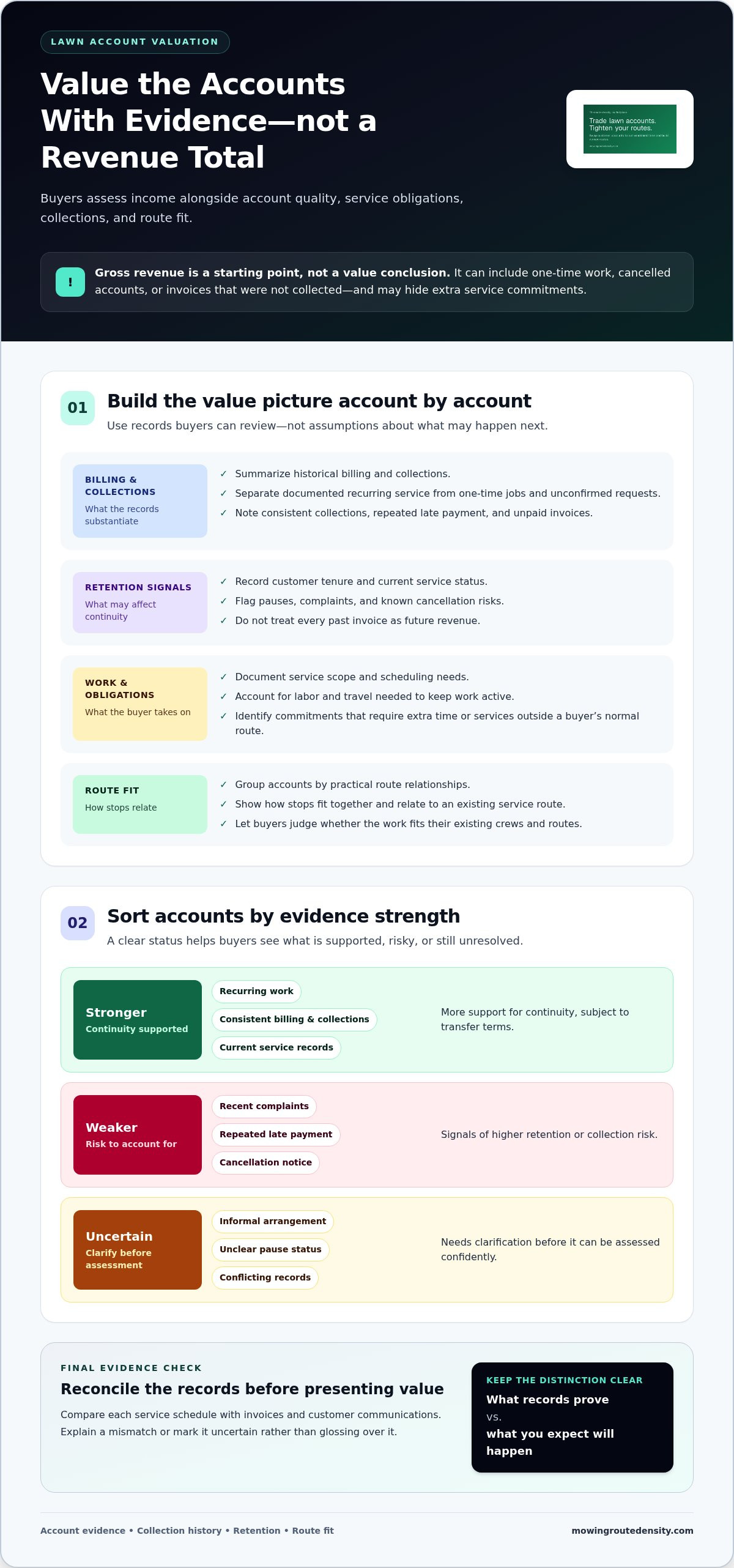
A defensible asking price starts with evidence at the account level, not a single revenue total. Buyers weigh income alongside service obligations, collection patterns, retention evidence, and the labor and travel needed to keep accounts active. The same revenue can represent very different opportunities: one account group may be compact and consistently serviced, while another includes scattered stops, frequent complaints, or unpaid invoices.
Gross revenue is a starting point, not a value conclusion. It may include one-time work, accounts that have since cancelled, or invoices that weren’t collected. It can also hide commitments that take extra time or require services outside the buyer’s normal route. If you want to sell lawn care client list assets credibly, separate what the records prove from what you expect will happen.
Assess recurring revenue and account quality
Summarize historical billing and collections using records you can substantiate. Separate documented recurring service from one-time jobs and unconfirmed requests. Note payment patterns, pauses, complaints, and known cancellation risks. This helps a buyer assess likely continuity without treating every past invoice as future revenue.
Apply the same evidence check to every account. For example, compare the service schedule with invoices and communications. Explain a mismatch or mark it uncertain rather than glossing over it.
| Evidence level | Account signals | What it tells a buyer |
|---|---|---|
| Stronger | Recurring work, consistent billing and collections, current service records | More support for continuity, subject to transfer terms |
| Weaker | Recent complaints, repeated late payment, or a cancellation notice | More retention or collection risk to account for |
| Uncertain | Informal service arrangement, unclear pause status, or conflicting records | Needs clarification before it can be assessed confidently |
Measure route fit and transfer risk
Group accounts by practical route relationships. Show how stops fit together, then document the service scope and scheduling needs. A buyer can use this information to judge whether the work fits existing crews and routes. Don’t claim that a route is profitable or efficient unless your records support it; travel time and service effort can change the calculation.
Separate account quality from transfer certainty. Contract terms, customer consent, notice requirements, and assignment conditions can affect whether an account can move as planned. Flag those points for appropriate legal review rather than assuming a buyer can take over every relationship.
There’s no universal multiple that settles the price. Buyer fit, documentation, route compatibility, and agreed transfer terms all shape negotiation. A well-supported account summary gives both sides a clearer basis for discussion. Contractors preparing an account group for a potential sale or route adjustment can use a lawn account trading platform to connect with professionals looking to buy, sell, or swap service routes.
Prepare Account Records Buyers Can Review with Confidence
Good records make an account group easier to assess and reveal gaps before a buyer finds them. Build one consistent schedule, reconcile it against source records, and keep early-stage materials focused. A seller preparing to sell lawn care client list assets should be able to explain where each material detail came from instead of relying on memory.
Create a buyer-ready account schedule
Use the same fields for every account so a buyer can compare service needs and status without decoding different formats. Keep the schedule factual. Label details that are estimated, disputed, or missing rather than presenting them as confirmed.
- Service: Work included and any scope limits or recurring add-ons.
- Schedule: Service frequency, usual timing, and any seasonal pause.
- Billing: Invoice history, payment status, and unresolved balances.
- Relationship: Customer tenure, last service date, and current account status.
- Exceptions: Complaints, special instructions, informal arrangements, or incomplete records.
Next, reconcile the schedule. Match each account against invoices, route or work schedules, and relevant customer communications. Check that the service described was actually billed and that the account hasn’t cancelled or paused since the schedule was last updated. Record the latest verification date. If sources conflict, note the discrepancy and its status rather than quietly choosing the version that makes the account look stronger.
Operational costs also affect how a buyer reads the records. Fuel, labor, and time spent on each service help explain the workload behind billed revenue. For related overhead context, see the lawn care profit margin optimization guide. Keep account-level facts separate from broader business estimates.
Protect customer information during review
Initial buyer screening usually doesn’t require a customer’s name, phone number, or street address. Where practical, use an anonymized account ID and grouped or summarized location information. Include enough detail to communicate service scope, schedule, billing status, and route relationships without exposing unnecessary personal data.
Reserve more identifiable details for an appropriate later review stage, with access limited to the people and purpose agreed for the transaction. Before sharing personal information, verify applicable privacy, contract, and disclosure requirements. Don’t assume that owning the records means every detail can be disclosed or transferred without restriction.
Keep the summary separate from supporting documents. The summary helps buyers screen the opportunity; invoices, schedules, and communications support closer review. This staged approach gives a serious buyer evidence to evaluate while reducing unnecessary exposure of customer information. Update both sets if an account changes status so nobody is evaluating an outdated picture.
Manage Buyer Due Diligence, Negotiation, and Customer Handoff
A clean transfer depends on sequence. Share too much too early and customer information is exposed before the buyer has established serious interest. Move too quickly at the end and accounts can be missed, double-billed, or left without a clear service contact. Set the review steps first, then tie the handoff to written terms.
- Share an initial summary. Describe the account group, service mix, and route fit without unnecessary identifying details.
- Answer buyer questions. Clarify account scope and status, and identify anything that still needs verification.
- Arrange a records review. Provide supporting documentation through an agreed process, limited to the transaction’s purpose.
- Put terms in writing. Specify the accounts included, effective date, responsibilities, and treatment of exceptions.
- Plan the transition. Coordinate billing, scheduled work, records, and customer communication around the agreed date.
For a broader view of timing and sale readiness, use this lawn care business exit strategy guide alongside the account-level preparation. A client-list sale may be only one part of an owner’s exit plan, so keep the route transaction’s scope distinct from any broader business sale.
What buyers may examine during due diligence
Expect a buyer to compare the account schedule with invoices, service schedules, and relevant customer records. Organize supporting documents by account or a consistent identifier, and make exceptions easy to find. If an account paused, changed scope, or raised a complaint after the summary was prepared, disclose the change and update its status before review. An unexplained discrepancy can make otherwise reliable records look unreliable.
Keep access limited to the agreed review purpose. Share only the information needed at each stage, and don’t distribute identifiable customer details beyond the appropriate participants. Document what was shared and when, so both sides can track the review and identify which records are current.
How to organize a clean customer transition
The written terms should state who handles work already scheduled, open invoices, billing questions, and customer communications after the effective date. Clarify how to handle exceptions, such as a customer who cancels before transfer or disputes a charge. Don’t rely on a verbal understanding about who owns the next step.
Build the transition around the service calendar. Align the final visit under the seller’s responsibility with the first visit under the buyer’s to avoid missing or duplicating a scheduled job. Coordinate who updates schedules and records, and when customers will be informed. Explain the change clearly, but don’t promise that every customer will stay.
Before transferring records or assigning service arrangements, verify applicable contract assignment, customer-notice, privacy, and record-retention requirements for the transaction. These can depend on the agreements and circumstances involved. Contractors ready to explore a route transfer can list accounts on a lawn route trading platform and connect with professionals pursuing account acquisitions.
Sell Lawn Care Accounts Through a Route Trading Platform
A route trading platform gives lawn care contractors a focused channel to explore buying, selling, or swapping service routes. Rather than presenting a bare customer list, describe a real account opportunity in terms another contractor can evaluate: the work involved, how service is scheduled, and how the accounts fit together operationally.
Prepared records make the opportunity easier to assess. They let prospective buyers evaluate documented scope, service continuity, billing status, and route relationships rather than relying on a headline customer count. If you plan to sell lawn care client list assets, treat the platform listing as a concise, evidence-based introduction, not a substitute for due diligence or written transfer terms.
Match the account opportunity to contractor needs
Contractors may be looking for accounts that fit their existing schedules, services, and routes. Make those points easy to assess. Describe the service mix and frequency, explain whether work is recurring or seasonal, and show how the stops relate to one another. Avoid claims about savings or profitability that your records can’t substantiate.
Keep the summary specific enough to show the operational picture and consistent with what you can document. Identify included and excluded work, flag exceptions, and distinguish confirmed details from estimates. This lets a buyer judge whether the accounts could complement current operations or require a different service setup. It doesn’t guarantee interest, a completed sale, or customer retention.
- Account scope: State what services are included and note any limits.
- Service continuity: Summarize current status and documented scheduling patterns.
- Route relationships: Show how the accounts are grouped and the practical connections between stops.
- Transfer questions: Identify unresolved terms or exceptions for discussion before finalizing a deal.
When comparing route-trading options, consider the type of transaction you want and what information each requires. Selling a defined account group, swapping outlying accounts, and transferring a broader route can call for different buyer conversations and terms.
Choose the next step after preparing the sale
Bring your seller materials together: a concise account-group summary, supporting records, open transfer questions, and priorities for scope and timing. Decide which accounts are included, which are excluded, and what needs resolution before a buyer can make a meaningful assessment. This preparation keeps discussions focused and reduces backtracking.
Then choose a next step that fits your transaction goals. Mowing Route Density’s B2B platform is designed for lawn care professionals looking to buy, sell, or swap service routes. Explore lawn account trading to see how your prepared account group may fit into a route transaction.
Set Your Next Route in Motion
A sale should support the way you want to run your business next. Decide whether transferring accounts will free up capacity, simplify your routes, or help you focus on work that better fits your operation. That gives you a practical filter for deciding which opportunities to pursue and which terms matter most.
If your goal is to sell lawn care client list assets, identify your priorities and the next unresolved transfer question, then take a measured step toward finding a suitable buyer. A dedicated B2B route-trading platform helps contractors explore account transactions, with Mowing Route Density serving lawn care professionals across the United States.
Explore the lawn account trading platform to consider how a route transaction could fit your next move. A well-chosen next step can put your hard-earned accounts to work for a new owner while helping you move forward with confidence.
Frequently Asked Questions
How do I determine what my lawn care client list is worth?
Estimate value from income a buyer can verify, the effort required to deliver the work, and how well the accounts fit a potential buyer’s route. To sell lawn care client list assets with a credible asking price, compare collected recurring revenue with service costs and review account status individually. For example, an account with steady payments but substantial travel may appeal differently from a nearby account with uncertain renewal.
Can I sell lawn care accounts if customers do not have written contracts?
Possibly, but the lack of written contracts makes clear evidence and careful review more important. Invoices, schedules, and dated communications may help establish what service has actually been provided, but they don’t automatically prove an account can transfer. Describe informal arrangements honestly, avoid promising continued work, and verify applicable contract, privacy, and customer-notice requirements before agreeing to transfer an account.
What information should I include when selling a lawn care client list?
Include enough operational detail for a buyer to understand the work, not just who the customers are. Along with service scope and frequency, note access instructions that affect the job, special property conditions, seasonal changes, and service add-ons. For example, describe a recurring mowing account that also needs occasional trimming separately from mowing-only work. Clearly label estimates and unverified details.
How do I protect customer information while a buyer reviews my accounts?
Start with a summary that uses account codes instead of names and omits contact details. Share only what’s needed for the current review stage, and redact unrelated personal or payment data from supporting documents. Keep a record of what information you disclose and to whom, and avoid sending an unfiltered customer spreadsheet through ordinary email. Before revealing identifiable details, verify the privacy and contractual requirements that apply to your transaction.
Do customers need to agree before their lawn care service transfers?
It depends on the service arrangement and applicable requirements, so don’t assume either that consent is always required or that notice alone is enough. Review written terms for assignment or change-of-provider language, then verify relevant privacy and customer-notice obligations. If an account is based on an informal understanding, treat transferability as an open question until it has been assessed. Put the agreed approach and timing in the sale documents.
What happens if a customer cancels after the account sale?
The transaction documents should determine how a cancellation affects the parties. They can specify who handles an account that cancels before the effective date, who completes or refunds prepaid work, and whether the buyer or seller is responsible for customer communication. Don’t assume a cancellation automatically changes the sale price or creates a refund. Record the cancellation date and follow the written terms, with unresolved disputes handled as agreed.
Where can lawn care contractors buy or sell service routes?
Lawn care contractors can use Mowing Route Density’s dedicated B2B account trading platform to buy, sell, or swap service routes. It serves lawn care professionals across the United States. A clear route summary helps other contractors assess the work and its fit with their operations. Treat a platform listing as the start of a transaction discussion, then confirm scope, transfer terms, and customer-information handling before completing a deal.


