
The sticker price is only the starting point. Calculating the true cost of lawn equipment ownership means adding the purchase price, operating expenses, and maintenance costs, then subtracting the equipment’s estimated resale value. If you finance the purchase, include applicable fees, taxes, and total loan interest in the acquisition cost.
It’s easy to focus on a mower’s price today and overlook what it will cost the business over time. Fuel, maintenance, repairs, and lost resale value all affect the bottom line. This guide shows you how to calculate ownership costs so you can compare equipment on a consistent basis.
You’ll work through the total-cost formula, estimate energy and operating expenses, account for maintenance and repairs, and factor in depreciation through expected resale value. You’ll also learn to convert the total into a cost per operating hour, helping you judge whether a machine fits your operation.
Key Takeaways
- Build a full ownership-cost picture by adding purchase and operating expenses, then subtracting expected resale value.
- Include fuel, upkeep, repairs, and replacement parts so routine expenses don’t disappear from your calculations.
- Estimate remaining value using prices for comparable used equipment, then account for depreciation over your planned ownership period.
- Divide total costs by expected operating or billable hours to see what the equipment costs to put to work.
- For equipment needed only temporarily or infrequently, compare ownership with renting before committing capital.
Maintenance and repair costs
Local ordinances and HOA rules may restrict gas-powered equipment or operating hours. Because restrictions depend on the applicable rules, include any limits that affect how many hours you can realistically use the equipment.
Budget for safety gear, secure storage, and disposal of used oil, batteries, and worn parts. Include replacement protective equipment and any disposal charges that apply to your operation.
- Build a maintenance budget from actual service records. Include lubricants, preventive services, repairs, component replacements, filters, and belts. Separate routine work from major repairs, then total each category for the year. This makes small recurring costs visible alongside less frequent replacements.
- Estimate costs for a new machine using your existing fleet. Average annual maintenance costs across several similar machines, then multiply that average by the projected years of use. Adjust for equipment use, operator experience, preventive maintenance frequency, and planned ownership duration. These factors affect lifetime costs, so use machines with comparable workloads.
- Track operating cost per hour as well as annual spending. Use your own fuel, maintenance, repair, and usage records to calculate a useful figure.
- Account for fuel or electricity with a repeatable calculation. For fuel, multiply average annual operating hours by fuel consumed per hour and the price per gallon, then extend the estimate across the machine’s expected lifespan. For electric or hybrid equipment, include charging electricity. Factor in possible fuel-price changes when planning future operating costs.
- Add transportation and storage expenses when they apply. Include hauling equipment between jobs, the space needed to store it, and any costs tied to protecting it from weather or damage. For disposal, list used oil, batteries, and worn components separately. This prevents end-of-life handling from disappearing inside general overhead.
- Review maintenance and operating costs together before deciding to keep or replace a machine. Energy, maintenance, and repair costs are predicted to have at least five times more relevance than upfront cost. Preventive maintenance can reveal repair needs early and help avoid more extensive work. Record each service, repair, and operating hour to refine next year’s estimate.
Remaining value and depreciation
Estimate what the equipment could sell for at the end of your planned ownership period. Subtract that remaining value from your costs instead of treating the full purchase price as a cost that is never recovered.
-
Assess Equipment Depreciation
Set the ownership period, then estimate how much the equipment’s value will decline during that time. Depreciation is the difference between its cost and its remaining value, not a separate cash payment. For a fair comparison, use the same planned ownership period for each machine. Don’t assume the equipment will be worthless at the end; resale value can offset some of its cost.
-
Estimate Equipment Resale Value
Estimate resale value by comparing prices for used equipment similar to yours. Match the make, model, age, condition, and operating history as closely as possible. Use an estimate for the year you expect to sell, not today’s used price.
-
Compare Like With Like
Use comparable machines to ground your estimate. Check that used listings reflect similar equipment, attachments, and working condition. A listing for a mower with different features or substantially different use can skew the estimate.
-
Account for Condition and Use
Adjust your estimate for how the machine will be used and maintained. Operating hours, repair history, visible wear, and service records help explain why similar models may have different resale values. Keep the estimate consistent with your ownership plan: a machine kept longer or worked harder may be worth less than a comparable unit sold sooner.
-
Record the Estimate by Ownership Year
Record the expected resale value at the end of your chosen period, along with the estimation method and comparable equipment. Revisit the figure as actual use and condition become clearer. This gives you a traceable estimate instead of a guess carried forward unchanged. Keep the five-year Pump A and Pump B figures tied to that comparison period.
-
Apply Remaining Value to Your Cost Calculation
Subtract estimated resale value from purchase, operating, and maintenance costs to calculate ownership cost. The resale estimate matters: using the wrong period or an unsuitable comparison can change which option appears less costly.
Purchase price, fees, taxes, and financing interest
Start with the full amount required to put the equipment into service, not just its advertised price. These steps help you capture the acquisition cost accurately.
- Record the equipment’s purchase price before adding other charges. Keep the machine and any included attachments together in your worksheet. These figures establish the starting point, not the complete ownership cost.
- Add applicable fees and taxes to the purchase price. Use the amounts shown on the transaction documents and record each charge separately. This makes the calculation easy to audit and distinguishes the listed price from the amount paid to acquire the equipment. Use the figures for this transaction rather than estimating a tax or fee from another purchase.
- If you finance the equipment, include the total loan interest. Use the full interest amount across the loan term, not just the first payment or one year’s payments. Add that interest to the acquisition cost. The loan principal funds the purchase; interest is an additional financing expense that increases the total cost of ownership.
- Compare financed and cash purchases on the same basis. For a financed machine, add the purchase price, applicable fees and taxes, and total loan interest. For a cash purchase, include the purchase price, fees, and taxes, without loan interest. This separates financing costs from differences between the machines.
- Compare alternatives using the same ownership period and cost categories. Don’t compare one machine’s equipment price with another’s financed total. Put acquisition figures in separate columns, then include them in the total-cost calculation.
- Keep the supporting records with your calculation: the purchase invoice, fee and tax breakdown, and loan schedule. If the financing schedule changes, update the total interest in your estimate. Clear records let you revise acquisition costs without mixing financing charges into maintenance or operating expenses.
- Use the completed acquisition total as one input, not as the final decision. A lower initial cost can still lead to higher ownership costs once operating, maintenance, and resale figures are included. Keep each category visible so you can see what drives the difference instead of burying those costs in one purchase figure.
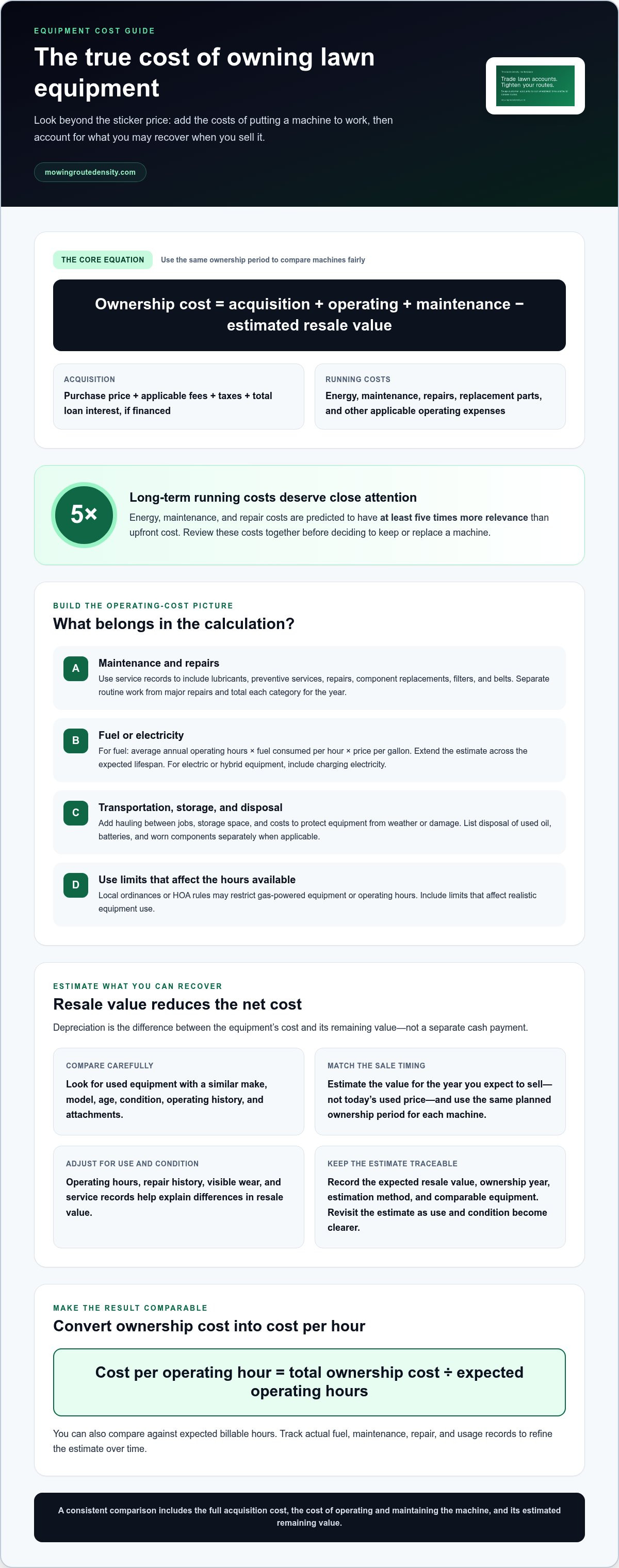
Total cost of ownership formula
Use one formula and the same ownership period for every machine. This formula is the core of calculating the true cost of lawn equipment ownership.
-
List Costs Included in Ownership
Gather initial acquisition costs, operating costs, maintenance costs, and expected resale value. Include applicable fees, taxes, and total loan interest in the initial cost. Operating expenses can include fuel or electricity; maintenance covers preventive service, repairs, and replacement parts. Keep each category separate to spot missing expenses and avoid counting a cost twice.
-
Apply the Total Cost Formula
Add the initial purchase price, operating costs, and maintenance costs, then subtract the expected resale value.
- Keep the comparison period consistent. The Pump A and Pump B figures cover five years, so don’t compare them with a machine’s costs over a different period. Match the timeframes for operating hours, maintenance, and estimated resale value. When calculating the true cost of lawn equipment ownership, consistent periods prevent an option from seeming cheaper simply because fewer years of expenses were counted.
- Convert the total into a cost per operating hour when machines have different workloads. Divide ownership costs by expected operating hours over the same period. This connects the equipment’s cost to its use rather than relying on the lifetime total alone.
- Compare the result with the work each machine must handle. This shows why comparing purchase prices alone can miss important costs. Before deciding which machine better fits your workload, review the assumptions for operating hours, maintenance, and remaining value.
- Keep estimated and actual costs side by side. Enter each formula category in a worksheet, then update operating and maintenance figures as records accumulate. Preserve the ownership period and resale estimate used for each comparison. This creates a consistent baseline for later decisions and shows which assumptions need revising when calculating the true cost of lawn equipment ownership.
What costs should be included in the total cost of owning lawn equipment?
Build a complete cost inventory before comparing machines. Include expenses related to acquiring, operating, maintaining, storing, and eventually selling the equipment.
- Record acquisition and ownership costs in separate categories. Include the purchase price, applicable fees and taxes, and total loan interest if financed. Add maintenance, repairs, replacement parts, fuel or charging electricity, transportation, and storage. Then subtract expected resale value. Keeping categories distinct prevents an expense from being counted twice.
- Estimate energy use from operating hours and consumption. For fuel, multiply average annual operating hours by fuel consumed per hour and the price per gallon, then extend the estimate across the planned ownership period. For electric or hybrid equipment, include charging electricity over that period. Consider possible inflation and fuel-price fluctuations in future estimates.
- Include equipment-specific supplies and replacements, not just scheduled servicing. Filters, belts, lubricants, blades, and replacements for handheld tools can add recurring costs. Use this approach to identify what to include, then enter your actual hours and replacement records.
- Include labor when measuring the full cost of using equipment. Estimate operator wages by multiplying the hourly wage by annual operating hours and the equipment’s ownership period. Keep labor separate from machine expenses if you need both an equipment-only figure and a full operating-cost figure. This prevents wages from being hidden in maintenance or fuel totals.
- Include transportation, storage, insurance, and downtime where they apply. Hauling equipment between jobs and storing it securely both affect ownership costs. Insurance can protect equipment against losses from accidents, storms, or flooding. Downtime also has a business impact: estimate lost productive hours using the value of delayed or missed work, rather than counting repair bills alone.
- Compare ownership with rental for equipment needed only temporarily or infrequently. Renting can avoid some long-term costs related to storage, depreciation, and maintenance, while ownership may suit equipment used regularly. If considering lawn mower rental, compare the rental period and use pattern with your ownership estimate before committing capital.
- Turn the inventory into a decision worksheet. Enter each cost over the same ownership period, record the assumptions behind fuel use and operating hours, and subtract expected resale value. If a mower is needed for occasional work rather than routine routes, explore lawn mower rental as an alternative to carrying its full ownership costs.
Mowing Route Density: lawn mower rental
Mowing Route Density offers lawn mower rental for lawn care professionals who need equipment without committing to ownership. Renting can fit temporary work, seasonal demand, or an occasional job where buying adds storage, upkeep, and depreciation to overhead. Compare the rental need with your ownership estimate: consider how often the mower will work, how long you need it, and whether it would otherwise sit idle. If regular use makes ownership more practical, keep using your total-cost calculation to guide the decision. If a temporary need makes rental the better operational fit, explore lawn mower rental through Mowing Route Density. Visit mowingroutedensity.com to learn more.
Make the Next Equipment Decision With a Clearer Plan
A cost worksheet is more useful when you update it as actual hours, repairs, and resale expectations change. Use those records to decide whether to keep, replace, or rent equipment. The goal isn’t to own less for its own sake, but to keep capital tied to work that supports your operation.
If growth is the bigger constraint, Mowing Route Density also offers a lawn account trading platform and a lawn mowing service provider locator. These tools help you find route opportunities and connect with professional mowing companies, addressing needs beyond equipment costs. Choose the next step that matches the bottleneck your numbers reveal.
Put your ownership estimate to work. Contact Mowing Route Density to discuss a practical next step for your lawn care operation.
Frequently Asked Questions
How is Total Cost of Ownership Calculated?
Add acquisition, operating, and maintenance expenses, then subtract expected resale value. When calculating the true cost of lawn equipment ownership, keep the comparison period and workload consistent across machines. Separate fuel, repairs, and other cost categories to see what drives the result. When comparing two mowers, use each machine’s expected hours rather than assuming they’ll handle identical workloads.
What is the average annual maintenance and repair cost for lawn equipment?
There’s no single annual maintenance figure that works for every mower or tool. Costs depend on usage, service frequency, operator experience, and repair needs. Estimate your budget using service records from comparable machines, separating routine servicing from repairs and replacements. Maintenance is one part of calculating the true cost of lawn equipment ownership, so update your estimate as actual hours and repair history accumulate.
How much do gas, electricity, and batteries cost to operate lawn equipment?
Estimate energy expenses using the equipment’s consumption and expected usage. For gas equipment, combine operating hours, fuel consumed per hour, and the price per gallon. For electric equipment, estimate charging electricity based on its work schedule and applicable electricity costs. Include batteries in your equipment budget if replacement is part of your ownership plan. Actual workload and idle time affect energy use, so base estimates on operating records.
How long do lawn mowers and other lawn equipment typically last?
Useful life varies with operating hours, workload, maintenance, storage, and operator handling. Track meter hours and service history instead of relying on purchase age alone. A mower used regularly for commercial jobs faces a different workload from one used occasionally. Set a planned replacement point for your estimate, then revise it as wear, repair frequency, and productivity clarify the machine’s remaining working life.
How do depreciation and resale value affect lawn equipment ownership costs?
Depreciation reflects the decline in equipment value during ownership, while resale value offsets part of the total cost when you sell. Estimate resale value using comparable used equipment with similar condition, features, and operating history. Keep maintenance records and hour-meter readings to track condition. A realistic resale estimate can change the comparison, especially when machines’ expected values differ at the end of ownership.
Is it cheaper to buy or rent lawn equipment for occasional use?
Renting may suit temporary or infrequent needs because ownership also involves storage, maintenance, and depreciation. Compare rental costs for the expected work period with the full ownership estimate, including expected resale value. Ownership may better fit regular, repeated use. For a one-off job or temporary workload, lawn mower rental is worth comparing with tying up capital in equipment.
What are the total ownership costs of gas vs. electric lawn equipment?
Compare both equipment types over the same ownership period and workload. Include acquisition, energy, maintenance, repairs, storage, transportation, and expected resale value. Gas costs depend on fuel consumption and prices; electric costs include charging electricity and any planned battery replacements. The better fit depends on actual use, energy needs, maintenance demands, and how well the equipment suits your operating schedule.


