
Your fuel tank is leaking money every single day, and it isn't a mechanical failure. It's a logistical one. If your crews spend more time behind the wheel than behind a mower, you're subsidizing waste at the expense of your profit margin. You've felt the sting of scattered accounts and the headache of finding a vetted partner who actually performs. Using a professional lawn mowing service provider locator isn't just about finding a residential lead; it's about fixing a broken route.
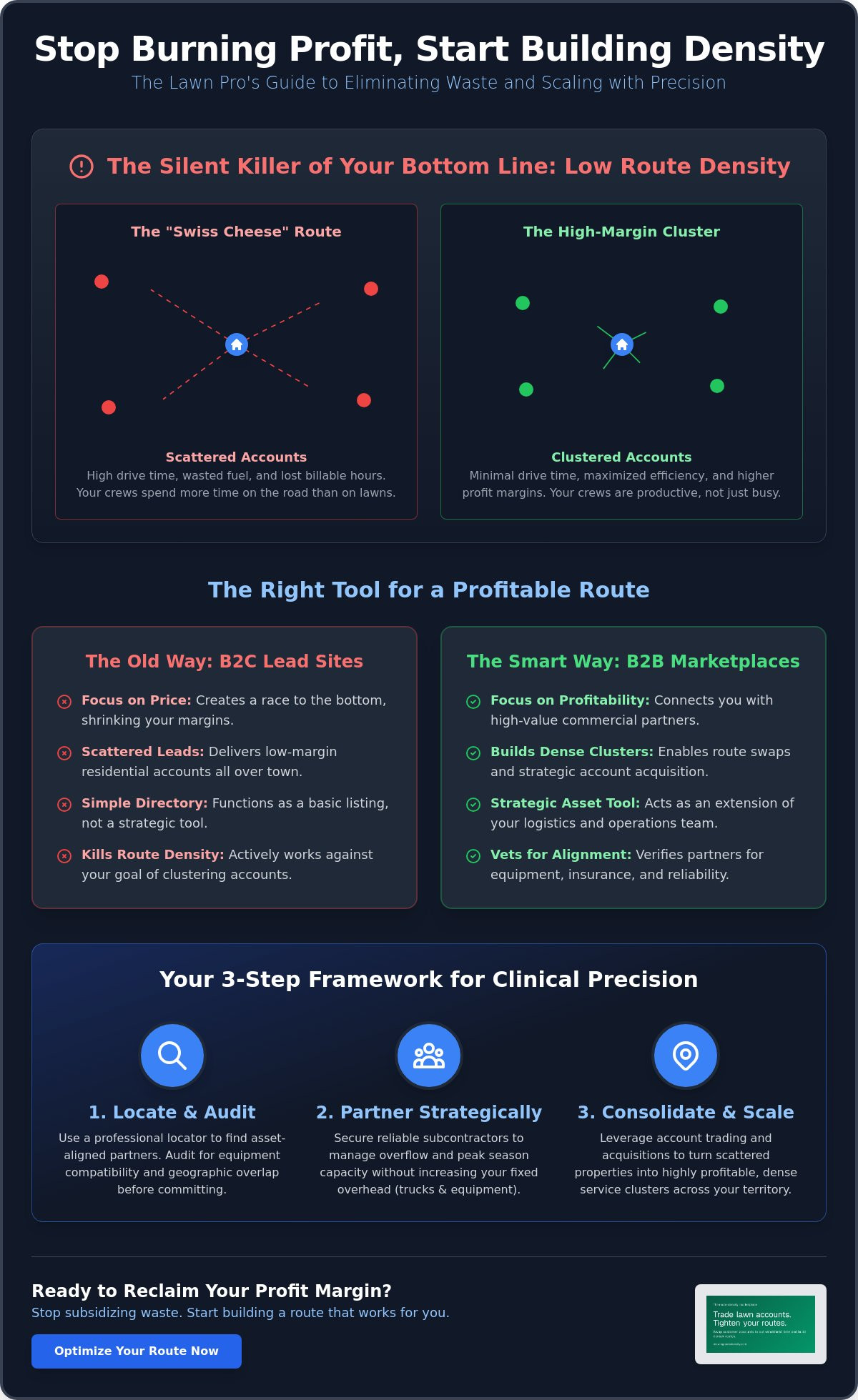
We agree that low route density is the silent killer of your bottom line. You need a way to tighten your operations and reclaim those lost billable hours. This article explains how to leverage professional tools to identify asset-aligned partners, secure reliable subcontractors, and eliminate drive-time inefficiencies. We'll break down a strategic framework for clustering accounts and managing capacity so you can stop burning fuel and start scaling with clinical precision.
Key Takeaways
- Stop chasing low-margin residential leads. Professional B2B frameworks function as strategic asset management tools, not just simple directories.
- Kill "dead-heading" waste. Use professional networks to find reliable subcontractors for overflow management and peak season capacity.
- Stop paying for names. Account marketplaces outperform B2C lead sites by focusing on route profitability instead of referral fees.
- Audit for alignment. Use a lawn mowing service provider locator to verify equipment compatibility and geographic overlap before signing a partnership.
- Build route density. Leverage account trading to turn scattered properties into high-margin clusters across your service territory.
Beyond the Consumer Search: Why Contractors Need a Professional Locator
Most search tools are built for the homeowner who wants a cheap cut. For a professional contractor, that's a distraction. You don't need another lead-gen site that sells you a $45 residential account across town. You need a lawn mowing service provider locator that acts as an extension of your logistics team. This isn't about finding a "gig worker." It's about securing a B2B partner who understands that profit is found in the gaps between stops. A professional locator is a strategic asset management tool, not a directory.
This shift toward professional management tools is mirrored across industries; for example, Computer Market Research provides SaaS solutions that help enterprises automate and streamline their channel management for better operational control.
Territory consolidation is the only way to survive rising fuel costs and labor shortages. If you're growing organically by taking whatever account comes your way, you're building a "Swiss cheese" route full of holes and wasted drive time. Identifying the right partner is the first step in plugging those holes. You move away from random acquisition and toward asset-aligned growth. This means you only add accounts or partners that strengthen your existing footprint. It's a shift from working harder to working with clinical geographic precision.
The Difference Between B2C Directories and B2B Networks
B2C sites prioritize the homeowner's price point. They create a race to the bottom where the lowest bidder wins and the provider eats the overhead. These platforms often lead to low-margin accounts with high drive times because they ignore the logistics of your route. A B2B network is different. It prioritizes route density and professional vetting. When you use a professional Strategic Subcontracting framework, you're looking for partners who can uphold commercial standards. You need to know their insurance is valid, their crews are reliable, and their routes overlap with yours to eliminate waste.
Identifying Asset-Aligned Partners for National Projects
Scaling a national or regional contract requires more than just names in a database. You need to find partners with similar equipment footprints to ensure service consistency. If a job requires 60-inch zero-turn mowers for wide-open turf, a subcontractor showing up with residential-grade gear is a liability. You must use a locator to find providers who already understand commercial SLAs and have the fleet to back it up. Asset-alignment is the synchronization of equipment type and geographic proximity. Using a lawn mowing service provider locator to verify these details before the first site visit prevents operational friction. It ensures that every partner you bring on board adds value to the contract rather than creating a management headache.
Strategic Subcontracting: Using Locators to Solve Capacity Gaps
"Dead-heading" is the silent thief in your business. It's the 20-minute drive between accounts that costs you in labor and fuel but earns you zero. If your crews spend more time in traffic than on a mower, your profit margin is evaporating. A strategic lawn mowing service provider locator allows you to identify contractors already working in your target zip codes. By partnering with these providers, you protect your margins through proximity. You don't need a provider ten miles away. You need the one already on the same street.
Scaling doesn't always mean buying more trucks. It often means finding the right B2B Marketplaces where you can offload inefficient accounts to someone for whom they are efficient. This is the core of lawn care profit margin optimization. You trade a low-margin, isolated account for a high-margin, clustered one. It isn't just about finding help. It's about finding the right help in the right place.
Eliminating Drive Time Through Territory Clustering
The math is simple. Five accounts on one block beat ten accounts scattered across town. Travel time is non-billable. You can use a lawn mowing service provider locator to find acquisition targets for route swaps. If a competitor has a lone account in your territory and you have one in theirs, a trade makes both of you more profitable. It's about tightening the net. You can browse our lawn account trading platform to see where your route could be denser and more profitable.
Managing Overflow Without Increasing Fixed Overhead
Peak season is a double-edged sword. You have the work, but do you have the capacity? Buying or renting another mower is a tactical decision, but it increases your fixed overhead. Subcontracting allows you to scale without the long-term debt of equipment longevity issues. A locator helps you maintain a lean internal fleet. You keep your core crews busy and use a tool to find lawn care subcontractors to handle the surge. It's about capacity management. You don't want to own 20 mowers if you only need 15 for ten months of the year. Work smarter by letting others handle the overflow while you keep the core of your business lean.
B2C Lead Sites vs. B2B Marketplaces: A Tactical Comparison
Lead-generation sites are a trap for contractors focused on growth. They sell you a name and a phone number; they don't sell you a profitable route. A professional lawn mowing service provider locator should be a tool for asset optimization, not a funnel for low-margin residential churn. If you're paying for leads, you're buying work. If you're using a B2B marketplace, you're buying efficiency. There is a massive difference between the two.
B2C platforms thrive on referral fees that eat your margin before the mower even leaves the trailer. They encourage a race to the bottom by forcing you to compete on price alone. This commodity market ignores your overhead and equipment longevity. A B2B framework focuses on marginal utility. It’s about maximizing billable hours per mile driven. You need data transparency, including account history and service frequency, not just a simple contact info sheet. Knowing how an account fits into your existing route is more valuable than the account itself.
The High Cost of 'Cheap' Leads
Residential customers found through consumer locators have a notoriously high churn rate. They're often looking for the lowest price and will switch the moment a neighbor's kid offers a better deal. This instability makes it impossible to plan for long-term labor needs. According to Lawn Care Industry Employment Statistics, the demand for grounds maintenance remains high, but labor is a finite resource. You can't afford to waste your crew's time on low-LTV (Lifetime Value) accounts. A B2B lawn care marketplace provides access to commercial contracts and established routes that offer the stability needed for real scaling.
Account Stability and Route Liquidity
Sustainable growth is impossible without route density. As fuel costs continue to rise, the distance between stops becomes your biggest liability. Professional locators facilitate account swaps between contractors to fix this. If you have three accounts in a neighborhood where a peer has ten, it makes sense to trade. This liquidity allows you to tighten your net and reduce non-billable drive time. This shift toward lawn care lead generation B2B strategies ensures that every new account you add actually increases your profitability instead of just increasing your workload. Stop chasing names. Start building clusters.
How to Audit a Service Provider for Route Alignment
Selecting a partner is a cold, data-driven calculation. It isn't a popularity contest. If you're lazy with your vetting, you're inviting a parasite into your operations. You need to verify that a provider’s presence in a territory actually improves your bottom line. A professional lawn mowing service provider locator acts as your diagnostic tool. It provides the geographic data necessary to move beyond simple contact info and into true logistical synchronization. Don't just find a name; find a match.
Equipment Footprint Compatibility
If you're managing a route of tight residential yards with narrow gate access, a partner running 72-inch zero-turns is useless. They can't get the machine to the grass. You must match the asset to the density profile of the specific neighborhood. Equipment-Route Mismatch is a primary cause of labor waste. Using a lawn mowing service provider locator to filter by equipment type ensures that the subcontractor can actually execute the work without needing specialized hand-mowing support. If the machines don't fit the gates, the partnership won't fit your budget. For specialized projects that require precision equipment, you can visit Ray Lawns to see how professional providers maintain high service standards.
Insurance and Compliance for Professional Networks
Consumer-facing apps often gloss over the legal side of the business. In the B2B world, that’s a non-starter. You need absolute verification of General Liability and Workers Comp. If a provider isn't compliant, they aren't a partner; they're a liability. Your brand standards are on the line every time a subcontractor pulls onto a property. Use a professional network to review service history and compliance documents before you ever send a crew a work order. You can verify these credentials and start tightening your route today by using our lawn mowing service provider locator.
The audit process follows a linear path to ensure zero waste:
- Step 1: Verify Equipment. Ensure mower deck sizes match the physical constraints of the route.
- Step 2: Map Overlap. Use geographic data to confirm the provider is already working in your target zip codes.
- Step 3: Check Compliance. Review insurance certificates and commercial service history.
- Step 4: Run a Trial. Execute a two-week subcontracting period to verify quality and punctuality.
- Step 5: Finalize the Swap. Use density data to pull the trigger on a permanent account acquisition or long-term partnership.
This methodical approach eliminates the guesswork that kills margins. Every partner you add should make your route tighter and your overhead lower. If they don't, move on to the next candidate. Your business doesn't have room for "good enough." It only has room for "asset-aligned."
Scaling Your Footprint with Mowing Route Density
Mowing Route Density is the premier national B2B lawn mowing service provider locator for contractors who refuse to accept operational waste. We don't care about "getting your name out there" for residential leads. We care about your EBITDA. Our platform is a specialized ecosystem where account trading meets equipment logistics. It's designed to eliminate the fat from your operation with clinical precision. By letting density do the heavy lifting, you stop fighting for scraps. You start building a fortress. This is the only way to scale in a market defined by rising labor costs and razor-thin margins.
Working smarter means recognizing that your biggest expense is movement. Every turn of the ignition key is a cost center. Our framework allows you to swap, sell, or acquire accounts with surgical geographic precision. You're no longer at the mercy of a random, scattered customer list. You're an architect of your own efficiency. Join the network. Tighten the net. Watch your margins breathe again. If you aren't optimizing your route, you're just a delivery company that happens to cut grass. Stop delivering. Start dominating.
The Route Density Advantage
Territory clustering does more than save fuel. It transforms your business valuation. When the time comes to sell, a sophisticated buyer isn't looking at the age of your fleet. They're looking at your clusters. A dense route is a premium asset that commands a higher multiple because it's easier to manage and more profitable to run. A scattered route is a management nightmare that buyers avoid or devalue. This is the foundation of a successful lawn care business exit strategy. Use our lawn mowing service provider locator to perform an operational audit. Find where you're weak. Trade where you're strong. Build a business that is worth more than the sum of its parts.
Join the Asset-Light Growth Revolution
Real growth is asset-light. Scaling doesn't require a massive capital outlay that chokes your cash flow. Our locator identifies the geographic opportunity; our professional lawn equipment rental services provide the tools to execute. This synergy allows you to take on larger commercial contracts without the burden of long-term debt or equipment longevity concerns. You don't need to own 50 mowers to manage 500 accounts. You need a strategic framework that combines geographic intelligence with flexible equipment access. Stop over-leveraging your future. Start optimizing your present. Optimize Your Route Density Today.
Stop Bleeding Profit and Start Tightening Your Net
Efficiency isn't a luxury. It's a survival requirement. If your crews are still driving across three zip codes to service one account, you're subsidizing your customers' lawns with your own profit margin. You've learned that a professional lawn mowing service provider locator is more than a directory. It's a diagnostic tool to fix your broken route density. By focusing on asset-aligned partnerships and account trading, you turn non-billable drive time into profitable mowing hours.
Stop chasing low-margin residential leads that churn every season. Secure your business valuation by building dense, clustered territories that attract high-multiple buyers. Our specialized B2B account trading platform and national network of professional contractors provide the infrastructure you need to scale without the weight of unnecessary overhead. We also provide integrated commercial equipment rental solutions to keep you agile during peak demand. You've got the work. Now get the density.
Optimize your route density and find asset-aligned partners today. It's time to work smarter and keep your margins where they belong.
Frequently Asked Questions
What is a B2B lawn mowing service provider locator?
It's a strategic logistics tool designed to connect contractors with other professionals rather than homeowners. Unlike residential search engines, this framework focuses on asset alignment and geographic proximity to optimize operational efficiency. It serves as a hub for finding partners who can handle commercial overflow or help consolidate territories.
How does a professional locator differ from residential booking apps?
Professional locators prioritize route density and B2B compliance over the homeowner's price point. Residential apps often create a race to the bottom with low-margin cuts and high referral fees. A B2B locator focuses on the marginal utility of an account. It provides data on account history and service frequency to ensure every stop adds real value to your bottom line.
Can I use a locator to find subcontractors for commercial contracts?
Yes, finding reliable subcontractors is a primary function of a professional lawn mowing service provider locator. You can identify partners who already have a presence in your target zip codes to handle overflow during peak seasons. This allows you to manage national or regional contracts without the massive fixed overhead of purchasing a larger internal fleet.
Is it possible to swap lawn care accounts through a locator platform?
Trading accounts is one of the most effective ways to fix a "Swiss cheese" route. A professional platform facilitates swaps where you trade isolated, low-margin accounts for ones that sit within your existing clusters. This strategy turns non-billable drive time into billable mowing hours. It’s about tightening your geographic net to maximize the profitability of every crew.
How do I verify the quality of a service provider found online?
You must audit their commercial insurance compliance and service history before signing a partnership. Verify their General Liability and Workers Comp certificates to protect your business from liability. A professional network often provides access to these records. After verification, always execute a brief trial period to ensure their quality and punctuality meet your brand standards.
Why is route density more important than the number of leads?
Leads are just potential work; density is actual profit. Ten accounts scattered across a city will bleed you dry through fuel costs and labor waste. Five accounts on the same block are infinitely more valuable. High route density reduces equipment wear and tear and maximizes billable time. It's the single most important metric for increasing your business valuation.
What should I look for in a B2B lawn care partner's equipment list?
Look for equipment that matches the physical constraints of your specific route. If you have residential accounts with 36-inch gates, a partner with only 60-inch zero-turns is a liability. For large commercial sites, ensure they have the fleet capacity to handle multi-acre properties efficiently. Equipment-route mismatch is a primary cause of labor waste and must be avoided.
How do I use a locator tool to reduce fuel and labor costs?
Use the lawn mowing service provider locator to identify partners who can take over your outlying accounts. By offloading properties that are far from your core clusters, you eliminate the dead-heading time your crews spend driving. This reduction in travel time directly lowers fuel consumption and labor hours. It allows your team to focus on high-density areas where they are most profitable.


