Buying your fleet outright is often a vanity play that starves your business of the liquidity it needs to scale. You want the title in your hand, but that piece of paper doesn't mow grass or sign new contracts. In 2026, tying up six figures in depreciating metal is a tactical error. High upfront costs kill your cash flow. Maintenance on older machines eats your margins. You need a better way to stay competitive. Understanding commercial lawn mower lease options is the first step toward building an asset-light operation that prioritizes route density over ownership.
It's a common trap. You think owning equipment provides security; it actually limits your agility when seasonal needs shift. This guide explores how to leverage modern leasing structures to maximize fleet reliability and preserve capital. We'll look at the current 2026 landscape, including Section 179 tax deductions and specific terms from manufacturers like Scag or Exmark. You'll learn how to maintain a modern fleet with predictable monthly costs. We'll cover everything from FMV leases to the impact of CFPB Section 1071 on your next equipment acquisition. It's time to stop overpaying for the right to own a mower and start paying for the ability to grow.
Key Takeaways
- Stop freezing cash in depreciating assets. Treat equipment as a tactical operating cost to maintain liquidity for route expansion and labor costs.
- Navigate commercial lawn mower lease options with precision. Compare FMV and $1 Buyout structures to identify the 24-36 month sweet spot for your specific fleet needs.
- Audit your Total Cost of Operation. Learn to account for maintenance, obsolescence, and the hidden financial drain of running older, unreliable machines.
- Align equipment hours with route density. Use the "Dead Time" calculation to ensure your leased machinery stays on the turf and off the trailer.
- Adopt an asset-light strategy. Focus on logistics management rather than equipment ownership to increase your business valuation and long-term exit potential.
Why Commercial Lawn Mower Lease Options Outperform Ownership in 2026
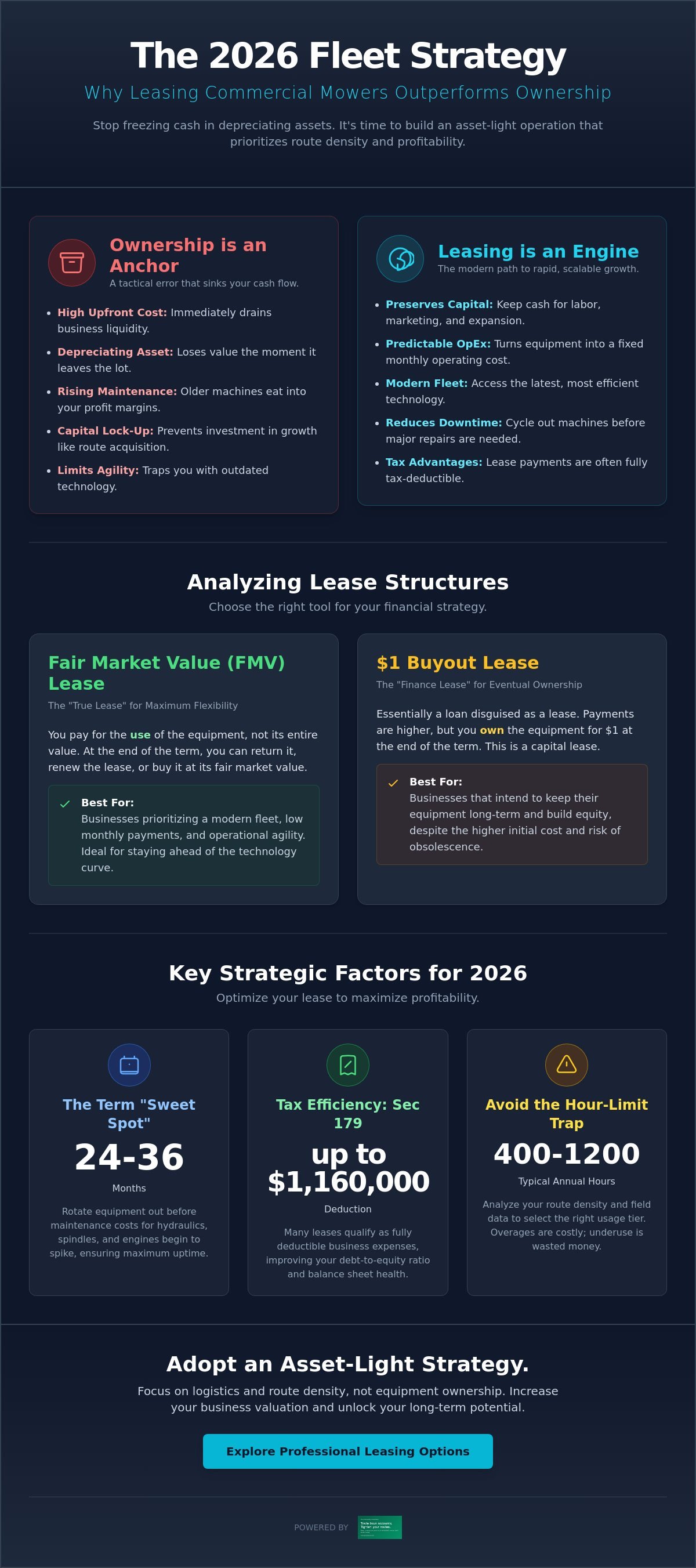
Ownership is a trap. Most landscaping business owners view a paid-off mower as a badge of success. It isn't. It's an anchor. In a high-speed market, commercial lawn mower lease options provide the only viable path to rapid growth. When you buy equipment, you're committing a massive capital expenditure (CapEx) to an asset that loses value the moment it leaves the lot. You're betting that your 2026 purchase will still be competitive in 2030. That's a losing bet. By shifting your equipment costs to an operating expense (OpEx), you keep your cash where it belongs: in your growth fund.
An asset-light strategy is the fundamental driver of landscaping profitability in 2026 because it prioritizes cash flow and operational flexibility over the ownership of depreciating hardware. Instead of tying up $15,000 in a single zero-turn, you pay for the hours that machine actually works. This shift allows you to preserve "opportunity capital." In 2026, the real money is in route acquisitions and account trading. If your cash is locked in a trailer full of mowers, you can't strike when a competitor's route becomes available. You need liquidity to scale, not a graveyard of aging machinery.
The 2026 technology cycle has created an "Obsolescence Hedge." With electric mower adoption growing at over 10% and robotic navigation becoming standard, a five-year-old mower is a dinosaur. Leasing ensures you aren't stuck with yesterday's tech. Most professional Lease Structures allow you to cycle out equipment before maintenance costs spike and efficiency drops. Why own a liability when you can lease an engine?
Ownership is an Anchor, Leasing is an Engine
Equity in heavy machinery is an illusion. You aren't building value; you're managing a slow-motion fire. Leasing turns your fleet into a predictable, fixed monthly cost. This certainty is vital for national-scale operations where budget variance is the enemy. Stop paying for the metal. Start paying for the utility. When the machine breaks or becomes outdated, it should be the leasing company's problem, not yours. You're a logistics manager, not a mechanic.
Tax Implications and Off-Balance Sheet Benefits
Leasing is a tax-efficient weapon. Under the 2026 tax code, Section 179 allows businesses to deduct up to $1,160,000 of equipment put into service. Many commercial lawn mower lease options qualify as fully deductible business expenses, providing a cleaner balance sheet. This improves your debt-to-equity ratio, making it easier to secure lines of credit for major route expansions. Consult your accountant to maximize these 2026 benefits. The logic is clear: lean operations win. Tighten your balance sheet and optimize your cash flow before your competitors do.
Analyzing the Mechanics: FMV vs. $1 Buyout Lease Structures
Choosing the wrong lease structure is a quiet way to bleed cash. You aren't just selecting a monthly payment; you're deciding the future of your fleet's agility. Most commercial lawn mower lease options fall into two categories: Fair Market Value (FMV) and $1 Buyout leases. An FMV lease functions as an operating expense. You pay for the use of the machine, then return it. A $1 Buyout lease is a capital lease. It's essentially a loan disguised as a lease, where you own the machine for a buck at the end of the term. If you want to scale, the distinction is everything.
Timing is your most critical variable. The industry "sweet spot" for lease terms is 24 to 36 months. Why? Because commercial mowers are high-intensity assets. After three years of heavy production, maintenance costs for hydraulic pumps, spindles, and engines begin to climb. By capping your term at 36 months, you rotate the machine out just as its reliability starts to dip. This keeps your crews in the field and out of the repair shop. If you find yourself struggling with equipment downtime, it might be time to explore professional rental or leasing alternatives to stabilize your schedule.
Don't fall into the 'Hour-Limit' trap. Tiers typically range from 400 to 1200 hours per year. Picking the wrong one is expensive. Overages carry heavy penalties. Under-utilization means you've overpaid for capacity you didn't use. Look at your field data. If your route density is low, you're racking up engine hours just driving between properties. Match your lease tier to your actual billable cutting time, not a guess.
The FMV Lease: Maximum Agility
The FMV lease offers the lowest possible monthly payments. It focuses on the asset's residual value, essentially letting the leasing company bet on what the mower will be worth in three years. This is the "Walk Away" advantage. You return the equipment before major service intervals hit. It's the ideal choice for contractors focused on lawn care profit margin optimization. You keep your fleet modern, your costs fixed, and your capital free.
The $1 Buyout Lease: Path to Ownership
The $1 Buyout lease has higher payments because you're paying for the full value of the equipment. This makes sense for low-hour backup units that don't face the same technological obsolescence as your primary production machines. When considering Leasing vs. Buying, remember that $1 Buyout leases often qualify for Section 179 depreciation. In 2026, you can deduct the full purchase price of the equipment in the first year. This structure is for those who intend to run the machine into the ground long after the payments stop. Just ensure you've accounted for the rising maintenance costs of an aging fleet.
Leasing vs. Buying vs. Professional Rental: A Financial Audit
Stop looking at the sticker price. The only number that matters is the Total Cost of Operation (TCO). If you buy a used mower to save $5,000 upfront, but it spends three days a month in the shop, you haven't saved anything. You've paid a "Reliability Tax." This tax is paid in lost billable hours, frustrated crews, and missed contract deadlines. In 2026, where over 80% of commercial equipment is financed or leased, the industry has already voted. Owning older machines is a liability that compounds with every broken belt and blown hydraulic pump.
Maintenance responsibility is the great divider. In most commercial lawn mower lease options, you are responsible for consumables. You pay for the blades, belts, and oil. However, major failures on a new machine are typically covered by warranty. When you buy used, every catastrophic engine failure is a direct hit to your bottom line. Leasing new machinery ensures your TCO remains predictable. You trade the uncertainty of repairs for the certainty of a monthly payment. It's a simple exchange of volatility for stability.
Seasonal surges require a different weapon. When you land a massive municipal contract in July, don't rush into a long-term commitment. Leverage professional lawn equipment rental to bridge the gap. Rental allows you to scale capacity instantly without the long-term debt. It is the tactical choice for managing volatility. It keeps your balance sheet clean while your crews stay productive.
The Rental Strategic Play
Use short-term rentals to test route density. Don't commit to a 36-month lease until you know a route is profitable. Rentals eliminate storage and off-season maintenance costs. If the machine isn't cutting, you aren't paying. This is how you build a national fleet strategy that stays lean. You only pay for the metal when it's making you money. It is common sense logistics. Tighten your operations by only holding assets that are actively generating revenue.
Acquisition Decision Matrix
- High-Growth Phase: Leasing wins. Preserve your cash for labor and marketing. Keep your fleet modern and your crews fast.
- Stable Phase: Buying can work. If your routes are set and your growth has plateaued, running a machine into the ground might save pennies. But watch the maintenance spike.
- Crisis or Surge Phase: Rental is the only logical choice. You need immediate capacity to fulfill a contract. Don't over-leverage your future for a temporary spike.
Strategic Selection: Matching Lease Terms to Route Density Goals
Don't treat your lease like a gym membership. If you pay for hours you don't use, you're subsidizing the leasing company's profit. If you over-use those hours on "windshield time," you're burning cash on depreciating metal that isn't making you a dime. Route density is the only metric that matters when evaluating commercial lawn mower lease options. Every minute that engine is running must be billable. If your machines are idling on a trailer or crawling between distant properties, you're wasting your lease allotment on logistics instead of production.
The "Dead Time" calculation is simple but brutal. Take your total engine hours and subtract your actual cutting time. The remainder is waste. In a low-density route, drive time eats into your leased hour allotment, forcing you into higher, more expensive tiers just to cover the transit. High route density justifies higher lease tiers by maximizing mower utilization. By clustering your accounts, you ensure that every hour on the meter is generating revenue. This is how you transform an equipment cost into a profit engine.
Hour Management Tactics
Precision requires data. Use GPS tracking to audit mower usage against your lease caps in real time. Don't wait for the end of the season to realize you're 200 hours over your limit. If one machine is hitting its cap too early, rotate it. Move your high-hour units to your tightest, most efficient clusters. Shift your low-hour machines to the outskirts. Balancing wear across the fleet prevents "Excessive Hour" penalties while ensuring you don't leave "Unused Hours" on the table. It is common-sense fleet management that protects your margins.
Scaling via Account Swaps
If your geographic footprint is a mess, your lease will be a mess. Use a lawn account trading platform to swap distant, isolated accounts for properties within your core clusters. Trading accounts reduces transit time and immediately lowers the wear-and-tear on your machinery. You aren't just swapping customers; you're optimizing your fleet's logistical footprint. Geographic clustering reduces fuel consumption and keeps your mowers on the turf where they belong. To fix your equipment costs, you must first fix your routes. Find high-density accounts in your area to maximize your leased equipment's ROI.
Scaling with Agility: Implementing an Asset-Light Fleet Strategy
Stop thinking like a mechanic and start thinking like a logistics manager. Your value isn't tied to the number of mowers you own. It's tied to the efficiency of your routes and the reliability of your service. In 2026, the most successful landscaping brands are moving toward an asset-light model. They don't want the burden of a massive balance sheet. They want the agility to pivot when the market shifts. By utilizing commercial lawn mower lease options, you transform your fleet from a stagnant capital burden into a flexible tool for expansion. You aren't just cutting grass. You're managing a high-velocity service network.
An asset-light fleet significantly increases your business valuation. When you prepare for a future exit, a buyer looks at your equipment. They see a yard full of aging, owned machinery as a massive maintenance liability. They see a modern, leased fleet as a turnkey operation with predictable costs. It removes the "maintenance bomb" risk from the transaction. If you have accounts in low-density areas that eat your margins, don't buy more equipment to service them. Use a lawn mowing service provider locator to find partners who can handle those outliers. Keep your leased fleet focused on your highest-density clusters to maximize ROI.
Building for Liquidity
Buyers crave certainty. Modern fleets provide exactly that. Ensure your lease contracts include transferability clauses to facilitate a smooth business handoff. This allows a new owner to step into your operational rhythm without a massive capital injection. Maintain high service standards to protect the value of your accounts on the marketplace. A clean balance sheet and a high-performing fleet make your business an easy target for acquisition. Ownership is a dead end. Agility is the exit strategy.
Next Steps for Growth
Success requires a cold, hard look at your current assets. Conduct a 2026 fleet audit immediately. Identify the "dead weight" machines that cost more in repairs than they generate in revenue. If you have seasonal peaks, explore transitioning some of your commercial lawn mower lease options into short-term rentals for maximum flexibility. Don't let your equipment dictate your growth. Join the Mowing Route Density network to optimize your accounts and equipment today. Tighten your operations. Cut the waste. Scale with precision.
Take Command of Your Fleet Strategy
Your equipment should be a tool for expansion, not a financial burden. By now, the logic is undeniable. Ownership in 2026 is a slow-motion drain on your liquidity. Successful operators win by prioritizing route density and maintaining a lean, asset-light balance sheet. You've seen how the right commercial lawn mower lease options protect you from obsolescence and repair spikes. You understand that every engine hour must be a billable hour. It is time to stop subsidizing depreciation and start investing in growth.
We provide the pragmatic B2B solutions you need to thrive in a competitive market. Through our national network of professional contractors, we offer integrated account trading for route optimization. This ensures your mowers stay on the turf instead of the trailer. Scale your fleet without the debt—explore our professional lawn equipment rental and route trading options. You have the strategy. Now, take the action. Your more profitable future starts with a tighter, smarter fleet.
Frequently Asked Questions
Is it better to lease or buy a commercial lawn mower in 2026?
Leasing is generally superior for growth-oriented firms. It preserves capital for route expansion and avoids the "Reliability Tax" of aging machinery. Buying only makes sense if growth has plateaued and you have the shop capacity to handle rising maintenance. In 2026, cash is king. Don't freeze yours in metal that loses value every time the blades spin. Ownership is an anchor; leasing is an engine.
What happens if I exceed the hour limit on my mower lease?
You pay per-hour penalties that erode your margins. These fees protect the asset's residual value for the lender. If you exceed your limit, you're paying a premium for poor logistics. To avoid this, audit your GPS data monthly. Rotate high-hour units to your tightest route clusters to balance wear. If you consistently hit caps, you must tighten your service area or increase your lease tier.
Can I customize a leased commercial mower with my own branding?
Yes, but stick to vinyl wraps or magnetic decals. You must return the machine in its original condition at the end of the term. Permanent paint or modifications are a breach of contract. These will trigger restoration fees that wipe out your seasonal profits. Think of the mower as a temporary tool, not a permanent possession. Keep your branding professional but removable to ensure a clean handoff.
Are maintenance costs included in a commercial lawn mower lease?
You handle the consumables. Blades, belts, and hydraulic oil are on your dime. However, major mechanical failures are usually covered under warranty. This is a key advantage of commercial lawn mower lease options. You trade the volatility of major repair bills for the stability of a fixed monthly payment. It's a simple exchange of risk for operational certainty. It keeps your crews in the field.
How does route density affect my choice of lease options?
Route density is the primary driver of engine hour efficiency. Low density means you waste commercial lawn mower lease options on transit time. High density allows you to maximize billable cutting time. This justifies higher hour tiers and keeps your cost-per-cut low. If your mowers are on a trailer more than they are on the turf, your lease structure will never be profitable. Focus on clustering accounts first.
Can a new landscaping business qualify for a commercial mower lease?
Yes, but prepare for higher entry costs. Lenders typically look for a credit score between 600 and 660 and at least six months of revenue history. New businesses may be required to provide a 10% to 20% down payment. It's a "risk premium" for your lack of history. Use this as motivation to tighten your operations and build a track record of reliability and high route density.
What are the tax advantages of leasing landscaping equipment over buying?
Leasing transforms equipment into a fully deductible operating expense. This keeps your balance sheet lean and improves your debt-to-equity ratio. Under the 2026 tax code, Section 179 allows you to deduct up to $1,160,000 of equipment put into service. Consult your accountant to maximize these benefits. Leasing is a tax-efficient weapon that allows you to scale while keeping your total tax liability to a minimum.
Can I trade in my owned equipment to start a new lease program?
Trading in owned equipment is a tactical move to transition to an asset-light model. Dealers often apply trade-in value toward your initial lease payments or documentation fees. It liquidates your depreciating anchors and replaces them with modern, reliable machinery. Stop holding onto old metal for sentimental reasons. Use that equity to fund a more efficient, leased fleet that can actually handle your 2026 growth goals.


