
Every minute your crew spends behind the windshield is a direct hit to your bottom line. At the 2026 IRS rate of 76 cents per mile, scattered routes aren't just an inconvenience; they're a margin killer. You know the frustration of watching billable hours evaporate in traffic while fuel costs climb. Most owners accept scattered accounts as a necessary evil for growth. They're wrong. You don't need more accounts; you need better geography. A professional lawn care route marketplace allows you to stop chasing leads and start trading for density.
This article will show you how to leverage a B2B route marketplace to eliminate windshield time, acquire profitable clusters, and scale your landscaping business without taking on massive equipment debt. We'll explore the strategic framework for trading away your outliers for neighbor properties that sit directly inside your existing routes. You'll learn how to lower your overhead per stop and use commercial mower rentals to service new growth without the weight of long term capital expenditures. It's time to stop working harder and start tightening your route logic.
Key Takeaways
- Stop paying crews to sit in traffic. Learn how to calculate your true route density to identify exactly where windshield time is cannibalizing your net profit.
- Leverage a lawn care route marketplace to trade away distant, low-margin accounts for neighbor properties that tighten your existing service clusters.
- Discover why route acquisition offers immediate cash flow and lower customer acquisition costs than the slow, expensive burn of traditional marketing.
- Audit service history and logistics with a proven framework to ensure acquired accounts are as profitable and sticky as advertised.
- Scale your operations without massive equipment debt by pairing route acquisition with strategic commercial mower rentals to manage seasonal spikes.
The Hidden Tax of Scattered Routes: Why Density Dictates Your Bottom Line
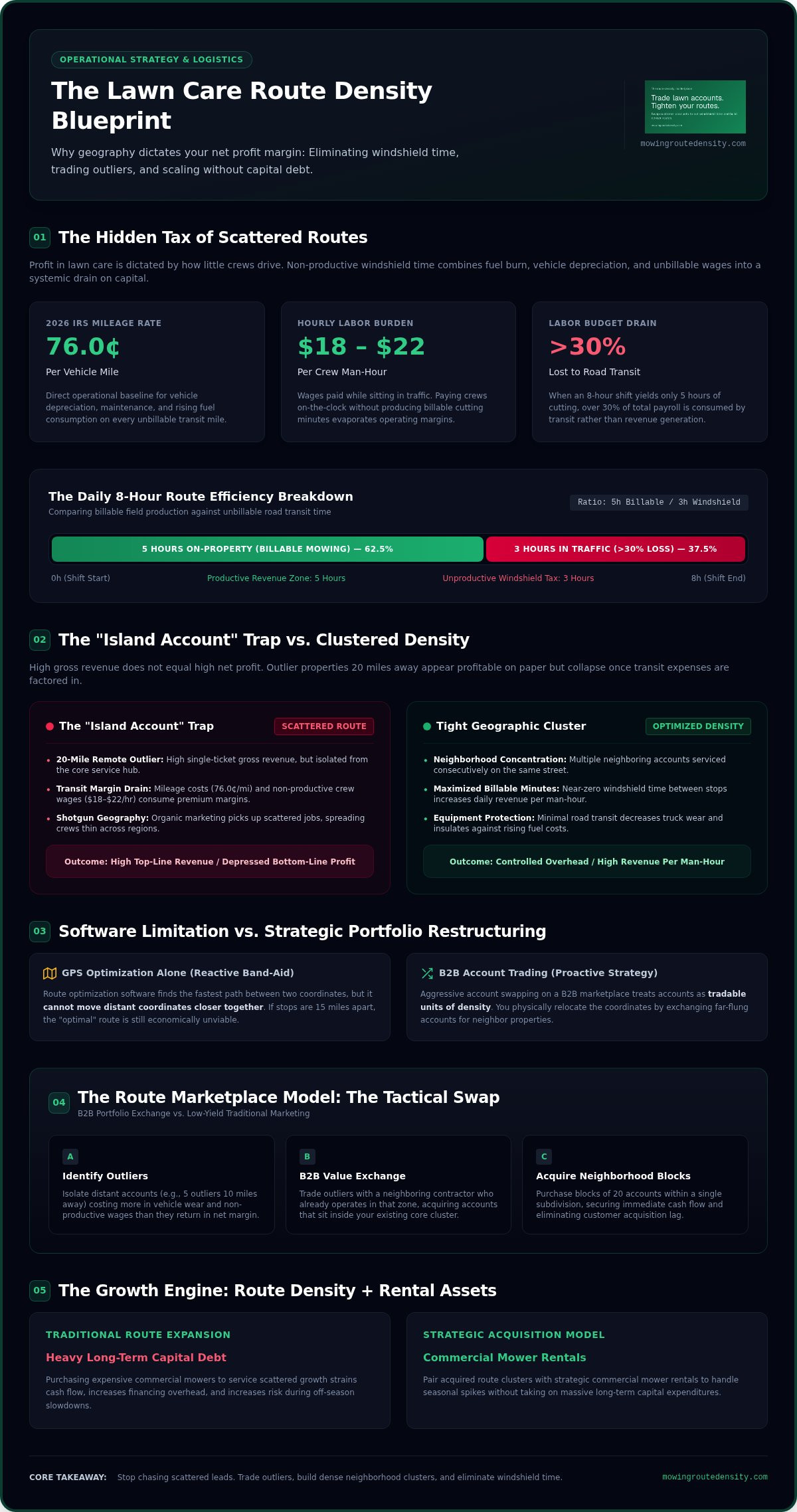
Profit in the lawn care industry isn't just about how fast your crew mows. It's about how little they drive. Route density is the only metric that truly matters for your bottom line. It's the ratio of billable hours to total on-clock hours. If your crew is on the clock for eight hours but only mows for five, your density is failing. You're losing over 30% of your labor budget to the road. This isn't just a scheduling hiccup. It's a systemic drain on your capital.
Windshield time is a direct tax on net profit margins. With the IRS standard business mileage rate set at 76.0 cents per mile for the second half of 2026, every mile counts. Combine that with labor costs averaging $18 to $22 per hour. You're paying for fuel, vehicle depreciation, and non-productive wages simultaneously. This is the hidden cost of a scattered route. Organic growth often makes this worse. You pick up a house here and a commercial lot there. Soon, your map looks like a shotgun blast. A lawn care route marketplace fixes this by allowing you to trade away the outliers for clustered growth.
The Math of Route Density
Most owners fall for the "island account" trap. They see a high-paying customer 20 miles away and think it's a win. It isn't. When you factor in the transit time, that premium price evaporates. High revenue doesn't mean high profit if the logistics are broken. Understanding lawn care route density transforms your P&L from a guessing game into a clinical operation. You stop looking at gross revenue and start looking at revenue per man-hour within a tight geographic radius. Tight routes mean less wear on your trucks and more billable minutes in the day.
Software vs. Strategy: Why You Need More Than a GPS
Optimization software is a popular band-aid. It can find the most efficient path between two points, but it can't move those points closer together. This is a classic vehicle routing problem that software alone cannot solve. If your accounts are 15 miles apart, the "best" route is still a losing one. True efficiency requires a proactive portfolio strategy. You must move from reactive scheduling to aggressive account swapping. Use a lawn care route marketplace to build tight clusters where crews can spend more time mowing and less time navigating. Tight clusters are the only way to insulate your business against rising fuel costs and labor shortages.
Decoding the Lawn Care Route Marketplace: Trading Accounts for Operational Efficiency
The traditional way to grow a lawn care business is slow and inefficient. You bid on individual leads. You hope they are close to your current route. They usually aren't. A lawn care route marketplace flips this model entirely. It isn't a B2C lead board where you fight for scraps. It's a B2B exchange. You aren't bidding against twenty hobbyists for a single yard. You're trading portfolios with other professionals. It's about liquidity; it's about turning scattered accounts into concentrated cash flow. You stop viewing accounts as fixed assets and start seeing them as tradable units of density.
Using a lawn account trading platform provides a tactical advantage that marketing alone cannot match. You can buy a block of twenty accounts in a single neighborhood, or you can sell the five outliers that cost you more in fuel than they pay in revenue. This is how you build a business that scales without breaking your equipment or burning out your crews. You choose the density. You control the overhead.
How Account Swapping Works
The "Swap" is the ultimate waste-cutting tool for the modern contractor. Imagine you have an account ten miles east of your core area. Your competitor has one ten miles west of theirs. You both lose money on travel; you both waste non-billable hours. By executing a value-for-value exchange, you both gain density. You both win. It's pragmatic. It's efficient. When evaluating a transfer, consult the SBA guide to buying an existing business to understand the nuances of asset transfer. Ensure your customer contracts include assignability clauses. Without them, your density is just a handshake. If you're ready to optimize, you can view available routes to find a match.
Who Uses a Route Marketplace?
Different operators use the lawn care route marketplace for different strategic ends. It serves as a clearinghouse for efficiency. The user base typically falls into three categories:
- Scaling Contractors: They seek immediate market share without the lead lag of SEO or direct mail.
- Retiring Owners: They use the platform as a clean exit strategy, selling their route in pieces to maximize total payout.
- Efficiency Experts: They "tighten" their perimeter by selling anything outside a five-mile radius and buying anything inside it.
This isn't about just getting more work. It's about getting the right work in the right place. Every account you add should make the next one cheaper to service. If it doesn't, you aren't growing; you're just getting busier.
Strategic Acquisition: Buying Existing Routes vs. Organic Lead Generation
Growth is a math problem. Most contractors try to solve it with marketing. They spend thousands on Google Ads and localized mailers. In 2026, the average Customer Acquisition Cost (CAC) for a single lawn account ranges from $100 to $250. That is roughly 25% to 33% of the first year contract value. Even worse, those leads are random. They pop up wherever the algorithm lands. You end up with a high grossing business that is logistically bankrupt. A lawn care route marketplace offers a different path. Instead of gambling on ads, you buy certainty. You acquire established revenue streams that are already geographically clustered.
The speed of growth is the primary differentiator. Organic marketing is a slow burn. It takes months to build a route from scratch. Buying a route segment provides immediate cash flow on day one. You skip the sales cycle. You skip the lead lag. To find potential partners for these transactions, smart operators use a lawn mowing service provider locator to identify businesses with overlapping service areas. This isn't just about getting bigger. It's about getting faster.
The Real Cost of Organic Growth
Organic leads are often "untested" liabilities. A new sign up has no service history with your crew. You don't know if they pay on time or if they'll churn after three mows. Purchased accounts come with data. You can see the billing history and the actual man hours required for the job. More importantly, organic growth is rarely dense. One new account five miles away adds non-billable transit time that eats your margin. Purchased accounts allow you to skip the "scattered" phase of business development. You move straight to the profit phase.
Buying for Density, Not Just Volume
Quantity is a vanity metric. Density is a sanity metric. When browsing a lawn care route marketplace, look for "anchor" accounts. These are high value properties or tight residential clusters that justify your presence in a neighborhood. Don't fall into the dilution trap. If a route increases your total footprint without adding density, it is a bad buy. Before signing any contract, you must adhere to due diligence legal standards to verify service records and payment history. Verify the churn rate. Verify the pricing consistency. If the math doesn't show a 20% to 25% increase in billable capacity through tighter clustering, walk away. You are buying profit, not just a list of names.
Due Diligence Framework: How to Value and Verify Marketplace Listings
Buying accounts is a gamble if you don't verify the data. A listing on a lawn care route marketplace might look perfect on paper. It's your job to prove it. You aren't just buying revenue; you're buying a logistics puzzle. If the pieces don't fit your current operation, you're buying a liability. Don't let a seller's "estimated" revenue blind you to the operational reality of the stops.
Start with equipment compatibility. Can your current fleet service these specific properties? If your 60 inch zero turn can't fit through the gates of a new residential cluster, you're looking at a capital expenditure that kills your immediate ROI. Next, check the contract terms. You want auto renewing service agreements, not handshake deals that evaporate the moment a new truck pulls into the driveway. Use a lawn care profit margin optimization framework to audit the target route. If the margin isn't there, the density won't save it.
The Verification Checklist
Don't take the seller's word for it. Demand proof of payment history for at least the last 12 months. High churn is a red flag that the customers are unhappy or the pricing is unsustainable. Request drive time maps. If the "cluster" requires crossing a major highway during rush hour, it isn't a cluster. It's a logistical nightmare. Confirm the handoff protocol. How will the seller introduce you to the clients? A cold handoff leads to a higher churn rate in the first 30 days. You need a structured transition to protect your investment.
Valuation Models for Lawn Routes
Valuation is where most contractors overpay. While many trade on revenue multiples, you should value based on Seller’s Discretionary Earnings (SDE). A tight route with a 30% net margin is worth a significantly higher multiple than a loose route with 15%. You're paying a premium for density, not just volume. Factor in the transition costs. If you need to hire a new technician or rent a mower to cover the new accounts, subtract those costs from your offer. The goal is to acquire profit, not just more work. If the numbers don't show a clear path to 20% growth in billable capacity, the price is too high.
Ready to audit a potential deal? Browse verified listings on our platform to find your next acquisition.
Scaling Without the Overhead: Integrating Rental Assets with Route Expansion
Traditional scaling is a trap. Most owners buy a $15,000 zero-turn and a $50,000 truck before they have the density to support the debt. That is a mistake. It is how businesses go under. A smarter, more clinical way exists. You use a lawn care route marketplace to secure the work first. Then you use rental assets to service it. This "asset-light" strategy keeps your balance sheet clean. It allows you to grow without the crushing weight of high-interest equipment loans during the critical first 90 days of an acquisition.
Integrating professional lawn equipment rental into your expansion plan provides a necessary buffer for seasonal spikes. Seasonal growth is unpredictable. Labor is expensive. Don't add a permanent monthly payment for a temporary increase in work. Industry benchmarks establish a 50% utilization threshold for equipment. If a specialized mower is used less than half the month, the total cost of ownership, including depreciation and insurance, exceeds rental costs. If you need a more permanent solution without the upfront hit, commercial lawn mower lease options offer a tactical middle ground. You protect your cash flow while you tighten your new route clusters.
Matching Mowers to Your New Marketplace Accounts
Every yard is different. You shouldn't use the same mower for a tight residential cluster that you use for a five-acre commercial lot. Renting gives you the flexibility to match the machine to the specific route you just acquired. It's a low-risk way to test route profitability. If the man-hours don't align with your projections, you haven't wasted capital on a machine you don't need. You also eliminate the cost of maintenance downtime. If a rental unit breaks, you swap it for a fresh one. Your crew stays on the schedule. Your billable hours remain protected. This is how you maintain a lean, high-output operation.
The 2026 Scaling Roadmap
Success in 2026 requires a surgical approach to expansion. Following a methodical path prevents the typical overhead bloat that kills landscaping margins.
- Step 1: Audit your existing density. Find the gaps in your schedule where crews are sitting idle.
- Step 2: Use the lawn care route marketplace to swap your outliers for accounts that fill those gaps.
- Step 3: Rent equipment to service the new clusters. Only commit to long-term debt when your route density justifies the purchase.
Tighten Your Perimeter and Protect Your Profits
Density is the only real hedge against rising costs. Every minute your crew spends in transit is a minute you aren't billing. You've seen the math. Traditional growth is too slow and too scattered. By using a lawn care route marketplace, you take control of your geography. You trade away the waste and buy the clusters that actually move the needle on your P&L. It's a clinical approach to a messy industry. You stop chasing leads and start acquiring certainties.
Mowing Route Density provides a secure B2B trading environment for contractors who value efficiency over vanity metrics. With our national network of professional contractors and integrated commercial equipment rental solutions, you can scale your operation without the typical overhead bloat. You don't need more trucks; you need better stops. You don't need more debt; you need more density. This framework allows you to dominate a territory without overextending your capital.
Stop letting windshield time eat your margins. Explore the National Lawn Care Route Marketplace today and start building a business that works as hard as you do. Your next high-density cluster is waiting. Build the route you actually want to service.
Frequently Asked Questions
Is it legal to buy and sell lawn care accounts?
Yes. Lawn care accounts are recognized as intangible assets under IRS Section 197. While the FTC's nationwide non-compete ban was struck down in 2024, restrictive covenants remain enforceable under sale of business exceptions in most states. You aren't just buying names; you're buying contracts and goodwill. Always verify that your service agreements include an assignability clause to ensure a smooth legal transfer. It's about protecting your investment from day one.
How much does a typical lawn care route cost in a marketplace?
Valuations in 2026 typically range from 0.4x to 0.8x trailing 12-month gross revenue for owner-operated routes. If the accounts are exclusively recurring maintenance with signed contracts, you might see multiples between 1.0x and 2.0x. Larger commercial operations with management teams often trade between 3.6x and 6.0x EBITDA. Density acts as a multiplier. A tight, clustered route always commands a higher premium than a scattered list of names.
What is the difference between a route swap and a route sale?
A route sale is a straight cash transaction for a portfolio of accounts. A swap is a tactical, value-for-value exchange between two contractors. Swapping is the ultimate tool for cutting operational waste. You trade your distant outlier accounts for properties that sit directly inside your existing routes. Both parties win by reducing windshield time and increasing billable hours without spending a dime on marketing or acquisition fees. It's pragmatic growth.
How do I handle the customer transition after buying a route?
Success depends on a structured handoff. Use a formal transition agreement that includes earn-out clauses. Paying 70% upfront and 30% after a 60 or 90 day retention milestone protects your investment against immediate churn. Have the seller send a formal introduction letter to every client. Consistency is key. Keeping the same service day and pricing during the first season prevents unnecessary friction and builds trust with your new accounts.
Can I buy just a few accounts to tighten my existing route?
Absolutely. Using a lawn care route marketplace for tactical purchases is a smart way to increase density. You don't need to buy a whole business to improve your margins. Acquiring even three or four accounts on a street where you already have a presence can cut your drive time per stop significantly. This targeted approach allows you to grow your billable capacity without adding the overhead of a new truck or crew.
How do I verify the revenue of a listing in a lawn care marketplace?
Don't trust verbal claims. Demand proof of payment history for the last 12 months and review the seller's tax records. Healthy routes maintain a retention rate between 75% and 85%. You should also audit the customer concentration. If more than 20% of the revenue comes from a single client, the risk of churn increases. Use drive-time maps to verify that the accounts are as clustered as the seller advertises. Verify everything.
Why should I rent equipment instead of buying it when expanding routes?
Renting protects your cash flow during the critical first phase of an acquisition. If your equipment utilization is below 50% for a specific machine, renting is more cost-effective than ownership. Ownership involves debt service, maintenance, and storage costs that eat your margins. Renting allows you to test the profitability of a new route segment before committing to long-term capital expenditures. It keeps your balance sheet lean and your operations flexible.


