
Software doesn't fix a bad route. It just draws a faster line between mistakes. You've seen the invoices for your SaaS subscriptions climb while your fuel costs hit $4.08 a gallon. If you're looking for lawn care routing software alternatives, you're likely tired of watching your crews spend more time behind the windshield than behind a mower. It's frustrating to pay for "optimization" that still leaves your accounts scattered across three counties. You know that software can't fix a fundamentally broken map.
There's a better way to build a profitable business. Density beats algorithms every single time. This article explores why traditional routing software often fails to deliver a real ROI. You'll discover how strategic route trading and asset-light equipment management provide a superior path to profitability. We'll show you how to reduce non-billable drive time, lower your overhead, and create a tight route that maximizes crew efficiency. It's time to stop chasing dots on a screen and start owning your territory.
Key Takeaways
- Stop using software as a band-aid for bad logistics. Learn why algorithms can't fix a scattered map or eliminate the "windshield time" trap that drains your profit.
- Leverage asset-light growth through lawn mower rental. Scale into new, high-density clusters without the long-term debt or geographic restrictions of equipment ownership.
- Trade your way to a tighter route. Discover how lawn care routing software alternatives like account trading platforms physically fix your geography instead of just managing it.
- Perform a ruthless operational audit. Identify accounts that cost more in fuel and vehicle wear than they pay in fees and learn the tactical way to cut them.
- Shift your business model from management to density. Understand how combining account swaps with flexible equipment creates a permanent path to superior margins.
The Software Band-Aid: Why Your Routing App Isn't Saving You Money
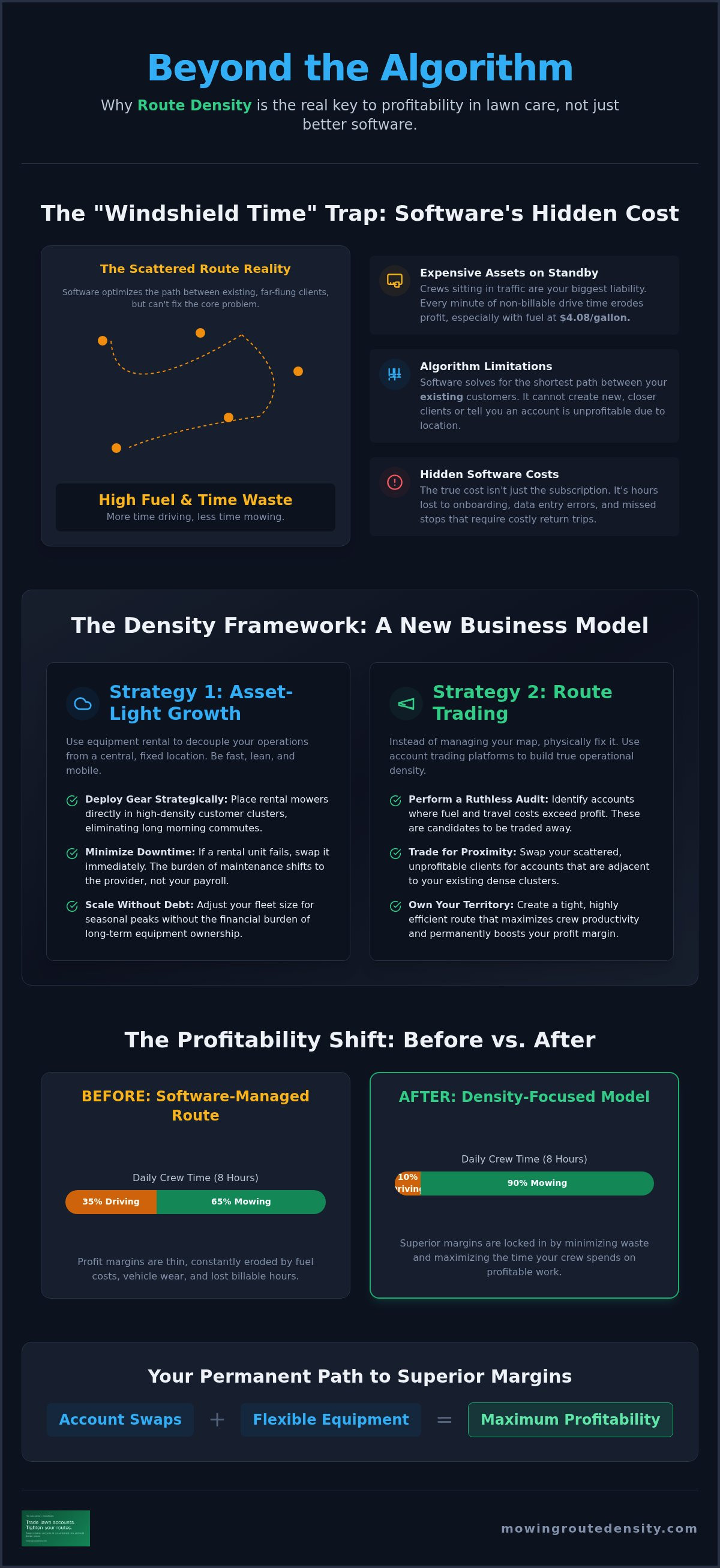
Software doesn't fix a broken business model. It just makes it more expensive to run. Many contractors search for lawn care routing software alternatives because they've realized a hard truth: an app can't move a house five miles closer to your last stop. You're paying for a digital map while your crews sit in gridlock. That is a losing game. With fuel costs hitting $4.08 per gallon in 2026, every minute spent behind the windshield is a direct hit to your profit margin. You aren't just losing fuel. You're losing billable hours, equipment longevity, and crew morale.
The "Windshield Time" trap is the silent killer of landscaping profits. Your most expensive asset is a crew sitting in a truck. If they're in traffic, they're a liability. If they're mowing, they're an asset. Software helps you manage the mess, but it doesn't clean it up. Adding another SaaS subscription to a thin margin is often just throwing good money after bad logistics. You need a tighter map, not a prettier interface.
The Limits of Algorithmic Optimization
Algorithms are designed to solve the Vehicle Routing Problem (VRP). This is a mathematical challenge of finding the most efficient path between a set of points. Here is the problem: the algorithm accepts your points as permanent. It prioritizes the shortest path between your existing customers, even if those customers are miles apart. It cannot create new, closer clients for you. It cannot tell you that a specific account is fundamentally unprofitable due to its location. Relying solely on software masks the underlying issue. Your business model needs physical density, not just digital math.
Hidden Costs of Traditional Routing Software
The price on the sales page is never the true cost. If you are evaluating lawn care routing software alternatives, consider the time lost to onboarding. Every hour a manager spends training a new hire on a complex interface is an hour not spent on quality control. Data entry errors are another drain. One wrong address or a missed gate code leads to a missed stop. That means a return trip, double the fuel, and an angry client. Most importantly, these apps don't integrate with physical asset management. They track where the mower is, but they don't help you scale into a new territory without the weight of long-term debt. Real efficiency requires a shift in how you acquire and service accounts.
Asset-Light Growth: Renting as a Routing Strategy
Ownership is a logistical anchor. It ties your expensive fleet to a single depot or garage. If your accounts are 20 miles away, your crew spends 90 minutes a day just hauling iron. That is "dead-head" time. It is unbillable. It is pure waste. In 2026, savvy contractors are evaluating professional lawn equipment rental as a core logistics strategy. This approach offers the geographic flexibility that fixed assets lack. You can scale your fleet for seasonal peaks without taking on five-year debt obligations that choke your cash flow during the off-season. It is about being fast, lean, and mobile.
Decoupling Equipment from Geography
Traditional routing software tries to optimize the path, but it can't shorten the distance from your shop to the first stop. When looking for lawn care routing software alternatives, consider the physical location of your gear. Renting allows you to deploy units directly into high-density clusters. You can store a rental unit in a local storage unit near your densest route. This eliminates the need for expensive, fuel-heavy trailers for every single crew. You can even use commercial lawn mower lease options to test a new territory for a few weeks. If the density isn't there, you walk away. This is a practical way to solve the Vehicle Routing Problem (VRP). You don't just calculate a better route. You change the physical starting point of the work day.
Maintenance and Downtime: The Efficiency Killers
Downtime is a profit killer. When a mower breaks down in a scattered route, your entire day is finished. The distance between stops makes recovery impossible. Rental units offer a guaranteed uptime that ownership can't match. If a machine fails, you swap it for a fresh one immediately. Rental maintenance shifts the burden of repair off your billable hours and back to the equipment provider. This keeps your crews moving and your schedule intact. It is a no-nonsense approach to scaling. If you're tired of the SaaS treadmill, exploring lawn mower rental is the tactical shift your balance sheet needs. It's about being asset-light and density-heavy.
Route Trading vs. Software: The Density Comparison
Software tries to find the best path between points you shouldn't have in the first place. Real efficiency comes from changing the points, not just the path. Trading an outlier account for one next door is the ultimate routing move. It's not just a digital tweak. It's a physical fix. By using a lawn account trading platform, you turn your client list into a tradable commodity. You gain the liquidity to shed waste and acquire density. This is the most powerful of all lawn care routing software alternatives because it eliminates the distance that algorithms can only try to manage.
The Mechanics of an Account Swap
Outlier accounts are the profit killers. They are the "one-offs" located ten minutes away from your main cluster. They drain your lawn care profit margin optimization efforts every single week. Stop keeping them out of habit or fear of losing revenue. Use a lawn mowing service provider locator to find a contractor who is already working that specific street. You swap your outlier for their outlier that sits in your backyard. The handoff is professional. You transfer the service contract, introduce the new provider, and walk away with a tighter map. It's a tactical maneuver that software can't replicate.
The Math of Density
Compare two scenarios. Crew A has 50 accounts spread over 20 miles. Crew B has 40 accounts on a single block. Crew A has higher top-line revenue, but Crew B has higher bottom-line profit. Crew A spends hours trying to find optimal routes for multiple vehicles just to keep up with the windshield time. Crew B doesn't need an algorithm. They park the truck once and mow. While a scattered route might net a 10% margin, an optimized, dense route can hit 25%. The smaller, tighter route often yields a 30% higher net profit because it slashes non-billable labor and fuel costs. Route Density is the only metric that truly matters in 2026.
This isn't about working harder. It's about working closer. When your accounts are clustered, your equipment lasts longer. Your fuel bill drops. Your crews aren't exhausted from fighting traffic. You don't need a faster van. You need a better map.
Operational Audit: Is Your Business Model the Real Problem?
Stop staring at your software dashboard. Look at your map with a critical eye. If your accounts look like a shotgun blast across the county, no amount of digital optimization will save you. Many owners search for lawn care routing software alternatives because they've reached a breaking point with overhead. The reality is often uncomfortable. Your business model might be the problem. It is time for a tough love audit. You must identify and cut accounts that cost more in fuel, labor, and vehicle wear than they pay in service fees. If an account is an island, it is a liability.
Tightening your routes now is also about your future value. When you eventually prepare a lawn care business exit strategy, potential buyers won't value a scattered list of names. They value density. They want a tight route where a crew spends the day mowing, not driving. A dense route is a liquid asset. A scattered route is just a collection of expensive logistical hurdles. Use your data to decide where to stop marketing and where to start trading.
Analyzing Your Billable vs. Non-Billable Hours
Efficiency starts the moment the truck leaves the shop. Track your crew's time meticulously. While mobile field service software like Repair-CRM helps digitize day-to-day operations and team tracking, you must also pay close attention to where drive hours accumulate. You aren't just paying for the time the blades are spinning. You're paying for every red light and traffic jam. Follow the 15-Minute Rule. If the drive time to an account is longer than the actual mow time, you're losing money on that property. Every non-billable minute is a drain on your net profit. Identify your geographic sweet spot. This is the area where your travel time is minimal. Protect it fiercely. If a lead falls outside that circle, don't take it.
Strategic Subcontracting for Outliers
Sometimes you have a high-value client that is simply too far away. Don't drive there yourself. Instead, learn how to find lawn care subcontractors who are already working in that area. This allows you to maintain your brand standards and client relationships while removing the logistical overhead from your own fleet. Using B2B locators to manage overflow and distance is a strategic move. It keeps your core crews focused on your high-density clusters. You stop fighting the map and start making it work for you. If you're ready to stop the waste and start building real density, it's time to audit your route map today.
The Mowing Route Density Alternative: A New Framework
Most contractors are stuck on a treadmill. They buy more ads, sign more scattered clients, and then buy more software to manage the mess. Mowing Route Density is the pivot. It isn't just a platform. It is a strategic shift from managing chaos to creating order. By integrating rental equipment with traded routes, you achieve a level of efficiency that software alone cannot touch. This is one of the most effective lawn care routing software alternatives because it addresses the physical reality of your business. Stop hustling for every lead. Start strategizing for every mile.
The Power of the Marketplace
Our account trading platform creates a liquid market for landscaping contracts. Traditionally, you were stuck with whatever accounts you signed, regardless of where they were located. Now, you can swap them. Contractors who trade accounts grow faster than those who only buy ads. Trading gives you immediate density. You don't have to wait for a neighbor to see your yard sign or find you on a search engine. You find a partner through the locator tool and exchange your outliers for their clusters. It is a win-win that slashes drive time overnight. You aren't just adding revenue. You are subtracting waste. This is the ultimate way to use lawn care routing software alternatives to your advantage.
Building a Lean, Asset-Light Fleet
Don't be "equipment rich and cash poor." Owning a massive fleet of mowers and trailers feels like success until the repair bills and insurance premiums arrive. A lean model uses rental equipment to stay mobile. Rental allows you to pivot your business geography in days, not years. If you trade into a new, dense cluster across town, you don't need to haul gear back and forth. You rent a unit, store it locally, and start billing. This flexibility is the core of the Mowing Route Density framework. It's about maximizing your net profit per man-hour without the weight of long-term debt. You stay fast. You stay profitable.
The first step toward a better business is an honest audit. Print your route map. Circle your clusters. Look at the isolated dots that are killing your margins and draining your fuel tank. Those dots are your trading chips. Find your first swap and start tightening your map. Audit your density today and stop paying for software to manage your logistical mistakes.
Stop Managing Waste and Start Building Density
Software won't move houses closer together. It only draws lines between them. If you want real profitability in 2026, you need to change the physical map. We've explored how asset-light rental strategies and account trading provide the geographic density that algorithms lack. These lawn care routing software alternatives aren't just tools. They represent a fundamental shift in how you scale a landscaping business. It's about owning a territory, not just a list of addresses.
By leveraging a specialized B2B marketplace for contractors, you can swap unbillable windshield time for actual billable hours. Our commercial-grade equipment rental network ensures you stay mobile and flexible without the burden of long-term debt. It is time to stop the "hustle" and start the strategy. Audit your current route. Identify your outliers. Trade for the density your bottom line deserves. Focus on operational efficiency and watch your margins climb.
Optimize your profit margins by trading for better route density on our platform today.
You've built the business. Now, make it efficient. Your future profitability depends on the tightness of your routes, not the complexity of your apps. Build a business that works for you.
Frequently Asked Questions
Is lawn care routing software worth the cost for small businesses?
Software is rarely worth the investment if your accounts are miles apart. Small businesses often find that monthly SaaS fees eat into thin margins without fixing the underlying logistics. While apps can draw a faster line between stops, they can't eliminate the physics of distance. Instead of paying for digital maps, many owners look for lawn care routing software alternatives that physically tighten their territory through account trading or strategic rental placement.
What is the best way to increase route density without buying new leads?
Account trading is the most efficient way to increase density without spending a dime on marketing. By swapping an outlier account with another contractor who is already working in that neighborhood, you gain proximity without the cost of customer acquisition. This "neighbor-for-neighbor" swap ensures that your crew spends less time in traffic and more time on the grass. It is a pragmatic fix for a scattered map that delivers immediate results.
How does account trading work in the lawn care industry?
Account trading functions as a B2B marketplace where contractors list accounts that are geographically inconvenient. You find a partner through a platform like Mowing Route Density and propose a swap for an account that sits within your existing clusters. Once both parties agree on the value, you facilitate a professional handoff of the service contracts. It turns your client list into a liquid asset that improves your operational efficiency and bottom-line profit.
Can I rent commercial lawn mowers for an entire season?
Yes, commercial mower rental is a viable strategy for handling seasonal peaks or testing new territories. Renting allows you to scale your fleet without the long-term debt of a five-year lease or a major capital purchase. It keeps your business asset-light and mobile. You can deploy rental units directly into high-density zones, storing them locally to eliminate the need for hauling heavy trailers across the county every single day.
What are the biggest hidden costs in a scattered lawn care route?
The primary hidden costs are unbillable labor and excessive vehicle wear. When your crew is stuck in traffic, you are paying for their time but generating zero revenue. Fuel costs, which reached $4.08 per gallon in 2026, also drain your profit. Additionally, the constant stop-and-go driving of a scattered route accelerates engine wear and tire replacement. These "invisible" drains often exceed the cost of the actual mowing service you provide.
Should I sell my outlier accounts or try to hire a subcontractor?
Trading or selling is usually the better move for long-term profitability. Hiring a subcontractor requires constant management, quality control, and administrative overhead that can outweigh the marginal profit of a distant account. By trading that outlier for an account closer to your shop, you simplify your logistics and increase your net margin. It is better to have a smaller, tighter route than a large, unmanageable one that requires constant babysitting.
How do I value a lawn care route if I want to swap or sell it?
Route value is determined by a combination of recurring revenue and geographic density. An account that sits in the middle of your existing route is worth significantly more to you than a high-revenue account ten miles away. When swapping, look at the "drive time per dollar" ratio. A tight cluster of accounts is a premium asset because it maximizes billable hours. Valuation should focus on how much profit stays in your pocket after fuel and labor.
What is the difference between route optimization and route density?
Route optimization is about finding the best path between existing points, while route density is about how close those points are to each other. Optimization is a software fix that tries to make a bad route slightly better. Density is a business model fix that eliminates the need for complex optimization in the first place. You don't need a sophisticated algorithm when all your accounts are on the same three blocks. Density wins every time.


