

Scaling to three or four crews is often the fastest way to go broke. It looks like growth on paper, but without a specific framework, it’s just a larger drain on your bank account. You feel the weight of managing people more than the grass. It’s exhausting. With diesel prices hitting $5.85 per gallon, every minute your trucks spend idling in traffic is profit you will never see again. You aren't alone in realizing that managing multiple lawn care crews effectively is a logistical puzzle that usually eats your margins before the weekend hits.
We know the frustration of equipment failure stalling a crew and the headache of non-billable drive time. It doesn't have to be this way. This article provides the tactical framework to stop the hemorrhaging and scale with clinical precision. You will learn how to achieve operational density that reduces drive time by 30% and keeps your teams moving without constant supervision. We are breaking down the shift from being a reactive boss to an efficient strategist with a self-managing field operation that prioritizes the bottom line over busy work.
Key Takeaways
- Growth is a liability when it lacks logic. Identify the "invisible leaks" like non-billable drive time that turn expansion into a financial drain.
- Prioritize the tightest route over the biggest contract. Density is the only metric that solves the problem of rising fuel and labor costs in 2026.
- Implement a tactical field framework for managing multiple lawn care crews effectively by using standardized load-out checklists and "no-office" communication rules.
- Scale without the debt. Use commercial mower rentals to handle seasonal peaks and keep your field teams moving without massive capital expenditure.
- Trade to tighten. Learn how an account marketplace allows you to swap distant contracts for local ones to build a truly efficient, high-margin portfolio.
The Scale Trap: Why Managing Multiple Crews Often Erases Profits
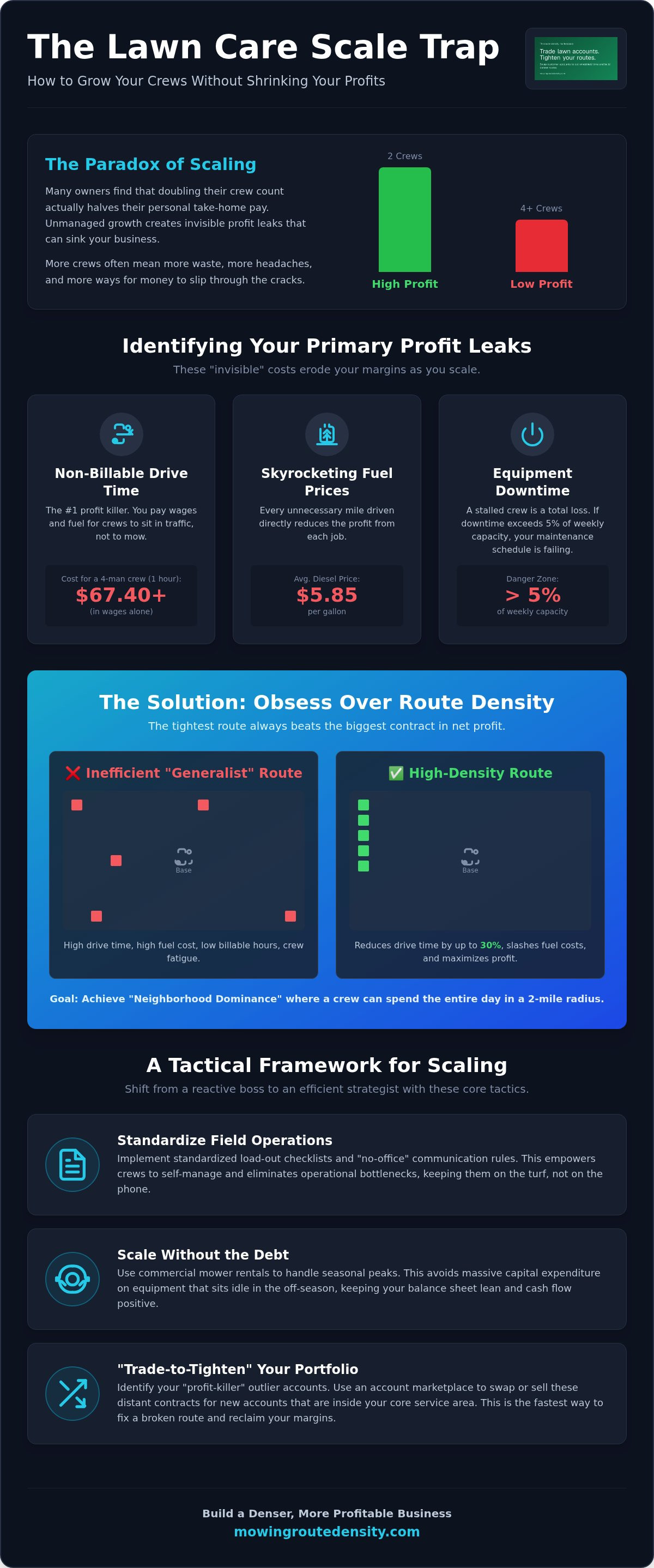
Scaling feels like winning until the monthly bank statement arrives. Many owners find that doubling their crew count actually halves their personal take-home pay. It’s a trap. Growth does not always equal profit. In fact, more crews often just mean more waste, more headaches, and more ways for money to slip through the cracks. If your overhead is growing faster than your billable hours, you aren't building a business; you're building a liability. Realizing that managing multiple lawn care crews effectively is a logistics challenge, not just a labor challenge, is the first step toward actual growth.
Identifying Your Primary Profit Leaks
You need to look at your numbers with clinical precision. Start with fuel consumption versus acreage mowed across all teams. If Crew A uses 20% more fuel than Crew B to service the same amount of turf, you have a density problem. The "Invisible Leak" is windshield time. For a four-man crew earning the 2026 average of $16.85 per hour, one hour of drive time costs you $67.40 in wages alone. Add $5.85 per gallon for diesel, and that single hour of non-billable time becomes a silent killer. In the wider landscape maintenance industry, these leaks are what separate the survivors from the statistics. Stop guessing. Evaluate your equipment downtime as a percentage of your weekly capacity. If it's more than 5%, your maintenance schedule is failing your bottom line.
The Myth of Infinite Scalability
The "one more truck" philosophy is a dangerous gamble. It assumes that more assets automatically lead to more profit. It’s false. Managing five crews is fundamentally different from managing two. At two crews, you can still touch every job. At five, you are a logistics coordinator. If those five crews are scattered across the map like a generalist operation, your logistics will eventually collapse under their own weight. You must prioritize lawn care profit margin optimization before adding that next vehicle to the fleet. Ask yourself: is your route tight enough to support another team, or are you just buying a very expensive way to sit in traffic? Density is the only way to scale without drowning in debt.
Optimizing Route Density: The Key to Crew Productivity
Managing multiple lawn care crews effectively depends on one metric: route density. This is the concentration of accounts within a tight geographic radius. Most owners focus on the "big" contract. They chase a high-dollar site twenty miles away. That is a tactical mistake. The tightest route always beats the biggest route in net profit. Why? Because you aren't paying your crew to sit in a truck. You're paying them to mow. Every mile driven is a direct deduction from your bottom line. Shrink the map to grow the profit. If you want to see how an established residential and commercial provider highlights service reliability and operational standards, visit Yardworx Lawn & Landscape.
Clustering Accounts for Zero-Waste Logistics
Aim for neighborhood dominance. Your goal is a two-mile radius where a crew can spend the entire day. The math is simple. Two accounts on the same street are worth more than four accounts scattered across town. When you reduce travel, you maximize billable hours. This is a core pillar of lawn care route density. It reduces crew fatigue. It slashes fuel costs. It keeps your equipment on the turf instead of on a trailer. If you are starting a landscaping business or scaling an existing one, density must be your obsession. It turns a chaotic schedule into a predictable, high-margin machine.
Trading Low-Density Accounts for Strategic Growth
Identify your profit-killers. These are the "service-area outliers" that take forty minutes to reach. They feel like revenue. They are actually debt. You must learn the psychology of letting go. Selling a client list isn't a failure; it’s a strategic move to reclaim your margin. Use a lawn account trading platform to swap these disparate clients for accounts that fit your existing clusters. Sell the outlier to a competitor who is already in that neighborhood. Use that cash to buy an account on your core street. This "trade-to-tighten" strategy is the fastest way to fix a broken route. If you want to stop the bleed, you can explore our marketplace to start optimizing your portfolio today. Leveraging a marketplace allows you to acquire accounts that fit your crew's current path, ensuring every minute on the clock is spent producing revenue.
Tactical Asset Management: Keeping Crews Moving Without the Debt
Owning twenty commercial mowers in 2026 isn't a sign of success. It's often a sign of poor capital management. High-interest loans and depreciation eat your margin while the machines sit in the shop. If you want to succeed at managing multiple lawn care crews effectively, you need to adopt an asset-light mindset. This means prioritizing cash flow over titles. Every piece of iron on your trailer must be producing billable hours, not just collecting dust and interest. Your growth should be powered by productivity, not by the size of your equipment debt.
Standardize your fleet immediately. Every crew member should be able to operate every machine without a learning curve. This simplicity is vital for streamlining essential tasks like training and field repairs. When a mower goes down, don't let the crew sit idle. Implement a "Swap-and-Go" strategy. Have a backup unit ready or use a local partner to get a replacement on-site within the hour. A broken machine is a $60 per hour drain on your labor budget. You can't afford to pay a three-man crew to watch a mechanic work. Keep a spare or have a rental on speed dial.
Commercial Mower Rental vs. Ownership
Stop looking at rental as a last resort. It’s a strategic tool for scaling. Compare the cost of a high-interest equipment loan to a flexible professional lawn equipment rental. With rental, you outsource the maintenance. You don't pay for shop time, parts, or a full-time mechanic. You only pay for the machine when it's earning you money. This is how you scale for "The Push" in spring without carrying that overhead through the slow months. You get the latest commercial-grade tech without the long-term debt or the maintenance headaches.
Flexible Leasing for Asset-Light Growth
Cash is king. Using commercial lawn mower lease options allows you to preserve your capital for marketing and labor. It lets you match your equipment expenses directly to your contract revenue. If a contract ends, you aren't stuck with the bill for a machine you no longer need. This approach eliminates the "Winter Drain" where idle machinery bleeds your bank account dry during the off-season. Managing multiple lawn care crews effectively requires you to be a financial strategist as much as a field boss. Keep your assets lean and your crews moving.
Building a Scalable Field Operations Framework
Managing multiple lawn care crews effectively requires a system that functions without your constant input. You aren't a babysitter. You are a strategist. If you still answer every equipment question or gate code inquiry, you haven't scaled; you've just multiplied your stress. A scalable framework is built on four clinical steps that remove the owner from the day-to-day friction of field logistics.
Step 1: Establish standardized "Load-Out" and "Return" checklists. A forgotten trimmer or a dull blade is a $70 mistake in lost labor and fuel. It’s a preventable leak. Step 2: Implement a "No-Office" communication rule. Use field management tools for all dispatching and site-specific updates. Step 3: Track "Square Footage per Man-Hour" as your primary KPI. This metric cuts through the noise of contract size and focuses on raw efficiency. Step 4: Create a tiered crew leader system. Decentralize decision-making so your senior leads mentor junior leads and solve problems before they ever reach your desk.
Communication Protocols That Eliminate Friction
Morning chaos is a choice. It’s the result of poor planning and a lack of clear protocols. Digital dispatch and site-specific notes remove the "where do I go next?" friction that stalls crews at the shop. Implement the "Three-Minute Rule." If a field issue, like a broken belt or a locked gate, takes more than three minutes to solve, the lead reports it immediately. No tinkering. No guessing. This empowers your leads with real-time data and keeps the owner focused on high-level growth rather than gate codes.
Performance Metrics That Actually Matter
Revenue per hour is a vanity metric. It’s misleading because it often ignores the cost of non-billable drive time and the $5.85 per gallon diesel cost you're eating in 2026. You need raw data on equipment utilization. If a mower is strapped to a trailer for half the day, it's a liability, not an asset. Use your field data to identify which teams are struggling and which need more lawn care route optimization. Managing multiple lawn care crews effectively means looking past vanity numbers to find the real profit. If you're ready to tighten your operations and reclaim your margins, explore our marketplace tools to see how density changes your bottom line.
Scaling Your Portfolio with Mowing Route Density
Managing multiple lawn care crews effectively requires a shift in how you view your service area. You aren't just a service provider; you are a territory manager. You've identified the leaks in your labor budget and standardized your field protocols. Now you must consolidate your portfolio. Our platform facilitates the "Trade-to-Tighten" strategy. This is the final phase of operational maturity. Stop chasing every lead that calls your office. Start trading the accounts that don't fit your density map for the ones that do. Refine the map to maximize the margin.
Leveraging the Account Trading Marketplace
List your outliers today. Find high-density account clusters that fit your existing routes. The marketplace provides the security of a dedicated B2B environment. You aren't just offloading a client list; you're optimizing a territory. Acquiring a cluster of accounts in a specific zone justifies the cost of a new crew instantly. It removes the "guesswork" of expansion. When you buy accounts that are already grouped, you eliminate the ramp-up period where a new crew usually bleeds cash. Trade the distant contracts. Buy the neighboring ones. Win the neighborhood.
On-Demand Equipment for National Scale
Rapid mobilization is a competitive advantage. National contractors use our rental network to scale without the typical capital risk. They don't wait for financing approvals. They don't buy trailers and mowers for a short-term seasonal contract. They access professional-grade mowers on-demand to keep crews operational during peak demand. This ensures your teams always have the latest, most efficient deck sizes for the specific turf they are cutting. Efficiency is found in the right tool for the specific job, not just the tool you happen to own.
Joining a B2B network through our lawn mowing service provider locator connects you with the assets and partners needed for clinical expansion. The final step in this framework is psychological. Move from crew manager to strategic business owner. Owners don't mow. Owners don't fix trailers. Owners manage density and assets. If you want to stop the profit bleed and start scaling with precision, you need to optimize your routes and rent your fleet today.
Mastering the Logistics of Scale
Scaling doesn't have to mean working more for less. By focusing on operational density and asset-light growth, you move from being a reactive manager to a strategic owner. Managing multiple lawn care crews effectively requires you to cut the "invisible leaks" like non-billable drive time and high-interest equipment debt. Stop letting your profit evaporate on the highway. Instead, use a secure B2B account marketplace to trade outliers for high-density clusters and leverage commercial-grade mower rentals to handle peak demand without the permanent overhead.
Our national contractor network is designed to help you mobilize fast and stay efficient. It’s time to stop fighting the logistics and start winning the neighborhood. You have the tactical framework; now you need the tools to execute with clinical precision and protect your margins. Reclaim your time and your cash flow by making data-driven decisions that prioritize density over raw crew count. Ready to transform your field operations into a high-margin machine? Optimize Your Crew Density and Rent Commercial Mowers Now. Your bottom line will thank you.
Frequently Asked Questions
How do I know when it is time to add a second or third lawn care crew?
You should add a crew only when your current teams hit 90% capacity within a specific, tight geographic cluster. Don't scale just because your phone is ringing. If those new leads are scattered across the map, they will destroy your margin. Wait until you have enough work in a single neighborhood to justify the fuel and labor costs. Scaling too early leads to profit-killing drive time and unnecessary debt.
What is the most effective way to track crew productivity in the field?
The only metric that matters is "Square Footage per Man-Hour" combined with GPS drive-time data. You must compare billable time against non-billable windshield time to see if a crew is actually profitable. Digital field management tools provide this data in real time. This removes the guesswork. It allows you to hold teams accountable for their pace and identifies which routes need to be tightened or traded.
Is it better to buy or rent commercial lawn mowers when scaling?
Renting is the superior choice for asset-light growth in 2026. It allows you to scale for seasonal peaks without carrying high-interest debt or maintenance costs through the winter. Rental mowers ensure your crews always have modern, efficient equipment. This strategy matches your equipment expenses directly to your contract revenue. It preserves your cash flow for labor and marketing instead of tying it up in depreciating iron.
How can I reduce drive time without losing my best customers?
You don't have to fire a customer; you can swap them. Use a B2B account trading platform to exchange distant clients with other professional contractors who are already working in that neighborhood. This maintains service quality for the client while radically improving your route density. It is a strategic move that reduces fuel consumption and wear on your vehicles. Trading outliers is the fastest way to fix a broken route.
What KPIs should I use to manage multiple lawn care crews effectively?
Focus on three primary KPIs: Square Footage per Man-Hour, Revenue per Mile Driven, and Equipment Utilization Rate. These metrics reveal if you are managing multiple lawn care crews effectively or if your overhead is eating your profits. Tracking revenue alone is a vanity move. You must track the cost of reaching the job to see the real margin. High revenue with low density is just a fast way to go broke.
Can I swap lawn care accounts with competitors to improve my route density?
Yes, swapping accounts is a strategic necessity for high-density operations. Professional B2B marketplaces allow you to list outliers and acquire accounts that fit your core routes. This isn't just about offloading clients; it's about territory consolidation. It turns a scattered list into a profitable, defensible neighborhood cluster. Swapping allows you to grow your footprint without increasing your drive time or fuel budget.
How do I manage equipment maintenance for a large fleet of mowers?
Standardize your equipment and outsource the heavy lifting. If you use commercial rentals, the provider handles the major maintenance and shop time. For owned assets, implement strict daily load-out and return checklists to prevent small issues from becoming catastrophic failures. A "Swap-and-Go" strategy ensures crews never sit idle. If a machine breaks, replace it with a backup or a rental immediately to keep the crew moving.
What should be included in a lawn care crew leader job description?
A crew leader is a logistics coordinator, not just a lead mower. Their description must include:
- Executing daily load-out and return checklists to prevent equipment loss.
- Managing on-site efficiency and safety protocols.
- Reporting field issues within a strict "Three-Minute Rule" to minimize downtime.
- Tracking and submitting crew performance data through digital tools.
- Mentoring junior staff to ensure standardized service quality across all properties.


