

Your highest hourly rate is a vanity metric if your mowers spend more time on a trailer than on a property. Most contractors focus on the bid price while ignoring the logistical rot that kills their bottom line. You know the frustration. Fuel prices are volatile; maintenance costs are climbing; and startups are low-balling contracts they don't even understand. It's a race to the bottom that leaves you working harder for less money.
We agree that the industry status quo is broken. You shouldn't have to choose between winning a contract and making a profit. This commercial lawn care pricing guide is designed to help you stop guessing and start engineering your margins. We'll show you how to master route density and equipment overhead to reclaim your billable hours. High-density routes aren't a luxury. They're a survival requirement.
You'll learn a repeatable bidding framework that accounts for real-world logistics. We will explore how to cut fuel costs by tightening your service area and how to use asset-light equipment strategies to stay competitive without drowning in debt. It is time to treat your route like a puzzle and your equipment like a tool for profit, not just a line item on a balance sheet.
Key Takeaways
- Stop basing bids on market averages that ignore your specific operational costs and logistical drains.
- Follow this commercial lawn care pricing guide to calculate a real hourly rate that includes the "hidden tax" of drive time and equipment maintenance.
- Leverage commercial lawn mower rental to scale your fleet without the burden of high-interest debt or long-term depreciation.
- Maximize profitability by bidding for route density, prioritizing jobs that increase billable stops per square mile over high-value scattered accounts.
- Optimize your portfolio by using an account trading platform to swap inefficient properties for accounts that fit your core service area.
The Commercial Pricing Trap: Why Market Averages Fail Contractors
Basing your business on what the competition charges is a quick way to go broke. It's a common trap. You see a national average or hear a rumor about a neighbor's bid and assume that's the market rate. It isn't. National averages for the lawn care industry in the United States don't account for your specific overhead, your debt, or your route density. If your competitor has a paid-off fleet and you're carrying high-interest notes, their "profitable" price is your bankruptcy.
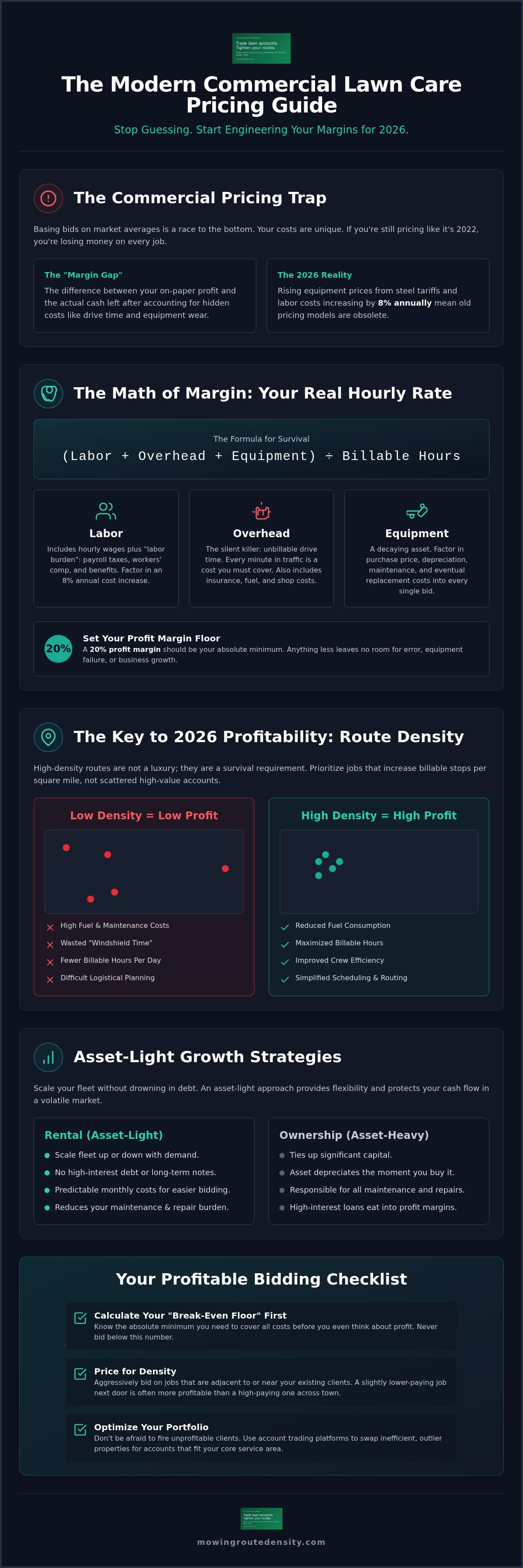
In 2026, the baseline has shifted. Tariffs on imported steel have pushed equipment prices higher. Labor costs are rising by 8% annually. If you're still pricing like it's 2022, you're losing money on every mow. You must identify your "Break-Even Floor" before you bid. This is the absolute minimum dollar amount required to cover labor, fuel, insurance, and equipment depreciation. This commercial lawn care pricing guide helps you find that floor so you stop donating your time to property managers.
B2B vs. B2C Pricing Dynamics
Residential mows are one-off transactions. B2B contracts are logistics partnerships. Commercial clients prioritize Service Level Agreements (SLAs) over the lowest price. They need to know the property will look perfect for their tenants every Tuesday morning. Established operators like Performance Lawns, INC build long-term relationships by focusing on dependable quality rather than competing in a race to the bottom. Reliability is a currency. Stability in a long-term contract allows you to plan your cash flow; however, it also means you're locked into a price. If that price doesn't account for 2026 inflation, your stability becomes a financial cage.
The True Cost of 'Cheap' Bids
Low-balling doesn't just hurt your current bank account. It destroys your future. When you bid too low, you can't afford professional-grade equipment maintenance. You start skipping oil changes. You delay blade sharpening. Soon, your equipment fails, and you're out of the game. Beware of "portfolio builders." These are high-profile properties that offer low pay for the "prestige" of the account. Prestige doesn't pay the lease on a commercial mower. The Margin Gap is the difference between your perceived profit on paper and the actual cash remaining after accounting for unbillable drive time and equipment wear.
The Math of Margin: Calculating Your Real Hourly Rate
Profit is a calculation, not a feeling. If you aren't tracking every dollar of overhead, you're just guessing. Drive time is the silent killer of your bottom line. It's unbillable labor. Every minute your crew sits in traffic is a minute you pay for without generating revenue. This is a core pillar of any America's SBDC guide to setting prices. You must account for the "hidden tax" of windshield time before you ever set a blade to grass. If your route is scattered, your hourly rate needs to be significantly higher to cover the gaps.
Think about your equipment life cycle. A commercial zero-turn isn't just a purchase; it's a decaying asset. You need to factor in maintenance and replacement costs into your hourly rate. If you don't, you'll reach the end of the machine's life and realize you haven't saved enough to buy the next one. Set a 20% profit margin as your absolute floor. Anything less leaves no room for error, equipment failure, or business growth. This commercial lawn care pricing guide is about building a business that lasts, not just one that pays the bills this month.
The Commercial Pricing Formula
This is the formula for survival: (Labor + Overhead + Equipment) / Billable Hours. Billable hours are the key. If your crew works 40 hours but only mows for 30, your overhead must cover those 10 missing hours. Fuel consumption is another critical variable. In 2026, fuel prices for commercial logistics remain volatile. A heavy-duty mower can consume significant gallons per hour under load. High-traffic commercial sites often require off-peak hours or specific noise-mitigation strategies. These aren't just inconveniences; they are billable events. Adjust your rates for complex terrain or high-traffic sites where productivity slows down.
Managing Labor Burden in 2026
Labor burden in 2026 is about more than just hourly wages. It includes payroll taxes, workers' comp, and benefits. With labor costs rising by 8% annually, your pricing must be proactive. Turnover is expensive. Training a new operator for specialized commercial work can cost thousands in lost productivity. Review our lawn care profit margin optimization guide for deeper audit steps. To keep these costs manageable, many contractors use commercial lawn mower rental to scale their fleet without the massive upfront capital and maintenance labor of owning every unit.
Asset-Light Growth: Rental vs. Ownership in Your Pricing
Owning a massive fleet feels like success until the monthly loan payments arrive. High-interest equipment loans are a debt trap. They lock you into a rigid pricing structure that leaves no room for negotiation. You can't lower your bids to win strategic accounts because your fixed costs are too high. You're working for the bank, not yourself. Rental changes the math. It turns a massive, terrifying fixed cost into a predictable variable expense.
Using "Other People's Machinery" (OPM) through commercial lawn mower rental allows you to scale based on actual revenue, not credit limits. When you bid a job using rented gear, you treat the rental fee as a direct job cost. You build it into the quote. This ensures the client pays for the equipment wear and tear. Your bank account stays protected. This commercial lawn care pricing guide emphasizes that your equipment strategy is your pricing strategy. If your gear is flexible, your business is resilient.
There is hidden profit in renting. You aren't paying a mechanic to fix a broken spindle. You aren't stocking spare belts or hydraulic fluid. If a machine goes down, you swap it for a fresh one. Your billable hours stay high while your maintenance labor stays at zero. Profit is protected by agility, not by a yard full of aging, depreciating steel.
Ownership Costs vs. Rental Flexibility
Depreciation for commercial zero-turns in 2026 is aggressive. Machines lose value the moment they leave the dealer. Academic research, such as the University of Missouri Extension on pricing strategies, highlights that understanding the shift from fixed to variable costs is vital for business health. Renting turns a liability into a tactical advantage. You can rent specialized gear for a specific six-month contract and return it when the work is done. Check our guide on commercial lawn mower lease options to see how this fits your fleet management plan.
Keeping Your Fleet Nimble
Peak season shouldn't mean a permanent increase in your overhead. You need more mowers in May than you do in October. Why pay for them all year? An asset-light strategy means you only pay for the capacity you actually use. Downtime is the enemy. Rental swap-outs ensure your crews stay on the grass, not sitting in the shop waiting for parts. An Asset-Light strategy is a business model that prioritizes operational agility and cash flow by minimizing owned capital assets in favor of flexible, on-demand resources.
Pricing for Density: The Key to 2026 Profitability
Driving is a drain on your business. A high-priced contract located 20 miles away from your core route is a financial trap. It looks good on a spreadsheet, but it's a fool's errand. Route density is the number of billable stops per square mile. It's the single most important metric for your bottom line. If you want to master this commercial lawn care pricing guide, you have to stop chasing dollar amounts and start chasing proximity. A lower-priced job next door to your current anchor account is always more profitable than a high-ticket outlier.
The Math of Proximity
Every minute your crew spends in the truck is a minute you aren't billing. Cutting just 10 minutes of drive time per stop across a standard crew schedule adds up to hundreds of unbillable hours saved per year. That's straight profit. Tight geographic clustering reduces fuel consumption and slows down equipment wear. It keeps your mowers on the grass and your trucks off the highway. This level of efficiency is the only way to maintain a pricing floor that competitors can't touch. Read the full guide on lawn care route density to see the tactical breakdown of these savings.
Trading Your Way to Profit
Some accounts are toxic. They aren't bad clients, but their location makes them unprofitable. If an account is an outlier, get rid of it. You can swap these "toxic" accounts for properties that fit your core route. Use a lawn account trading platform to find contractors who are looking for exactly what you have. When you value a lawn care account for a trade, don't just look at the contract value. Look at the logistical fit. A $10,000 contract that is 30 miles away is worth less to you than a $7,000 contract that shares a fence with your existing client.
The "Cluster Strategy" is your secret weapon. Bid aggressively for properties adjacent to your current anchors. You can afford to bid lower because your marginal cost to service the neighbor is almost zero. You're already there. Your equipment is already off the trailer. This strategy allows you to dominate specific business parks or commercial corridors while maintaining elite margins. To start optimizing your territory today, browse our lawn account trading platform to find properties that fit your map.
Scaling the Strategy: Subcontracting and National Networks
Strategic Capacity Management
Know your numbers. If an account is inside your high-density cluster, use commercial lawn mower rental to scale up and keep the work in-house. If the property is an outlier, find a subcontractor. It's a simple choice between operational control and logistical waste. Quality control is the only real hurdle. You must vet your partners and set clear expectations. Check out our guide on how to find lawn care subcontractors to build a reliable network. Scaling should feel like a strategy, not a crisis.
Preparing for Liquidity
Your business is an investment. One day, you will want to sell it. Buyers in 2026 aren't looking for a list of names; they are looking for a machine that produces predictable profit. Dense, logically routed accounts fetch the highest premiums. A buyer would rather have 50 accounts in one zip code than 100 accounts spread across the state. Logic equals liquidity. Start planning your lawn care business exit strategy now by tightening your routes today. Efficiency is the ultimate selling point for any professional buyer.
Stop guessing your rates and start engineering your profit. Optimize your route and rent professional gear today to build a business that is built to last.
Stop Chasing Revenue and Start Engineering Profit
The 2026 market doesn't reward the busiest contractor. It rewards the most efficient one. If you've followed this commercial lawn care pricing guide, you now understand that profit is won in the miles between stops, not just the minutes on the grass. You've seen how "windshield time" drains your bank account and how high-interest equipment debt kills your flexibility. It's time to stop guessing and start tightening your operations. Every unbillable mile is a leak in your bucket.
Tighten your routes by swapping outliers for local anchors. Scale your fleet without the burden of depreciation by leveraging professional-grade equipment on demand. By focusing on route density and asset-light growth, you build a business that's resilient, scalable, and ready for a high-value exit. We've built the tools to help you get there. You can scale your business with our commercial mower rentals and route trading platform today. Our specialized B2B marketplace, national route optimization network, and professional-grade equipment inventory are designed to put your mowers exactly where they belong: on the grass, making you money. Don't let your margins leak out of your gas tank. Get lean, get dense, and get profitable.
Frequently Asked Questions
How much should I charge per hour for commercial lawn care in 2026?
Most professional landscape companies charge between $75 and $100 per man-hour in 2026. This rate must cover your fully burdened labor costs, insurance, and equipment depreciation. Don't guess based on what the guy down the street charges. Your specific overhead and route density determine your required rate. If you spend significant time driving between accounts, your hourly rate on the property must be higher to maintain your 20% profit floor.
Is it better to price commercial lawn care by the acre or by the hour?
Acreage pricing is more effective for large, open commercial sites, while hourly rates are better for high-detail properties. For properties between 1 and 5 acres, industry rates typically fall between $50 and $150 per acre. For larger sites over 5 acres, the price often drops to $25 to $60 per acre. Always verify your production rates with your specific equipment. This ensures your per-acre bid actually covers your billable time requirements.
How do I factor fuel costs into my commercial bidding process?
Calculate fuel as a direct job cost by tracking the gallons per hour your mowers consume under load. Commercial mowers are high-performance machines that require significant fuel. Don't treat this as a vague overhead expense. Estimate the total hours on site and multiply by your average fuel burn rate. If prices are volatile, include a fuel surcharge clause in your contract. This protects your margins when logistics costs spike during the season. For broader operational savings across your business facilities and fleet, learn more about Fleetmaxx Solutions to cut energy procurement costs.
Can I use a lawn account trading platform to improve my route density?
Yes, you can use a lawn account trading platform to swap distant accounts for properties that sit closer to your core route. This is the fastest way to fix a scattered, unprofitable map. Trading allows you to build clusters of accounts in a single geographic area. It reduces non-billable drive time and lowers your fuel consumption per stop. High density is the secret to making a lower bid more profitable than a high-priced outlier.
What is the average profit margin for a commercial landscaping business?
A 20% net profit margin is the bare minimum for a sustainable business in 2026. High-performing contractors often reach 30% or more by aggressively optimizing their route density. If your margins are lower, you won't have the cash to replace equipment or handle labor cost increases. Use a commercial lawn care pricing guide to audit your overhead. Efficiency is the only way to protect your bottom line from rising equipment and labor expenses.
How does commercial lawn mower rental affect my pricing strategy?
Renting allows you to turn a fixed capital expense into a variable job cost that you can pass to the client. When you utilize commercial lawn mower rental, you build the rental fee directly into your bid. This keeps your fleet nimble and your balance sheet clean. You avoid the "debt trap" of high-interest loans and the hidden costs of maintenance labor. It's an asset-light strategy that keeps your pricing competitive and your cash flow stable.
What should be included in a commercial lawn care service agreement?
How do I compete with lower-priced competitors without cutting my rates?
Compete on operational reliability and specialized expertise rather than price. Startups often bid low because they don't understand their real overhead. They will eventually fail when their equipment breaks. Highlight your professional-grade fleet and your ability to meet strict corporate SLAs. Use a service provider locator to demonstrate your capacity for large-scale work. If a competitor's bid is below your break-even floor, let them take the loss while you focus on profitable accounts.


