

What if your next step in growing a landscaping business isn’t buying another mower or taking on every customer who calls? An asset-light model for landscaping business growth lets you match equipment and customer volume to demonstrated demand instead of tying up cash in assets and overhead too soon. Ownership can provide control, but underused equipment still commits capital. More accounts can bring in work, but scattered routes and stretched crews can erode service quality.
It’s worth weighing flexibility against reliability. Renting equipment can help you add capacity without owning every machine, while buying or swapping lawn service accounts can change your workload and route density. The key is to stay in control of scheduling, service standards, and the decisions that affect your margins. This 2026 guide explains how the model works, compares ownership, rental, and account strategies, and shows how to plan around cash flow and billable work. You’ll also see how commercial mower rentals and a lawn account trading platform can fit into a practical growth plan.
Key Takeaways
- An asset-light model for landscaping business growth means securing the resources needed for paid work without assuming every asset must be owned.
- Compare ownership, rental, and hybrid approaches by control, cash commitment, flexibility, and how consistently equipment gets used.
- Test the model in steps: baseline current assets, forecast demand, compare access options, then track utilization and service consistency.
- Keep equipment decisions separate from customer-account decisions. Each affects capacity and route workload in different ways.
- Commercial mower rentals and lawn account trading can help you adjust equipment access and customer volume.
What an asset-light model means for a landscaping business
An asset-light model for landscaping business operations limits the equipment and other resources a contractor owns while maintaining dependable access to what paid work requires. Ownership is one way to secure capacity, not the only way. A contractor might own core mowers, rent equipment for a temporary increase in workload, or acquire and sell lawn accounts as route needs change.
Asset-light doesn’t mean asset-free, debt-free, or automatically more profitable. Renting can bring scheduling constraints and recurring commitments. Owning can provide more direct control, but equipment that sits idle still ties up capital and needs upkeep. The right mix depends on demand, utilization, route design, and customer service expectations. To understand what counts as an asset, Asset provides a basic overview of categories that include fixed and current assets.
Which landscaping assets shape the operating model?
Resources play different roles. Physical assets help crews complete work; customer relationships generate work and shape where it happens. Consider each category separately:
- Mowers and equipment: These affect job capacity and can be owned, rented, or combined according to expected use.
- Customer accounts: They represent recurring work and influence route density, workload, and revenue potential. Buying, selling, or swapping accounts can change customer volume without changing the equipment itself.
- Crews and vehicles: Labor capacity and transportation affect how much work a business can complete and how efficiently teams move between jobs.
- Operating systems: Scheduling, communication, and recordkeeping help coordinate resources and maintain consistent service.
The goal isn’t to reduce ownership across every category. A business may choose to own equipment it uses steadily while keeping other capacity flexible. Operational control comes from managing the work, crew assignments, and customer expectations, not just from owning every machine or account.
Why contractors consider asset-light operations
Equipment purchases can tie up capital before demand shows that a machine will be used often enough. That money may be needed for other operating priorities, such as labor, vehicles, or business systems. But avoiding ownership at all costs isn’t a strategy either. If equipment access is unreliable or poorly timed, crews can lose productive hours and service can suffer.
When demand is uncertain or seasonal, flexibility is worth evaluating. A contractor expecting a temporary increase in work can compare renting with buying equipment that may sit idle later. Account growth calls for the same scrutiny: additional customers can bring in work, but they also add route and capacity demands. The practical test is whether the business can meet demand reliably while balancing cash commitments with service standards. Asset-light is a way to make that decision deliberately, not a shortcut around operating discipline.
How equipment access and lawn accounts work together
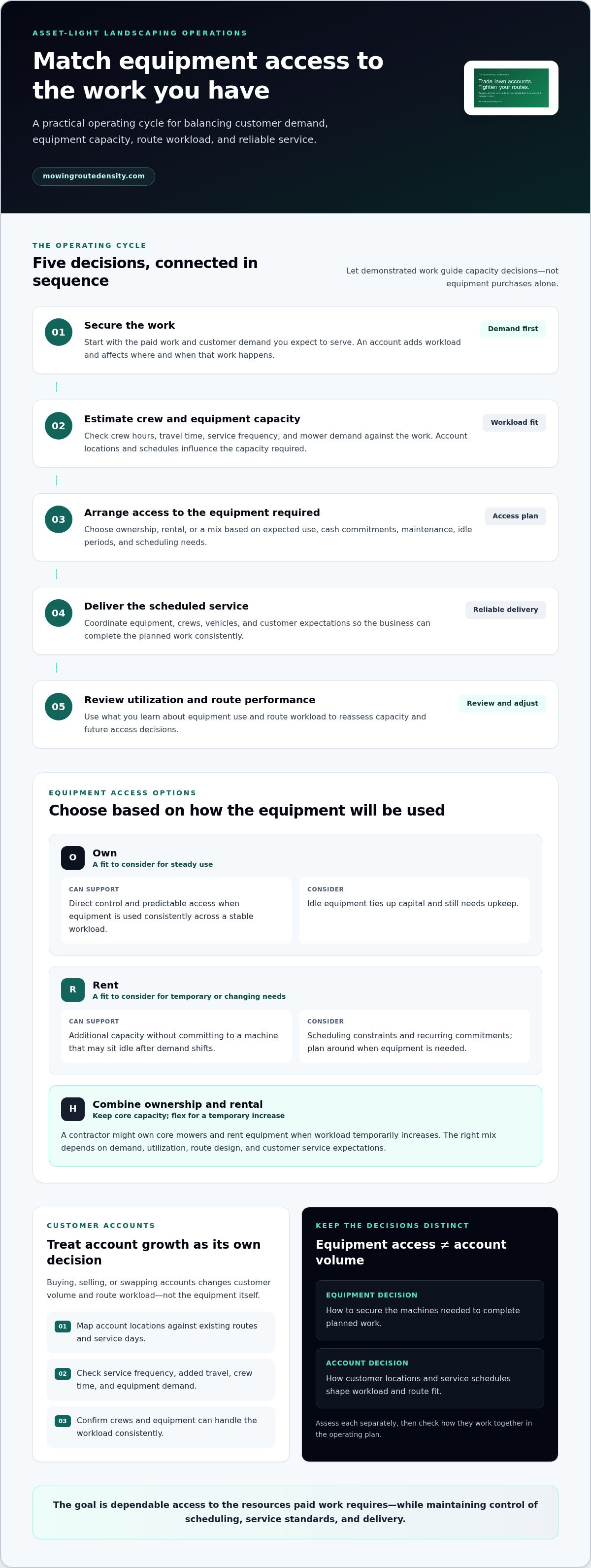
Equipment decisions make sense in the context of the work they support. A practical operating cycle is to secure work, estimate crew and equipment capacity, arrange access to the machines required, deliver service, then review utilization and route performance. This helps prevent a new account from automatically triggering a purchase and ties rental decisions to actual demand.
Assess equipment capacity and account volume together. Account locations and service frequency shape crew hours, travel time, and mower demand, while equipment access determines how much scheduled work the business can reliably complete. That’s the operating logic behind an asset-light business model: access can support growth, but the contractor still has to manage delivery.
Match equipment access to actual work
Start with expected use. Equipment used consistently across a stable workload may justify ownership, especially when direct control and predictable access matter. Rental can suit temporary demand or a changing equipment need, without committing to a machine that may sit idle once the work shifts. Compare maintenance responsibilities, idle periods, scheduling needs, and available cash before choosing. Renting is another way to access equipment, but it still requires planning around when you need it.
For a closer look at how contractors can weigh these factors, use this professional lawn equipment rental framework as part of your decision.
Match account growth to route capacity
An account changes more than the customer count. Its location affects travel between stops, its service frequency affects the calendar, and its workload affects crew time and equipment demand. Buying or swapping accounts can add work that fits an existing route, or create extra travel that uses capacity without improving the day’s schedule. More accounts don’t automatically mean better utilization or stronger margins.
Before taking on a group of customers, map where the work falls and how it fits existing service days. Then check whether your crews and equipment can handle the added workload consistently. A lawn care route density guide can help frame that review.
In an asset-light model for landscaping business plan, make equipment access and account growth separate decisions, then assess how they work together. Mowing Route Density provides commercial mower and equipment rentals alongside a platform to buy, sell, or swap lawn service accounts. Explore equipment rental and lawn account options as tools for adjusting capacity, while continuing to manage schedules, crews, and service standards.
Ownership, rental, and hybrid models: what does asset-light really trade off?
Asset-light can shift costs and constraints, not eliminate them. Renting may reduce the need to own equipment for occasional work, but it can bring scheduling limits, rental terms, and less direct control over access. Ownership provides more control over when a machine is used, but requires capital and maintenance. A hybrid approach combines both. Compare how each option supports your actual workload and service commitments, rather than choosing the label that sounds leanest.
| Approach | Control | Cash commitment | Flexibility | Utilization |
|---|---|---|---|---|
| Ownership | Direct control over equipment access and scheduling | Capital is committed to the equipment, with ongoing maintenance responsibilities | Less adaptable if equipment needs change | Can suit equipment used consistently; idle time still matters |
| Rental | Access depends on rental arrangements and equipment availability | Commitment is tied to rental use and terms | Can adjust access as needs change | Worth assessing for variable demand or limited-use needs |
| Hybrid | Direct control over core equipment, with some access arranged as needed | Combines owned-asset responsibilities with rental commitments | Balances a stable base with adjustable capacity | Can reserve owned equipment for regular work and use rentals for peaks |
These are trade-offs, not guarantees. Rental terms, access, maintenance arrangements, and the consequences of a machine being unavailable all affect whether an option supports reliable service. An asset-light model for landscaping business that works on paper still has to work on the schedule.
When ownership may fit the work
High, predictable utilization is a reason to evaluate ownership, not a universal rule. A machine used regularly may give a contractor more control over access and scheduling, helping protect planned work. Weigh that control against the capital tied up, maintenance duties, storage, and periods when equipment may sit idle. Tax, financing, and accounting treatment depend on the business and should be reviewed with a qualified professional.
When rental or a hybrid approach may fit
Rental may be worth assessing when workload changes, a contractor is testing demand, or capacity needs rise temporarily. One option is to own core equipment used for recurring work and rent for variable needs. That mix still takes planning: estimate when equipment is needed, account for rental terms, and avoid promising work around access you haven’t secured.
For example, a contractor expecting a short-term increase in scheduled jobs could compare renting for that period with owning equipment that might be underused afterward. Neither option is automatically cheaper or safer. Review expected utilization, service reliability, and the business’s ability to handle constraints before committing. Keep the decision tied to work the crew can deliver consistently.
A practical framework for testing an asset-light landscaping model
Don’t change your equipment strategy based on a busy week or a rough guess about next season. Test one defined change against a clear baseline. The goal is to learn whether flexible access supports the work without creating scheduling gaps, idle capacity, or inconsistent service. Separate observed data from assumptions, and write down what you expect to happen before the test begins.
- Baseline current assets. Record which equipment you own, how often crews use it, maintenance downtime, capacity limits, and recurring operating commitments. Note where equipment shortages or idle periods already affect work.
- Forecast demand. Review scheduled and likely work for the period you’re planning. Separate confirmed jobs from prospects, and account for customer volume, service frequency, crew capacity, and route workload.
- Compare access options. For the specific equipment need, compare ownership, rental, or a mix. Consider expected use, idle time, maintenance responsibility, cash needs, access terms, and how a delay could affect scheduled service.
- Test one change. Choose one defined workload or equipment need. Set a review period and avoid changing several parts of the operation at once. That makes it easier to identify what caused the result.
- Review and adjust. Compare the test with your baseline. Keep, revise, or reverse the change based on operating results, not on the label “asset-light.”
Set a baseline before changing the model
Use business records rather than memory. Track equipment use and downtime, recurring commitments, customer volume, and how work is distributed across existing routes. Note any capacity constraints that force schedule changes or limit the jobs crews can complete. These observations give you a practical comparison point and help distinguish an operating improvement from a demand spike you would have experienced anyway.
For a wider view of how operating decisions relate to profitability, use this lawn care profit margin optimization guide alongside your own records.
Run a controlled test and review the result
Choose a specific equipment need or workload, then define what success and disruption would look like before starting. Review the same measures during the test and against your baseline. Equipment utilization, idle time, billable hours, route workload, interruptions, and service consistency can show whether flexibility is working. If access creates scheduling gaps or equipment is poorly used, adjust the mix before expanding the approach.
That’s how to evaluate an asset-light model for landscaping business operations: measure what changed, account for what didn’t, and protect reliable service while you learn. To explore equipment access and customer-account options for a controlled test, view mower rentals and lawn account trading options.
Put the asset-light strategy into practice with equipment and account options
Turn the operating plan into two separate decisions: how to access equipment for scheduled work, and whether customer-account growth fits your route and crew capacity. The decisions affect each other, but they aren’t the same. A new account doesn’t automatically justify another mower, and equipment access doesn’t make every available account a good fit.
Mowing Route Density provides commercial mower and equipment rentals for lawn care professionals, plus a platform to buy, sell, or swap lawn service accounts. These resources can support an asset-light strategy, while your workload and operating plan determine how they fit. Profitability, route fit, and service outcomes depend on the contractor’s ability to deliver consistently.
Use equipment rental to address a defined capacity need
Start with the workload you’ve documented, then identify the specific capacity gap. Is existing equipment heavily utilized, or is a machine needed only for a limited period or a changing workload? Rental can address a defined need without adding equipment that might sit idle later. Factor access arrangements into the schedule, and don’t build a service commitment around equipment you haven’t secured.
Use the commercial mower lease options guide to consider how equipment access fits into an asset-light growth plan. Ground the decision in your utilization records and work requirements, not in a general assumption that renting is always more flexible or owning is always more reliable.
Use account trading as a deliberate growth decision
Buying, selling, or swapping lawn service accounts changes the contractor’s customer base and can reshape the work the business needs to deliver. Treat an account transaction as a capacity decision as well as a customer decision. Before adding or adjusting work to the schedule, consider whether it fits available crew time, equipment access, and planned routes.
A lawn account trading platform helps contractors pursue those transactions, but the platform doesn’t determine whether a particular account fits the business. That remains an operating judgment. Tie account growth to a plan for delivering the work, rather than treating a larger customer list as proof of stronger performance.
The practical order is clear: identify the capacity need, choose the relevant equipment or account option, then evaluate how it affects actual operations. Mowing Route Density brings contractor-focused equipment rentals and lawn account trading together as resources for these distinct decisions. Explore contractor-focused equipment and account options to put the strategy into practice.
Make flexibility part of your growth plan
Build your next decision around a clear operating trigger. For example, decide what change in workload would prompt you to reassess equipment access or customer volume. This gives the asset-light model for landscaping business a practical role in ongoing planning instead of making it a one-time choice. Revisit the plan as demand changes, and keep the measure simple: can your business take on suitable work and deliver it consistently?
Mowing Route Density’s contractor-focused resources connect equipment access and customer growth through commercial mower and equipment rentals, a platform for buying, selling, or swapping lawn service accounts, and a provider locator that connects customers with lawn mowing companies. These tools support operating decisions, but don’t replace sound planning.
Choose the capacity question you need to solve next, then explore the tools that fit. Explore equipment rental and lawn account options to plan your next growth step around work you can deliver consistently.
Frequently Asked Questions
What is an asset-light model for a landscaping business?
An asset-light model for a landscaping business limits owned equipment and operating capacity while arranging access to the resources needed to serve customers. A contractor might keep a mower used on regular routes, rent extra equipment for a defined workload, and adjust customer accounts separately. It doesn’t mean owning nothing or guaranteeing higher margins. Judge the approach by whether equipment access, crew capacity, and service commitments line up in actual operations.
Is renting equipment always cheaper than buying it for a landscaping business?
No. The better fit depends on how often equipment is used, how long it’s needed, maintenance responsibilities, rental terms, and the value of having it ready when work is scheduled. For example, compare a machine used across recurring jobs with one needed occasionally. Include possible downtime and scheduling disruption in the comparison. Use your business records rather than assuming ownership or rental will cost less.
Can a small landscaping business grow without owning all its equipment?
Yes, a small contractor can evaluate growth that combines owned equipment with rental access. Start with booked work and identify the specific capacity gap, such as needing another mower for a defined stretch of jobs. Then consider whether crews, scheduling, and equipment access can support that work reliably. Flexible access can support a growth plan, but it won’t replace planning the workload and service delivery.
How do lawn care accounts affect an asset-light business model?
Accounts shape how much work a contractor must complete, how often it’s due, and where crews need to travel. An account that fits an existing service schedule uses capacity differently from one that adds travel or falls on an already full day. Buying, selling, or swapping accounts changes the customer base, but account volume alone doesn’t show whether the added work fits available crews and equipment.
What happens if rented equipment is unavailable when a crew needs it?
An equipment gap can delay jobs, disrupt the schedule, or affect customer service. Reduce that risk by planning access around the work calendar instead of treating rental as an automatic backup. Consider when equipment is needed, which jobs depend on it, and what schedule adjustments are possible if access falls through. During a rental test, record interruptions and their effects so your decision reflects field conditions.
How do I measure whether an asset-light strategy is working?
Compare a defined test with your normal operating baseline. Track equipment use, idle time, maintenance downtime, and whether billable hours or scheduled work are affected. Also note route workload, service consistency, and commitments tied to each access choice. Record results as they occur instead of relying on memory at the end of the test. This makes the trade-offs easier to see.
Is an asset-light landscaping business the same as a business with no assets?
No. Asset-light describes how a business balances ownership with access, not a rule to own nothing. A contractor may retain equipment used regularly and arrange other capacity as needs change. The same principle can apply to operating resources beyond machinery, but each decision should support the work the business performs. Consider utilization, cash priorities, service obligations, and the level of control needed before changing how a resource is secured.


