
Most lawn care contractors are starving on a diet of high-volume, low-margin residential leads. They believe more clicks will solve their cash flow problems. They're wrong. Chasing scattered residential accounts is a fast track to burnout and broken equipment. Effective lawn care lead generation B2B isn't about buying more generic digital ads; it's about owning your geography. You're likely tired of watching profit disappear into a fuel tank while your mowers sit idle between 20-minute drives. It's a logistical nightmare. It's a waste of labor. It's a drain on your sanity.
You deserve a business that scales without doubling your overhead. This article promises to show you how to stop the inefficient marketing approach that keeps you small. You'll learn how to acquire high-density B2B accounts through strategic route trading and network leverage. We're breaking down the exact mechanics of building a concentrated commercial route, utilizing service provider locators to find national partners, and scaling your fleet with commercial rentals. It's time to trade your scattered leads for predictable, high-margin revenue and asset-light growth.
Key Takeaways
- Prioritize geographic density over lead volume to cut fuel waste and maximize billable hours per crew.
- Use account trading as a tactical lawn care lead generation B2B tool to swap outlier jobs for high-value commercial clusters.
- Leverage B2B locators to build long-term partnerships with national property managers instead of paying for low-quality clicks.
- Scale your fleet through commercial mower rentals to fulfill major contracts without taking on high-interest equipment debt.
- Audit your current routes to identify logistical drains and trade away accounts that don't fit your core service area.
The Economics of B2B Lead Generation: Why Density Wins
Stop thinking about "getting your name out there." That's residential thinking. It's expensive. It's inefficient. Lead generation in the B2B sector isn't about casting a wide net; it's about surgical acquisition. For contractors in 2026, lawn care lead generation B2B is the targeted process of securing high-value, recurring commercial contracts that keep your crews on-site and off the road. You don't need more calls. You need the right calls.
Traditional marketing focuses on volume. It counts clicks. It celebrates "leads" without looking at the map. This is a fundamental mistake. A lead is just a possibility. An account is a commitment. Strategic lead generation ignores vanity metrics and prioritizes logistics. If a new lead doesn't fit into a cluster of existing work, it isn't a growth opportunity. It's a liability that drains your resources.
Defining the B2B Lawn Care Marketplace
The B2B world doesn't care about your "family-owned" story. Facility managers care about uptime, reliability, and risk mitigation. Residential leads are one-off transactions. B2B accounts are long-term partnerships. Securing a commercial contract requires a professional pitch, detailed service level agreements, and the right equipment. It's a different game with different rules.
Profitability in this space depends entirely on lawn care route density. You don't get paid to drive. You get paid to mow. A crew that spends four hours a day in traffic is a crew that's losing you money. B2B contracts allow you to park the truck once and bill for eight hours. That's how you scale without burning out your team or your fleet.
The Cost of "Bad" Leads: Drive Time and Overhead
Every mile your truck travels costs you. Fuel. Wear and tear. Labor. Insurance. If you accept a lead that sits 20 miles away from your core route, you're paying for the privilege of working there. You might see a high top-line number on the invoice, but your bank account will tell a different story. "Free" leads are often the most expensive ones you'll ever find.
Real success comes through lawn care profit margin optimization. This means saying no to outlier leads. It means building geographic hubs where your crews can move from one commercial property to the next without ever hitting the highway. In 2026, lawn care lead generation B2B must be synonymous with density. If you aren't clustering your work, you're just a delivery driver who happens to own a mower.
Route Trading: The "Secret" B2B Lead Generation Strategy
Stop waiting for Google Ads to deliver. Most contractors treat marketing as an expense. It should be a trade. In the world of lawn care lead generation B2B, the fastest way to grow isn't buying clicks; it's buying routes. Why spend $150 on a lead that might not close when you can buy a guaranteed contract that's already on your street? Buying an existing account eliminates the uncertainty of the sales funnel. You aren't pitching; you're taking over. It's the most efficient way to scale without the headache of cold calling.
Route trading allows you to swap your logistical "dead zones" for profitable hubs. According to landscaping industry employment data, the sheer volume of workers in this sector means there's a massive, fragmented market of accounts changing hands every day. You can use a lawn account trading platform to find these opportunities. It's instant density. No six-month SEO wait. No bidding wars. Just immediate billable hours that start the moment you park the truck.
How to Buy Mowing Routes Safely
Don't buy blind. You need a process. First, audit the route for geographic proximity. If it adds more than ten minutes of drive time to your current hub, walk away. Second, verify the contract terms. Look at payment history and renewal dates. You want recurring revenue, not a one-time cleanup. Third, use a secure platform to facilitate the transfer. Route liquidity is the ability to convert your existing accounts into cash or better-located jobs without losing value. If you want to see what's available in your area, check out the listings at Mowing Route Density.
Account Swapping for Operational Efficiency
Every contractor has an "outlier." It's that one B2B account that's 20 minutes away from everything else. It kills your profit. Stop keeping it out of pride. Connect with a competitor who already works in that area. Swap your outlier for one of theirs that sits in your core territory. It's a win-win. This is the concept of marginal utility. Every new B2B lead must increase your density, not just your revenue. Effective lawn care lead generation B2B is about tightening the circle around your hub. If it doesn't tighten your route, it's a lead you don't want. Tight routes win. Scattered routes go broke.
Leveraging B2B Locators vs. Pay-Per-Lead Sites
Stop throwing money at pay-per-call sites that send you unvetted "tire kickers." Pay-per-lead is a gambling habit, not a business strategy. In the world of lawn care lead generation B2B, quantity is the enemy of profit. Generic lead sites thrive on selling the same low-quality phone call to five different contractors. They don't care about your route density or your crew's efficiency. They only care about the transaction. B2B locators operate on a completely different logic. They connect professionals with property managers who need reliable, long-term partners, not just a one-time mow.
Strategic growth requires being visible where the big players look. Using a lawn mowing service provider locator positions your business in front of national facility owners and REIT managers. These clients aren't looking for the lowest bid on a single lawn. They're looking for a contractor who can handle multi-site commercial portfolios. This visibility leads to high-density clusters of work that pay better and last longer than any residential lead ever could.
Why Locators Outperform Generic Lead Sites
Locators build trust through pre-vetted networks. When a facility manager uses a locator, their intent is clear: they want a professional. They aren't looking for a "cheap quote" from anyone with a trailer. They're looking for a partner. Generic sites are built for one-time transactions that disappear the moment the check clears. Locators facilitate long-term B2B relationships. These platforms prioritize your credentials and your service area, ensuring the leads you get actually fit your operational footprint. It's about quality over noise, whether it's the precision of your landscaping or the elegance of a corporate banquet featuring table linens from Table Terrain.
Don't overlook the power of subcontracting. It's a low-risk gateway into the commercial market. Large national firms often use locators to find reliable lawn care subcontractors to fulfill massive project requirements. This is your chance to piggyback on their sales efforts. You get the benefit of a high-volume B2B contract without the overhead of a six-month sales cycle. Focus on these high-volume national project partners to keep your crews busy and your revenue predictable. Work smarter by letting the national firms handle the high-level bidding while you dominate the local execution.
Scaling B2B Operations with Asset-Light Rental Strategies
Winning a massive commercial contract is a victory. Buying three new zero-turns to service it is a risk. Many contractors suffocate their growth by tethering themselves to five-year equipment loans before the first check clears. It's a mistake. Effective lawn care lead generation B2B creates sudden capacity needs. If you don't have the assets to fulfill the work, you lose the account. But if you buy the assets outright, you kill your cash flow. The solution is simple: stay lean.
Asset-light growth is about speed. It's about agility. You can utilize professional lawn equipment rental to match the specific demands of a new site without the long-term liability. Maybe you need a wide-area mower for a corporate campus but only for the peak growing season. Why own a machine that sits idle in a shed for four months? Rental allows you to scale up exactly when the contract demands it and scale back when the work slows down. It preserves your capital for further lawn care lead generation B2B efforts.
Rental vs. Leasing for B2B Contracts
Choose your tool based on the timeline. Short-term rental is your best friend for seasonal surges or trial periods with new clients. It's flexible. It's fast. However, if you've secured a multi-year commercial contract, you should evaluate commercial lawn mower lease options. Leasing provides long-term stability and lower monthly costs than daily rentals; it keeps the equipment off your balance sheet as a depreciating asset. Match the financial instrument to the contract duration. Don't use a short-term solution for a long-term job.
Reducing Maintenance Overhead
Ownership hides costs. You see the monthly payment, but you ignore the billable hours lost to repairs. Rental equipment shifts that burden. Most professional rental agreements include maintenance. If a machine breaks, you swap it out. No downtime. No mechanic bills. Consider the "opportunity cost" of a mower sitting in the shop during a critical B2B service window. You aren't just paying for the part; you're losing the revenue from that day's route. Reliable rental fleets ensure your crews stay in the field. Maximize your billable hours by offloading the maintenance headache to someone else. Ready to scale your fleet without the debt? Explore our commercial mower rental options today.
Implementation: Your 2026 B2B Growth Blueprint
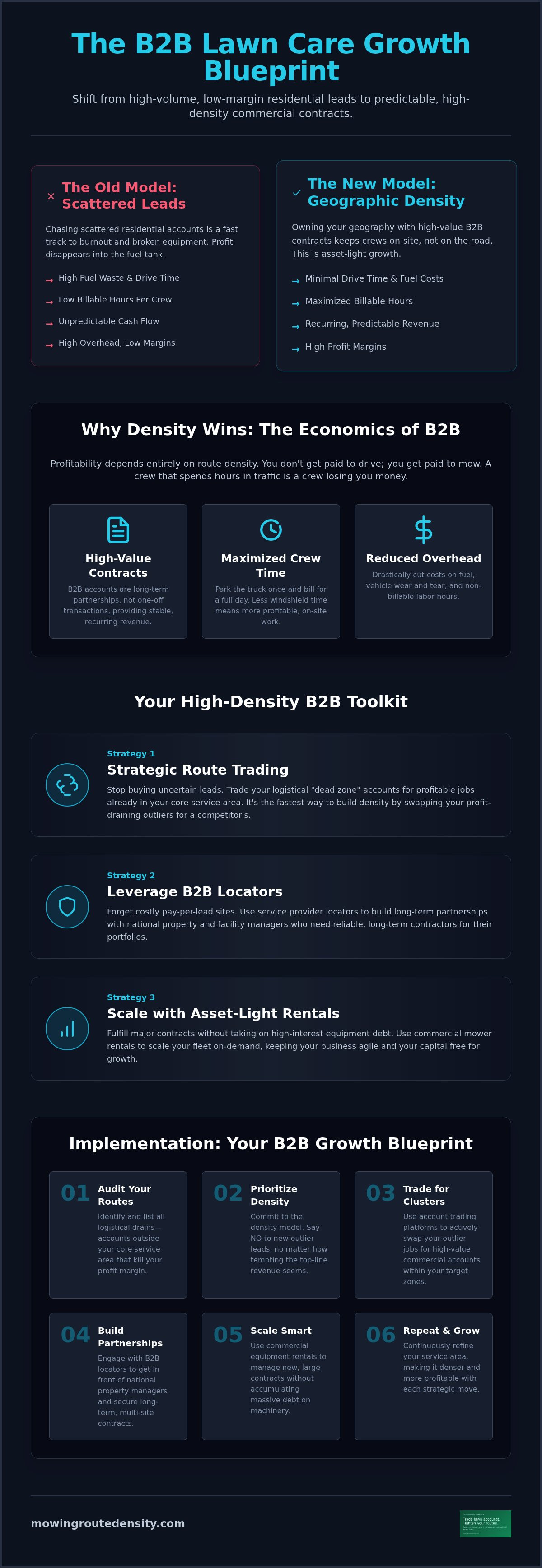
Growth isn't a happy accident. It's the result of a deliberate blueprint. In 2026, lawn care lead generation B2B succeeds only when it's rooted in logistical reality. Stop guessing where your profit is. Audit your current route density today. Map every account. Identify the "dead zones" where travel time exceeds billable time. These aren't just inefficient; they're toxic to your bottom line. If you can't service an area profitably, you shouldn't be there.
Once you've identified the outliers, don't just keep them out of habit. List those accounts on a trading platform. Swap them for jobs that sit within your core hubs. This builds instant density without the cost of a traditional marketing campaign. Next, register your business on a national service provider locator. This isn't about getting more phone calls; it's about being visible to property managers who value logistics as much as you do. Finally, plan your equipment needs around actual contract wins. Don't buy a machine for a job you haven't secured yet. Stay lean. Stay liquid.
Building Your B2B Sales Pipeline
Focus on account acquisition over lead buying. A lead is a cost; an account is an asset. When pitching new commercial clients, use your high-density routes as a selling point. Integrating an interactive project map for website allows you to show prospects that your crews are already on their block three times a week. This proves you can offer better reliability because you're already on-site. Operational authority is the ability to prove lower costs through better logistics. It makes you the obvious choice for a facility manager who is tired of contractors showing up late because they're stuck in traffic across town.
You won't mow forever. Eventually, you'll want to cash out. A dense B2B route is significantly more valuable to potential buyers than a scattered residential list. Buyers want predictable, clustered revenue. They don't want to buy a fuel bill. Integrate your lead gen strategy with a lawn care business exit strategy from the start. High-density routes command premium prices in the secondary market because they represent a turnkey, high-margin operation. If you build for density now, you build for a massive payday later. Tighten your routes today so you can sell them for a premium tomorrow.
Dominate Your Market with Logistical Precision
You can't out-hustle a bad map. Success in the commercial sector requires you to stop thinking like a laborer and start thinking like a logistics manager. The most effective lawn care lead generation B2B strategy isn't found in a marketing agency; it's found in your own route data. By prioritizing geographic density, you turn wasted drive time into billable hours. You swap the headache of scattered, low-margin routes for the stability of high-value commercial clusters.
Scaling your operations shouldn't mean drowning in debt. Use commercial-grade mower rentals to meet new contract demands while keeping your balance sheet clean. Leverage a national network of B2B contractors to find partners and utilize a secure marketplace to trade your outlier accounts for better-located jobs. This is how you build a business that is both profitable today and valuable when you're ready to exit. Ready to stop the waste? Optimize your B2B route density and trade accounts today. Your growth is waiting on the other side of your next tactical trade. Get to work.
Frequently Asked Questions
Is B2B lawn care lead generation more expensive than residential?
Upfront costs are higher, but the return on investment is far superior. While you might pay $50 to $200 per qualified commercial lead, the contract value is significantly larger. Residential leads often result in low-margin, one-off transactions. B2B leads represent recurring, multi-year revenue. Stop obsessing over the lead cost and start measuring the lifetime value of the account. Professional relationships cost more because they pay more.
How do I verify the quality of a B2B lead from a locator?
Check for detailed property data and clear contract timelines. A high-quality lead includes specific site requirements and direct facility manager contact info. Pre-vetted networks on a service provider locator do the heavy lifting for you. Look for "hire intent" rather than "quote seeking." If the lead doesn't provide clear service specifications, it's a red flag for a low-quality inquiry that will waste your time.
Can I swap residential accounts for B2B commercial contracts?
Yes, but you'll usually need to bundle multiple residential jobs to match one commercial contract's value. Trading platforms allow you to offload residential "noise" to contractors who specialize in that market. In exchange, you acquire the commercial density you need. This tactical move cleans up your balance sheet. It removes the logistical drain of residential stops and replaces them with high-margin, professional accounts that fit your route.
What is the best way to find commercial landscaping partners for national projects?
Use a national service provider locator to find firms holding master service agreements. These large companies often need reliable local partners to fulfill regional requirements. It's a faster route to B2B growth than cold-calling property managers. By positioning yourself as a vetted subcontractor, you gain access to national contracts without the massive sales overhead. Focus on partners that value logistics and route density as much as you do.
How does route density affect my ability to win B2B contracts?
Density is your strongest selling point. Property managers value reliability above all else. If you can prove your crews are already on their street multiple times a week, you've eliminated their risk. It also allows you to be more competitive on pricing without sacrificing your profit margin. High density reduces your fuel and labor overhead. This gives you the operational authority to win bids against scattered, inefficient competitors.
Should I rent or buy equipment when starting a new B2B route?
Rent until the contract is proven and profitable. Buying equipment for an unproven route is a financial gamble that kills cash flow. Commercial mower rental allows you to scale up immediately to meet requirements without a five-year debt commitment. It keeps your operation lean and preserves capital for further lawn care lead generation B2B efforts. Once the account is stable and the revenue is predictable, evaluate long-term leasing or purchase options.
What are the most common mistakes in B2B lawn care lead generation?
The biggest mistake is prioritizing volume over density. Many contractors chase any commercial lead regardless of location. This creates a logistical nightmare that erodes profit through fuel and labor waste. Another error is treating B2B leads like residential ones. Commercial clients require professional service level agreements and reliable equipment. Finally, ignoring the secondary market for accounts means you're missing the fastest way to build a clustered, high-profit territory.
How do I use a lawn account trading platform to grow my business?
Use the platform to surgically refine your service area. List your "outlier" accounts—the ones sitting 20 minutes away from your core route—for sale or trade. Then, use the proceeds or a direct swap to acquire accounts sitting within your existing hubs. This is the most efficient form of lawn care lead generation B2B because it creates instant density. You're moving from a scattered map to a concentrated, high-margin operation.


