

Scaling your operation through subcontracting is often the exact moment you start hemorrhaging profit. It sounds like a growth move. In reality, it's often an invitation for route poaching and massive liability gaps. You need a lawn care subcontractor agreement that does more than satisfy a lawyer. It must protect your route density and your bottom line with clinical precision.
You already know the frustration of watching an outside crew deliver sub-par service under your brand name. It's a gamble with your reputation. This guide provides the strategic 2026 framework you need to hire help without sacrificing control. We'll cover the latest federal worker classification rules, specifically the "economic reality" test, and the clauses that prevent partners from becoming competitors. You'll get a clear roadmap for building a bulletproof contract that turns subcontracting into a lean, high-efficiency engine. Stop guessing about liability. Start locking in your margins.
Key Takeaways
- Stop relying on handshakes. Use a professional framework to define clear B2B boundaries and avoid costly worker classification traps.
- Protect your high-density routes. A solid lawn care subcontractor agreement must include enforceable non-solicitation and geographic boundary clauses to prevent poaching.
- Know when to pivot. Use subcontracting for temporary capacity spikes, but look toward route trading for permanent geographic efficiency and margin protection.
- Standardize your output. Enforce service quality through clinical scopes of work and ensure partners meet professional standards with commercial-grade equipment rentals.
- Optimize your network. Leverage a B2B locator to find vetted partners and scale your operation without the overhead of a massive internal fleet.
The Strategic Role of a Lawn Care Subcontractor Agreement
Handshake deals are amateur. They work for a single crew, but they fail for ten. In 2026, a handshake is a legal liability and an operational leak. You need a formal lawn care subcontractor agreement to define where your business ends and theirs begins. Without it, you risk misclassification under the Department of Labor’s "economic reality" test. This rule, proposed in early 2026, focuses on two core factors: the worker's control over their work and their opportunity for profit or loss. If you treat a subcontractor like an employee without providing the benefits, you're asking for a lawsuit. Precision in your contract is the only way to protect your assets.
Protecting your brand requires clinical standards. Your customers don't care who mows the lawn; they care that it's done right. If a sub misses a strip or leaves a gate unlatched, you lose the account. Clear service level expectations in your agreement prevent these failures. It defines the "how" and "when" without micromanaging the "who." This distinction is critical. It maintains your status as a lead contractor rather than an employer. It ensures your route density isn't sacrificed for a partner's convenience.
Beyond Legalities: Subcontracting as a Scalability Lever
Subcontracting is your primary tool for asset-light growth. You can test a new neighborhood without buying a $60,000 truck or hiring a full-time crew. It allows you to stay agile while the market fluctuates. By delegating labor, you can focus on lawn care profit margin optimization by keeping your internal overhead low. It's about moving from a "worker" mindset to a "strategist" mindset. You aren't just buying labor; you're buying capacity without the long-term debt of equipment ownership.
The Risk of "Loose" Logistics
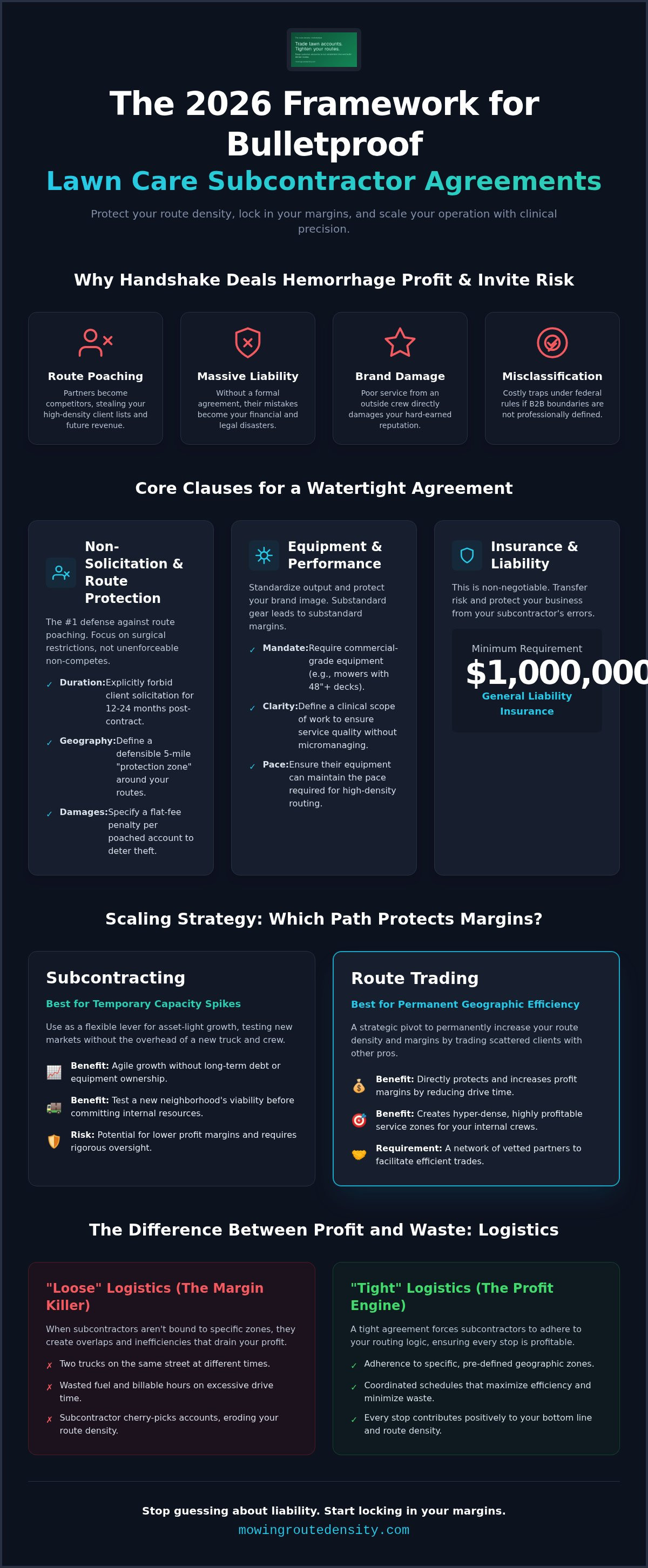
Logistics are the difference between profit and waste. If your subcontractors aren't bound to specific geographic zones, they'll create overlaps. You'll see two trucks on the same street at different times. That's a fuel drain. It's a waste of billable hours. Poorly coordinated schedules lead to "loose" logistics that eat your margins. Is your subcontractor building their density at the expense of yours? If they cherry-pick accounts while you pay for the drive time, you're losing. A tight agreement stops this bleed. It forces subcontractors to adhere to your routing logic, ensuring every stop is a profitable one.
Essential Clauses: Protecting Your Route Density and Assets
A generic contract is a sieve. It leaks profit. Your lawn care subcontractor agreement must be a watertight seal around your assets. In 2026, the legal landscape for restrictive covenants has shifted. Non-compete clauses are increasingly difficult to enforce at the federal level. You need a surgical approach. Focus on non-solicitation and geographic exclusivity instead. Understanding Prime and subcontracting frameworks is vital. You are the prime. The subcontractor is a partner, not a competitor. Your agreement must reflect this hierarchy to survive a legal challenge.
Non-Solicitation: The Key to Route Protection
Poaching is the biggest risk in subcontracting. A sub sees your high-density neighborhood and wants a piece of the action. Your contract must explicitly forbid them from soliciting your clients for a set duration. Typically, 12 to 24 months is the standard. Define the radius with care. A 50-mile restriction might be tossed out in court, but a 5-mile "protection zone" around your specific routes is often defensible. Liquidated damages are your teeth. Specify a flat fee per poached account. This makes the cost of betrayal higher than the potential profit. It protects your client list liquidity and keeps your routes intact.
Equipment and Performance Standards
Substandard gear leads to substandard margins. Residential-grade mowers are a liability. They break down. They cut slowly. They ruin the professional image you've spent years building. Require subcontractors to use commercial-grade equipment with at least a 48-inch deck. If their fleet is aging out, suggest professional lawn equipment rental to bridge the gap. This ensures they maintain the pace required for your route density. Slow equipment is a hidden tax on your business. Don't pay it.
Liability is non-negotiable. Require a minimum of $1 million in general liability insurance. In 2026, you should also verify workers' compensation coverage. Penalties for uninsured workers are rising. In California, for example, the minimum penalty for a contractor without coverage increased to $10,000 for sole proprietors as of January 1, 2026. Don't take their word for it. Demand a certificate of insurance (COI) that names your business as an additional insured. While you're vetting their paperwork, use a lawn mowing service provider locator to find partners who already meet these professional benchmarks. It's the fastest way to scale without the risk.
Subcontracting vs. Route Trading: Which Scales Faster?
Subcontracting is a bandage. Route trading is a cure. When you first start a landscaping business, you likely accepted every lead within a thirty-mile radius. Now, you're paying for that desperation in fuel and wasted drive time. A lawn care subcontractor agreement is an excellent tactical tool for managing overflow or sudden capacity spikes. It keeps your promises to clients without the immediate need for new trucks. However, it doesn't fix a broken map. If you are using subcontractors to service outliers permanently, you are just managing a low-margin headache.
The Capacity vs. Density Dilemma
Subcontracting increases your capacity, but it often dilutes your density. You are essentially paying a premium to have someone else handle your logistical mistakes. Trading accounts allows you to cluster your assets for maximum efficiency. Instead of managing a complex lawn care subcontractor agreement for a single stop ten miles away, you swap that account for one next door to your current route. This is the point where you move from surviving to thriving. Stop managing paperwork and start using a lawn account trading platform to prune your service area into a high-profit cluster.
- Subcontracting: Best for seasonal surges, testing new zip codes, or temporary labor shortages.
- Route Trading: Best for eliminating "one-off" stops, tightening geographic focus, and permanent margin protection.
Long-Term Valuation Impact
Revenue generated through subcontractors is valued differently by potential buyers. It's seen as higher risk and lower margin. If you are planning a lawn care business exit strategy, you need owned, high-density routes. Managed sub-networks are fragile; if the sub leaves, the revenue vanishes. Buyers look for client liquidity. Client liquidity is the measure of how easily an account can be serviced, sold, or traded within a high-density cluster without logistical friction. A business built on tight, owned routes will always command a premium over a business built on a sprawling network of third-party contractors. Density is equity. Subcontracting is just cash flow.
2026 Subcontractor Agreement Template: Essential Components
A thin contract is a liability. Your lawn care subcontractor agreement needs to be an operational manual, not just a signature page. Vague language leads to disputes. Disputes lead to lost accounts and drained margins. You aren't just hiring a mower; you're protecting a route. Every clause must serve that goal with clinical precision. If the contract doesn't dictate exactly how the work happens, the subcontractor will decide for you. That is a recipe for inconsistency.
Drafting the Scope of Work
Be clinical. List every service explicitly: mowing, edging, blowing, and debris removal. The same rigor applies when subbing out heavier property work—partnering with specialists like Statement Tree Care for technical pruning and tree removal requires unambiguous contract terms to separate hazardous arboreal liability from routine groundskeeping. Don't leave "cleanup" to interpretation. Use a 24-hour callback rule. If the customer reports a missed strip or a messy driveway, the sub has one day to fix it at their own expense. If they don't, they don't get paid for that cut. Demand photo proof and GPS time-stamping for every visit. In 2026, "I was there" isn't evidence. Digital proof is the only way to manage a remote fleet without losing your mind or your reputation.
Financial and Legal Safeguards
Cash flow is the lifeblood of your operation. Set up Net-30 or Net-60 payment terms to keep your own books balanced. Use a "back-to-back" payment clause. This ensures you only pay the subcontractor after you've received payment from the client. It protects your liquidity and keeps the sub invested in the client’s satisfaction. Define the "Independent Contractor" status clearly to avoid tax penalties. If a dispute arises, specify mediation before arbitration. It's faster. It's cheaper. It keeps you out of court and in the field.
You need a clean exit strategy. If a sub underperforms, you must be able to terminate the relationship without losing the route. Ensure the contract states that the route and the client relationship belong exclusively to your business. Include a strong indemnification clause. Indemnification isn't just a legal word; it's your shield. It shifts the burden of onsite accidents, property damage, or injuries onto the subcontractor. They own the risk. You own the route. If you need to find crews that already understand these professional standards, use the lawn mowing service provider locator to find vetted partners.
Scaling Operations with Mowing Route Density
A lawn care subcontractor agreement is just paper without the right partners. You need crews that actually show up. You need operators who respect your route density. Most contractors fail here because they hire based on desperation rather than strategy. They pick the first person with a trailer and hope for the best. That isn't scaling; it's gambling. To grow an asset-light business in 2026, you must move from managing labor to managing assets. This shift requires a reliable network and professional equipment standards.
Strategic Capacity Management
Finding reliable help is the industry's biggest bottleneck. You can't scale if you're constantly babysitting. Use a lawn mowing service provider locator to find vetted B2B partners who understand professional standards. These aren't just random laborers. They are businesses that fit into your logistical framework. Once you find lawn care subcontractors that align with your geography, you must ensure they have the tools to succeed.
If their mower dies, your route dies. Support their uptime with commercial lawn mower lease options. It keeps them in the field without adding debt to your balance sheet. It ensures they use the professional-grade gear your lawn care subcontractor agreement demands. The Mowing Route Density network provides this national infrastructure. It allows you to expand your footprint without the traditional overhead of fleet ownership. You provide the route; we help provide the capacity.
The Path to Maximum Liquidity
Stop thinking about grass. Start thinking about clusters. A fragmented network of subcontractors is a management nightmare. A tightened, high-density route is a tradable asset. When you eliminate operational waste and enforce your legal frameworks, you build a business ready for acquisition. Buyers want efficiency. They want proof of margin. They want to see that your subcontractors are profit centers, not liability gaps.
Tightening your operational waste is the only way to prepare for a high-value exit. By using our platform to trade low-density outliers for high-profit clusters, you increase your business's total valuation. You're no longer just a service provider. You're a strategist managing a high-yield portfolio. Ready to trade low-density accounts for high-profit clusters? Visit the Mowing Route Density marketplace. Stop chasing grass; start chasing density.
Dominate Your Market with Strategic Density
Operational waste is the silent killer of landscaping businesses. Are you running a business, or are you just funding a subcontractor's fuel tank? You've learned that a lawn care subcontractor agreement is more than a legal shield; it's a tool for enforcing route density and professional standards. By defining clear boundaries and clinical service levels, you stop the hemorrhage of drive-time waste. You move from being a manager of people to a manager of high-yield assets. Permanent profitability comes from geographic clustering and asset-light growth.
It's time to stop tolerating inefficient maps. Leverage our national route trading marketplace to swap outliers for high-profit clusters. Use our strategic B2B locator tool to find partners who actually meet your standards. If your fleet is holding you back, commercial-grade equipment rentals can bridge the gap without the burden of long-term debt. The tools for a leaner, more profitable operation are at your fingertips. Take control of your margins and build a business that actually scales.
Optimize your routes and trade accounts today on Mowing Route Density
Frequently Asked Questions
Do I need a different agreement for commercial vs. residential subcontracting?
What is the standard pay rate for lawn care subcontractors in 2026?
National averages in 2026 range between $40 and $80 per crew member. These rates fluctuate based on your market and the complexity of the job. Don't just look at the hourly cost. Consider the equipment they bring and the drive time involved. Paying a higher rate for a high-density route often yields better margins than a cheap sub on a sprawling route. Focus on the total cost per cut.
Can I require my subcontractor to use specific commercial equipment?
You can mandate performance standards, but be careful with worker classification. The 2026 Department of Labor "economic reality" test looks at how much control you exert. Instead of naming a specific brand, specify the deck size and engine type required to meet your efficiency targets. This ensures they maintain your route density without triggering an employee-employer relationship. Professional results require professional tools. Don't let a residential mower slow down your commercial profits.
How do I prevent a subcontractor from stealing my lawn care clients?
Use a surgical non-solicitation clause. Specify a 12 to 24-month ban on contacting your clients within a defined geographic radius. Include a liquidated damages provision. This sets a pre-determined financial penalty for every poached account. It makes theft more expensive than the potential profit. Protect your client list liquidity by making betrayal a bad business move. A strong lawn care subcontractor agreement keeps your routes intact and your partners honest.
What happens if a subcontractor causes property damage?
The subcontractor is responsible for any damage they cause. Your agreement must include an indemnification clause that shifts this liability onto them. Verify their insurance before the first cut. Demand a certificate of insurance that names your business as an additional insured. This ensures their policy pays for the broken window or damaged irrigation head. Without this, the cost comes out of your pocket. Don't gamble with your profit margins.
Is a non-compete clause legal for landscaping subcontractors in the US?
Non-compete clauses are increasingly difficult to enforce at the federal level in 2026. Courts often view them as an unfair restraint of trade. Switch your focus to non-solicitation and trade secret protection. These clauses are more defensible because they protect specific business assets rather than preventing someone from working. They keep your routes safe without the legal baggage of a broad non-compete. Focus on what you can actually win in court.
Should I provide the mowers for my subcontractors or make them rent?
Make them rent or provide their own. Providing equipment increases your overhead and risks worker misclassification. It turns you into a fleet manager instead of a strategist. Use commercial mower rental options to help your subcontractors upgrade their gear without taking on debt. This keeps your business asset-light and agile. It ensures the subcontractor has skin in the game. Let them handle the maintenance while you handle the route density.


