
Your shiny new fleet is likely a financial anchor disguised as an asset. Most contractors view ownership as a sign of success, but in 2026, an idle machine is just a drain on your bottom line. The debate over renting vs buying lawn equipment isn't just about upfront costs; it's about operational agility. You've felt the sting of a mower sitting in the shop while your crew loses billable hours. You've watched fuel margins evaporate due to inefficient routing. It's frustrating to manage assets that cost you money even when they aren't moving.
We agree that the industry's status quo is broken. High overhead and underutilized equipment are silent killers of profitability. This guide promises to help you eliminate that waste and maximize your margins with pragmatic fleet strategies. We will preview the "65% Rule" for equipment usage, explain how to cluster accounts for better route density, and show you how to scale without massive capital. It's time to stop tracking trucks and start tightening the distance between your billable minutes.
Key Takeaways
- Identify and liquidate "zombie assets" that drain your profit margins through constant idling and unnecessary maintenance costs.
- Master the renting vs buying lawn equipment dilemma by applying the 65% utilization rule to keep your balance sheet lean and responsive.
- Reduce your total vehicle count and fuel consumption by prioritizing route density and clustering accounts to minimize non-billable drive time.
- Implement a 2026 fleet audit to track the actual billable hours of every machine, ensuring your equipment generates more revenue than it consumes in overhead.
- Scale your operations nationally without the risk of heavy debt by leveraging B2B subcontractor networks and account trading platforms instead of purchasing more trucks.
The Real Cost of a Bloated Landscaping Fleet
A bloated fleet is a slow death for a landscaping business. You might think more trucks mean more revenue. Usually, it just means more headaches. When you weigh renting vs buying lawn equipment, you have to look past the shiny paint and consider the drag on your cash flow. Fuel, idling, and unnecessary mileage are the silent killers of your profit margin. Every mile driven between jobs is an hour of labor lost. It's a gallon of fuel burned for zero return. Worse, it’s wear and tear on an asset that isn’t even working. The correlation is simple. Higher drive time equals shorter equipment lifespan. Without route density, a larger fleet simply scales your inefficiencies. It creates logistical chaos that burns out your best crew leads. They want to be on the job, not stuck in traffic managing a breakdown.
Calculating Your True Cost of Ownership (TCO)
Analyzing renting vs buying lawn equipment requires a cold look at the numbers. Don't just look at the monthly payment. That's amateur logic. You have to factor in the secondary costs that eat your lunch:
- Insurance and Storage: Keeping machines safe and covered isn't free.
- Specialized Labor: You need mechanics on payroll, not just operators.
- Opportunity Cost: Money tied up in a depreciating mower is money you can't spend on marketing or talent.
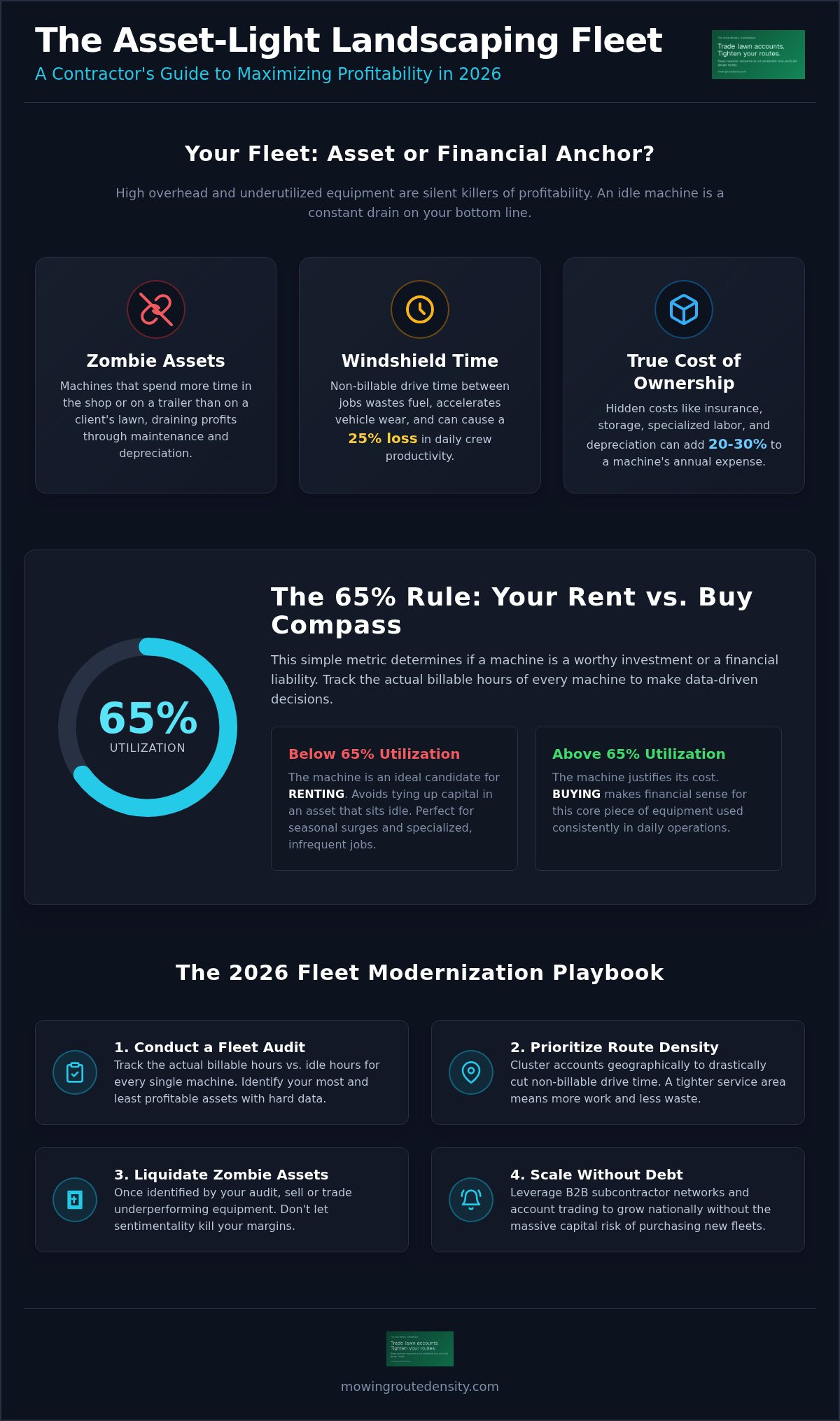
The True Cost of Ownership (TCO) for a commercial mower is the total sum of the purchase price, financing interest, insurance, and storage, combined with the recurring expenses for specialized maintenance and the steep impact of annual depreciation. According to industry data, these hidden costs can add 20% to 30% to the annual cost of the machine. If your assets are sitting in the shop, they are actively draining your bank account while producing zero billable hours.
The Hidden Drain of Windshield Time
Windshield time is a direct hit to your bottom line. It’s non-billable. It increases the frequency of maintenance events because the engine is running while the blades aren't. In the equipment rental industry, machines are priced by the hour for a reason. They know every minute counts. On a national level, traffic and logistics can cripple a fleet's readiness. If your crew spends two hours a day in a truck, you've lost 25% of your productivity before the first gate is opened.
Every mile your truck travels is a liability. Excessive travel doesn't just waste fuel; it accelerates the replacement cycle of your entire fleet. This isn't just a math problem; it's a survival problem. To protect your margins, you must stop treating your fleet like a collection of assets and start treating it like a logistics puzzle that needs solving.
Renting vs Buying Lawn Equipment: Mastering the Asset Lifecycle
Stop hoarding machines. Owning a massive fleet isn't a badge of honor; it's often a sign of poor planning. Successful contractors in 2026 adopt an Asset-Light philosophy. This means you own your core units but rely on external partners for the seasonal surge. The debate over renting vs buying lawn equipment isn't a one-time choice. It's a continuous lifecycle decision. You must identify your "zombie assets" today. These are the machines that spend more time on a trailer or in the shop than on a client's lawn. If a mower costs more in monthly repairs than a rental fee, trade it in immediately. Don't let sentimentality kill your margins.
There is a clear point of diminishing returns for aging commercial equipment. After a specific hour threshold, the risk of catastrophic failure outweighs the benefit of ownership. By exploring commercial lawn mower lease options, you can ensure your crews always operate high-efficiency machines. This shift aligns with broader fleet management trends where uptime and reliability take precedence over raw asset accumulation. If you want to scale without the weight of debt, consider how professional lawn equipment rental can bridge the gap during your busiest months.
The Strategic Case for Renting vs Buying Lawn Equipment
Ownership is expensive. It ties up capital that you could use for marketing or hiring. Renting allows you to reduce upfront capital expenditure during rapid growth phases. It ensures your crew always has access to late-model, high-efficiency machines without the long-term maintenance liabilities. When you rent, the rental company handles the major repairs. You focus on the billable hours. It's a cleaner, faster way to work. If you are looking to optimize your asset mix, you can browse specialized rental fleets to find the right fit for your next contract.
Preventive Maintenance vs. Reactive Repair
Maintenance is a discipline, not a suggestion. You need a No-Nonsense rule: if it is leaking, it is not leaving the shop. Period. Standardizing daily inspection checklists for trucks and mowers prevents small issues from becoming $5,000 engine replacements. Create a culture of accountability. Your crews should treat equipment like their own tools. When a crew lead takes pride in their gear, the gear lasts longer. Reactive repairs are for amateurs. Professionals plan for wear so they never have to react to a breakdown in the middle of a Tuesday morning rush.
Route Density: The Logic Behind Fleet Efficiency
Route density is the ultimate fleet management hack. It is the difference between a profitable operation and a logistics nightmare. Most contractors focus on adding more trucks to grow revenue. This is a mistake. If your accounts are scattered across the county, you aren't growing; you're just increasing your liability. High lawn care route density allows you to do more with less. When you cluster accounts, you reduce the number of vehicles required on the road. It’s simple math. Ten accounts in a single square mile require one crew and one truck. Ten accounts spread across twenty miles require two crews and two trucks just to keep pace. The scattered model doubles your maintenance, fuel, and insurance costs instantly.
Fixing your logistics doesn't always mean changing your schedule. Sometimes it means changing your client list. Using a lawn account trading platform allows you to offload the outliers that drain your resources. If an account is twenty minutes away from your core cluster, it is a "zombie account." It eats your profit in fuel and windshield time. The decision of renting vs buying lawn equipment becomes much clearer when your routes are tight. You can justify buying high-end gear when that gear is running six hours a day in one neighborhood. If you are looking at SBA financing options to grow your fleet, remember that a denser route is better collateral than a new truck.
Asset Clustering and Logistics
Clustering assets is about tactical geography. You must assign specific crews to tight zones. This minimizes travel and maximizes billable minutes. Industry professionals report that effective route density significantly lowers fuel consumption and idle time. It also keeps your trucks off the highways. Less highway time means fewer accidents and lower insurance premiums. You aren't just saving gas; you're protecting your equipment's longevity by avoiding high-speed wear and tear on your trailers and transmissions. Beyond vehicle fuel, managing your facility's power costs is essential in 2026; The Energy Desk offers specialized energy management to help UK businesses keep their total overhead as lean as their fleet.
Sell your outliers. If a client doesn't fit your cluster, they are costing you more than they pay you. A strategic move is swapping these distant clients for local ones via a marketplace. This isn't losing business; it's optimizing your footprint. Many contractors find that tightening their territory allows them to service more clients with fewer machines. Account trading directly improves fleet ROI by concentrating your equipment's operational hours within the smallest possible geographic radius. This ensures your mowers are cutting grass, not sitting on a trailer behind a truck stuck in traffic.
The 2026 Landscaping Fleet Audit: A Practical Checklist
You can't manage what you don't measure. A fleet audit isn't a suggestion; it's a financial necessity. Start by tagging every asset in your shop. This includes everything from zero-turns to string trimmers. If it has a serial number, it needs a tag. Digital maintenance logs must be verified and up to date. A missing log is a missing profit margin. You need to know exactly when a machine last had an oil change or a blade sharpening. Guesswork leads to breakdowns. Breakdowns lead to lost billable hours. It's that simple.
Step 1: The Asset Utilization Audit
Calculate the revenue per hour for every major piece of equipment. If a mower sits on the trailer for twenty hours a week, it is a liability. This is where the debate of renting vs buying lawn equipment becomes a mathematical certainty. Industry standards suggest the "65% Rule." If you use a machine more than 65% of the time, around 150 working days a year, ownership makes sense. If utilization drops below 40%, you are better off renting. Identify the money pits in your lineup. These are the machines that cost more in storage and insurance than they generate in revenue. Sell them. Use that capital to fix your cash flow or invest in higher-density routes. For contractors diversifying into facility maintenance, United Lift LLC provides detailed buyer’s guides for specialized machinery like electric scissor lifts to help you maintain a high-efficiency fleet.
Fuel is one of your largest overhead costs. Stop letting it evaporate. Implement strict no-idle policies to preserve engine hours and cut waste. An idling engine is a burning dollar bill. Review your GPS data to find recurring dead zones in your routing. If a truck spends forty minutes in a specific traffic bottleneck every morning, change the route or the start time. Audit your fuel card usage weekly. Look for slippage or unauthorized purchases. Tightening these small leaks prevents your profit from bleeding out through the exhaust pipe.
Once you've identified your underutilized assets, you need a strategy to replace them with more efficient options. You can access commercial mower rentals to fill those gaps without taking on new debt. A lean fleet is a profitable fleet. Don't let your trailer become a graveyard for equipment you don't need. Clear the clutter. Focus on the assets that move the needle. Every machine in your fleet should be a revenue generator, not a decoration.
Scaling Your Fleet Without Increasing Risk
Stop confusing growth with accumulation. A bigger fleet often just means bigger problems. When you face the choice of renting vs buying lawn equipment for a new national contract, the answer shouldn't always be a trip to the dealer. Ownership is a long-term commitment that limits your flexibility. In 2026, the market rewards the strategist who can mobilize assets without owning every engine. Scaling isn't about buying more iron. It's about managing capacity. For example, contractors scaling in the Southern California area can visit LA Dumpster Bins to manage site debris through rentals, illustrating how to increase capacity without adding to your permanent fleet of disposal vehicles. Most contractors fail because they scale their debt faster than their revenue. You don't need more trucks to take on bigger projects; you need a better way to leverage the assets already on the road.
Leveraging Contractor Networks
B2B partnerships are the secret to asset-light growth. Instead of financing a specialized mower for a single large-scale project, use a lawn mowing service provider locator to find partners who already own the gear. This allows you to take on massive contracts without the capital risk of new equipment. When you find lawn care subcontractors to handle distant clusters, you eliminate the need for extra trailers and fuel. Quality control stays in your hands while the maintenance liability stays in theirs. It's a pragmatic way to expand your footprint without expanding your overhead. You focus on the logistics; they focus on the blades. This decentralized approach protects your margins and keeps your core crew focused on your highest-density routes.
The Future of Lean Landscaping
The 2026 market dynamics favor companies that stay light. Transitioning from a mower owner to a logistics strategist is the only way to survive rising labor and fuel costs. A hybrid fleet, mixing owned core assets with rented and subcontracted capacity, is the gold standard for efficiency. This lean structure also makes your company more attractive to buyers. If you are preparing for a lawn care business exit strategy, remember that a lean fleet is a liquid fleet. Potential acquirers want to buy your cash flow and your route density, not your aging equipment. They don't want a yard full of "zombie assets" that require immediate replacement. They want a streamlined machine that generates profit with minimal friction. Before you buy your next truck, audit your current routes. Tighten your territory. Only when your existing fleet is running at maximum billable capacity should you consider adding more iron to the fire.
Turn Your Fleet Into a Profit Center
Success in 2026 requires a shift in mindset. You aren't just a mower operator anymore. You're a logistics strategist. Stop letting underutilized assets sit in your shop like expensive lawn ornaments. By mastering the 65% utilization rule and tightening your route density, you eliminate the operational waste that kills your bottom line. Every mile saved is a dollar earned. Every billable hour added is a step toward true scalability.
The decision of renting vs buying lawn equipment should always be driven by data, not ego. Ownership has its place, but agility is what wins the long game. Audit your fleet. Liquidate your zombie assets. Focus on the accounts that fit your cluster and offload the ones that don't. You have the tools to build a lean, high-margin operation that doesn't rely on massive capital or crushing debt.
Ready to stop the bleed? Tighten your routes and optimize your fleet today with Mowing Route Density. You can maximize your lawn care profit margin optimization while accessing a national network of commercial contractors. Rent high-performance mowers without the long-term debt and start winning bigger contracts. Your more profitable future starts with a leaner fleet.
Frequently Asked Questions
How often should I perform a fleet management audit?
Perform a comprehensive audit twice a year, ideally before the spring surge and after the autumn wind-down. Monthly spot checks on high-utilization machines are also necessary. Waiting for a breakdown to check your logs is a failure of leadership. Regular audits identify underutilized assets before they drain your cash flow. If you don't know your revenue per engine hour, you aren't managing; you're just hoping.
Is it better to lease or buy commercial landscaping equipment in 2026?
The choice between leasing and buying depends on your cash position and the machine's expected utilization. Buying makes sense for core assets used over 150 days a year. Leasing is a strategic tool for asset-light growth, allowing you to access late-model machines without heavy debt. When debating renting vs buying lawn equipment, remember that ownership is a liability if the machine sits idle. Use leases to stay nimble and protect your cash.
What is the most effective way to reduce fuel costs in a lawn care business?
Tightening your route density is the most effective way to slash fuel expenses. Clustering accounts minimizes windshield time and non-billable mileage. Implementing a strict no-idle policy can also save significant fuel over a season. If your trucks are idling for thirty minutes a day, you're literally burning profit. Stop chasing distant accounts that don't fit your core geographic zones. Dense routes equal lower overhead and a much healthier bottom line.
How does route density affect the resale value of my landscaping business?
Route density is often more valuable than your equipment list to a potential buyer. A dense, high-margin territory represents predictable cash flow with low overhead. Acquirers want to buy a streamlined logistics machine, not a graveyard of aging trucks. If your accounts are scattered, your business is a liability. Tightening your footprint increases your exit multiple because it proves your operational efficiency and long-term profitability. Don't build a fleet; build a territory.
Can I manage a multi-crew fleet without expensive software?
Yes, you can manage a fleet using simple digital logs and standardized checklists. High-priced software is a tool, not a strategy. You need clear processes and disciplined crew leads more than you need a fancy dashboard. Focus on tracking engine hours, fuel consumption, and billable minutes manually if you must. If your team won't follow a paper checklist, they won't follow a digital one either. Discipline drives results, not the platform you use.
What are the first signs that a piece of equipment has become a zombie asset?
The first sign is a machine that costs more in monthly repairs than it generates in billable revenue. If a mower sits in the shop for more than three days a month, it's a zombie. Look for assets with utilization rates below 40%. These machines are financial anchors. They take up trailer space and increase insurance costs without contributing to the bottom line. Sell them immediately to free up capital for better assets.
How do I hold crews accountable for equipment maintenance?
Tie crew lead bonuses to equipment longevity and uptime. If a machine breaks down due to neglected daily inspections, the crew responsible should feel the impact. Use a no-nonsense rule: if a leak isn't reported, the lead is held accountable. Standardize morning walk-arounds and end-of-day cleanings. When crews treat equipment like their own tools, maintenance costs drop. Accountability isn't mean; it's necessary for survival in a low-margin service industry.
What is the ideal ratio of owned vs. rented equipment for a scaling contractor?
Aim for a 70/30 ratio where you own your core fleet and rent for the seasonal surge. This asset-light approach protects you from carrying heavy debt during the off-season. The renting vs buying lawn equipment balance ensures you always have the capacity to take on large contracts without the risk of over-leveraging. Adjust this ratio based on your route density. If a route is temporary, never buy the gear to service it.


