
Every mile your crew drives between non-contiguous accounts is a direct hit to your bottom line. In an industry where landscaping service prices spiked by 10.70% in 2026, you can't afford to let fuel costs and scattered routes eat your remaining margins. Learning how to find commercial landscaping partners is no longer a luxury; it's a survival tactic for any firm facing labor shortages and rising overhead. You're likely tired of seeing high-quality labor wasted on windshield time instead of site work.
You already know that growth feels like a zero-sum game when your accounts are spread across multiple zip codes. It's frustrating to watch profit leak out of the tailpipe while your equipment depreciates in traffic. This strategic framework will teach you how to consolidate your service areas and maximize route density. We'll show you how to identify and vet the right B2B allies to stop the financial drain of "dead miles" once and for all.
We're moving beyond basic networking. We'll cover how to use account trading platforms to swap inefficient jobs for local density, how to leverage a service provider locator to find reliable subcontractors, and how to use commercial mower rentals to scale your new partnerships without heavy capital investment. It's time to tighten your operations and protect your profit.
Key Takeaways
- Stop the profit leak caused by "windshield time" by auditing your route logistics to identify and eliminate high-cost outlier accounts.
- Learn how to find commercial landscaping partners through specialized B2B locators that prioritize operational capacity over unreliable word-of-mouth.
- Utilize account trading platforms to swap isolated properties for local density, turning scattered routes into high-margin clusters with minimal effort.
- Scale your partnership capacity without heavy capital investment by leveraging commercial mower rentals for high-volume contracts.
- Vet potential allies based on strict equipment standards and billable hour efficiency to ensure they meet professional-grade commercial requirements.
The Logistics of B2B Landscaping: Why Partnerships Fail or Flourish
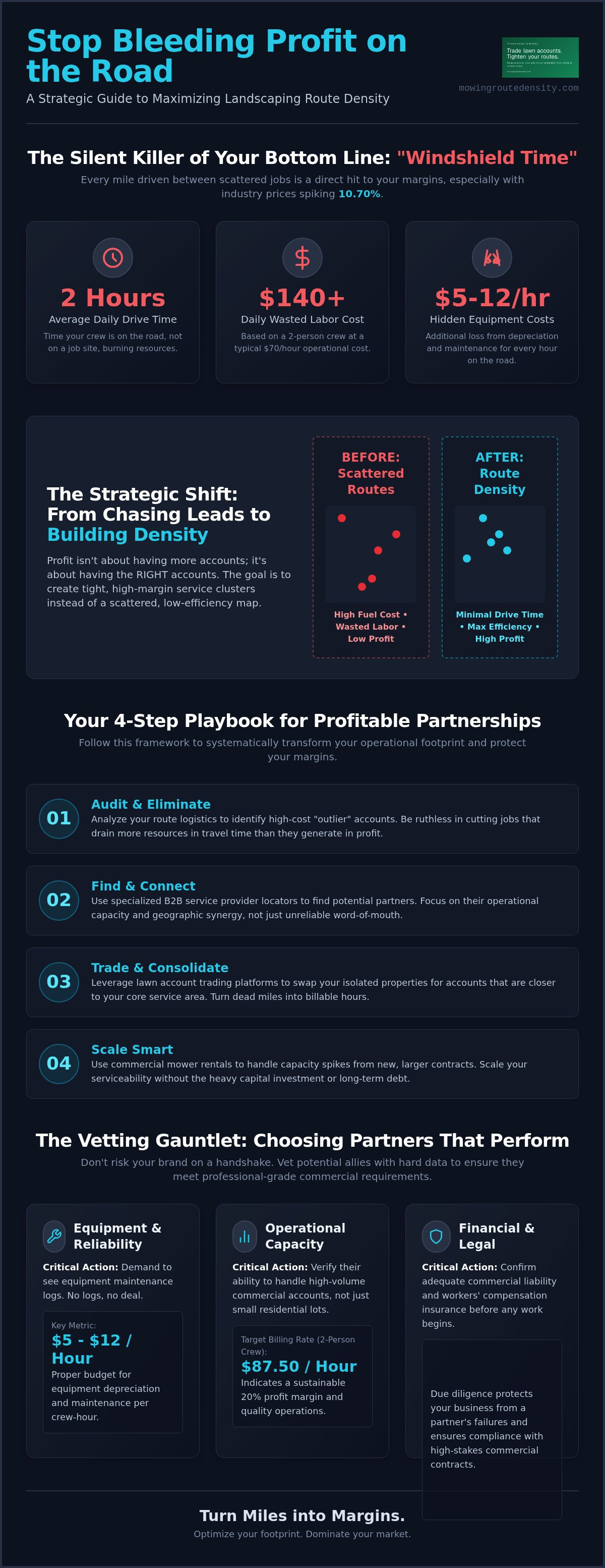
Windshield time is the silent killer of the commercial landscaping industry. Every minute your crew spends on the highway is a minute you aren't billing. Many owners think they have a revenue problem. They actually have a geography problem. To fix it, you must find commercial landscaping partners who value route density as much as you do. Traditional networking often fails because it focuses on "getting leads" rather than "building routes." You don't need more scattered accounts. You need clusters. Density is profit.
The Cost of Inefficient Route Management
The math is brutal. Research shows a typical two-person crew costs about $70 per hour to operate. If that crew spends two hours a day driving between non-contiguous sites, you're burning $140 in labor alone. That doesn't include fuel or the $5 to $12 per hour in equipment depreciation and maintenance costs. Beyond the money, there's a psychological cost. Field teams want to see progress. Excessive drive time leads to burnout and high turnover. It's hard to keep a lead foreman when they feel like a professional driver rather than a landscaper.
Partnership as an Operational Strategy
True growth requires a shift in mindset. You aren't just a service provider; you're a logistics manager. This is a core reality in the profession of landscape contracting. Strategic partnerships allow you to swap "outlier" accounts for properties that fit your existing routes. By using a lawn account trading platform, you can offload properties that are too far away to be profitable. In exchange, you gain accounts that sit right next to your current jobs. This asset-clustering creates a competitive advantage. It makes your margins untouchable for competitors who are still wasting fuel on scattered routes. Using a B2B service provider locator to find commercial landscaping partners allows you to vet capacity before you sign a contract. This isn't about giving away work. It's about optimizing your footprint.
Key Metrics for Vetting Commercial Landscaping Partners
Don't base your business future on a handshake at a supply house. Finding a partner who "seems reliable" is a recipe for a breached Service Level Agreement (SLA). When you find commercial landscaping partners, you're essentially hiring a temporary extension of your own brand. If they fail, you fail. Professional vetting requires hard data on equipment reliability, operational bandwidth, and legal compliance. You need a partner who operates with the same clinical precision you do; for instance, Snow Removal Denver showcases how over 44 years of specialized experience ensures a partner can meet the rigorous demands of commercial contracts. Clean trucks are a start; clean data is the requirement.
A partner's fleet is their lifeblood. Ask for maintenance logs. If they can't produce them, walk away. Equipment downtime doesn't just delay a mow; it triggers penalties in high-stakes commercial contracts. Industry data suggests that budgeting for equipment depreciation and maintenance should sit between $5 and $12 per crew-hour. If your partner isn't hitting these benchmarks, their gear is likely on its last legs. For temporary capacity spikes, consider an asset-light approach. Strategic partners can utilize lawn mower rental fleets to scale for large contracts without the burden of long-term debt. This ensures the job gets done with fresh, professional-grade machinery rather than a beat-up backup unit.
Operational Capacity and Route Alignment
Verify their ability to handle high-volume accounts. A crew that excels at half-acre lots will struggle on a 20-acre industrial park. Ask about their target billing rate; for a two-person crew, it should hover around $87.50 per hour to maintain a 20% profit margin. If their numbers are lower, they're likely cutting corners on labor or safety. Route alignment is equally critical. A partner might be skilled, but if their existing route is twenty miles from your density cluster, you're back to wasting fuel. Look for geographic synergy that shortens drive times for both parties. Communication is the final pillar. Establish how they manage reporting and client handoffs before the first blade of grass is cut.
Financial and Legal Due Diligence
Insurance isn't optional. Verify commercial liability and workers' comp before anyone steps onto a site. In 2026, regulatory environments are tightening across the country. New mandates for large-scale landscapes often require dedicated water meters, with requirements for conversion reaching 20% of properties this year. To meet these efficiency standards, many contractors explore Project-based artificial turf design and installation fees as a way to offer clients sustainable, low-maintenance alternatives. Additionally, updated wildfire landscaping rules in high-risk areas now restrict vegetation within five feet of structures. Ensure your partner is up to speed on these specialized performance metrics and compliance standards. Establish clear payment terms and performance-based incentives. If they hit the marks, they get paid. If they don't, your contract must protect your margins. High-quality partnerships are built on transparency and verifiable performance, not just good intentions.
Relying on "who you know" is a liability. It limits your growth to your immediate social circle. In a national market with over 726,000 landscaping businesses, you can't find commercial landscaping partners by chatting at the local dealership. Traditional networking is slow. It's biased. It often leads to low-quality, scattered leads that don't fit your existing footprint. In 2026, the most successful firms use data-driven matching to build their networks. They treat partnership discovery like a logistical audit rather than a social exercise. If you want to scale, you need to move from "word of mouth" to a systematic discovery process.
The Power of a Dedicated Service Provider Locator
Speed is a competitive advantage. A specialized lawn mowing service provider locator removes the guesswork from the discovery phase. These tools allow you to filter potential partners by equipment type, service capability, and exact geographic footprint. This is how you scale into new territories without the overhead of a local office. You find contractors who already have the route density you need. A pre-vetted network reduces the time-to-partnership from months to days. It ensures that the firm you're talking to actually has the capacity for high-volume commercial contracts. Don't waste time on companies that aren't equipped for the scale you're aiming for.
Digital Marketplaces for Asset and Route Trading
The B2B lawn care marketplace has evolved. Public bid boards are often a race to the bottom. They focus on price, not synergy. They don't facilitate direct contractor-to-contractor collaboration. Private account exchange platforms are different. They allow for strategic route swapping based on hard data. Transparency is the currency here. You share route data to find a match that eliminates overlap. This data-driven approach is essential in an industry growing at a forecast rate of 5.7%. It allows you to trade your "outlier" accounts for properties that sit right next to your current jobs. While your competitors are still scrolling through social media groups for leads, you're using a marketplace to tighten your margins. Focus on platforms that offer verified route data. Real growth doesn't happen in a Facebook group; it happens on a professional exchange where logistics come first.
How to Scale via Account Trading and Route Swapping
Most contractors think the only way to grow is to bid on new work. They're wrong. Chasing fresh leads often results in a "geographic mess" of accounts that are miles apart. To scale effectively in 2026, you must stop looking for new clients and start looking for better ones. This requires a shift from organic lead generation to strategic account trading. By swapping your distant, low-margin properties for accounts that sit within your existing clusters, you increase your density without spending a dime on marketing. It's the fastest way to "un-clutter" your operations and reclaim your profit.
The Five-Step Framework for Strategic Swapping
- Step 1: Audit your map. Identify every "outlier" property. If an account requires more than 15 minutes of drive time from your nearest job, it's a liability, not an asset.
- Step 2: List the outliers. Use a lawn account trading platform to find commercial landscaping partners who are already operating in those distant areas.
- Step 3: Negotiate for density. Don't just sell; swap. Look for partners who have accounts in your "home" territory but are struggling with their own drive times.
- Step 4: Formalize the handoff. Use a professional account swap agreement. This protects your reputation and ensures the client receives uninterrupted service.
- Step 5: Reinvest the savings. Take the money you saved on fuel and "dead miles" and put it toward high-density growth in your core service areas.
The Mechanics of a Successful Account Swap
Valuation is the most critical part of a swap. A property's value isn't just its monthly billing. You must calculate the logistical value. An account that's five minutes from your shop is worth significantly more than one that's forty minutes away, even if the billing is lower. When you find commercial landscaping partners for a swap, be transparent about your margins and equipment requirements. A successful transition also requires clear communication with the client. Frame the change as a "logistical optimization" that ensures they get a more responsive, local crew. Trust is maintained when the service remains seamless.
Maximizing Marginal Utility Through Asset Clustering
Trading accounts is a direct strike against fuel and labor waste. When you cluster your assets, your crews spend more time with their hands on equipment and less time behind a steering wheel. This is the foundation of landscaping profit margin optimization. Clustering also makes it easier to manage equipment. If a mower goes down, a backup is only blocks away, not across the county. This strategy is a low-cost alternative to traditional growth. Instead of paying for clicks or door hangers, you're simply rearranging your existing portfolio for maximum efficiency.
Optimizing Your Partnership Strategy with Mowing Route Density
Efficiency isn't a one-time event. It's a continuous process of tightening your operational footprint to stay ahead of rising costs. Mowing Route Density provides the infrastructure for this evolution. We don't just help you find commercial landscaping partners; we provide the tools to make those partnerships profitable. By integrating account trading with equipment logistics, we help you build a business that's lean, agile, and ready for the demands of 2026. Stop reacting to your routes and start engineering them.
A Unified Platform for Professional Contractors
Stop treating equipment and routes as separate problems. They're two sides of the same coin. If you swap accounts but don't have the machinery to service the new cluster, you haven't solved anything. Our platform allows you to scale capacity through commercial lawn mower rental services. This asset-light strategy means you can take on high-volume B2B contracts without the anchor of a massive equipment loan. You get the newest professional gear when you need it. You return it when the job is done. This flexibility is how national firms outmaneuver local competitors who are bogged down by fixed overhead. You gain the ability to scale up for seasonal peaks without the long-term debt that kills profit margins. Accessing a network of professionals focused on operational efficiency ensures you're partnering with firms that speak the language of billable hours and fuel consumption.
Next Steps: Tighten Your Operations Today
Your first move is an audit. Look at your map and find the waste. Every outlier account is a leak in your bucket. Once you identify your inefficient properties, use our account trading marketplace to find a better fit. This isn't just about getting rid of work; it's about trading for density. Then, use the Lawn Mowing Service Provider Locator: A Strategic B2B Framework to find commercial landscaping partners who can help you execute your new, denser route plan. This tool connects you with pre-vetted contractors who have the equipment and capacity to handle commercial-grade requirements. This isn't about working harder. It's about working with clinical precision. Use our specialized tools to conduct a route density audit and start reclaiming the hours you've been losing to traffic. The status quo is expensive. Tightening your operations is the only way to protect your bottom line in a competitive market.
Secure Your Margins Through Strategic Density
Driving miles for a single account isn't growth. It's a slow leak. You've seen how route density transforms your bottom line. You now have the framework to find commercial landscaping partners who align with your logistical goals. Vetting isn't just about equipment; it's about operational synergy. Trading accounts isn't about losing work; it's about gaining clusters. Stop letting fuel costs dictate your profit margins. You need a network that works as hard as your crews do.
Mowing Route Density is built for the strategist. We provide a professional lawn account trading platform to help you un-clutter your map. Our high-performance commercial mower rentals let you scale without the debt. You can access a national B2B contractor network designed for high-volume work. It's time to stop chasing leads and start building routes. Find your next strategic partner on the Mowing Route Density locator and start tightening your operations today. Your crews deserve better routes, and your business deserves better margins. Build your cluster and dominate your territory.
Frequently Asked Questions
How do I ensure a potential partner won't steal my commercial clients?
Protect your portfolio by using formalized non-solicitation and non-compete agreements. Professional B2B partnerships rely on reciprocal benefit, not poaching. When you find commercial landscaping partners through a verified marketplace, they value long-term logistical synergy more than a single stolen account. Reputation in a specialized network is a high-value asset; poaching leads to immediate blacklisting. Stick to contracts that outline clear boundaries and heavy penalties for interference to maintain trust.
What is the difference between a subcontractor and a strategic landscaping partner?
A subcontractor is a vendor you pay to perform a specific task. A strategic partner is an ally you use to optimize your entire operational footprint. Subcontracting often adds management overhead without fixing your geography. Strategic partners allow for account trading and route swapping. You aren't just offloading work; you're rearranging your service area to eliminate "dead miles." This collaboration turns a logistical nightmare into a high-margin cluster.
How can a service provider locator help me scale nationally?
A locator tool provides an immediate, pre-vetted footprint in territories where you have no physical presence. It allows you to bid on national contracts with confidence. You can find commercial landscaping partners who already have the density and local knowledge you lack. This bypasses the months of recruiting and equipment procurement usually required for expansion. It's the fastest way to scale without the risk of heavy capital expenditure or local office overhead.
What are the benefits of trading lawn care accounts instead of just bidding for new ones?
Bidding for new work often adds more "windshield time" to your day. Trading accounts allows you to swap your outliers for properties that sit right next to your current jobs. This provides an immediate margin boost by slashing fuel and labor waste. Organic lead generation is expensive and unpredictable. Account trading is a surgical strike that tightens your routes and increases your billable hours without any additional marketing spend.
How much can I realistically save by optimizing my route density?
Optimizing density can save thousands in monthly overhead. A typical two-person crew costs about $70 per hour to operate. If you cut just one hour of drive time per day, you save $350 a week in labor alone. When you add in fuel and the $5 to $12 per hour in equipment depreciation, the savings are massive. High-density routes maximize the billable output of every crew, turning wasted travel time into pure profit.
What equipment standards should I require from a B2B partner?
Require documented maintenance logs and commercial-grade machinery. Residential-grade equipment will fail under the pressure of 20-acre industrial sites. Look for partners who budget for equipment longevity and regular fleet updates. If their gear looks neglected, their service will be too. High standards prevent the downtime that triggers SLA penalties. A reliable partner should be able to prove their fleet is ready for high-volume work and professional-grade performance.
Is it better to rent or buy equipment when scaling with a new partner?
Renting is the superior choice for scaling with a new partner or handling seasonal peaks. It allows for asset-light growth without the burden of high-interest equipment loans. Buying is for established, high-density routes where you have guaranteed long-term volume. For new partnerships, lawn mower rental provides the flexibility to test synergy without financial risk. You get professional-grade equipment without the long-term maintenance liabilities or depreciation costs on your books.
How do I value a commercial landscaping route for a potential swap?
Valuation goes beyond gross revenue. You must calculate the logistical value based on drive time from your nearest hub. An account that's five minutes away is worth significantly more than a higher-paying job forty minutes away. Factor in the profit margin after fuel and labor costs. Use a lawn account trading platform to compare market rates and ensure the swap is equitable. True value is measured in billable hours, not just the contract price.


