

Most lawn care owners don't own a business. They own a grueling, high-overhead job that evaporates the second they step off the mower. It's a blunt truth, but without a proactive lawn care business exit strategy, your years of labor have zero liquidity. You're likely staring at messy spreadsheets and wondering if your clients will bolt the moment a new owner shows up. These aren't just minor frustrations. They're systemic flaws that tank your valuation and scare off qualified buyers.
You deserve a clean break and a payout that reflects your sacrifice. We'll show you how to transform your operation into a high-value asset that functions without you. This guide provides a pragmatic roadmap to audit your financial records, optimize your route density, and strip away unnecessary liability. You'll learn how to price your accounts with clinical precision and execute a transition that secures maximum cash at the closing table. Stop guessing what your sweat equity is worth. It's time to start building a business that professional buyers actually want to pay for.
Key Takeaways
- Stop waiting for burnout to dictate your departure. Learn why a proactive plan prevents low-ball fire sales and secures higher valuation multiples.
- Shift your focus from top-line revenue to route density. We explain how optimizing your territory reduces overhead and turns your business into a high-margin asset.
- Evaluate different exit paths, including full M&A and high-speed route trading, to determine the best lawn care business exit strategy for your timeline.
- Clean up your books by recasting financials to show true discretionary earnings and standardizing agreements to eliminate buyer-scaring "handshake deals."
- Discover how to leverage specialized B2B marketplaces and locator tools to find qualified buyers within the industry without paying traditional broker fees.
Defining Your Exit: Why Hope is Not a Strategy
Hope is a terrible business model. Most owners wait until they're physically broken or mentally drained to think about leaving. That is a mistake. A business exit strategy isn't just a retirement plan; it's a blueprint for extracting every cent of value from your years of labor. Without it, you aren't building an asset. You're just maintaining a job. Executing a successful lawn care business exit strategy requires moving from an operator mindset to an investor mindset. You must view your routes, crews, and equipment as components of a machine designed for sale.
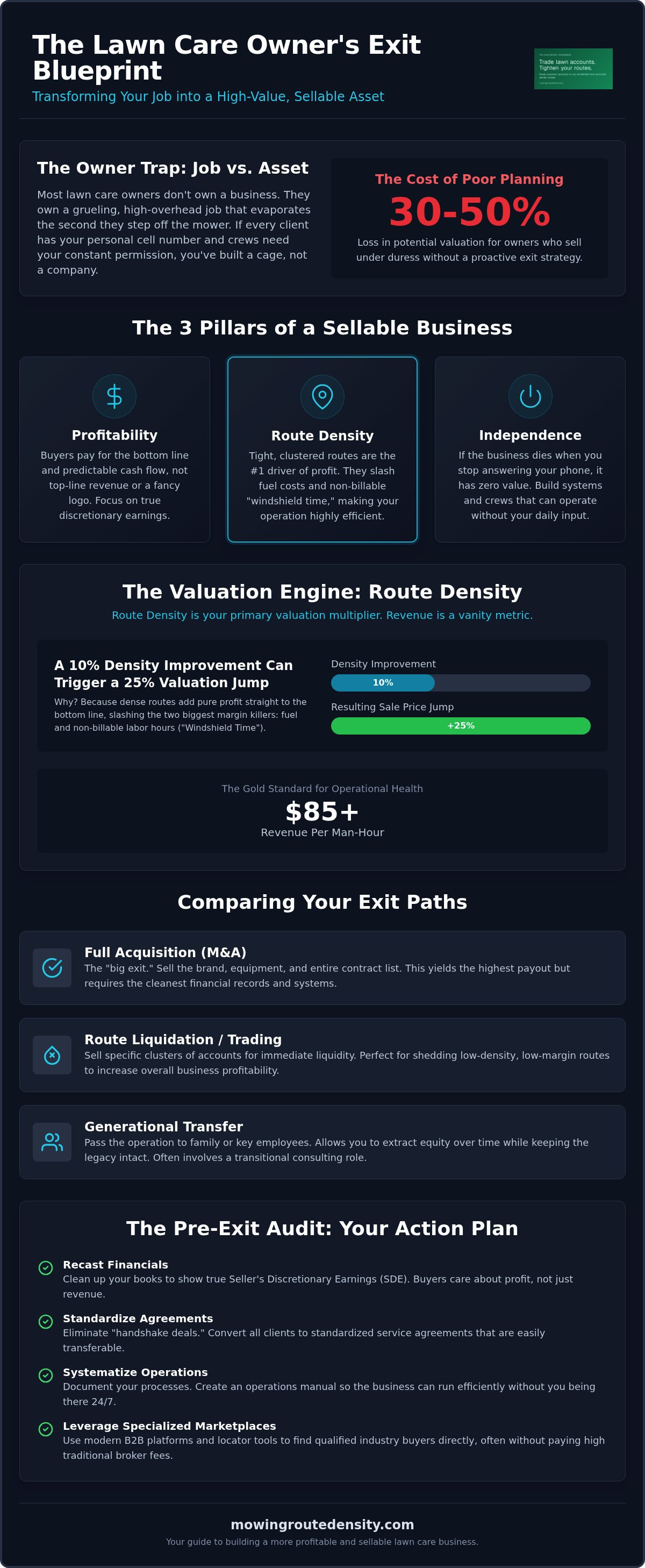
A clean exit stands on three pillars:
- Profitability: Buyers pay for the bottom line, not your top-line revenue or your logo.
- Density: Tight routes mean lower fuel consumption and fewer non-billable hours.
- Independence: If the business dies the moment you stop answering your phone, it has zero value to an outsider.
The Cost of Poor Planning
Unplanned exits are expensive. Industry data suggests that owners who sell under duress or without preparation often face a 30% to 50% loss in potential valuation. You lose leverage when you need to sell fast. The biggest hurdle is the "Owner Trap." If every client has your personal cell number and every crew needs your permission to start a mower, you haven't built a company. You've built a cage. In the 2026 market, buyers are hunting for lean, high-density operations that run on systems, not personalities. They want predictable cash flow and standardized service agreements, not a list of handshake deals that might vanish after the closing.
Common Exit Types in the Green Industry
You have options beyond just locking the gate and walking away. Choosing the right path depends on your timeline and your financial goals.
Full Acquisition: This is the "big exit." You sell the brand, the equipment, and the entire contract list to a competitor or a private equity firm. It yields the highest payout but requires the cleanest financial records. To maximize this, consider using lawn mower rental instead of taking on new debt for equipment in the years leading up to the sale. This keeps your balance sheet lean and attractive to buyers.
Route Liquidation: Sometimes you don't want to sell the whole ship. You can sell specific clusters of accounts for immediate liquidity. Using a specialized lawn account trading platform allows you to shed low-density routes that drag down your margins. This "cleans up" the business, leaving you with a high-profit core that is easier to manage or sell later.
Generational Transfer: You pass the operation to family or key employees. You might maintain a minority stake or act as a consultant. This allows you to extract equity over time while keeping the legacy intact.
The Valuation Engine: Route Density as Your Primary Multiplier
Revenue is a vanity metric. If your million-dollar company requires three hours of driving for every four hours of mowing, it's inefficient and unattractive to investors. Buyers aren't looking for a list of names; they're looking for a machine that prints money. In any professional SBA guidelines on selling a business will highlight the importance of operational efficiency, and in this industry, that means route density. High density protects your bottom line by slashing fuel costs and maximizing billable labor hours. It is your most powerful lever.
Consider the math. A 10% improvement in route density can often trigger a 25% jump in your final sale price. Why? Because that 10% isn't just revenue; it's pure profit that drops straight to the bottom line. Buyers hate "Windshield Time." It is an invisible tax on your payroll. If your crews spend 30% of their day in traffic, a savvy buyer will discount your valuation to account for that systemic waste. They want to buy routes, not a fleet of trucks stuck in gridlock.
Calculating Your Route Density Multiplier
In 2026, the gold standard for operational health is maintaining a Revenue per Man-Hour that exceeds $85 across all crews. To hit this, you need a lawn care route density framework to audit every account on your books. Stop looking at a "spaghetti map" of scattered clients. Start clustering. Identify your most profitable zones and draw a hard line around them. If an account falls outside that circle, it's costing you more than it's worth. Clustering transforms a chaotic list of addresses into a high-value asset.
Trimming the Fat: Selling Off Outliers
Executing a smart lawn care business exit strategy means you shouldn't list your entire business until you've pruned the dead weight. Selling off low-density outliers before a full exit makes your core operation look lean and disciplined. Use a lawn account trading platform to swap those distant, high-maintenance clients for local ones that fit your existing clusters. This "tightens" your operation before the due diligence process begins.
Presenting a compact, optimized route to a buyer signals strategic foresight. It proves you've already done the hard work of cutting waste and optimizing fuel consumption. This transparency builds trust and justifies a higher multiple. If you want to see how your current routes stack up against industry buyers, use a B2B locator tool to find local competitors who might be looking to expand their own density. It's the fastest way to turn a liability into liquid cash.
Exit Paths: Comparing M&A, Route Trading, and Asset Liquidation
Not every departure requires a total shutdown. Your lawn care business exit strategy should match your specific financial goals and timeline. A full Mergers and Acquisitions (M&A) deal offers the highest potential payout. It also demands the most rigorous preparation. Buyers in this category are looking for an "asset-light" operation. They don't want to inherit your aging fleet or high-interest equipment loans. They want your recurring revenue and your density. If you've utilized lawn mower rental instead of heavy capital expenditures, your balance sheet will look significantly more attractive. You're selling a streamlined profit machine, not a collection of depreciating steel.
If you aren't ready for a total exit, asset liquidation or route trading offers a faster path to liquidity. You'll need a detailed business sale checklist to keep the process organized. Strategic liquidation allows you to extract cash without abandoning the industry entirely. It's about being tactical with your equity. Don't let your business value sit idle in underperforming routes.
The Strategic Sale to a Competitor
Strategic buyers pay a premium. They aren't just buying more work; they're buying a specific footprint to eliminate a competitor or bridge a gap in their own route density. Use a lawn mowing service provider locator to identify these local players. These are the entities that will see the most value in your optimized clusters. Be prepared for strict non-compete agreements during these negotiations. A buyer won't pay top dollar if they suspect you'll restart a competing brand across the street next season. They're paying for the security of your client list and the market share you've captured.
Route Trading for Incremental Liquidity
You don't always have to sell the whole brand to get a payout. Sometimes you just need to sell lawn mowing accounts that no longer fit your operational mission. This is route trading. It's the fastest way to generate cash in 2026. You can perform an "Account Swap" where you trade away distant, high-overhead clients for cash or better-located accounts. This keeps your brand active while extracting equity immediately. It's a pragmatic way to scale back your involvement without a full-scale liquidation. Trading allows you to "clean up" your business for a larger sale later or simply enjoy a more profitable, less stressful operation today.
The Pre-Exit Audit: Tightening Operations Before the Hand-Off
You can't sell a mess. Buyers hate uncertainty and they loathe disorganization. A successful lawn care business exit strategy requires a clinical audit of your operations before you ever list. It's about tightening the bolts. You need to prove that your business is a well-oiled machine, not a chaotic collection of trucks and lawn mowers. If a buyer sees a "junkyard" of broken gear in your shop, they'll assume your books are just as neglected. Clean up the physical space and the digital records. This preparation is the difference between a high-multiple payout and a desperate fire sale.
Step 1: Clean Up the Books
Recasting your financials is non-negotiable. Tax returns are for the IRS; Seller's Discretionary Earnings (SDE) are for the buyer. SDE shows the true cash flow by adding back personal perks, one-time equipment repairs, and owner salaries. You need three years of spotless P&L statements and balance sheets. Separate your personal vehicle payments from the business account today. This transparency proves your lawn care profit margin optimization efforts are based on hard data. Buyers pay for clarity.
Step 2: Optimize the Asset Mix
Audit your fleet with zero sentiment. Sell off non-essential or aging equipment that doesn't add immediate value to the sale. Non-functional gear is a red flag that suggests poor maintenance habits. Ensure all remaining equipment has documented logs showing regular oil changes and blade sharpening. To keep your balance sheet lean, consider commercial lawn mower lease options for your primary fleet. Leasing allows you to provide a buyer with reliable, modern equipment without the heavy, long-term debt that scares off lenders.
Step 3: Document the Secret Sauce
Write everything down. Every recurring task needs a Standard Operating Procedure (SOP). Show the buyer how the routes are managed, how the crews are scheduled, and how the billing is handled without your direct input. Owner Independence is the primary driver of high-value multiples because it proves the business is a self-sustaining asset rather than a personal service. If the business can't survive a month without you answering the phone, it isn't ready for market. Standardize your service agreements now. Handshake deals are worthless in a sale. Buyers need signed contracts that legally transfer to a new owner.
Your crews are the backbone of the operation. If they quit during the transition, the buyer is left with empty trucks and angry clients. Develop a retention plan to ensure key employees stay through the hand-off. This stability protects the valuation and ensures a clean break for you. Ready to see how your operational efficiency compares to industry standards? Use our lawn account trading platform to audit your route density and find potential buyers today.
Executing the Exit: Leveraging Marketplaces for a Strategic Payout
Finding a buyer is the final hurdle. Most owners waste months with traditional business brokers who don't understand the green industry. These brokers treat your operation like a generic retail shop. They don't value route density or the nuances of labor management. Digital marketplaces and industry-specific B2B networks offer a faster, more surgical match. This is the execution phase of your lawn care business exit strategy. You need a buyer who recognizes the value of a lean, optimized machine.
Finding the Right Buyer via B2B Networks
Your most likely buyer is already in the industry. They're a competitor looking to expand their footprint or a larger entity hunting for dense clusters. Use a lawn care contractor network to identify and vet these parties. These buyers already speak your language. They understand the "Windshield Time" tax and will pay a premium for your optimized routes. Maintain strict confidentiality throughout this process. Use Non-Disclosure Agreements (NDAs) before sharing any proprietary data. You must protect your client list and crew morale until the deal is finalized.
Maximizing the Final Check
Structure matters as much as the sticker price. You'll likely face a choice between "Cash at Closing" and an "Earn-out" structure. Cash is king. Earn-outs tie your payout to the business's future performance under new management, which is a risk you don't need. You can make your business more attractive by lowering the buyer's entry cost. Highlight how professional lawn equipment rental allows them to maintain the operation without taking on massive, high-interest debt for new mowers. This asset-light approach makes the acquisition much easier to finance. Finally, offer a transition period of 30 to 90 days. Training the new owner ensures client retention and solidifies your legacy as a professional strategist.
Secure Your Liquidity and Walk Away
You've spent years battling the weather and the clock. Don't let your hard work dissolve into a low-value liquidation because you lacked a plan. A successful lawn care business exit strategy requires clinical execution. You must prioritize route density to protect your margins. You must recast your financials to reveal true profitability. You must build a business that operates independently of your daily input. Buyers want cash flow and efficiency, not your personal cell phone number. They want an asset, not a job.
Use our specialized route trading marketplace to shed low-density accounts and tighten your operation. Access our B2B contractor locator to find strategic buyers who value your territory. Leverage flexible commercial mower rental to keep your balance sheet lean and attractive. Stop running the mower and start managing the asset. Optimize your routes and prepare for exit with Mowing Route Density today. Your legacy is only as strong as the payout you secure at the closing table. You've earned the right to a clean break and a maximum payout.
Frequently Asked Questions
How much is my lawn care business worth in 2026?
Valuation depends on your Seller's Discretionary Earnings (SDE) and route density. While the average U.S. lawn care company generates between $232,000 and $297,000 in annual revenue, buyers pay for profit. Highly optimized businesses with 20% net margins command premium prices. If your financials are messy or your routes are scattered, expect a significant discount regardless of your top-line numbers.
Can I sell my lawn care routes without selling the whole company?
You can absolutely sell specific account clusters without liquidating your entire brand. This is called route trading. It's an efficient way to generate immediate cash or shed low-density areas that drain your resources. Many owners use this tactic to clean up their operation before a full exit or simply to scale back their daily logistical headaches.
What is a typical valuation multiple for a landscaping business?
Typical multiples range from 2x to 4x your Seller's Discretionary Earnings (SDE). Small, owner-operated businesses usually sit at the 2x mark. Larger, system-driven companies with high route density and recurring maintenance contracts can reach 3.5x or higher. To see an example of a professional firm that leverages high-margin service offerings to build value, you can discover The Dirt Crew. Buyers pay more for businesses that don't depend on the owner's physical labor to function.
Should I sell my equipment with the business or separately?
It's often better to sell equipment separately from the client list. Buyers want your dense revenue streams, not your depreciating trucks and repair bills. By selling assets separately, you can target different buyers and avoid having a buyer discount your whole business because they don't like your specific mower brand or equipment age.
How long does it take to sell a lawn care business?
Expect a full business sale to take six to twelve months from listing to closing. This timeline includes the due diligence period and financing hurdles. If you need liquidity faster, route trading through a specialized platform can often be completed in a few weeks. Proper preparation of your financial records is the only way to accelerate this process.
Is it better to use a broker or a lawn account trading platform?
Platforms are generally superior for industry-specific exits. Traditional brokers often lack the logistical knowledge to value route density properly and they charge high commissions. A specialized trading platform connects you directly with other contractors who understand the value of your accounts. This peer-to-peer approach cuts out the middleman and speeds up the matching process.
What happens to my employees when I sell my business?
In most cases, your employees will transition to the new owner. Labor is the hardest asset to replace in the green industry, so buyers will likely want to keep your crew intact. You should discuss retention strategies early in the negotiation. Ensuring your team stays through the hand-off protects your lawn care business exit strategy and prevents client loss.
Do I need a lawyer to sell my lawn care routes?
You should always involve a lawyer to review your Asset Purchase Agreement and non-compete clauses. A solid lawn care business exit strategy requires legally binding contracts to protect you from post-sale liability. While you can find buyers on your own, legal counsel ensures that the transfer of accounts and the payment structure are enforceable and professionally documented.


