
Most lawn care owners think growth requires more trucks and more marketing. They're wrong. Growth without density is just a faster way to burn fuel and waste labor. If your crews spend half their day behind a steering wheel, you aren't running a service business. You're running a non-profit delivery service. You need to stop chasing random leads and start buying efficiency. When you buy lawn care routes with a focus on geographic clusters, you stop paying for travel and start getting paid for work.
You already know that fragmented schedules are killing your margins. It's frustrating to watch a profitable morning get erased by a cross-town commute. This guide will teach you how to acquire high-density routes that maximize your billable hours and eliminate operational waste. We'll examine current valuation multiples, due diligence for route books, and the exact strategy for tightening your geographic footprint through smart acquisitions. It's time to stop driving and start earning.
Key Takeaways
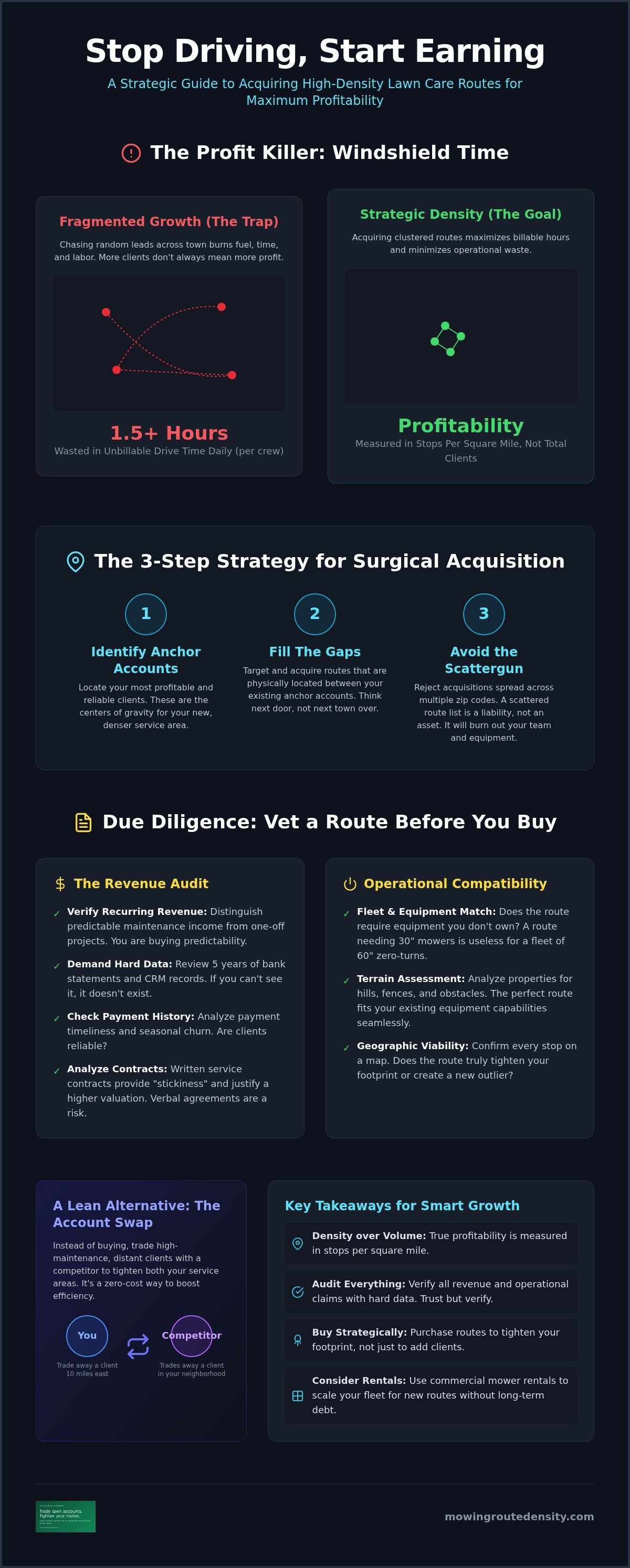
- Profitability is a function of density, not volume. Focus on stops per square mile to ensure every minute on the clock is billable.
- Audit every acquisition for geographical viability and verify revenue through hard data like bank statements and CRM records.
- Strategically buy lawn care routes to tighten your footprint and eliminate the fuel costs associated with fragmented service areas.
- Trade away high-maintenance outliers for local stops using account swapping to optimize your existing crew's efficiency.
- Scale your fleet without the burden of long-term maintenance by utilizing commercial mower rentals for newly acquired routes.
Why Buying Lawn Care Routes is a Logistics Strategy, Not Just a Growth Tactic
Growth for the sake of growth is a trap. It's a vanity metric that often hides operational rot. If you double your client list but triple your service area, you aren't scaling. You're bleeding. In the Landscape maintenance industry, profit is won or lost in the gaps between properties. With the market projected to reach $176.7 billion in 2026, the opportunity is massive, but so is the potential for waste. When you buy lawn care routes, you shouldn't just be looking for revenue. You should be looking for proximity. Profitable density is measured by stops per square mile. If that number is low, your fuel tank and your payroll are subsidizing the commute. Distance is a tax you choose to pay. Stop paying it.
The Math of Windshield Time
Windshield time is the enemy of the bottom line. It's labor you pay for but can't invoice. Think about the math of a typical day. A five-minute drive between stops seems small. Multiply that by twenty stops a day. That's over an hour and a half of unbillable labor per crew. At 2026 labor rates, that's a massive leak in your bucket. Reducing that gap by just five minutes per stop transforms your profit margin instantly. Clustering accounts isn't a suggestion; it's a survival tactic. Every minute your crew spends behind a steering wheel is a minute they aren't generating revenue. Your truck is a tool, not a mobile office. Tighten the radius and watch the billable hours climb.
Acquiring for Density
Strategic acquisition beats organic marketing because marketing is a gamble. A Facebook ad might get you a lead ten miles away. To buy lawn care routes is to perform a surgical strike. You're purchasing established cash flow in a specific neighborhood. It's the difference between fishing with a single line and buying the whole pond. To do this effectively, follow these steps:
- Identify Anchor Accounts: Locate your most profitable, reliable stops. These are the centers of your gravity.
- Fill the Gaps: Target routes that occupy the physical space between your current clients. Look for the house next door or the street behind.
- Avoid the Scattergun: Don't buy a list of 50 accounts spread across three zip codes. That isn't an asset; it's a liability that will burn your equipment and your team.
Buying for density means you can service more clients with fewer trucks. It reduces wear on your fleet and keeps your crews productive. In a tight labor market, making the work easier for your team by cutting out the commute is a competitive advantage you can't ignore.
Due Diligence: How to Vet a Lawn Care Route Before You Buy
Buying a business based on a handshake and a spreadsheet is a recipe for bankruptcy. Sellers are motivated to show you their best day, not their worst. To protect your capital, you must perform rigorous Due Diligence before signing any contracts. A route isn't just a list of names. It's a logistical puzzle. If the pieces don't fit your existing operation, the acquisition will drain your resources rather than replenish them. Verify every claim. Audit every stop. If you can't see the data, the revenue doesn't exist.
The Revenue Audit
Revenue quality matters more than revenue volume. You need to distinguish between recurring maintenance and one-off project work. Project revenue is a bonus; recurring revenue is the backbone. When you buy lawn care routes, you're paying for predictability. Demand to see bank statements and CRM records from the last five years. Look for patterns in payment history and seasonal churn. Are clients paying on time? How many cancel after the first frost? If the average ticket price per stop is significantly lower than your current minimum, you're buying a headache. Check if the accounts are tied to written service contracts or just verbal agreements. Written contracts provide the "stickiness" that justifies a higher valuation multiple.
Operational Compatibility
Your current fleet dictates which routes are viable. Don't buy a route that requires specialized equipment you don't own unless you're prepared to invest in new assets immediately. Terrain is the deciding factor. A route comprised of large commercial properties is worthless if your crews only run 30-inch push mowers. A fleet of 60-inch zero-turns is useless in a neighborhood of fenced-in residential lots. The perfect fit route is one where your existing equipment can enter, service, and exit the property without manual workarounds or specialized tool requirements. If you find a route that fits your geography but stretches your equipment capacity, consider using a professional equipment rental service to bridge the gap during the transition. Efficiency dies when you force the wrong tool into the wrong yard.
The Account Swap: A Lean Alternative to Buying Routes
Cash isn't the only way to scale. Sometimes, the smartest move is a trade. Most contractors carry "outlier" accounts-those one-off stops that sit ten miles outside the core cluster. They're profit killers. Instead of trying to buy lawn care routes to fill the space between, you can simply trade your outliers for accounts that sit inside your existing footprint. This is a capital-free growth strategy. It fixes your logistics without touching your bank balance. It turns your logistical weaknesses into bargaining chips.
Identifying Your Tradeable Assets
Start with a route audit. Look for the accounts that force your crew onto the highway for more than ten minutes. These are your tradeable assets. To you, they're a drain on fuel and labor. To a competitor whose shop is two blocks away, they're high-density gold. By using a lawn account trading platform, you can find local partners who are dealing with the same fragmentation. You trade your distant headaches for their local stops. The result is a tighter footprint and an immediate increase in billable hours per man-hour. You aren't just losing a client; you're gaining a more profitable schedule.
The Mechanics of a Successful Swap
A successful swap requires more than just a map. You need revenue parity. If you're trading a $60 mow, you expect a $60 mow in return. You also need to standardize service levels. Clients don't care about your logistics; they care about their grass. Ensure the partner you're trading with maintains the same quality standards you do. This prevents churn during the handoff. Use a neutral marketplace to facilitate the transfer. This ensures the data is verified and the transition is professional.
Collaboration beats competition when the goal is efficiency. Swapping accounts allows you to buy lawn care routes in spirit by acquiring density through exchange. It's a surgical approach to growth that prioritizes the bottom line over top-line vanity. Stop driving across town for one yard. Trade it away. Stay where the profit is. Tighten your radius and stop subsidizing the commute with your hard-earned margins.
Scaling Your Fleet: Managing Equipment for New Routes
Inherited equipment isn't a gift. It's often a repair bill disguised as an asset. When you buy lawn care routes, the seller's old fleet is frequently at the end of its lifecycle. You're buying their headaches. If a mower goes down during the first week of a new route, you risk losing clients before you've even earned their trust. Uptime is non-negotiable. You need a strategy that prioritizes reliability without burying your business in high-interest debt. Retention depends on your ability to show up. Broken equipment ensures you won't.
Rental vs. Purchase for New Routes
Scaling quickly requires capital. Spending it all on iron is a mistake. Asset-light growth allows you to expand your capacity without the long-term burden of ownership. Utilizing professional lawn equipment rental provides the flexibility to handle a sudden influx of accounts. It preserves your cash flow for other operational needs. If the new route doesn't perform as expected, you aren't stuck with a monthly payment on a machine you don't need. Exploring commercial lawn mower lease options can bridge the gap between seasonal demand and permanent fleet expansion. Renting allows you to test the topography of a new route before committing to a specific mower type. You get to use the right tool for the job without the risk of a bad purchase.
Optimizing Labor with Better Tech
New routes often come with old productivity benchmarks. Your goal is to beat the previous owner's times. If the route consists of tight residential lots, stand-on mowers offer superior visibility and speed compared to traditional zero-turns. They allow your crews to move faster and stay fresher. Modern equipment reduces labor fatigue and turnover by making the job physically less demanding. When you buy lawn care routes, you're buying labor hours. Maximizing the efficiency of those hours is the only way to increase your margins. Equip your team with tools that work as hard as they do. Don't let outdated machinery slow down a high-density route.
Ready to scale without the debt? Rent commercial-grade mowers through our marketplace to keep your new routes profitable from day one.
Execution: How to Buy Mowing Routes on Mowing Route Density
Execution is where strategy meets reality. You've done the math. You've vetted the numbers. Now you need to pull the trigger. Serious contractors don't waste time on generic classified sites. Craigslist is for homeowners selling old mowers; it isn't for professionals looking to buy lawn care routes. You need a specialized B2B environment where density is a data point, not a buzzword. Mowing Route Density provides the framework to find, filter, and finalize acquisitions that actually make sense for your bottom line. Stop browsing and start targeting.
The process starts with a professional profile. This isn't a social media page. It's your operational resume. Once active, you can filter listings by the metrics that matter: stops per square mile, specific equipment requirements, and verified revenue. This precision prevents you from chasing routes that would only add windshield time to your schedule. You're here to cut waste, not add it. Connect with sellers through secure tools that prioritize professional transparency over vague promises.
The Professional Marketplace Advantage
Specialized platforms offer a layer of security and intent that generic brokers lack. By leveraging the lawn mowing service provider locator, you can identify strategic partners in your immediate service area. This tool isn't just for buying. It's for building a network. You're looking for contractors whose routes overlap with yours. These connections lead to future trades, acquisitions, and collaborative growth. It turns the fragmented market into a targeted list of opportunities. It's about finding the right neighbor, not just the right price.
Post-Acquisition Integration
The first 30 days after a purchase are a sprint. Your primary goal is retention. Clients are often wary of new ownership. Show up on time. Maintain the quality. Prove the transition is seamless. During this window, you must perform a comprehensive lawn care route density audit to see exactly how these new accounts mesh with your existing crews. Data from the previous owner is a starting point, but your own audit is the truth.
Don't just tack new stops onto the end of an old list. Re-route your entire fleet. Move accounts between trucks to ensure every crew is operating at peak efficiency. If a new account sits next to an existing client on Route A, but you put it on Route B, you've failed the logistics test. Tighten the radius immediately. When you buy lawn care routes, the profit isn't in the purchase price. It's in the optimization that follows. Own the neighborhood, not just the names.
Stop Driving and Start Dominating Your Local Market
Success in this industry isn't about the size of your logo. It's about the tightness of your radius. You've learned that growth without density is a financial drain. Windshield time is a tax you can't afford to pay. Whether you choose to swap outliers or buy lawn care routes, every decision must prioritize billable hours over total revenue. Vetting your acquisitions with data ensures you aren't inheriting another owner's mechanical failures or logistical nightmares.
Lean operations are the only way to survive rising fuel and labor costs. Use our national marketplace for account trading and commercial mower rentals to scale without the debt trap. Focus on overhead reduction and route optimization. The path to a more profitable business is through a smaller, denser map. It's time to stop chasing leads across the county and start owning your neighborhood. You have the tools to build a business that works for you, rather than you working for the commute.
Browse high-density lawn care routes for sale on our B2B marketplace.
Frequently Asked Questions
How much does it typically cost to buy a lawn care route?
Small owner-operated businesses typically trade between 2.5x and 5x of Seller’s Discretionary Earnings (SDE). Larger operations with over $1M in earnings can command 4x to 8x EBITDA. The price depends on route density and equipment condition. Don't pay a premium for a fragmented list. A route with high travel time is worth less than a tight cluster. Focus on the cash flow, not the top-line revenue number.
What is the standard multiplier for valuing a lawn care client list?
The standard multiplier for residential businesses is often 3x to 5x SDE. If the business has a high percentage of recurring revenue, usually 60% or more, it can command a higher turn. Commercial accounts often trade at a premium compared to residential. Buyers pay for predictability. If the route book is documented and automated, expect to pay more. Documented systems reduce the risk of client churn during the transition.
Is it better to buy a residential or commercial lawn care route?
Commercial routes are generally superior because they offer more predictable revenue and higher valuation multiples. HOAs and office parks provide the stability that residential accounts lack. However, residential routes often offer better density in specific neighborhoods. Your choice should depend on your existing fleet. If you run large zero-turns, stay commercial. When you buy lawn care routes, ensure the properties fit your specific equipment and crew size; utilizing WithEasement to check property data and recorded easements can help you identify potential access issues or boundary restrictions before finalizing the purchase.
How do I protect myself from clients leaving after I buy the route?
Protect your investment by including a retention clause in the purchase agreement. This allows you to hold back a portion of the sale price based on client stay-rates after 90 days. Ensure all contracts have an assignability clause. This legally permits the transfer of service to your company. A seamless transition is critical. Introduce yourself early and maintain the same schedule to minimize perceived changes for the customer.
Can I buy just a portion of someone else’s lawn care route?
Yes, you can buy specific clusters to improve your density. Many contractors sell off distant accounts to focus on their core service area. This is often more efficient than buying an entire company. Use a specialized marketplace to find these specific opportunities. Targeted acquisitions allow you to grow without adding unnecessary windshield time. It’s a surgical way to expand your footprint while keeping your overhead low.
What equipment should I have ready before buying a new route?
You need equipment that matches the terrain of the new route. Don't assume your current fleet is a perfect fit. If you acquire commercial accounts, you'll need high-capacity zero-turns. For residential routes, stand-on mowers often provide better speed and visibility. Consider commercial mower rentals to bridge the gap during the initial 30 days. This keeps your capital liquid while you assess the true needs of the new accounts.
How do I handle the transition of employees when buying a route?
Employees are your most valuable asset during an acquisition. They hold the relationship with the client and know the route's quirks. Offer a retention bonus to keep key personnel through the first 90 days. Meet with them early to explain the new culture and benefits. If their skill set doesn't match your standards, plan for a gradual phase-out. Abrupt changes in personnel often lead to abrupt client cancellations.
Are contracts legally binding when I buy a lawn care business?
Contracts are legally binding only if they include a valid assignment of contract clause. Without this, the client is technically free to walk away the moment the business changes hands. Verify every contract during due diligence. Check for expiration dates and renewal terms. If the seller relies on verbal agreements, the route is significantly higher risk. Always have a professional review the agreement before you buy lawn care routes.


