

Your internal crews are likely costing you money every time they cross a county line. Most owners think growth requires more trucks, more debt, and more headaches. They're wrong. Learning how to get lawn care subcontracts is the only way to achieve asset-light scaling in a high-cost environment. It isn't a backup plan for when you're busy. It's a tactical tool for aggressive capacity management.
You've felt the sting of drive time eating your margins. You've worried about a third party's quality reflecting poorly on your brand. It's frustrating to watch profit bleed out through windshield time while you struggle to verify if a partner even has the right insurance. We're going to fix that. This guide provides the tactical framework you need to identify, vet, and manage subcontractors to scale your operations without touching your fixed overhead.
We'll break down how to use service provider locators to find vetted partners and how to leverage equipment rentals to boost their capacity. You'll learn to tighten your route density and squeeze more billable hours out of your internal teams. It's time to stop managing labor and start managing logistics.
Key Takeaways
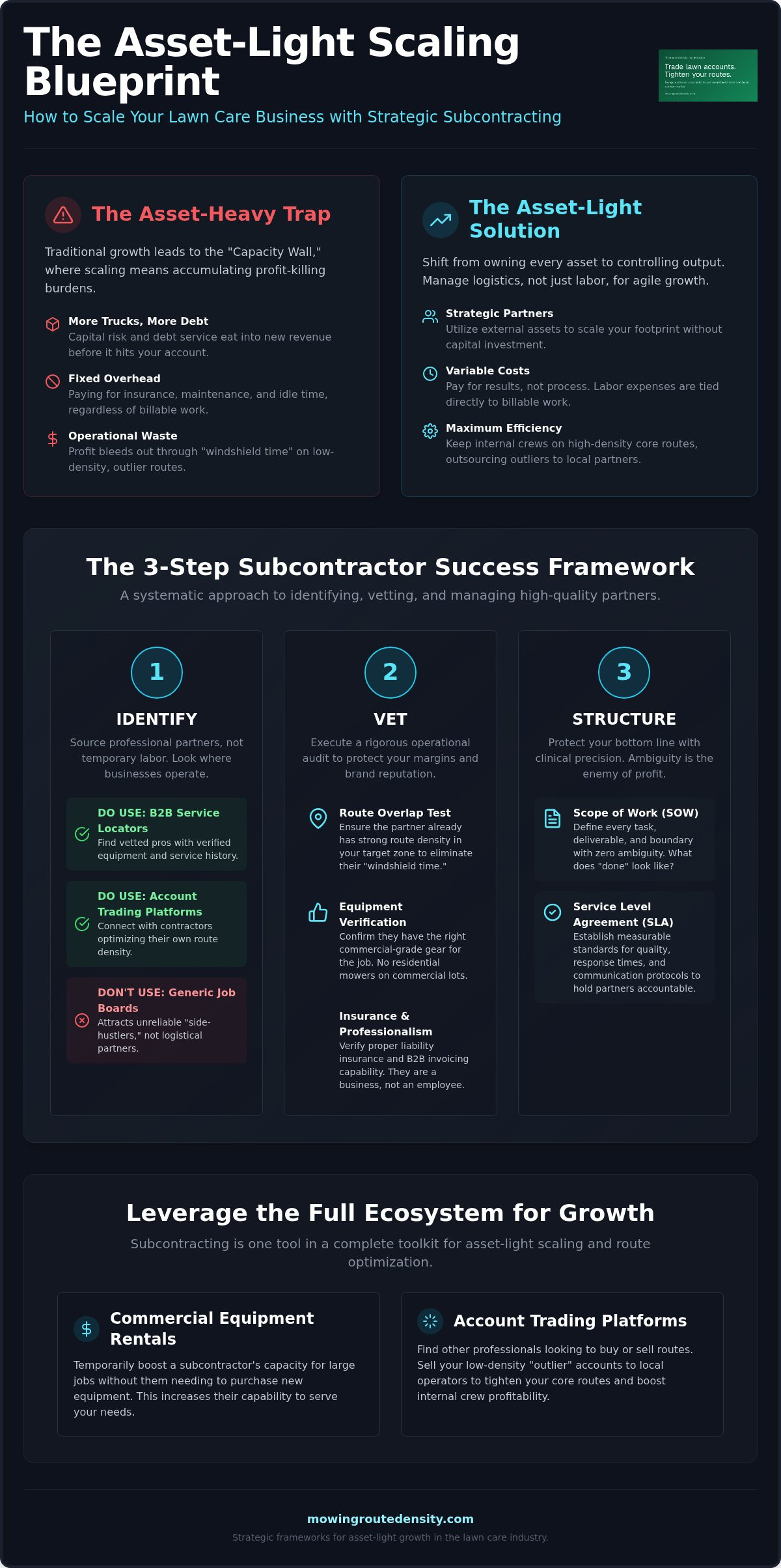
- Stop treating subcontracting as a backup plan. Shift to strategic capacity management to scale your business without the burden of new equipment debt.
- Master how to get lawn care subcontracts by utilizing professional provider locators that connect you with B2B-ready partners instead of unreliable leads from generic job boards.
- Execute a rigorous operational audit. Use the Route Overlap test and equipment verification to ensure your partners protect your margins and service quality.
- Protect your bottom line with clinical precision. Define every Scope of Work and Service Level Agreement to eliminate ambiguity and hold third parties accountable.
- Leverage a full ecosystem of tools. Use commercial equipment rentals and account trading platforms to equip your subcontractors and optimize your route density for long-term growth.
Why Strategic Subcontracting is the Key to Asset-Light Growth
Strategic capacity management isn't just about hiring extra hands. It's the calculated move from owning every asset to controlling the output. Most owners hit a "Capacity Wall" when they try to scale. They think more revenue requires more trucks, more mowers, and more debt. It's a trap. Debt service and maintenance eat the gains before they hit your bank account. Knowing how to get lawn care subcontracts allows you to scale your footprint without the anchor of a massive fleet. You use external assets to protect your internal margins.
The math is blunt. Internal crews carry heavy overhead. You pay for their insurance, their idle time, and their training. A subcontractor is a fixed cost. You pay for the result, not the process. This shift turns your labor expenses from a fixed burden into a variable cost. You only pay when you have billable work. That's how you protect your bottom line in a volatile market. It's about moving fast without the capital risk of traditional expansion.
The Asset-Light Business Model
Growth shouldn't feel like a weight. An asset-light model prioritizes agility over ownership. You keep your internal crews on high-density, high-margin core routes. You outsource the rest. By following standard subcontractor legal definitions, you establish a professional B2B relationship that offloads the risk of equipment depreciation. Your primary fleet stays local. Your profit stays high. You focus on winning contracts while others manage the mowers.
Eliminating Operational Waste
Drive time is a silent profit killer. If your crew spends 45 minutes on the highway to service one commercial lot, you've already lost. Subcontract that outlier. Use a local partner who is already in that neighborhood to handle the work. This is the foundation of lawn care profit margin optimization. You maintain the contract and collect the management fee while eliminating the fuel burn. It's also the perfect way to test new markets. Don't buy a truck for a new territory until the revenue is guaranteed. Use a sub first. It's common sense. It's efficient. It works.
Where to Find High-Quality Lawn Care Subcontractors
Stop looking for business partners on residential job boards. Craigslist and Indeed are magnets for entry-level labor and "side-hustle" operators. They lack the infrastructure, insurance, and professional mindset your commercial clients demand. Generic job boards attract individuals looking for a paycheck, not companies looking for a contract. You'll spend more time teaching these individuals how to invoice than they'll spend mowing. It's a waste of administrative time. Mastering how to get lawn care subcontracts requires you to identify peers who already have established routes and commercial-grade gear. You aren't looking for a worker. You're looking for a logistical partner who can execute without hand-holding.
Industry-specific marketplaces are the only place to find contractors with existing route density. These platforms allow you to tap into a network of professionals who are already operating in your target zones. This is especially critical for national project fulfillment. When you bid on multi-state contracts, you need a web of local experts. You act as the central hub. They provide the local muscle. This leverage is how you move from a local outfit to a regional power without increasing your fixed overhead.
The B2B Service Locator Advantage
A specialized lawn mowing service provider locator is your most effective filter. It targets professional entities specifically. These platforms allow you to search by equipment capability. You can verify if a sub has the right commercial mowers for high-acreage sites before the first phone call. It also helps you verify service history. You can see who is reliable and who isn't. This prevents the "no-show" nightmare that ruins your reputation with prime clients. It's about vetting for capability, not just availability.
Strategic Networking and Account Trading
Strategic networking often happens through a lawn account trading platform. These marketplaces allow you to find contractors who need to offload routes for their own density. It's a tactical exchange. You might have accounts that are outliers for you but core for them. Trading or subcontracting these accounts creates a permanent capacity shift. It builds a bench of reliable partners before you hit a capacity crisis. Following formal SBA subcontracting guidelines during this process ensures your B2B relationships are legally sound. You can start vetting your next partner by searching our national provider locator to see who is already operating in your target zones.
Vetting for Route Density: The Operational Audit
Do not be fooled by a clean social media profile or a few high-quality photos. Effective vetting is about logistics, not aesthetics. When you're figuring out how to get lawn care subcontracts that actually stick, you must perform a cold-blooded operational audit. If a potential subcontractor doesn't have existing route density near your accounts, they will eventually quit or ask for a price hike. Their drive time is your risk. You need to see their current route map. You need to see their equipment list. You need to see their insurance certificates. Anything less is just gambling with your reputation.
The Route Overlap test is your primary filter. Ask where their current clusters are. If they are already mowing three properties on a specific block, adding your fourth property is pure profit for them. That's the leverage you want. It's one of the core reasons for subcontracting: capturing efficiency that you can't achieve with your own remote crews. If they have to drive twenty miles to reach your site, the partnership is doomed before the first cut. You want partners who are already in the neighborhood.
Logistics and Route Alignment
Drive time is a toxic asset. You must analyze their service areas to ensure minimal travel between accounts. The ultimate objective is high lawn care route density for both parties. When a subcontractor is close to their own shop or existing accounts, they can offer you a more competitive rate. They spend less on fuel. They spend less on non-billable labor. You capture that savings in your margin. Tight routes make for stable partnerships.
Equipment and Asset Verification
Residential gear has no place on a commercial subcontract. You need to verify that your partners are using commercial-grade mowers. Ask for maintenance records. Check the hour meters. If their fleet is aging or insufficient, suggest commercial lawn mower lease options to help them upgrade their capacity. They get better tools. You get guaranteed uptime. It's a professional solution to a capacity problem. Ensure their fleet capacity matches your peak-season demand before signing the contract.
Financial due diligence is non-negotiable. Verify their general liability insurance and workers' comp. In 2026, national commercial contracts often require specific liability minimums; ensure they meet them. Once the paperwork is clean, start with a trial period. Give them a small cluster of three to five accounts. Watch their timing. Watch their quality. If they can't handle a small cluster, they'll never handle a whole territory. Use the trial to find the cracks before they become craters.
Structuring the Subcontractor Agreement for Profitability
A handshake isn't a contract. It's a liability. Most owners fail because they treat subcontracting like a casual favor between friends. It's a B2B transaction that requires clinical precision. Your Scope of Work (SOW) must leave zero room for "I didn't know." Specify the exact height of the cut. Define the edging requirements for every hard surface. Detail the debris removal process. If you're learning how to get lawn care subcontracts that actually scale, you must realize that a vague agreement leads to service drift. Service drift leads to lost clients. You aren't just hiring help. You're securing a result.
Set clear Service Level Agreements (SLAs) for timing and quality. If a commercial property must be serviced by Tuesday at 5:00 PM, put it in the contract. Liability is another non-negotiable pillar. In 2026, standard national commercial contracts typically require at least $1 million in general liability insurance. Verify their policy. Don't take their word for it. Demand a certificate of insurance (COI) that names your business as additionally insured. Protect your assets before you start sharing your profits. Payment terms should align with performance. If the work isn't done to spec, the payment doesn't trigger. It's that simple.
The Quality Control Framework
You can't be at every site. You shouldn't have to be. Implement a photo-per-service requirement via mobile apps for remote verification. No photo means no payment. This provides a digital trail you can show your clients to prove the work happened. Establish a 24-hour callback rule. If a customer complains, the subcontractor has one day to fix the issue at their own expense. Define grounds for termination with total clarity. If they miss two consecutive services or fail to provide verification photos, the partnership is over. Your brand reputation is more valuable than any single subcontractor relationship.
Pricing and Margin Protection
Flat-rate pay is usually safer for your bottom line. It keeps your costs predictable and your math simple. Percentage-based pay can work, but it often complicates your margins during seasonal peaks. Build in density bonuses for partners who take on clustered accounts. If a sub handles three properties on the same block, give them a small incentive. It rewards the efficiency that saves you money. Address equipment failures upfront. If their mower breaks, they bear the cost of the delay and the responsibility of finding a backup. To find partners who already understand these professional standards, search our national provider locator to connect with B2B-ready contractors.
Scaling with Mowing Route Density’s Ecosystem
Scaling is a logistical puzzle. You've identified the need for partners. Now you need a system that doesn't break under pressure. Mowing Route Density isn't just a directory. It's an ecosystem designed to eliminate the friction of B2B growth. By using our service provider locator, you bypass the amateurs and connect directly with contractors who understand commercial standards. You've already learned how to get lawn care subcontracts through vetting and audits. This platform is how you manage those relationships at a national scale.
One of the biggest hurdles in subcontracting is the "capacity gap." A potential partner might have the skills but lack the fleet to handle your largest commercial accounts. We solve this. Using professional lawn equipment rental allows you to equip your subcontractors without taking on long-term debt. You provide the machine. They provide the labor. You keep the margin. It's a clean, clinical way to expand your footprint without increasing your fixed overhead. You stop being a mower and start being a logistics manager.
Think about the end game. A business tied to its owner's personal labor or a massive, aging fleet is difficult to sell. A business built on optimized routes and reliable B2B partnerships is a high-value asset. Shifting to an asset-light model is a core part of a lawn care business exit strategy. You're building a machine that runs on systems, not just sweat. Investors buy cash flow and route density. They don't buy trucks and headaches. Subcontracting outliers today secures your liquidity tomorrow.
Integrated Capacity Management
Our platform streamlines the entire scaling process. You can find a vetted sub, rent them a commercial-grade mower, and assign them a dense route cluster in a single workflow. This eliminates the administrative waste of managing multiple vendors. It allows you to bid on national contracts with total confidence. You focus your energy on high-level sales and strategy. We handle the asset logistics and provider connections. It's about working smarter by leveraging an existing infrastructure rather than building your own from scratch.
Next Steps for Your Fleet
Start with a cold-blooded audit of your current routes. Identify the low-density outliers that are killing your profit. These are your first candidates for subcontracting. Once you've mapped your needs, list them on our service provider locator. Don't wait for a capacity crisis to start building your network. Finally, contact Mowing Route Density to discuss fleet-scale equipment rental solutions. Stop buying mowers. Start buying margins. It's time to tighten your operations and cut the waste.
Operational Mastery: Your Path to Asset-Light Scaling
Scaling your business doesn't have to mean drowning in equipment debt. By mastering how to get lawn care subcontracts, you shift your focus from managing mowers to managing margins. You've seen how a rigorous operational audit and a clinical Scope of Work protect your brand. You know that route density is the only metric that truly determines your profit. Now it's time to execute.
Stop letting drive time eat your revenue. Use our ecosystem to find vetted partners, rent commercial-grade equipment to boost their capacity, and trade outlier accounts for dense clusters. This isn't just about growth. It's about building a liquid, high-value asset that works for you. You've got the framework. Now use the tools to tighten your operations and cut the waste.
Find your next professional partner on our Service Provider Locator. Access our national network of vetted commercial contractors, utilize flexible commercial mower rentals to scale capacity instantly, and leverage secure account trading to optimize your route density. Build the business you deserve.
Frequently Asked Questions
How much should I pay a lawn care subcontractor in 2026?
What insurance does a landscaping subcontractor need for commercial work?
Commercial subcontractors must carry General Liability insurance with a minimum of $1 million per occurrence. They also need Workers’ Compensation insurance, even if they operate as a solo entity in certain states. You must require a Certificate of Insurance that names your business as an additionally insured party. This protects your assets from third-party claims. Never allow a crew onto a commercial site without verifying these active policies first.
Can I prevent a subcontractor from stealing my lawn care clients?
You should use a non-solicitation clause in your formal B2B agreement to legally bar them from poaching accounts. Beyond legalities, the best defense is a professional partnership. If you provide them with consistent work and dense routes, they won't want the administrative burden of managing the prime client. When you're learning how to get lawn care subcontracts, remember that being a reliable source of revenue makes you more valuable than a competitor.
How do I verify the quality of a subcontractor’s work without being on-site?
Implement a mandatory digital verification process using mobile apps for "before and after" photos. No photo means no payment. This creates a digital trail for your clients and ensures the work meets your Service Level Agreements. You should also establish a 24-hour callback rule where the sub must fix any quality issues at their own expense. This framework allows you to manage remote capacity without wasting time on constant site visits.
Is it better to hire an employee or a subcontractor for lawn mowing?
Your contract must clearly state that the subcontractor is responsible for their own equipment uptime and backup solutions. If their mower fails, they bear the cost of any delays. To mitigate this risk, you can facilitate commercial mower rentals through a professional platform to ensure they have reliable gear. Don't let their mechanical failure become your missed deadline. Professional partners should always have a contingency plan for fleet issues.
How do I find subcontractors for large-scale national landscaping projects?
Use a specialized national service provider locator to identify vetted, B2B-ready partners in remote territories. Generic job boards are inefficient for high-stakes national contracts because they lack professional filters. A dedicated platform allows you to search by equipment capability and service history. This is the most effective way to bid on multi-state portfolios with zero additional CAPEX. You act as the strategic hub while local experts provide the labor.
What are the IRS requirements for 1099 lawn care subcontractors?
The IRS requires you to issue a Form 1099-NEC if you pay a subcontractor $600 or more in a tax year. You must collect a signed W-9 form before the first payment is issued. To remain compliant, you cannot control the specific methods or timing of their work, only the final result. Misclassifying employees as subcontractors can lead to severe financial penalties. Understanding how to get lawn care subcontracts properly requires strict adherence to these federal guidelines.


