

Owning a commercial mower in 2026 isn't an investment. It's a slow-motion leak in your balance sheet. Every hour that engine runs, your capital evaporates. You're likely tired of watching depreciation eat your profits before the grass even grows back. It's a common trap. You buy a massive fleet to handle peak demand. Then you watch those machines sit idle and lose value all winter. Relying on seasonal lawn equipment rental for contractors changes the math entirely.
We agree that tying up your cash in aging iron is a liability you can't afford. This guide shows you how to transition to an asset-light strategy that prioritizes cash flow over ownership. You'll discover how to scale your fleet size based on route density without the burden of massive CAPEX or surprise repair bills. We'll explore the financial mechanics of long-term rentals, the shift toward 100% equipment uptime, and why the most profitable contractors in 2026 are renting their way to growth. It's time to stop managing a graveyard of equipment and start managing a business.
Key Takeaways
- Stop treating equipment as an investment when it’s actually a depreciating liability that drains your monthly cash flow.
- Leverage seasonal lawn equipment rental for contractors to align your fleet costs with peak revenue cycles and eliminate off-season waste.
- Deploy rented assets into high-density clusters to slash transport time and maximize billable hours per machine.
- Replace unpredictable repair bills and high-interest financing with a fixed monthly overhead for 100% equipment uptime.
- Combine flexible rentals with route trading to scale your business without the burden of massive capital expenditures.
Rethinking Asset Ownership in the Landscaping Industry
Buying a fleet of commercial mowers feels like an achievement. It looks like growth on paper. In reality, it's often a strategic anchor. In 2026, heavy asset ownership is a liability that stifles agility. You're locking your capital into "iron" that begins losing value the second the trailer gate drops. This is the ownership trap. It forces you to manage machines instead of managing profit margins. Consider the following drains on your capital:
- Depreciation: New equipment loses significant value the moment it hits the turf.
- Maintenance: Aging fleets require constant, expensive labor to remain operational.
- Storage: You pay to house and insure machines that sit idle for four months a year.
The math on depreciation is brutal. A high-end zero-turn mower can lose a massive chunk of its resale value in the first season alone. You're paying for the full life of a machine you only need for eight months of the year. This is where seasonal lawn equipment rental for contractors provides a tactical advantage. By choosing a rental model, you outsource the depreciation risk. You only pay for the utility of the machine during the months it's actually generating revenue. Think about the opportunity cost. A $15,000 down payment for a new unit could instead fund a marketing blitz or the acquisition of a competitor's route. One choice buys you a depreciated tool; the other buys you a growing business.
The Real Cost of Equipment Downtime
A mower in the shop doesn't just cost parts and labor. It costs billable hours that you can never recover. When a machine fails during the peak spring surge, your route density suffers. You're forced to shuffle crews, delay clients, and potentially lose contracts. Ownership ties your hands. You're stuck with the equipment you have, regardless of its condition. Transitioning to an equipment rental business model ensures 100% uptime. If a machine breaks, it's the rental provider's problem to solve, not yours. Stop fixing. Start growing.
CAPEX vs. OPEX: A Strategic Distinction
Understanding the difference between Capital Expenditure (CAPEX) and Operational Expenditure (OPEX) is vital for a lean operation. CAPEX involves massive cash outlays and long-term debt that clutters your balance sheet. OPEX, or renting, keeps your costs predictable and your cash liquid. In 2026, tax codes reward businesses that maintain lean operational spending. Consulting with a tax professional on how Section 179 applies to your seasonal lawn equipment rental for contractors can reveal significant savings compared to traditional ownership. Keeping your balance sheet light makes your company more attractive for future acquisitions or route trades. A lean business is a scalable business.
The Strategic Framework for Long-Term Commercial Rentals
Stop thinking about rentals as a "quick fix" for a broken engine. That mindset keeps your business small. In 2026, the most efficient operators use long-term agreements as a structural strategy. Moving beyond daily rates to seasonal or annual contracts changes your cost basis. You move from high-interest debt to a flat, predictable monthly fee. This stabilizes your annual cash flow. It allows for precise budgeting. You can reference SBA guidelines on equipment financing to see how this approach keeps your credit lines open for other investments.
Running a "Fresh Fleet" is a competitive advantage. Technology changes fast. Fuel efficiency improves. Ergonomics reduce crew fatigue. When you own, you're stuck with 2021 technology in 2026. When you rent, you're always running the latest models. You also shift the risk of catastrophic failure. If a hydraulic pump explodes on a rented unit, you aren't staring at a $3,000 repair bill. You're calling for a replacement. Your billable hours don't stop just because a machine did.
Scaling Your Fleet for Seasonal Density
Spring growth is a double-edged sword. You need more capacity, but you don't want year-round debt. seasonal lawn equipment rental for contractors solves this imbalance. You can add units specifically for the peak growth months. Once the summer heat slows the grass, you return the assets. You save on storage. You skip the winterization costs. You only pay for the machines when they are actively cutting. This flexibility lets you match specific mower types to high-density clusters for maximum efficiency. To start building a more agile operation, explore how lawn care route density and equipment management work together.
Access to Specialized High-Performance Machinery
Don't let your current fleet limit your bidding. Many contractors pass on lucrative commercial jobs because they lack specialized wide-area mowers. Rental removes that barrier. You can rent the exact machine needed for a specific contract. It's also an ideal way to trial new equipment. Compare stand-on mowers against zero-turns in the field before making a long-term commitment. Standardizing your fleet through a rental partner also simplifies training. Your crews use consistent controls across every job site. This consistency reduces operator error and maintenance issues. If you want to tighten your operations, a professional lawn mower rental service is the first step toward a leaner, more profitable business.
Optimizing Route Density Through Equipment Flexibility
Route density isn't just about geography. It's about how effectively your assets cover that geography. When you own your fleet, your logistics are fixed. You're forced to send whatever machine you have to whatever route you keep. This is inefficient. By utilizing seasonal lawn equipment rental for contractors, you gain the flexibility to match your tools to your density. If you trade a residential route for a large commercial cluster, you swap a 36-inch walk-behind for a 72-inch zero-turn. No long-term debt. No dead weight.
Asset clustering is the next level of operational maturity. You deploy rented mowers to specific high-density zones. This reduces transport time. It keeps trailers off the road and blades in the grass. If you're weighing the costs of expanding your fleet, consult this comprehensive guide to buying business equipment to see why locking into ownership often fails the flexibility test. Renting allows you to pivot. When you trade accounts on the marketplace, your equipment follows your strategy, not the other way around. You stop paying for mowers that serve routes you no longer own.
Maximizing Billable Hours with Reliable Assets
Equipment uptime is the heartbeat of your profit margin. A broken mower is a logistical disaster that ripples through your entire schedule. Rented assets ensure that your high-density routes stay on track. You can also match mower deck sizes to the specific gate widths or acreage of your current route list. This optimization reduces fuel consumption and operator fatigue. In 2026, lawn care route density is the primary driver of profit for every landscaping enterprise. Every minute spent in transit is a minute you aren't getting paid. High-performance rentals ensure that every billable hour is maximized.
Subcontracting and Fleet Integration
Scaling often requires more boots on the ground. When you find lawn care subcontractors to handle overflow, you face a quality control problem. Do they have the right gear? Is it reliable? You can solve this by providing them with long-term rental units. This standardizes your service quality across your entire network. It also lowers the barrier to entry for new service partners who might have the labor but lack the capital for professional-grade machines. You provide the route and the mower. They provide the labor. You keep the margin. It's a clean, scalable system that keeps your business asset-light and agile.
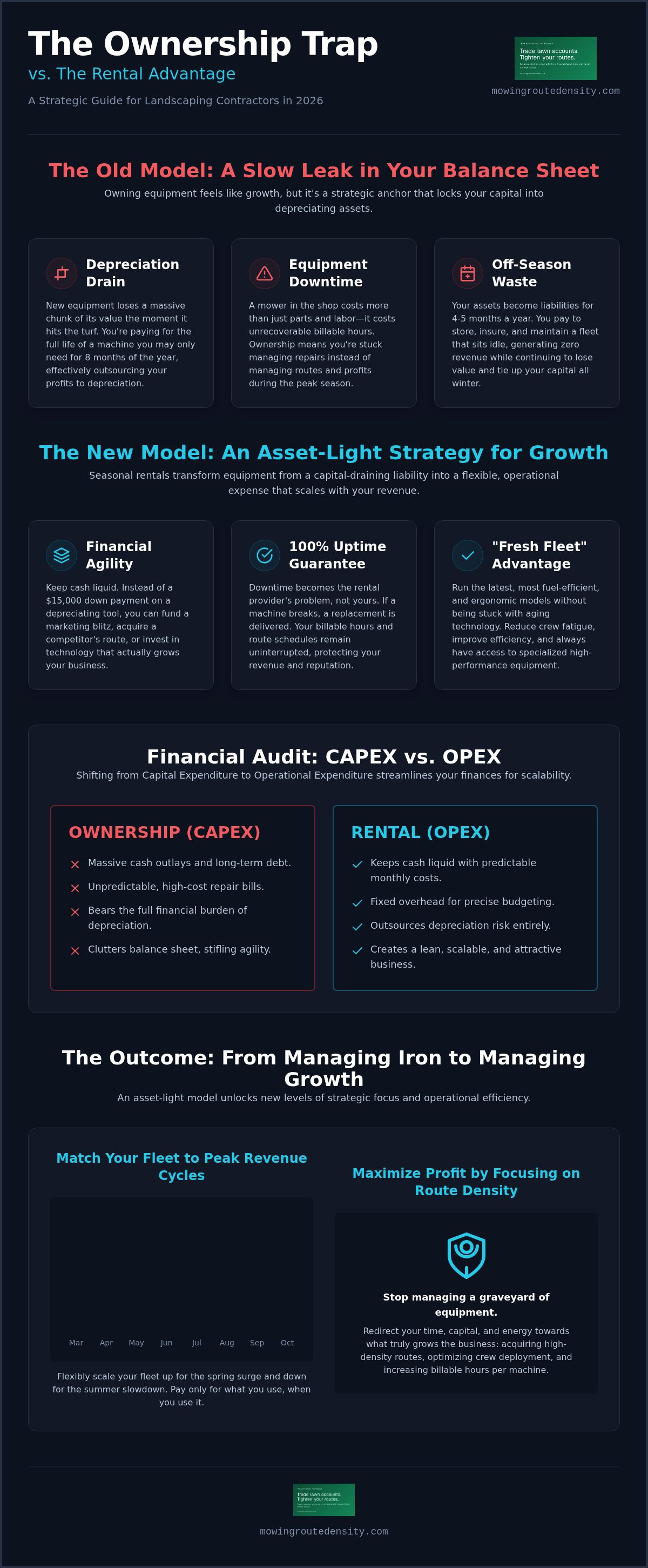
Financial Audit: Rental vs. Ownership for Fleet Expansion
Stop looking at the sticker price. It's a distraction. When you finance a new machine, you're only seeing the debt service. You aren't seeing the total weight on your balance sheet. In 2026, a direct comparison between monthly financing and long-term rental rates reveals a massive gap in "soft costs." Ownership requires you to handle insurance, registration, and routine maintenance. These aren't just expenses; they are management burdens. They steal time from your crews and focus from your strategy. Every hour you spend managing a title or a repair ticket is an hour you aren't optimizing your routes.
The depreciation gap is the silent profit killer. Calculate the resale value loss of a new commercial zero-turn over a three-year period. You'll find that you're paying for a significant portion of the machine's life while it sits idle during the off-season. seasonal lawn equipment rental for contractors eliminates this waste. You pay for the utility, not the asset. Tax implications also favor the lean model. While Section 179 allows for immediate depreciation of purchased gear, renting provides 100% deductibility as an operating expense. This keeps your cash flow predictable and your tax filing simple. You keep your capital liquid for growth, not buried in iron.
Predicting Your Total Cost of Operation (TCO)
A TCO model for a 60-inch commercial zero-turn mower must include more than fuel and blades. It must include downtime. If your owned machine is in the shop for a week, what is the cost of those lost billable hours? Ownership often looks cheaper on a spreadsheet but fails in the field. Rental agreements provide a guaranteed replacement unit. This is the value of peace of mind. You aren't just renting a mower; you're buying an uptime guarantee. You can't put a price on a crew that never stops moving because a hydraulic line blew.
Leveraging Commercial Lawn Mower Lease Options
Choosing between commercial lawn mower lease options and long-term rentals is a tactical decision. Leasing is often better for core fleet stability, while rentals provide the flexibility needed for rapid seasonal scaling. Fleet managers must use a decision matrix: is this asset for a permanent route or a temporary growth surge? Maintaining liquidity is the goal. You need cash available to move quickly on the lawn account trading platform. Don't tie your hands with high-interest equipment debt when you could be buying profitable routes instead. If you want to audit your current fleet for inefficiencies, explore our commercial rental solutions to see the math in action.
Implementing a Scalable Fleet Strategy with Mowing Route Density
Most rental companies treat equipment like a commodity. They hand you the keys and wish you luck. Mowing Route Density is different. We bridge the gap between iron and logistics. Our platform allows you to identify high-density clusters through route trading and then deploy the exact machines needed to service them. This isn't just about renting a mower. It's about building an asset-light growth engine. You use the platform to find the routes, then you use the equipment to cut them efficiently. This integrated approach ensures your machines are always where the profit is. It eliminates the friction of traditional fleet management.
Joining a national contractor network gives you the resources of a massive corporation while maintaining local control. You gain access to professional-grade gear without the corporate debt. This strategy allows for immediate deployment. When you acquire a new route, you don't wait for a financing approval. You rent the asset and start billing. It's a common-sense remedy to the capital bottlenecks that kill most landscaping businesses. Stop managing a graveyard of aging equipment. Start managing a high-velocity service enterprise.
Your 90-Day Fleet Transition Plan
Transitioning to a lean model requires a methodical approach. Start by auditing your current fleet. Identify the "dead weight" assets that spend more time in the shop than on the turf. These high-maintenance units are destroying your margins. Sell them. Use that cash to stabilize your balance sheet. Move toward a hybrid model where you own a lean core fleet for year-round work and utilize seasonal lawn equipment rental for contractors to handle peak growth. This shift has a direct impact on your lawn care profit margin optimization. You're paying for utility, not potential.
The Future of Landscaping Logistics
Profitability in 2026 is driven by route density, not machine ownership. The most successful companies will own fewer machines and more routes. Ownership is a drag on your exit value. A buyer wants a dense, profitable route list, not a trailer full of depreciated iron. Positioning your business for maximum liquidity means staying asset-light. It means being able to pivot when the market shifts. Take the next step in your operational evolution. Audit your route density today. Identify your equipment gaps. Then, use a strategic rental partner to fill them without the long-term risk. Your bottom line will thank you.
Secure Your Asset-Light Future in 2026
Ownership isn't a badge of honor. It's often an operational drain that limits your ability to pivot when the market shifts. By shifting to a strategic asset-light model, you stop paying for idle iron and start paying for billable hours. You've seen the math on depreciation. You've seen the true cost of mechanical downtime. Leveraging seasonal lawn equipment rental for contractors is the only pragmatic way to scale your landscaping enterprise without the crushing weight of high-interest debt or massive capital expenditures.
You now have the framework to audit your fleet, eliminate dead weight, and match your machines to your high-density route clusters. High-performance gear should be a flexible tool for expansion, not a permanent anchor on your balance sheet. Mowing Route Density is here to bridge that gap with B2B specialized equipment only, a national logistics network, and an integrated route trading marketplace designed for serious growth. Optimize your fleet and scale your routes with Mowing Route Density. It's time to stop managing waste and start managing margins. Your most profitable season is waiting for you.
Frequently Asked Questions
Is long-term commercial mower rental cheaper than financing a new unit?
Yes, when you factor in the total cost of ownership. Financing a new unit involves high-interest debt and immediate, crushing depreciation. Rental allows you to pay for utility only during revenue-generating months. You avoid the cost of storing, winterizing, and insuring idle assets during the off-season. For most contractors, the cash flow flexibility of a rental outperforms the long-term liability of a high-interest equipment loan.
What happens if a rented commercial mower breaks down mid-route?
You receive a replacement unit to ensure 100% equipment uptime. Unlike ownership, where a major hydraulic failure grounds your crew for days, a rental agreement shifts the repair burden to the provider. If a machine fails mid-route, it's swapped out. This protects your billable hours and keeps your route density targets on track. You stop paying for downtime and start paying for results.
Can I rent specialized equipment like stand-on mowers for a full season?
Professional-grade stand-on mowers are available for seasonal and annual agreements. This is a core component of seasonal lawn equipment rental for contractors. It allows you to trial specialized machinery on high-density routes without a massive capital commitment. You can match the mower deck size to specific contract requirements. If your route list changes, you aren't stuck with a specialized machine you no longer need.
Are routine maintenance costs included in long-term commercial rental agreements?
Routine maintenance is typically handled by the rental provider. This removes the hidden labor cost of your mechanics spending hours on oil changes, blade sharpening, and belt replacements. You outsource the logistical headache of fleet upkeep. By eliminating these maintenance intervals from your schedule, you free up your crew to focus on billable production. It's a common-sense way to tighten your operational overhead and improve margins.
How does long-term equipment rental affect my business taxes in 2026?
Rental payments are generally classified as operational expenditures (OPEX). This allows for 100% deductibility in the current fiscal year. Unlike purchasing, which requires complex depreciation schedules, rentals provide a clean and predictable tax write-off. This keeps your balance sheet light and your cash flow liquid. Consult with a tax professional to see how 2026 codes favor an asset-light strategy for your specific business structure and growth goals.
Can I swap equipment during a long-term rental if my route density changes?
Flexibility is the primary advantage of the rental model. If you use a route trading platform to acquire a new cluster of commercial accounts, you can swap your equipment to match the new terrain. You don't have to wait for a trade-in cycle or sell a used machine at a loss. You simply adjust your rental agreement to reflect your current operational needs. This ensures your fleet always follows your strategy.
Do I need special commercial insurance for long-term equipment rentals?
Most contractors use their existing general liability policy, but you must verify your coverage limits. The industry standard for equipment rental is a policy between $1 million and $2 million. You must ensure your insurance covers rented assets while they are in your possession. A solid rental agreement will clearly outline these liability requirements. Don't leave your business exposed; confirm your coverage before the first unit hits the turf.
Is there a minimum fleet size required for long-term rental programs?
No minimum fleet size is required to start an asset-light transition. Whether you need one specialized unit for a new commercial contract or ten mowers to handle a spring surge, the program scales with you. seasonal lawn equipment rental for contractors is designed to eliminate the barrier to entry for growing businesses. You can start small and expand your fleet only as your route density justifies the additional overhead.


