
Windshield time is the silent killer of your bottom line. You have a full schedule. Your crews are working hard. Yet, your margins are flat. If your stops are ten miles apart, you aren't running a service business. You're running a logistics company that mows on the side. Figuring out how to improve lawn care route density is no longer a luxury. It's a survival requirement for any contractor facing the rising overhead of 2026.
Fuel costs continue to climb. Fertilizer prices have jumped 50% following recent global trade shutdowns. You can't fix the price of gas, but you can fix your map. We know the pain of watching profit vanish through the exhaust pipe. This guide delivers the logistical frameworks and market-based strategies to eliminate waste and maximize profit per man-hour. You'll learn how to leverage account trading and commercial mower rentals to build tighter clusters, reduce vehicle wear, and finally see the billable hours your hard work deserves.
Key Takeaways
- Stop bleeding profit into the pavement by identifying the "windshield time" that turns a full schedule into a stagnant bank account.
- Master how to improve lawn care route density by trading high-maintenance outliers for clustered accounts through strategic account exchange.
- Apply the "One-Mile Radius" rule to your daily schedule to prioritize stop volume over geographic spread.
- Conduct a "True Profit" audit to uncover which properties are actually losing money when technician drive-time and fuel overhead are calculated.
- Use asset-light logistics, such as commercial mower rentals, to scale into new service clusters without the burden of massive upfront equipment costs.
The Logistics of Lost Profit: Understanding the Route Density Problem
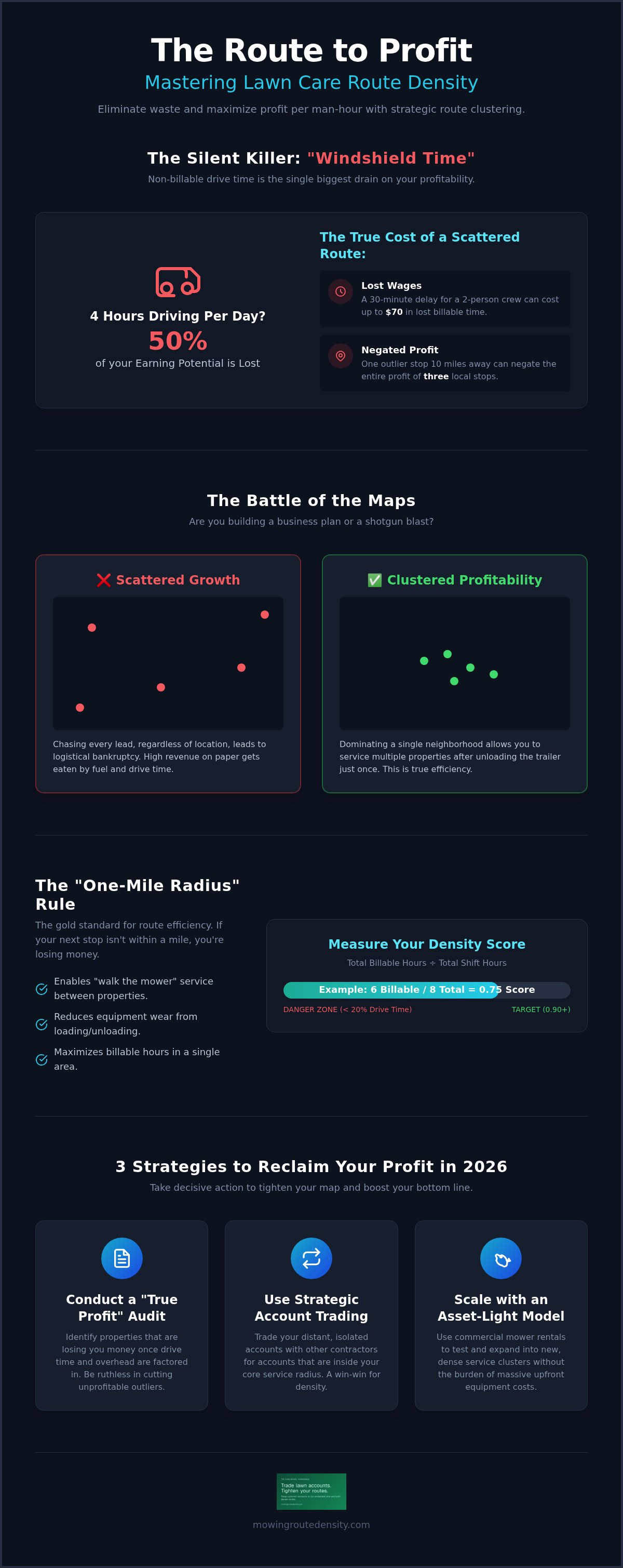
Route density is a simple ratio: billable service time versus non-billable transit time. If your crews spend four hours a day driving, you're losing 50% of your earning potential before you even unload a mower. This logistical challenge is a classic example of the Vehicle Routing Problem. Solving it is the difference between a business that scales and one that merely survives. Understanding how to improve lawn care route density starts with acknowledging that windshield time is a silent killer. It drains your bank account one mile at a time.
The Real Cost of Windshield Time
Every minute spent in the truck is a minute you aren't getting paid. With industry labor rates ranging from $35 to $70 per hour, a crew of two sitting in traffic for 30 minutes costs you up to $70 in lost wages alone. Add in fuel costs and vehicle depreciation, and the numbers get ugly. One outlier stop located ten miles from your core cluster can effectively negate the profit of three local stops.
In 2026, the stakes are higher. Fuel surcharges of $1 to $5 per visit are now standard because overhead has exploded. Fertilizer prices have also jumped 30% to 50% due to global supply chain disruptions. If you aren't tightening your routes, you're subsidizing your customers' driveways. This isn't just about gas. It's about the ripple effect. Long drive times lead to technician fatigue. Burnout leads to high turnover. High turnover leads to training costs. It's a cycle of waste that prevents true lawn care profit margin optimization.
Why Traditional Marketing Often Fails Density
Growth is often the enemy of efficiency. Traditional marketing teaches you to chase every lead, but scattered growth is a trap. A high-revenue commercial contract looks appealing on paper. However, if that property is 15 miles away from your nearest route, the logistical cost of servicing it likely eats the entire profit margin. You end up with a map that looks like a shotgun blast rather than a business plan.
You must establish a hard-line service radius for your field teams. Taking a shotgun approach to acquisition leads to logistical bankruptcy. Clustered profitability happens when you dominate a single neighborhood. If you can't hit five properties after unloading the trailer once, your density is failing. You don't need more customers; you need better-located ones. Learning how to improve lawn care route density means saying no to outliers so you can say yes to profit. Tightening your map is the only way to protect your bottom line against rising 2026 operational costs.
The Mathematics of Efficiency: Why Clustering Outperforms Volume
Stop chasing volume. Volume without density is just busy work. If you want to know how to improve lawn care route density, you have to look at the math of marginal utility. Adding one stop five miles away doesn't just add fuel costs. It subtracts from the billable capacity of your entire day. The "One-Mile Radius" rule is the gold standard. If your next stop isn't within a mile, you're losing money. True efficiency happens when you can "walk the mower" between properties. This eliminates the time-consuming cycle of loading, securing, and unloading trailers. This level of lawn care route density also extends equipment life. Fewer engine starts and less trailer vibration mean lower maintenance costs.
Calculating Your Current Density Score
You can't fix what you don't measure. Your density score is simple: Total Billable Hours divided by Total Shift Hours. If your crew is on the clock for eight hours but only billing for six, your score is 0.75. If drive time exceeds 20% of your day, you're in the danger zone. Use GPS data and Route Optimization Technology to find these gaps. High-performing teams aim for a score of 0.90 or better. This isn't just a number. It's a direct reflection of your take-home pay.
The Asset-Light Approach to Clustering
Clustering allows you to specialize. When stops are tight, you don't need a massive trailer for every crew. You can deploy smaller, more agile setups. If you're testing a new neighborhood cluster, don't buy new gear immediately. Use commercial lawn mower lease options to scale without heavy capital expenditure. This asset-light strategy lets you prove the density before committing to long-term debt. It's a smarter way to grow. You can even use a service provider locator to find partners for initial route support in new zones.
Impact on Labor and Retention
Density fixes your culture. Tighter routes mean predictable eight-hour workdays. Technicians hate sitting in traffic. It causes mental fatigue that leads to sloppy work and safety issues. When routes are tight, the work is consistent. You can even offer performance-based bonuses funded by the fuel and time you've saved. Happy crews stay. Efficient crews pay. Stop burning out your best people on the highway and start keeping them on the grass.
Strategic Account Trading vs. Organic Acquisition
Organic growth is a slow burn. You spend thousands on door hangers and digital ads, hoping for a cluster that might never materialize. If you want to know how to improve lawn care route density right now, stop waiting for the phone to ring. Start trading. Account trading is the strategic exchange of service contracts to fix your geography. It's the fastest way to turn a scattered map into a profitable one. You aren't just getting more work. You're exchanging the work you shouldn't have for the work you need.
A high-revenue outlier is a trap. It looks good on your profit and loss statement, but it's a drain on your logistics. Swapping that outlier for a lower-grossing stop that sits inside an existing cluster is a net win every time. You save on fuel. You save on labor. You save on vehicle wear. Using a lawn account trading platform facilitates these secure swaps. It allows you to tighten your service area without the long-term cost and uncertainty of organic lead generation.
The Mechanics of a Successful Account Swap
Value your routes based on density, not just gross revenue. A stop that allows you to keep the mower running is worth more than a "premium" stop that requires a 20-minute drive. Maintaining client trust is critical during these transfers. Be transparent. Ensure the new provider meets your standards. You can use a lawn mowing service provider locator to find local partners who are also looking to optimize their routes. It's a B2B solution for a B2B problem. When you find a partner whose outliers are your core stops, everybody wins.
Buying Density: When to Acquire Existing Routes
Sometimes, trading isn't enough. You need to buy. Look for "distressed" routes from owners who are exiting the business or failing logistically. These lists often contain hidden gems that fit perfectly into your core clusters. Before you sign, perform a logistical audit. Map every stop. Calculate the true drive time. If the accounts don't fit your existing route management software, the acquisition might cost more than it's worth. Buying density is a shortcut to scale, but only if the math works. Integrating these accounts quickly into your system ensures the efficiency gains are realized on day one. This is how to improve lawn care route density through aggressive, calculated expansion.
Tactical Audit: How to Identify and Eliminate Non-Profitable Outliers
You can't fix what you can't see. Most owners are blind to the logistical rot on their maps. If you want to know how to improve lawn care route density, you must perform a tactical audit. Stop guessing. Start mapping. Follow these five steps to clean your route of financial drains.
- Step 1: Map every stop. Draw a five-mile circle around your hub. Highlight any property outside this core. These are your red zones.
- Step 2: Calculate "True Profit." Subtract drive-time labor and fuel from the gross revenue of each outlier. Use the industry labor rate of $35 to $70 per hour. The results will be ugly.
- Step 3: Cloverleaf. Attempt to bridge the gap between outliers and your core with hyper-local marketing.
- Step 4: Execute the Trade. If density doesn't improve in 90 days, prepare the account for an exchange.
- Step 5: Transition the client. Use a lawn care business exit strategy framework to hand off the account without burning bridges.
The "Cloverleafing" 2.0 Strategy
Broad marketing is a waste of capital. Cloverleafing 2.0 means targeting the immediate neighbors of your most profitable stops. Use your routing software to identify "Add Neighbor" opportunities. Place door hangers on the three houses to the left and right of your active site. Your crew is already there. The equipment is already off the trailer. Every neighbor you sign reduces your average drive time per stop. This is the most cost-effective way to build density from the ground up.
When to Fire a High-Paying Outlier
High revenue is a vanity metric. Don't let a $150 stop distract you from the 45-minute drive it requires. That drive time is a lost opportunity. In those 45 minutes, your crew could have serviced three $50 stops in a tight cluster. You aren't just losing gas money. You're losing the ability to scale. If the math doesn't work, offload the client. Professionally refer them to a competitor who already operates in that area. It's not a loss; it's a strategic divestment. A tight route beats a big route every single day. If you're ready to start cleaning your map, you can find swap partners here to offload your outliers and regain your margins.
Scaling via Asset-Light Logistics and Account Exchange
Scaling doesn't have to be heavy. If you're figuring out how to improve lawn care route density, you need to look at asset-light logistics. Traditional growth relies on debt. You buy more trucks. You finance more mowers. You hope the new revenue covers the new payments. This is a high-risk gamble in 2026. Instead, use professional lawn equipment rental to service new clusters without the burden of capital expenditure. Renting allows you to scale your fleet to match your route density in real time. It's about agility, not ownership.
Leveraging Rental for Seasonal Density Spikes
Spring growth is a logistical nightmare. Your crews are already at capacity. You have a wave of new leads in a promising neighborhood. Don't rush to the dealer. Use mower rentals to handle the surge without over-leveraging your balance sheet. This is the "Rent-to-Test" model. You deploy rental units to service a new geographic zone. You prove the density exists. If the cluster holds and the drive time remains low, you can then justify a long-term asset. If it doesn't, you return the gear. You haven't lost a dime in depreciation. Specialized equipment rentals also allow you to tackle dense commercial clusters that require specific deck sizes you don't normally carry.
Building a Subcontractor Network for Density
Subcontractors aren't just for overflow work. They're a tactical tool for route cleaning. Learn how to find lawn care subcontractors who already live and work in the zip codes where you have outliers. Let them handle the high-drive-time stops while you maintain the service standards and the client relationship. This is the first step toward a permanent fix.
The long-term play is simple. You turn these subcontractors into account swap partners. You trade your outliers in their backyard for stops in your core service area. A B2B network is the ultimate solution for how to improve lawn care route density on a national scale. It creates synergy between account trading and flexible equipment fleets. Audit your routes today. Every mile of windshield time is a dollar stolen from your profit margin. Stop subsidizing the gas station. Start owning your clusters. Use a service provider locator to find your next trading partner and reclaim your billable hours.
Stop Subsidizing the Highway and Start Owning the Block
Density is the only metric that matters for your bottom line in 2026. Every minute your crew spends in transit is a minute of lost billable potential. You've seen the math. You know the cost. Clustered stops aren't just a goal; they're your primary defense against rising fuel and labor overhead. Stop chasing every distant lead. Start trading your outliers for local clusters. Use asset-light rental models to test new territories without the financial risk of new equipment debt.
Mastering how to improve lawn care route density requires making hard choices today to protect your margins tomorrow. Use our secure account trading platform, commercial-grade mower rentals, and B2B contractor locator to find the partners you need. It's time to tighten your map and eliminate the silent drain of windshield time. Optimize your routes today on the Mowing Route Density marketplace. Your profit belongs in your pocket, not in your gas tank. Let's get back to the grass.
Frequently Asked Questions
What is the ideal route density for a lawn care business?
The ideal route density is a billable ratio of 90% or higher. This means for every ten hours your crew is on the clock, nine are spent on a property rather than in traffic. Achieving this usually requires a "One-Mile Radius" policy where stops are clustered tightly. If your drive time exceeds 15 minutes between properties, your density is failing. You must prioritize stop volume over geographic spread to protect your net margins against 2026 overhead.
How do I calculate my lawn care route density score?
Divide your total billable hours by your total shift hours to find your score. For example, if a two-man crew bills 12 hours in a 16-man-hour shift, your score is 0.75. This is a critical step in learning how to improve lawn care route density because it highlights exactly where profit is leaking. Any score below 0.80 indicates a logistical problem that requires immediate route tightening or account trading to fix.
Should I fire a customer who is too far away even if they pay well?
Yes, you should offload them. High revenue is a vanity metric if the drive time eats the margin. A premium outlier stop often represents a massive opportunity cost. In the time it takes to drive 15 miles, your crew could have serviced multiple clustered properties. Don't be afraid to professionally refer these clients to a competitor who already operates in that area. A lean, tight route is always more profitable than a scattered one.
How does account trading actually work without losing clients?
Account trading involves swapping service contracts with other professionals to improve geographic clusters. You use a secure platform to find a contractor whose outliers are in your core area, and vice versa. It's a B2B exchange that keeps the client serviced while fixing your map. When you maintain transparency and ensure the new provider meets your standards, clients rarely object to the change. It's the fastest way to eliminate windshield time and logistical waste.
Can I improve route density without using expensive software?
You don't need high-end software to start. You can use manual mapping and "True Profit" audits to identify outliers. Simply drawing a five-mile circle around your hub on a map reveals your logistical rot. Focus on cloverleafing, which means marketing specifically to the neighbors of your existing profitable stops. This low-tech approach builds density house by house. It's about strategic discipline rather than expensive tools. Tightening your map is a manual process of elimination.
What are the best marketing tactics for building neighborhood clusters?
Cloverleafing 2.0 is the most effective tactic. This means placing door hangers or yard signs on the three houses to the left and right of your current job site. Since your crew and equipment are already on the street, the cost of acquisition is nearly zero. You can also offer "Add Neighbor" incentives to existing clients. This hyper-local focus ensures that you grow your business through clusters rather than random, scattered leads that drain your fuel budget.
Is it better to rent or buy mowers when expanding into a new dense route?
Renting is the smarter move for testing new clusters. Asset-light scaling allows you to prove that a new route is dense and profitable before you commit to long-term debt or CAPEX. Use commercial mower rentals to handle spring growth surges or to service new geographic zones. If the density doesn't materialize, you return the equipment without suffering from depreciation. Only buy once the route density score consistently hits your target and the profit is stabilized.


