

Revenue is a vanity metric; profit is the only number that pays the mortgage. If you are hauling a commercial mower across town for a single stop while paying $4.08 per gallon for fuel, you aren't a business owner. You're a high-priced delivery driver. It is a common trap in an industry that has surpassed $300 billion in value. You work harder, buy more gear, and hire more crew, yet your bank account stays flat. High overhead and rising wages aren't just inconveniences. They are margin killers that demand a total shift in lawn care profit margin optimization.
You already know that excessive drive time is professional suicide. You feel the sting of expensive assets sitting idle when labor is tight. This guide is your roadmap to stop the bleeding. We will show you how to eliminate operational waste and tighten route density until you reach a 15-20% net profit margin. We are going to break down the mechanics of account trading, the logic of capital preservation through equipment rentals, and the specific logistics required to build a scalable, debt-free model for 2026.
Key Takeaways
- Perform a 30-day logistics audit to pinpoint "Red Zones" where low stop density is draining your daily earnings.
- Shift to an asset-light model by using commercial mower rentals to preserve capital and eliminate the liability of aging equipment.
- Leverage account trading platforms to swap distant, low-margin stops for local accounts that instantly increase your route density.
- Execute a 90-day framework for lawn care profit margin optimization that prioritizes billable hours over total top-line revenue.
- Transform your operation from a high-volume revenue chaser into a lean, scalable business with a consistent 15-20% net profit margin.
The Revenue Trap: Why Your Lawn Care Profit Margin is Shrinking
Most lawn care owners are obsessed with the top line. They brag about $500k or $1M in annual sales while their bank accounts remain anemic. This is the revenue trap. It happens when you prioritize volume over marginal utility. You add more accounts, but those accounts are scattered across the map. You are busy, but you aren't profitable. True lawn care profit margin optimization requires looking past the invoice total and focusing on what stays in your pocket after the trucks return to the shop.
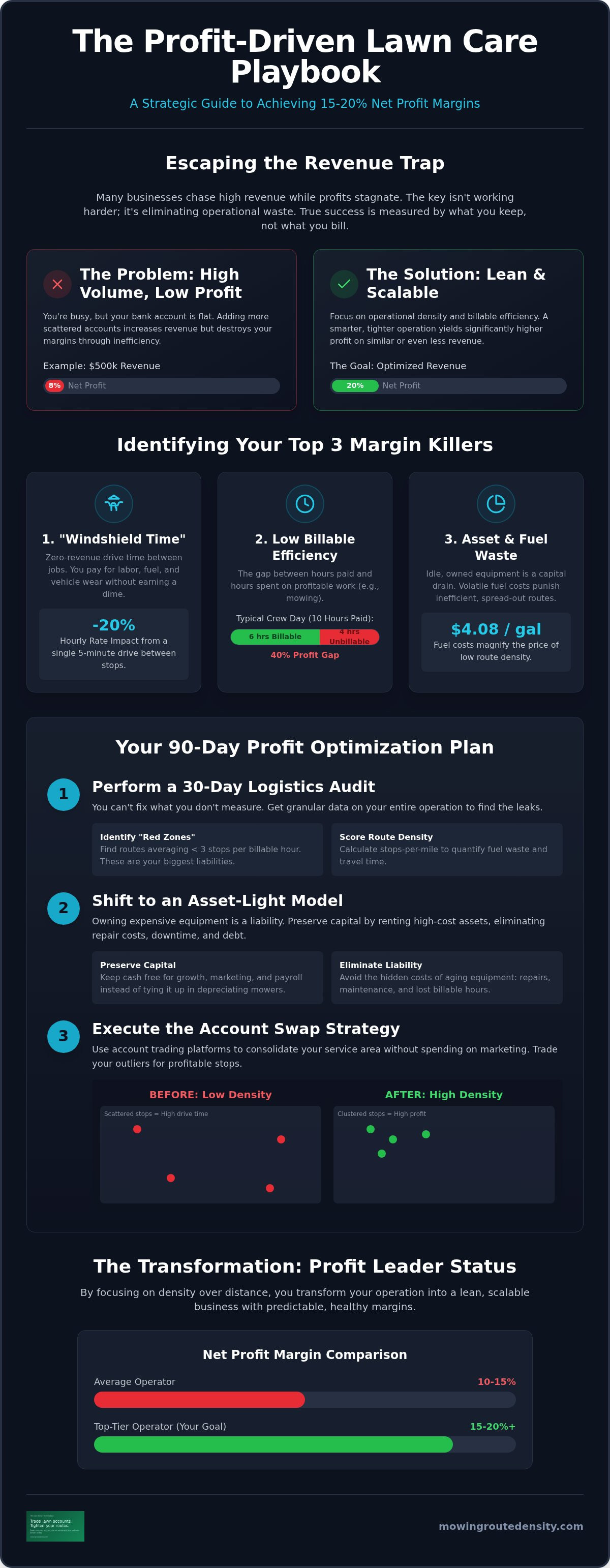
The silent killer in groundskeeping and maintenance is "Windshield Time." This is the period when your trucks are moving but your blades are not. It is a zero-revenue activity. Every minute spent in traffic is a minute you pay for labor, fuel, and wear and tear without receiving a dime in return. Industry benchmarks show that while the average net profit margin hovers between 10% and 15%, top-tier operators hit 20% or higher. The difference isn't how fast they mow. It is how little they drive. A simple five-minute drive between stops can slash your hourly rate by 20% before you even step off the trailer.
The Math of Mowing: Billable Hours vs. Total Labor
Stop looking at your hourly rate per job. It is a lie. If you charge $60 for a 45-minute mow but spend 15 minutes driving to it, your true hourly rate is based on 60 minutes, not 45. When you factor in loading, unloading, and the labor burden of taxes and insurance, your margin evaporates. Billable Efficiency is the ratio of time spent mowing to time spent on the clock. If your crew is on the clock for 10 hours but only mows for 6, your efficiency is 60%. That 40% gap is where your profit goes to die. You must bridge this gap to survive.
Fixed Costs vs. Variable Costs: The Margin Killers
Fixed costs like shop rent, insurance, and administrative waste are predictable but dangerous. They don't care if you have a rainy week or a labor shortage. Variable costs, specifically fuel, are volatile. National gas prices averaged $4.08 per gallon in August 2026. If your routes are loose, fuel consumption eats your earnings. Avoid "over-fleeting." Owning three mowers when your billable hours only justify two is a strategic failure. Every piece of idle equipment is capital that isn't working for you. Tighten your operation. Cut the waste. Focus on density over distance.
The Logistics Audit: Calculating Your Current Profitability
You can't optimize what you don't track. Most owners think they know their numbers, but a 30-day audit usually proves them wrong. This is the foundation of lawn care profit margin optimization. You need to look at every truck, every crew, and every gallon of fuel consumed. Start by identifying your "Red Zones." These are the routes where your crew averages fewer than three stops per billable hour. If you’re spending more time in the truck than on the turf, that route is a liability, not an asset. It is a drain on your resources that must be fixed or abandoned.
Analyzing your service mix is equally vital. Are you stuck in the low-margin grind of basic maintenance, or are you upselling high-margin specialized care? Basic mowing is the entry point, but fertilization and aeration are the profit drivers. Historical financial analysis of the landscaping services industry highlights that while sales often grow, net margins only stay healthy when overhead is strictly controlled. You must also track equipment downtime. If a mower is in the shop for three days every month, the repair cost is only half the story. The real cost is the lost billable hours and the disruption to your schedule.
The Route Density Scorecard
Measure your stops-per-mile to determine the health of your logistics. There is a direct, undeniable correlation between lawn care route density and fuel savings. If you're driving three miles to reach a single stop, you're hemorrhaging cash. Identify your "Anchor Accounts." These are your most profitable, high-density clusters that justify a crew's presence in a specific area. Everything else should be built around these anchors. If an account doesn't fit into a cluster, it is an outlier that needs to be swapped or priced out of your system.
Labor Productivity and Field Logistics
Stop guessing about what happens in the field. Use GPS data to identify unauthorized stops or inefficient travel patterns. The cost of "Equipment Fiddling" is a silent profit killer. This is the time lost to poor trailer organization, dull blades, or improper setup at the job site. If your crew spends twenty minutes "getting ready" at every stop, you've already lost the margin on that job. Empower your crews to report logistical bottlenecks in real-time. They are the ones seeing the traffic and the gate codes that don't work. Listen to them. You can also use a service provider locator to find B2B partners who can handle your distant outliers while you focus on your high-density core.
Asset-Light Growth: Maximizing Margin Through Mower Rental
Owning a fleet of mowers feels like building equity. It isn't. In reality, aging equipment is a depreciating liability that tethers your cash to a trailer. Every hour a machine sits idle in the shop is an hour of lost revenue plus the cost of parts and labor. For true lawn care profit margin optimization, you must separate the work from the machine. Moving to an asset-light model through professional lawn equipment rental transforms heavy fixed costs into flexible variable expenses. You only pay for the capacity you actually use. This strategy preserves your capital for marketing, higher wages, or better logistics tools instead of sinking it into iron that loses value every time the sun rises.
The "Swap and Mow" advantage is the ultimate hedge against downtime. When an owned mower breaks, your schedule collapses. When a rental unit fails, you swap it for a fresh machine. Your crew stays billable. While many small business owners struggle to maintain small business profit margin benchmarks of 7-10%, those who eliminate the hidden costs of ownership often see much higher returns. You aren't just renting a tool. You are buying operational uptime.
Buy vs. Rent: A Financial Comparison
The total cost of ownership (TCO) includes more than just the monthly payment. It includes oil changes, blade sharpening, hydraulic leaks, and eventual tech-obsolescence. Compare that to a flat rental rate. The math is often surprising. For those not ready for full rental, commercial lawn mower lease options provide a strategic middle ground for scaling without the immediate burden of a massive down payment.
| Factor | Ownership Model | Rental Model |
|---|---|---|
| Initial Capital | High (Down payment/Debt) | Zero to Low |
| Maintenance | Your Responsibility | Provider's Responsibility |
| Technology | Fixed (Ages out) | Flexible (Always current) |
| Tax Impact | Depreciation (Slow) | Direct Expense (Immediate) |
Scaling Fleet Capacity Without Debt
Peak season demand often forces owners into bad debt. You buy a fourth mower to handle the May rush, then pay for it while it sits in the shop during the August drought. This is a profit killer. Use seasonal rentals to match your capacity to your contract load. This allows you to test new service areas without a five-year commitment. Modern rental fleets also feature high-efficiency engines that lower fuel consumption compared to your five-year-old backup units. Work smarter. Keep your cash. Scale with agility.
The Account Swap Strategy: Fixing Density Without Marketing
Marketing is a slow, expensive gamble. You spend thousands on ads and wait months for leads that might not even be in your service area. Stop chasing new leads and start trading for better ones. If you have a customer ten miles away from your core route, you aren't making money; you're losing it on fuel and labor. A lawn account trading platform allows you to swap those logistical headaches for accounts that actually fit your schedule. This is the "Density Swap." You trade one high-revenue outlier for two or three neighbors in your existing clusters. Your top line might not change, but your bottom line will. This is the most direct route to lawn care profit margin optimization in a competitive market.
Strategic trading reduces your customer acquisition cost (CAC) to almost zero. Instead of paying for a click, you are exchanging a liability for an asset. This isn't just about getting rid of bad customers. It is about consolidating your footprint. When your crews spend more time mowing and less time navigating traffic, your equipment longevity increases and your fuel bill drops. It is a pragmatic solution to a logistics problem that marketing cannot solve. You don't need more customers. You need better ones.
Valuing Accounts for Trade or Sale
Not all revenue is created equal. When valuing an account for a trade, look at frequency, logistical fit, and service type. A high-maintenance customer who requires specialized gear might not be worth the trouble if they are off-path. Standardize your service agreements now. Clean contracts make handoffs seamless and increase your business value. This focus on operational clarity is the backbone of a strong lawn care business exit strategy. Buyers pay a premium for density, not just a list of names. They want to buy a machine, not a mess.
Building Strategic B2B Partnerships
Collaboration is more profitable than isolated competition. Use a lawn mowing service provider locator to identify other contractors who have the opposite problem. They might be driving into your territory while you drive into theirs. Swap those stops. If you have seasonal spikes you can't handle, find lawn care subcontractors to keep your density high without over-extending your own fleet. This creates a "Cluster Effect." Dominating a single neighborhood makes you the obvious choice for every neighbor on that block. It locks out competitors and maximizes your billable hours. Ready to stop driving and start earning? Use our lawn account trading platform to fix your density today.
Implementation: Your 90-Day Profit Optimization Plan
Transformation doesn't happen overnight. It requires a disciplined, phased approach to strip away the fat and rebuild your operation around efficiency. This 90-day plan is designed to move you from a chaotic revenue chaser to a lean logistics expert. If you follow this framework, lawn care profit margin optimization becomes a mathematical certainty rather than a seasonal hope. Stop overthinking and start executing.
- Phase 1: The Audit (Days 1-30). Identify every non-billable minute. Use your GPS logs to see exactly where your crews are stalling. Are they spending 40 minutes at the gas station? Is the morning load-out taking an hour? Document every second the blades are not spinning. This data is the only weapon you have against waste.
- Phase 2: The Trim (Days 31-60). This is the "tough love" phase. Trade away your outlier accounts using a trading platform. If a stop doesn't have two neighbors on the same street, it has to go. Simultaneously, audit your fleet. If a mower hasn't billed 30 hours this week, return it or sell it. Idle iron is a cancer on your balance sheet.
- Phase 3: The Scale (Days 61-90). Now that your core is tight, expand into dense clusters. Use rental fleets to handle the new volume without taking on long-term debt. This allows you to test new neighborhoods with zero capital risk. If the density doesn't materialize, you simply return the mower.
Set up a weekly "Margin Review" for your leadership team. Stop looking at gross sales. Instead, look at your net margin per route. If a route drops below 15%, it needs an immediate logistics audit. Accountability is the only thing that keeps margins from sliding back into the average industry trough.
Automating Route Management
Manual routing is a relic of the past. You need software that prioritizes density over simple scheduling. Your software should tell you where to add customers, not just when to mow them. Integrate your GPS tracking with labor cost analysis to see the real-time impact of traffic on your bottom line. Automating your billing and routing reduces administrative overhead, allowing you to run a larger operation with a smaller office staff. Every dollar saved in the office is a dollar added to your net profit.
The Asset-Light Conclusion
The most successful operators in 2026 have shifted their mindset. They are no longer equipment owners; they are logistics strategists. They understand that owning a mower is less important than maximizing the billable minutes of the person operating it. Profitability is found in the tight gaps between stops and the elimination of idle assets. Review your density scores before the next season starts. If your routes look like a spiderweb, you're doing it wrong. Optimize your route density today with Mowing Route Density and start keeping the cash you earn.
Take Control of Your 2026 Bottom Line
Profitability is not a mystery; it's a choice. You can continue chasing top-line revenue while fuel costs and labor shortages eat your earnings, or you can commit to lawn care profit margin optimization. The path is clear. Audit your routes to find the "Red Zones." Trade your distant outliers for local accounts that build real density. Shift your heavy fixed costs into flexible operating expenses by utilizing rental assets instead of sinking capital into depreciating iron.
The industry is evolving. The survivors will be logistics strategists, not just equipment owners. By leveraging a national account trading marketplace and a B2B service provider locator tool, you can dominate local clusters and lock out the competition. Accessing a commercial mower rental fleet ensures you have the capacity to scale without the anchor of bad debt. It's time to stop the bleeding and start keeping the cash you earn. Optimize your profit margins now with Mowing Route Density. Your more profitable future starts with a tighter route and a leaner operation. Let's get to work.
Frequently Asked Questions
What is a good profit margin for a lawn care business in 2026?
A healthy net profit margin for an optimized operation in 2026 is between 15% and 20%. While the industry average often hovers between 10% and 15%, top-tier contractors achieve higher returns by ruthlessly cutting operational waste. Reaching this goal requires a shift from chasing top-line revenue to focusing on billable efficiency. If your margin is below 10%, you are likely over-fleeted or suffering from poor route density.
How does route density specifically impact my net profit?
Route density is the primary driver of lawn care profit margin optimization because it minimizes non-billable windshield time. Every mile driven between jobs is a direct drain on your labor budget and fuel reserves. By clustering accounts in a tight geographic area, you increase the number of stops per hour. This allows your crews to generate more revenue without increasing their time on the clock or your fleet's wear and tear.
Is it better to rent or buy commercial lawn mowers for a growing business?
Rental is often superior for growing businesses because it preserves capital and eliminates the liability of aging equipment. Owning a fleet forces you into high fixed costs and maintenance debt. Rental allows you to scale capacity to match seasonal demand without long-term financial commitments. If a machine breaks, you swap it for a fresh unit, ensuring your crews stay billable. It moves equipment from a depreciating asset to a flexible operating expense.
How do I calculate the cost of "windshield time" in my operation?
Calculate windshield time by adding your crew's hourly labor burden to the per-mile operating cost of your vehicle, then multiplying by the total minutes spent driving. If your crew spends two hours a day in traffic, you are paying for ten hours of unproductive labor every week per truck. When you factor in fuel and vehicle depreciation, a single hour of drive time can cost significantly more than the profit from a standard mow.
Can I really trade lawn care accounts with other contractors safely?
Yes, you can trade accounts safely by using a dedicated lawn account trading platform that standardizes the exchange process. Trading allows you to swap distant outliers for accounts that sit directly on your existing routes. It is a strategic logistics move rather than a sales tactic. Ensuring that service agreements are clear and both parties understand the logistical fit is key. This approach fixes density issues much faster than traditional marketing ever could.
What are the biggest overhead costs I should cut first?
Start by cutting idle equipment and excessive shop space that doesn't contribute to daily billable hours. Many contractors are over-fleeted, paying for mowers that only see use during peak weeks. Administrative waste is another major drain. Automating your routing and billing processes reduces the need for a large office staff. Tightening these areas ensures that your overhead doesn't outpace your production capacity, keeping your business lean and responsive.
How do I use a service provider locator to improve my margins?
Use a service provider locator to find B2B partners who can handle accounts outside your core density zones. Instead of driving across town to service a single outlier, you can partner with a local contractor to manage that stop. This allows you to maintain the contract relationship without the logistical nightmare of a loose route. It transforms a low-margin liability into a streamlined partnership, keeping your crews focused on high-density clusters.
What happens to my profit margin if fuel prices spike suddenly?
Sudden fuel spikes directly attack your net margin, especially if your routes are spread out. With national averages reaching $4.08 per gallon in August 2026, fuel volatility is a constant threat. High route density acts as a natural hedge against these price increases. When you drive less, fuel represents a smaller percentage of your total operating costs. Tightening your logistics is the only way to protect your earnings when pump prices rise.


