

Your biggest competitor isn't the guy with the newer truck. It's the empty miles between your job sites. Windshield time is a silent profit killer that turns a $90 per hour operator into a financial liability. You know the frustration of winning a high-value contract only to realize the travel distance erodes every cent of margin. Marketing for B2B lawn care services shouldn't just be about getting more work. It must be about getting the right work in the right place.
You've likely felt the sting of high equipment overhead during growth phases or the headache of finding leads that actually fit your map. We're changing that. This 2026 Strategic Growth Framework teaches you how to acquire high-value commercial accounts while slashing overhead through route density and asset-light scaling. We'll explore how to trade accounts for better proximity, leverage rentals to avoid capital risk, and build a lead flow that keeps your crews billable, not just busy. It's time to stop chasing volume and start engineering profitability.
Key Takeaways
- Stop using residential tactics for commercial growth. Learn why high-volume "spray and pray" methods actually kill your margins.
- Use route density as your primary filter for marketing for B2B lawn care services. Focus your efforts on "Strike Zones" to maximize billable hours per crew.
- Move beyond door hangers. Discover how direct outreach and B2B marketplaces connect you with the right procurement managers.
- Scale without the CapEx trap. Use equipment rentals to fulfill new contracts and test territories without the risk of heavy ownership costs.
- Optimize your map through account trading. Swap your outlier jobs for high-density clusters to instantly tighten your routes and boost profit.
Why Residential Marketing Strategies Fail B2B Lawn Care Contractors
Residential marketing is a numbers game. You blast a neighborhood with flyers and hope for a 1% return. In marketing for B2B lawn care services, this "spray and pray" approach is financial suicide. It ignores the fundamental B2B marketing principles of strategic targeting and relationship management. A homeowner buys on emotion or a neighbor's recommendation. A facility manager buys on reliability, liability coverage, and budget predictability. One is a transaction. The other is a partnership. When you market to residential customers, you're competing on price and personality. In the commercial sector, you're competing on operational resilience. If your equipment breaks down on a residential job, one family is annoyed. If you fail a commercial site, you're jeopardizing a manager's job and a corporation's professional image. Your marketing must reflect that you understand these high stakes.
The High Cost of Dispersed B2B Portfolios
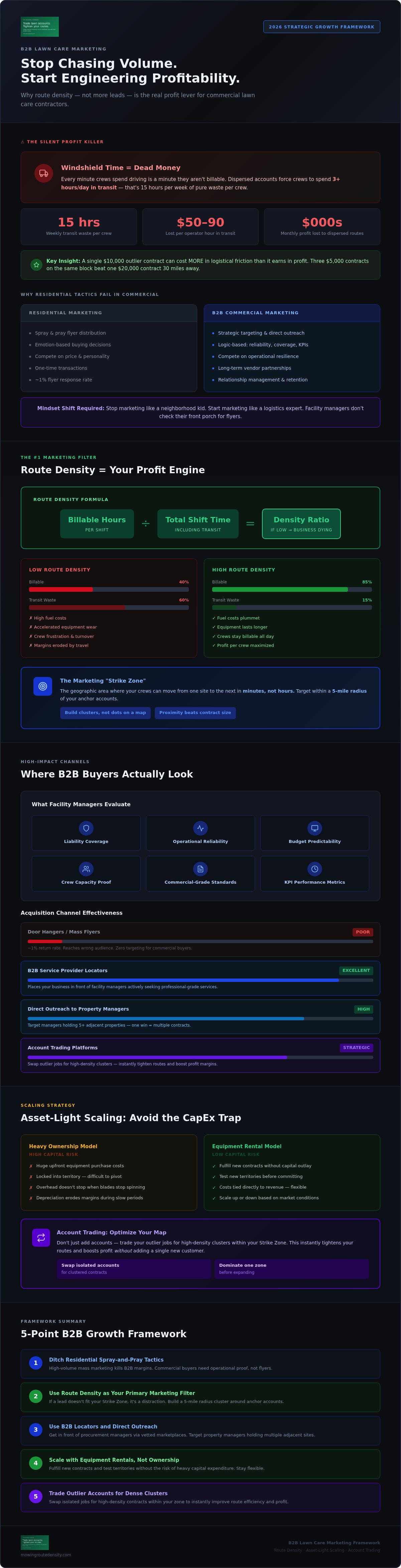
Dispersed accounts kill margins. You win a lucrative commercial bid 30 miles away and think you're growing. You're actually bleeding. Windshield time is the silent killer. Every minute your crew spends on the highway is a minute they aren't billable. Fuel consumption spikes. Equipment wear increases. Your overhead doesn't stop just because the mower blades aren't spinning. Non-contiguous accounts create a logistical nightmare. They force you to spread your assets thin. You end up with crews spending three hours a day in traffic. That is fifteen hours a week of pure waste. At an average hourly rate of $50 to $90 per operator, you're literally throwing thousands of dollars out the window every month. A single $10,000 contract can easily cost you more in logistical friction than it earns in profit if it's an outlier. You need clusters, not dots on a map.
B2B Decision Makers: Where They Actually Look
Facility managers don't check their front porch for flyers. They look for vetted professionals who understand commercial-grade standards. They value efficiency and proof of capacity. This is where a lawn mowing service provider locator becomes a critical asset. It places your business in front of people actively seeking professional-grade services. These decision makers want to know you have the right equipment and the right crew density to handle their site without excuses. They aren't looking for a "lawn guy." They are looking for a vendor who helps them hit their KPIs. Effective marketing for B2B lawn care services requires a permanent shift in perspective. Stop marketing like a neighborhood kid. Start marketing like a logistics expert.
Route Density as a Marketing Filter: Targeting for Profitability
Most contractors mistake movement for progress. They chase every RFP that hits their inbox. This is a mistake. Effective marketing for B2B lawn care services requires a filter. That filter is route density. If a lead doesn't fit your existing geographic cluster, it's not a lead; it's a distraction. Profit is won or lost in the "Marketing Strike Zone." This is the area where your crews can move from one site to the next in minutes, not hours. Asset clustering ensures your expensive mowers are actually cutting grass instead of sitting on a trailer. You must learn to say no. A $20,000 contract that sits in isolation is often less profitable than three $5,000 contracts on the same block. Proximity beats contract size every single time because it maximizes the marginal utility of your labor.
Mapping Your Strategic Growth Zones
Start with your anchor accounts. These are your most stable, high-value B2B clients. Draw a 5-mile radius around them. This is your primary growth zone. Focus your outreach here. When you dominate an industrial park, your overhead drops. Your fuel consumption plummets. Your equipment longevity increases. You can even consider an account trading platform to swap your outliers for jobs within these zones. Route density is the ratio of billable hours to total crew shift time. If that ratio is low, your business is dying. High density turns a struggling crew into a profit engine by eliminating the dead time between gates.
Leveraging Data to Optimize B2B Outreach
Don't guess where to market. Analyze your current lawn care route density before spending a dime on ads. Look for property management groups that hold concentrated portfolios. Winning one manager who oversees five adjacent office parks is the ultimate marketing win. This is the "Clustering Strategy." It allows you to deploy multiple crews to a single area, reducing the need for multiple trucks and trailers. You're not just selling mowing; you're selling a localized service model that your competitors can't match. When your crews are always visible in the same area, your brand becomes the default choice for every neighboring business. That is how you win the market without breaking your back.
High-Impact B2B Acquisition Channels: Beyond Door Hangers
Stop wasting money on billboards and radio spots. These are high-waste tactics that reach ten thousand homeowners for every one facility manager. Effective marketing for B2B lawn care services requires precision. You need to be in the room where procurement decisions happen. This means moving beyond passive advertising and into active, strategic outreach. Facility managers don't buy because they saw a sign in a yard. They buy because you've demonstrated you can handle their specific operational requirements without a glitch. Your marketing should scream reliability and capacity, not "free estimates."
Strategic subcontracting is another overlooked entry tool. Sometimes the fastest way to win a massive commercial account is to start as a partner to a larger firm. It builds your portfolio and proves your reliability on high-stakes sites. Networking through professional associations puts you face-to-face with decision makers. These aren't just social clubs. They are the gatekeepers to the industrial parks and office complexes that drive your route density. Don't just show up to eat; show up to solve their logistical headaches. If you can prove you're already working three other sites in their immediate area, you've already won half the battle.
Digital Presence for the Commercial Contractor
Your website shouldn't look like a residential gardener's blog. It needs to look like a logistics company's landing page. Optimize for search intent that signals a professional buyer, such as "commercial landscaping RFP" or "industrial park lawn maintenance." Show your fleet. Detail your equipment's age and reliability. Use LinkedIn to connect with property management groups. Don't send generic sales pitches. Send data-driven insights about how your concentrated service model allows you to offer more reliable response times than your competitors. Professional buyers value competence over charisma.
The Passive Lead Engine: Locators and Networks
You can't be everywhere at once. You need systems that work while your crews are in the field. Being listed in a lawn mowing service provider locator builds instant trust with managers who need a vetted professional. It's a passive lead source that targets the right kind of buyer. Partner with non-competing trades like HVAC or paving contractors. They are already on the sites you want. Swap leads. If you win a contract that exceeds your current labor capacity, use a guide to find lawn care subcontractors to fulfill the work. This keeps your reputation intact while you scale to meet the new demand. Don't let a temporary labor shortage stop you from securing a long-term commercial contract.
Scaling Market Share with Asset-Light Logistics
Growth is a double-edged sword. You win a major contract through aggressive marketing for B2B lawn care services. Now you need three more zero-turns. If you buy them, you are trapped in a CapEx nightmare. What happens if the property manager leaves and the new one cancels your agreement? You are left with the debt but no revenue. This is the capital expenditure trap. Smart contractors avoid it by scaling with an asset-light model. It allows you to test new territories without the anchor of a massive fleet payment. You stay lean. You stay profitable. You stay in control.
Strategic Equipment Rental for New Contracts
Renting isn't a sign of weakness. It's a sign of strategic foresight. Using professional lawn equipment rental allows you to fulfill contract spikes without permanent overhead. You can bid on a 50-acre industrial park with total confidence. If you win, you rent the capacity. If you lose the bid, you haven't lost a dime on equipment depreciation. The ROI of renting during a marketing push is often higher than buying. You preserve your cash flow for things that actually grow the business. For long-term scalability, evaluate commercial lawn mower lease options. This provides the tools you need without the upfront financial hit of ownership.
Maintaining Operational Agility
Peak season is a stress test for your logistics. Your marketing works. The leads come in. Suddenly your existing fleet is at 110% capacity. Most businesses fail here. They overwork their machines. This leads to breakdowns and missed service windows. Asset-light contractors don't have this problem. They scale their fleet up or down based on seasonal marketing success. Professional rental support ensures equipment uptime. If a machine goes down, your rental partner replaces it. You keep your promise to the facility manager. This agility is why lean operations often see much higher lawn care profit margins. You aren't paying for mowers to sit in a shed during the winter. Stop buying liability. Start renting capacity. View our national commercial mower rental fleet to get started.
Leveraging the Mowing Route Density Ecosystem for B2B Growth
Marketing for B2B lawn care services is often misunderstood as a purely external activity. It's actually an internal optimization process. You don't just need more clients. You need the right clients in the right zip codes. This is where the ecosystem of account trading, rentals, and locators creates a single growth engine. By integrating these tools, you move from a reactive contractor to a proactive market leader. You stop chasing every lead and start engineering a portfolio that works for you. This holistic approach ensures that every new contract strengthens your existing routes rather than diluting them.
The ultimate goal is a business that runs like a machine. You use locators to find high-value leads. You use rentals to fulfill those contracts without capital risk. Finally, you use account trading to polish your map. This isn't just a growth strategy. It is a survival strategy for the 2026 market. Labor and fuel costs are too high to ignore the "windshield time" that comes with a scattered portfolio. You must become a logistics expert who happens to mow grass. That is the difference between a struggling owner-operator and a dominant regional player.
The Account Trading Advantage
Traditional marketing takes time. SEO and PPC campaigns can take months to deliver a return. Using a lawn account trading platform is a shortcut. It allows you to "buy" marketing results by swapping your low-density outliers for high-density clusters. If you have a $5,000 contract 20 miles away, it is a liability. Trade it for a $4,500 contract next door to your anchor site. You lose $500 in top-line revenue but gain significant bottom-line profit by reclaiming lost hours. Valuing commercial routes for trade requires looking at the profit-per-stop rather than just the gross contract value. This is tactical marketing at its most efficient.
The Path to 2026 Market Dominance
The industry is evolving. The 2026 market belongs to the logistics strategist. You must stop thinking like a mower operator. Build a dense, defensible B2B portfolio that competitors cannot penetrate. When your route density is high, you can outbid rivals while maintaining higher margins. This also prepares you for a high-value lawn care business exit strategy. Investors and larger firms don't buy trucks and trailers. They buy predictable, dense revenue streams. A scattered portfolio is a management headache. A clustered portfolio is a liquid asset. Audit your route density today. Identify your outliers. Start trading your way to a more profitable map.
Dominate Your Market by Tightening Your Map
Success in the 2026 landscape requires more than just a sharp blade. It requires a lean, data-driven approach to your logistics. Stop chasing every lead and start filtering for density. If a contract doesn't tighten your route, it's a drain on your profit. Effective marketing for B2B lawn care services isn't just about winning bids; it's about building a clustered portfolio that maximizes billable hours per crew. You've seen how asset-light scaling through rentals and tactical account trading can transform your bottom line. Now it's time to execute.
The tools are ready for you. You can access national commercial mower rentals to fulfill new contracts without capital risk. You can trade your outliers in a secure marketplace to fix broken routes. You can join an industry-leading B2B contractor network that connects you with the right leads. Don't let your profits evaporate on the highway. Optimize your B2B growth with Mowing Route Density and reclaim your margins today. Your business deserves a map that works as hard as you do.
Frequently Asked Questions
How do I find commercial lawn care leads without paying for expensive ads?
Focus on passive lead generation and direct relationship building. You can list your business on a service provider locator to connect with facility managers actively searching for professional vendors. This places you in a B2B-specific network without the high cost of broad digital ads. Direct outreach to industrial parks and networking with non-competing trades also provides high-quality leads that fit your existing routes and minimize travel time.
Is route density more important than the number of clients?
Density is far more critical than raw client volume. You can have a hundred accounts, but if they are scattered across the state, your travel costs and windshield time will destroy your margins. Marketing for B2B lawn care services should prioritize "Strike Zones" where jobs are clustered. High density ensures your crews stay billable for the majority of their shift, turning labor into profit instead of logistical overhead.
What is the best way to market to property management companies?
Property managers value reliability and risk mitigation over low prices. Use professional platforms like LinkedIn to identify decision makers and present data-driven proof of your operational capacity. Showcasing your commercial-grade equipment and existing route density in their area proves you can handle their portfolio efficiently. Position yourself as a logistics partner who solves their maintenance headaches rather than just another vendor looking for work.
Can I rent a commercial lawn mower for just one large contract?
You can and you should. Renting commercial-grade equipment allows you to fulfill large-scale contracts without taking on the debt of a new fleet. This asset-light approach protects your cash flow and reduces financial risk if a contract is canceled. It is a strategic way to test new territories and scale your operations during peak season surges without the long-term burden of equipment ownership and depreciation.
How does a lawn account trading platform actually work?
A trading platform allows you to buy, sell, or swap service accounts with other professional contractors. If you have an outlier account that is killing your route efficiency, you can swap it for a job that sits closer to your main cluster. It functions as a secure marketplace where you can refine your geographic footprint. This process instantly tightens your routes and increases the billable hours per crew.
What are the most profitable B2B lawn care services to market?
The most profitable services are recurring maintenance contracts for industrial parks, medical complexes, and large-scale commercial properties. These sites offer consistent revenue and high billable hours per stop. Focus your marketing for B2B lawn care services on properties that allow for asset clustering. When you can service multiple adjacent sites with a single crew and trailer, your profit margins skyrocket because your mobilization costs and fuel consumption vanish.
How do I calculate my current landscaping route efficiency?
Efficiency is calculated by dividing your total billable hours by the total crew shift time. If your crew is out for eight hours but only mows for five, your efficiency is 62.5%. The remaining 37.5% is waste. To improve this number, you must audit your map and identify accounts that require excessive travel. Tightening these gaps through strategic account trading or localized marketing is the fastest way to increase your bottom-line profitability.
Should I use a subcontractor to handle accounts outside my main route?
Subcontracting is a viable short-term solution for accounts that break your route density. It allows you to maintain the contract and protect your reputation while avoiding the high cost of sending your own crews long distances. However, the long-term goal should be to swap these outliers for accounts within your strike zone. Using subcontractors helps you manage capacity gaps while you strategically reorganize your portfolio for maximum density.


