
Why are you still burning fuel to chase $40 residential mows three towns apart? It's a drain on equipment longevity and a waste of billable hours. Most contractors think they understand how to get listed on lawn care directories, but they treat these platforms like digital phone books. They're wrong. If you aren't using listings as a tactical B2B asset, you're just adding noise to a $62.91 billion market.
It's frustrating to manage inconsistent business data that attracts low-quality leads instead of commercial contracts. You know that a fragmented online presence kills your local SEO. This article provides a strategic framework to fix it. You'll learn how to tactically deploy business listings to build B2B credibility, improve search visibility, and drive operational route density. We'll examine how to identify high-authority directories and optimize your profiles to attract high-value partners. It's time to stop chasing leads and start clustering them for maximum profit.
Key Takeaways
- Treat business citations as financial assets. Consistent data across the web builds the credibility required to secure professional B2B partnerships.
- Stop wasting time on low-authority sites. Learn how to get listed on lawn care directories that actually drive local SEO visibility and commercial inquiries.
- Optimize your directory descriptions to signal a commercial focus. Use geographic targeting to improve route density and reduce equipment wear.
- Move beyond basic consumer platforms. Leverage specialized B2B locators to connect with contractors for route trading and professional network growth.
The Logistics of Business Citations: Why Consistency is a Financial Asset
A citation is any online mention of your business name, address, and phone number (NAP). While many view a business directory as a simple lead source, it's actually a data node. These nodes tell search engines and potential B2B partners whether your operation is legitimate or a disorganized mess. If you're researching how to get listed on lawn care directories, you must start with data integrity. Without it, you're building on sand. Messy data is expensive. Clean data is an asset.
The Cost of Fragmented Data
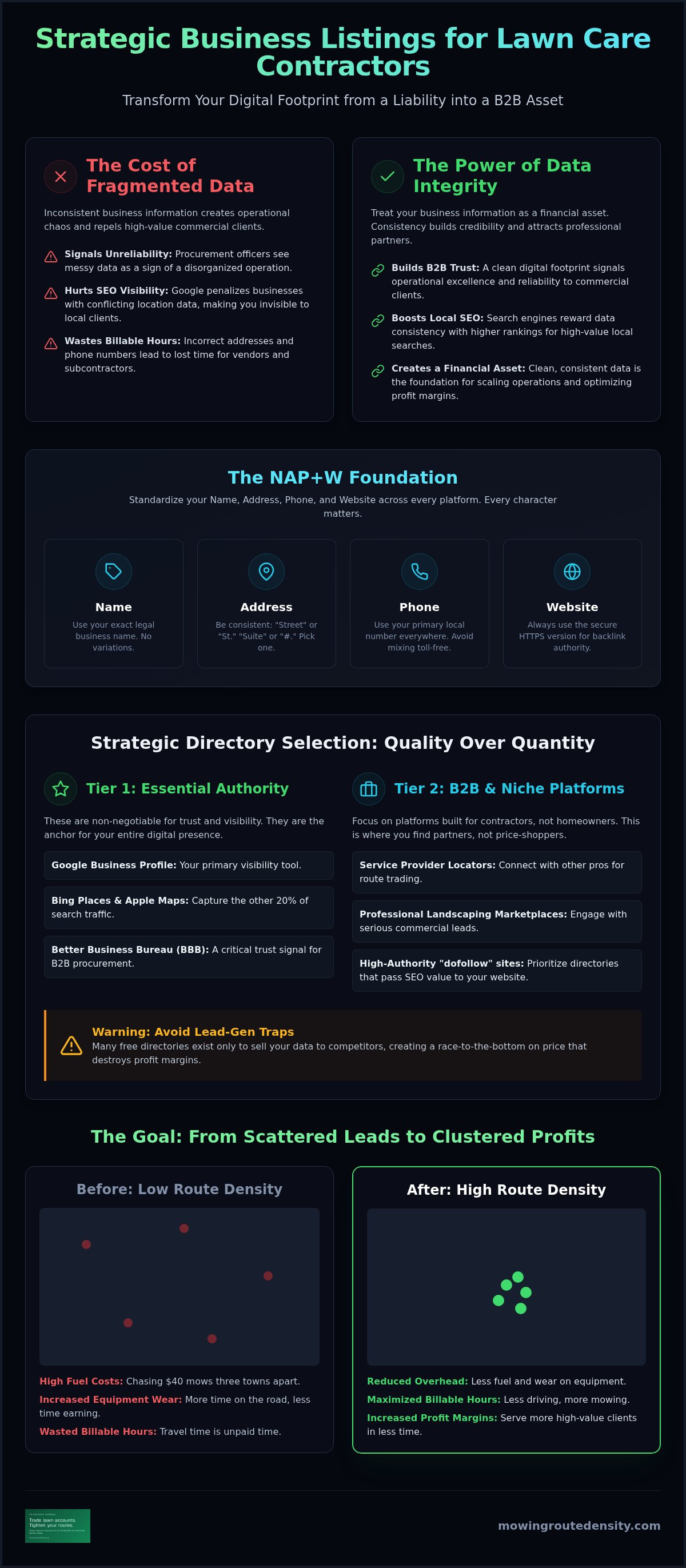
Conflicting data isn't a minor annoyance. It's a leak in your overhead. Conflicting phone numbers or addresses lead to lost billable hours when vendors or subcontractors can't find your shop. The psychological impact on commercial procurement officers is even worse. These professionals look for reliability. A "messy" digital footprint signals operational chaos. Why would they trust you with a multi-acre commercial contract if you can't manage a basic phone number? Google also punishes this lack of clarity. It penalizes businesses with "hallucinated" or outdated location data. If the algorithm can't verify where your trucks are, it won't show your business to high-value local clients. You're effectively invisible to the people who pay the most.
The Core NAP+W Framework
Efficiency requires total standardization. You need a rock-solid Name, Address, Phone, and Website (NAP+W) framework. NAP consistency is the digital foundation of route logistics. Every character matters. Use "St." or "Street" consistently across every platform. Don't swap between a local number and a toll-free line on different sites. Pick one and stick to it. This level of precision is a prerequisite for lawn care profit margin optimization. You can't tighten your margins if your digital presence is leaking authority through sloppy data entry. Ensure your website URL uses a secure HTTPS protocol. This maximizes backlink authority and signals to B2B partners that your business is professional, secure, and ready for national-scale operations. Tighten your data now or pay for the confusion later.
Identifying High-Impact Directories: Strategic Selection for Contractors
Most contractors treat directory listings like a "set it and forget it" chore. They join every free site they find. This is a mistake. You're trading your time for low-quality noise. When you prioritize how to get listed on lawn care directories, you must distinguish between general authority and niche relevance. High-authority sites help increase local SEO by passing domain strength to your primary website. Look for "dofollow" links. These move the needle for your search rankings. Avoid sites that hide your contact info behind a paywall. If a directory doesn't link directly to your site, its SEO value is near zero.
Tier 1: The Essential General Directories
Generic directories attract homeowners looking for a $40 mow. You want commercial partners. Prioritize platforms that support a lawn mowing service provider locator. These tools are built for B2B networking. They connect you with other contractors for route trading and subcontracting. If you're exploring commercial lawn mower lease options, use marketplaces that cater to professional landscaping logistics. These platforms understand asset-light growth. They provide the infrastructure to scale without the residential "tire-kickers" found on Yelp or Nextdoor.
Watch out for lead-gen traps. Many sites claim to offer free listings but exist only to sell your data to six different competitors. This creates a race to the bottom on price. It kills your profit margins. Focus on directories that respect your data and facilitate professional growth. You can build a network that actually pays by being selective. Start by vetting your current presence on a professional B2B platform to see where your data is leaking. Tighten your selection. Protect your time.
The Step-by-Step Execution: Auditing and Claiming Your Profiles
Execution is where most contractors fail. They treat digital presence as a quick task rather than a logistical deployment. Before you learn how to get listed on lawn care directories, you must understand what the internet already says about you. Most businesses have "ghost" listings. These are unverified mentions created by data aggregators or past employees. They're often riddled with errors. A Digital Audit is your first step to reclaiming your brand authority and stopping search cannibalization.
Phase 1: Search and Destroy Duplicates
Conflicting data splits your SEO authority. If Google sees three different addresses for your shop, it trusts none of them. Use search operators to find every iteration of your business. Search for your business name in quotes, followed by your phone number. Look for old shop locations or slight misspellings.
- Claim, Don't Create: If a listing exists, hit the "Own this business?" link. Creating a new profile while an old one lingers is a waste of time.
- Consolidate Authority: Merging duplicates forces search engines to attribute all "trust points" to a single, verified source.
- Eliminate Confusion: Procurement officers won't call a number that looks like it belongs to a defunct branch.
Phase 2: The Verification Slog
Verification is the gatekeeper of digital credibility. It's often a slow, manual process, but skipping it makes your business look like a scam. Google Business Profile usually requires a physical postcard sent to your registered address. For national operations, this requires coordination with local branch managers to ensure that mail isn't tossed as junk. Other platforms may use phone or video verification to prove you have the equipment and staff you claim.
Establish a Master Listing Document immediately. This is a single spreadsheet containing your exact business name, standardized address, primary phone, and secure website URL. Every future entry must match this document character for character. To stay ahead of the curve, set up automated alerts for your business name. You'll know the second a new mention appears, allowing you to claim it before a competitor or an aggregator messes with your data. Tightening your audit process now prevents expensive data cleanup later. Focus on the details. Protect your digital foundation.
Beyond the Listing: Optimizing for B2B Lead Quality and Route Density
Asset Clustering via Service Areas
Stop accepting every lead within a fifty-mile radius. That's a recipe for high fuel consumption and premature equipment wear. Use your directory settings to define tight service perimeters. This minimizes non-billable drive time. Tight service areas are the foundation of lawn care route density. When you cluster your assets, you increase your billable hours per gallon of fuel. You can also use these geographic filters to find lawn care subcontractors within specific clusters. This allows you to offload outlier accounts while maintaining a tight, profitable core. If a directory doesn't allow for specific service area targeting, it's likely a waste of your time.
Signaling B2B Authority
Your profile description is a vetting tool. Use it to repel low-value residential leads. Include keywords like "fleet," "logistics," "overhead," and "route density." These terms signal to commercial procurement officers that you speak their language. Don't just tell them you're professional. Show them. Upload high-quality photos of your crew using professional lawn equipment rental units to prove you have the capacity for large-scale contracts. A photo of a well-maintained 72-inch zero-turn says more about your capabilities than a paragraph of marketing fluff.
Stop asking for generic "great job" reviews. Ask your commercial clients for logistics-focused testimonials. You want them to mention your punctuality, your reporting, and your ability to handle complex sites. This builds a profile that attracts B2B partners who value reliability over the lowest possible price. Ready to stop chasing low-density leads? Start building a high-performance network on a dedicated route trading platform today. Tighten your profile. Protect your profit.
Scaling Your Network: Leveraging the Mowing Route Density Locator
Standard homeowner directories are designed to help consumers find the cheapest price for a one-off mow. They are lead-generation engines that prioritize volume over operational logic. For a serious contractor, this creates noise. It forces you to sift through low-density leads that break your schedule and increase your fuel consumption. If you've already mastered how to get listed on lawn care directories for basic SEO, you've built the foundation. Now you need to transition from simply "getting leads" to building a professional network that treats your route as a liquid asset.
Why Pro-Grade Locators Beat Yelp
Platforms like Yelp or Nextdoor don't understand route density. They don't care about your drive time or equipment longevity. A specialized B2B locator is different. It filters for contractors who understand the logistics of the service industry. This allows for professional account swaps. If you have an outlier account that is costing you too much in travel, you can find a partner who already has a cluster in that area. You trade that account for one that fits your existing route. This isn't just marketing. It's asset management. By reducing the noise of residential price-shoppers, you focus your billable hours on high-density clusters that actually move the needle on your bottom line.
A dense route is worth significantly more than a scattered one. When your accounts are clustered, your overhead drops and your profit per hour spikes. This is a critical component of a long-term lawn care business exit strategy. Buyers aren't looking for a list of random addresses. They are looking for a high-performance machine with optimized logistics. If you can prove your route density through a professional locator, you increase your business's liquidity and total valuation.
Joining the Mowing Route Density Contractor Network
The U.S. lawn care market is valued at $62.91 billion in 2026, but it remains highly fragmented. This fragmentation is an opportunity for contractors who work smarter. Learning how to get listed on lawn care directories that cater specifically to B2B needs puts you ahead of 90 percent of the competition. Our national service provider locator is built for pros. It connects you with a network focused on route trading, equipment rental, and commercial scaling.
Stop fighting for scraps on consumer sites. Use a platform that facilitates professional growth and asset-light expansion. When you Join the Mowing Route Density Network, you gain access to the tools needed to tighten your operations and maximize your route value. It's time to stop chasing every lead and start building a sellable, high-density business. Tighten your network. Protect your future.
Tighten Your Digital Footprint and Cluster Your Assets
Data fragmentation is a silent tax on your operations. Every inconsistent listing is a lost opportunity for B2B authority. You've learned that understanding how to get listed on lawn care directories is only the first step. The real work lies in standardized data entry and the strategic rejection of low-density residential leads. Clean citations aren't just for SEO. They are the foundation of a professional brand that procurement officers trust.
Stop wasting billable hours on platforms built for homeowners. You need a network that understands the logistics of route density and equipment longevity. Transitioning to a B2B framework allows you to trade accounts, optimize clusters, and scale your fleet without the noise of price-shoppers. It's time to treat your client list like the liquid asset it is.
Ready to join a national network of professional contractors? List your business on the Mowing Route Density Locator today. It's the only B2B locator focused specifically on route density. Access integrated route trading and equipment rental tools to maximize your profitability. Build a tighter route. Protect your margins.
Frequently Asked Questions
Do I need a physical office address to get listed on lawn care directories?
Yes. Most major directories require a physical address for verification purposes. If you operate from home, you can often hide your specific street address from the public while still using it to verify your location. B2B procurement officers prefer seeing a commercial shop address. It signals that you have the infrastructure and equipment storage capacity to handle large-scale contracts without logistical hiccups.
How long does it take for directory listings to improve my SEO?
Expect to see initial movement in 30 to 90 days. SEO is a long-term logistics play, not a quick fix. Search engines need time to crawl new citations and verify that your data is consistent across the web. If you're learning how to get listed on lawn care directories for the first time, don't expect overnight results. Consistency over several months builds the authority required to outrank competitors.
Is it worth paying for "Premium" or "Featured" directory listings?
Rarely. Most premium tiers on consumer sites are expensive lead-gen traps that sell your data to competitors. Unless a directory provides a "dofollow" backlink or connects you directly to a professional B2B network, keep your money. Focus your overhead on tightening your route density instead. High-authority niche sites often provide better ROI through free basic listings that support professional networking and account swaps.
What is the difference between a citation and a backlink?
A citation is a mention of your business name, address, and phone number. A backlink is a clickable URL to your website. Citations build local trust and verification. Backlinks build domain authority and search rankings. You need both to dominate local search. When researching how to get listed on lawn care directories, prioritize sites that offer both. A citation without a link is only half a tool.
How do I handle negative reviews on professional directories?
Respond with clinical precision and move on. Don't get emotional or defensive; it looks weak to potential B2B partners. Address the logistical failure if it occurred and offer a professional resolution. If the review is fake, use the directory's formal dispute process. High-value clients care more about how you handle problems than perfection. A transparent, professional response proves you have the management maturity to handle commercial accounts.
Can I use a P.O. Box for my business listing address?
No. Most high-authority directories, especially Google Business Profile, will suspend your listing for using a P.O. Box. They require a physical location where your business actually operates. Using a P.O. Box signals that you're a fly-by-night operator without real assets. If you don't have a commercial shop, use your residential address but set the profile as a Service Area Business to keep your home address private.
How often should I audit my business listings for accuracy?
Audit your listings every quarter. Data drifts over time as aggregators pull from outdated or incorrect sources. A quarterly check ensures that your NAP+W framework remains airtight. If you change a phone number or move shops, you must update every listing immediately to prevent logistical friction. Routine audits are a low-cost way to protect your SEO investment and ensure that commercial partners can always reach your dispatch team.
What is the best way to manage multiple listings at once?
Use a Master Listing Document to maintain a single source of truth. Manual entry is tedious but ensures the highest level of accuracy for Tier 1 directories. For Tier 2 sites, consider automated tools that sync your data across the web. However, never automate your primary B2B profiles. Those require a human touch to optimize descriptions for route density and commercial signaling. Efficiency comes from using the right tools for the right tier.


