
If your crews spend 30% of their day staring at a tailgate in traffic, you aren't running a lawn care business. You're running an accidental logistics company. Rising diesel prices and labor costs don't care about your "gut feeling" regarding route efficiency. Every mile driven between stops is a direct hit to your net margin. It’s time to stop guessing and start measuring the drive-time drain with a precision lawn care route density calculator. You already know that windshield time is the silent killer of your bottom line. We're going to show you how to fix it.
This strategic audit provides a mathematical framework to optimize your territory for 2026. You’ll learn how to assign a "Density Score" to every crew and identify exactly which outlier accounts are draining your resources. We'll show you how to prune unprofitable clients with confidence and transition toward more efficient operations. By the end of this guide, you'll have a data-backed plan to increase billable hours per man-hour and tighten your routes until they actually produce the profit you deserve. Stop letting your margins leak out of a tailpipe.
Key Takeaways
- Calculate the ratio of billable service time to non-billable transit time to identify where windshield time is killing your margins.
- Use a lawn care route density calculator to track total daily revenue against miles driven for every crew in your fleet.
- Establish a Revenue Per Mile (RPM) threshold by auditing 30 days of logs to pinpoint specific accounts that are draining your resources.
- Map your territory to visualize asset clustering and isolate "Lone Wolf" accounts that are geographically too far to be profitable.
- Scale your operation without adding logistical bloat by trading isolated stops for dense, pre-clustered routes on a dedicated trading platform.
Why Your Current Route is Bleeding Cash
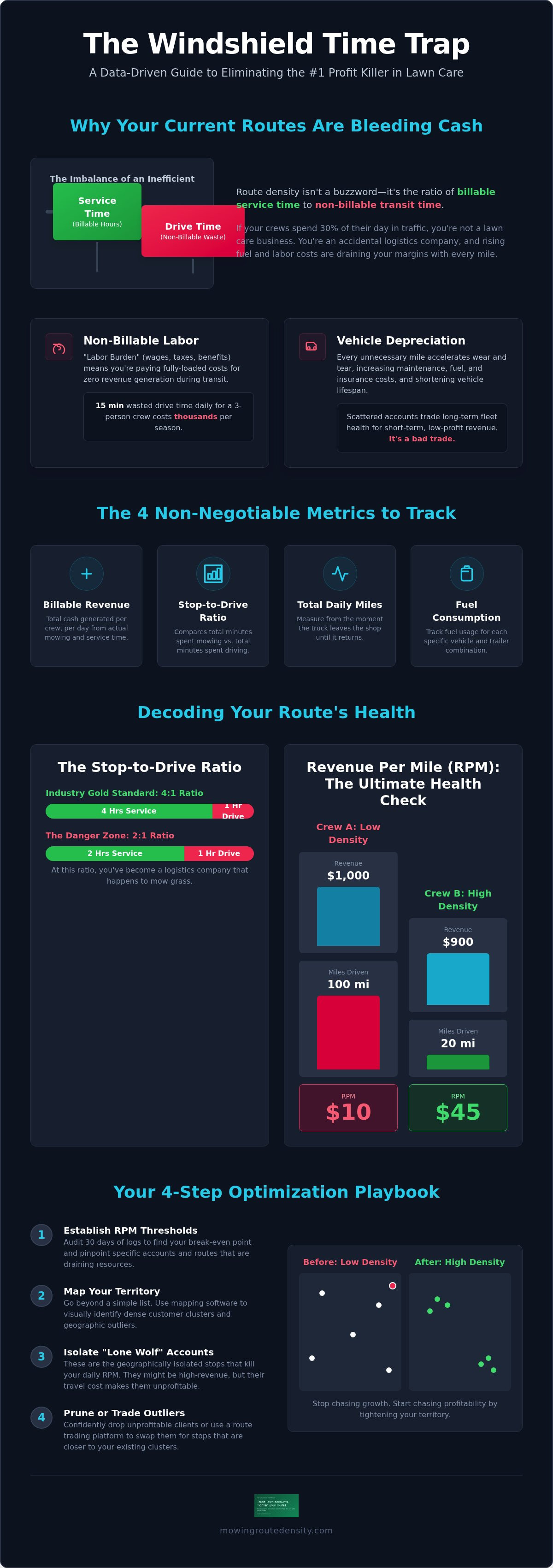
Route density isn't a metric. It's a survival strategy. It is the ratio of billable service time to non-billable transit time. Every minute your crew spends on the road is a minute they aren't generating revenue. If you aren't using a lawn care route density calculator, you're likely ignoring the "windshield time" trap. Paying a crew to sit in traffic is a silent margin killer. It feels like work, but it’s actually a financial drain. Logistics experts refer to this optimization challenge as The Vehicle Routing Problem (VRP). For your business, it’s the difference between scaling up and burning out.
The reality of 2026 makes inefficient routes unsustainable. Diesel prices are volatile. Labor inflation has pushed wages higher than ever. You can no longer afford to chase accounts across the county. Are you seeing high fuel spend despite low daily stop counts? That is route leakage. It's a symptom of a disorganized territory that prioritizes growth over profitability. Scattered growth is the fastest way to kill your fleet and your spirit. Stop guessing. Start measuring.
The Hidden Cost of Non-Billable Labor
Drive time is expensive because you’re paying for more than just a driver’s time. You’re paying for the Labor Burden. Labor Burden is the total cost of an employee per hour, not just their hourly rate. This includes payroll taxes, workers' compensation, and benefits. If a three-person crew wastes just 15 minutes of drive time per day, that equals 75 minutes of lost billable labor per week. Over a full season, that single inefficiency costs thousands of dollars per crew. You aren't just losing the wages. You're losing the revenue that crew could have generated at a job site.
Vehicle Depreciation as a Variable Expense
Your truck is a depreciating asset. It loses value every single mile it moves. When you audit your routes with a lawn care route density calculator, you must account for the per-mile cost of maintenance, tires, and insurance. Every unnecessary mile driven accelerates the need for a new transmission or a fresh set of tires. If your accounts are scattered, your equipment longevity plummets. You’re trading the long-term health of your fleet for short-term revenue from an outlier account. It’s a bad trade. Tightening your territory is the only way to protect your equipment and your cash flow.
The Variables: What Your Calculator Needs to Track
Data doesn't care about your feelings. To build an effective lawn care route density calculator, you must track four non-negotiable inputs. First, Total Daily Billable Revenue per crew. This is the hard cash your team generates only when the blades are spinning. Second, Total Daily Miles Driven. Measure this from the moment they leave the shop until they return. Third, the Stop-to-Drive Ratio. This compares total mowing minutes against total driving minutes. Finally, track the Fuel Consumption Rate for each specific vehicle and trailer combination. A heavy diesel truck pulling a 20-foot trailer has a different margin profile than a light-duty setup. You can't manage what you don't measure.
Defining the Stop-to-Drive Ratio
The 4:1 ratio is the industry gold standard. This means for every four hours of billable work, your crew spends only one hour in the truck. If your ratio drops to 2:1, you’ve stopped being a service provider. You’ve become a logistics company that happens to mow grass. This imbalance is a profit leak. It exposes the true labor burden you're paying for while your crew sits idle in traffic. To fix it, you need objective data. Don't rely on crew memories. Use GPS logs to minimize vehicle miles traveled (VMT) and get an honest look at where your time goes. If the numbers are ugly, you might need to trade your outliers for tighter clusters on a dedicated platform.
Quantifying Revenue Per Mile (RPM)
Revenue Per Hour is a deceptive metric. It tells you how fast your crew works, but it ignores the cost of getting them to the job. Revenue Per Mile (RPM) is the ultimate health check for your operations. To calculate it, divide Total Daily Revenue by Total Daily Miles. If a crew generates $1,000 but drives 100 miles, their RPM is $10. If another crew generates $900 but only drives 20 miles, their RPM is $45. Which route is actually healthier? The answer is obvious.
For 2026, commercial contractors should aim for high-density clusters where RPM stays well above the break-even point of fuel and labor inflation. Low RPM indicates "density decay." It means your growth is scattered and your overhead is eating your net profit. A lawn care route density calculator identifies these failing routes before they bankrupt you. Tighten the map or cut the client. There is no middle ground in a high-cost economy.
Revenue Per Mile: The Ultimate Operational Audit
A single day of data is a fluke. To run a real diagnostic, you need a 30-day average. Audit your daily logs for a full month to find your baseline. This is where a lawn care route density calculator moves from a theory to a weapon. Look at your total revenue against every mile driven. You’ll likely find that a small fraction of your accounts are dragging down the rest of your operation. These are your outliers. They are the "Lone Wolf" properties that look profitable on an invoice but are toxic to your fleet efficiency. Identify them. Measure them. Prepare to cut them.
Comparison is the only way to see the truth. Contrast your highest-density route against your most scattered one. The difference in net profit isn't just a few dollars. It’s often the difference between a 5% margin and a 25% margin. Once you see the numbers, set a "Hard Floor" for RPM. If a new lead doesn't meet this threshold, you don't bid. Period. Growth for the sake of growth is a slow-motion suicide for service businesses in 2026. Data doesn't lie. Your gut does.
Benchmarking Your Density Score
Efficiency happens in tiers. Tier 1 density consists of clustered accounts within 2-3 miles of each other. These are your profit engines. Tier 2 density involves regional clusters. You have good work in two different areas, but significant "dead head" time spent on the highway connecting them. Tier 3 is the danger zone. These are scattered accounts requiring highway travel between nearly every stop. If your lawn care route density calculator shows a Tier 3 score, you aren't growing. You're just vibrating in place while your equipment wears out.
The Impact of Commercial Mower Rental on RPM
You can't always fix a route by changing the map. Sometimes you fix it by changing the equipment. High-production mowers reduce time-on-site, which improves your billable ratio. Use professional lawn equipment rental to test new density clusters before committing to a six-figure equipment loan. This asset-light approach lets you scale up for a specific neighborhood and then return the gear if the density doesn't materialize. Matching mower width to property size is critical. A 72-inch deck on a property designed for a 48-inch unit is a waste of trailer space. Be precise. Every inch of deck and every minute of drive time matters.
Tightening Your Territory: Tactical Route Optimization
Visualization is the first step toward optimization. Map every active account to see where your trucks are actually going. You aren't just looking for dots on a map; you're looking for "Asset Clustering" opportunities. If your lawn care route density calculator identifies a cluster of high-revenue stops in one zip code, that is your stronghold. Conversely, the "Lone Wolf" accounts are your profit killers. These are the isolated stops 20 minutes away from everything else. They feel like revenue, but they're actually debt in disguise.
When the lawn care route density calculator flags an outlier, you must act. For these low-density stops, you have two choices: raise the price or cut the cord. Implement a fuel surcharge or a significant price increase immediately. If the client stays, your margins are protected. If they leave, you've freed up capacity for a better client. For accounts that simply don't fit your geographic focus, use a lawn account trading platform to swap them for stops that actually fit your route. This is how you turn a scattered mess into a streamlined machine.
Strategic Asset Clustering
Build your route around an "Anchor Account." This is usually a large commercial site where the crew stays for hours at a time. Once the trailer is dropped, every stop within a three-mile radius becomes high-margin profit. You minimize the loading and unloading cycles that kill your crew's energy and wear out your ramps. Use a lawn care service locator tool to find nearby partners for subcontracting or account swaps. Tight routes create predictable days. Predictable days create profitable businesses. Why work harder when you can just work closer?
Pruning Unprofitable Accounts
Firing a client doesn't have to be a bridge-burning event. Frame it as a "Logistics Realignment." Tell them you are tightening your service area to maintain the high quality they expect. This is the math of "Addition by Subtraction." By removing one outlier that requires 45 minutes of round-trip drive time, you can often add three new stops in an existing cluster. Stop chasing every lead that calls. Focus your marketing spend only on "Lookalike" properties that sit directly next to your current profitable accounts. If you can't see your next stop from your current one, you aren't dense enough yet.
Trade your isolated accounts for dense clusters on our platform today.
Scaling Without Bloat via Route Trading
Organic growth is often a trap. You say yes to a referral five miles out. You pick up another "good" account just past your current boundary. Suddenly, your map looks like a shotgun blast. This is "Density Decay." It's the silent erosion of your profit margins. A lawn care route density calculator will flag the damage, but it won't fix the geography. The fix is tactical route trading. Buying pre-clustered routes is more efficient than traditional marketing. It allows you to dominate a specific territory without the overhead of a multi-year customer acquisition campaign. Stop chasing every lead. Start buying clusters.
High density isn't just for today's cash flow. It’s for tomorrow’s payout. Use the lawn care business exit strategy framework to realize that a tight route is worth significantly more to a buyer than a scattered one. Volume is a vanity metric. Density is a sanity metric. Use a marketplace to swap your "Lone Wolves" for accounts in your core territory. Trade your weaknesses for someone else's strengths. If an account doesn't fit your cluster, it belongs to someone else. Let them deal with the drive time.
The Logistics of the Account Swap
Value an account by its proximity to your existing stops. If a stop is across the street from your anchor account, it's worth a premium. If it's ten miles out, it's a liability. Perform deep due diligence during any trade. Verify the revenue history and the specific equipment needs of the accounts you're acquiring. Maintaining client continuity is a matter of professional communication. Frame the transition as a logistical realignment that ensures more reliable service schedules. Most clients don't care who mows the grass as long as it's done well and on time.
Leveraging Asset-Light Growth
Don't buy a new truck for a new cluster until the density is proven. Use commercial lawn mower lease options to service new clusters without taking on long-term debt. This approach allows you to scale your fleet only when the lawn care route density calculator confirms the cluster is sustainable. Your goal is to maximize billable hours through superior logistics, not just by adding more trucks to the road. More trucks often mean more problems. More density always means more profit. Tighten the map before you expand the fleet.
Secure Your 2026 Margins Through Logistical Discipline
The 2026 season won't forgive operational waste. Every mile your trucks travel without spinning a blade is a mile that steals from your net profit. You've seen the math. You know that a 4:1 stop-to-drive ratio is the difference between a thriving enterprise and a logistics company in decline. A lawn care route density calculator is no longer optional; it is the baseline for any contractor serious about scaling without adding bloat.
Stop letting "Lone Wolf" accounts dictate your schedule. Use your data to prune the outliers and double down on the clusters that actually pay. Whether you need to swap territory or rent high-production equipment to speed up your stops, the path to profitability is clear. It requires the discipline to say no to scattered growth and the foresight to trade for density.
Ready to stop the bleed? Audit your routes and trade for density on our marketplace. Our national network of route trading professionals, commercial-grade equipment rental options, and B2B service provider locator are built for one purpose: your bottom line. Tighten your map. Protect your profit. Build a business that lasts.
Frequently Asked Questions
What is a good route density score for a lawn care business?
A high density score means your crew spends at least 80% of their day on-site and less than 20% in the truck. In a 10 hour shift, you want eight hours of billable work. If your density score is lower, you're paying for windshield time that produces zero revenue. Aim for clusters where stops are within three miles of each other. Anything less is just a waste of fuel and labor.
How do I calculate revenue per mile for my mowing routes?
Divide your total daily billable revenue by the total miles driven from shop to shop. If your crew brings in $1,200 but drives 100 miles, your RPM is $12. Compare this against your labor burden and vehicle overhead. A lawn care route density calculator helps you spot the specific routes where the drive time is eating your profit. High RPM indicates a tight, profitable cluster that protects your bottom line.
How often should I perform a route density audit?
Perform a full audit at least twice a year, specifically before the spring push and mid season. Routes decay over time as clients cancel or you add new leads in scattered locations. A quarterly check ensures you aren't letting "route creep" destroy your margins. Constant monitoring allows you to make surgical adjustments to your territory before the busy season peak hits your fuel budget and equipment longevity.
Does route density matter if I have a high hourly rate?
Yes, because a high hourly rate doesn't offset the hidden costs of non-billable drive time. You might charge a premium, but if your crew is stuck in traffic, you're still losing the opportunity to service more clients. High rates can mask inefficiency, but they don't fix it. Density ensures that your high hourly rate translates directly into net profit rather than subsidizing a fuel company or depreciating your fleet prematurely.
Can I improve density without firing clients?
You can use a lawn care route density calculator to identify where you need to add "fill-in" accounts to bridge geographic gaps. Targeted marketing in existing neighborhoods or trading isolated accounts for closer ones on a trading platform are effective strategies. However, if a client is too far and won't pay a premium, keeping them is a choice to lose money. Strategic realignment is often better for the business than simple growth.
What is the "Stop-to-Drive" ratio and why is it important?
This ratio compares total minutes spent mowing against total minutes spent driving. A 4:1 ratio is the industry gold standard for commercial crews. It matters because labor is your largest expense. If your ratio is 2:1, half of your payroll is going toward non-productive transit. Tightening this ratio is the fastest way to increase your capacity without hiring more people or buying more trucks. Efficiency is found in the truck, not just on the grass.
How do I use a route density calculator to set my 2026 prices?
Use the calculator to determine the true cost of service including the drive time labor burden. If a route has low density, you must add a "logistics premium" to those specific invoices to maintain your margin. Base your 2026 pricing on the Revenue Per Mile required to cover rising diesel and wage costs. Don't guess your overhead. Use the mathematical framework to ensure every stop is profitable regardless of its distance from the shop.
What should I do with accounts that are too far away to be dense?
You have three tactical options: raise their price until the margin justifies the drive, trade them on an account platform, or subcontract them out to a partner. Keeping an isolated "Lone Wolf" account just for the revenue is a strategic error. It prevents your crew from picking up more profitable work closer to the shop. Move these accounts to someone who already has density in that area to maximize everyone's efficiency.


