
Revenue is vanity. Density is sanity. Every mile your trucks travel between jobs is a direct hit to your bottom line. You aren't a shipping company. You're a lawn care professional. Yet, "Swiss cheese" routes have you burning fuel and burning out crews for the sake of scattered revenue. It's time to stop the bleed. Leveraging a professional lawn account trading platform is no longer optional. It is logistical surgery for your business. It is about cutting the waste and tightening your operations until every billable hour counts.
You already know that high-density clusters are the only way to protect your margins in a tightening 2026 market. We agree. This tactical guide will show you how to swap those far-flung, unprofitable accounts for high-density profit centers that drive real growth. We will examine the mechanics of secure account transfers, route consolidation strategies, and how to scale your new density using asset-light equipment solutions. Stop driving. Start profiting. It is time to trade your way to a leaner, more efficient fleet.
Key Takeaways
- Eliminate "Swiss cheese" routes by identifying the logistical waste that turns revenue into a liability.
- Select the best lawn account trading platform for your business by analyzing fee structures and B2B marketplace architectures.
- Mitigate transfer risks with escrow protections and verified handoff protocols to keep client retention high.
- Master the "Swap" strategy to trade far-flung outliers for profitable, high-density clusters in your primary service zone.
- Implement an asset-light growth model by pairing account acquisitions with commercial mower rentals for rapid, low-risk scaling.
The Logistics of Waste: Why You Need a Lawn Account Trading Platform
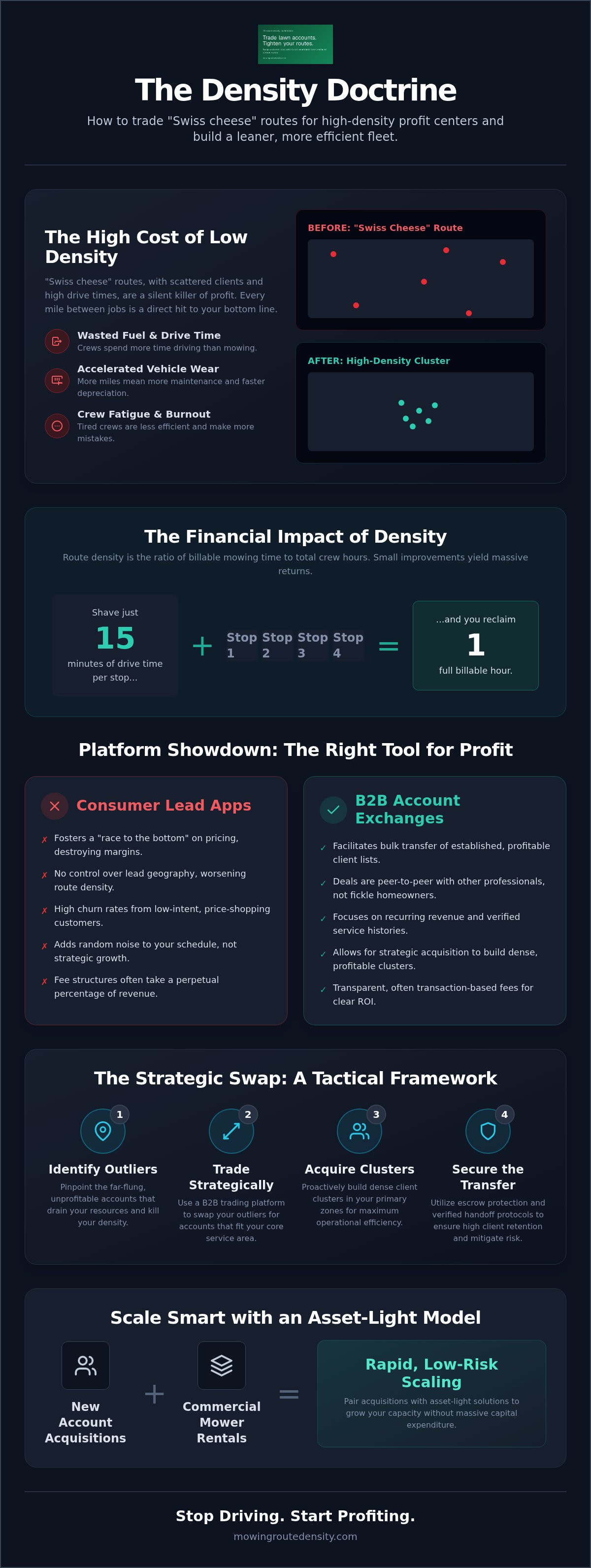
Your route map probably looks like a disaster. A "Swiss cheese" route is a map full of holes, characterized by high drive times and scattered clients. This is the natural result of undisciplined growth. You take a client five miles north because they called, then another three miles south. Your crews spend more time behind the wheel than behind a mower. This isn't expansion; it's a slow death by overhead. Every mile your trucks travel between jobs is a direct hit to your bottom line.
The Math of Drive Time and Billable Hours
Traditional business brokers are too slow for the needs of a growing contractor. They focus on selling entire companies, often demanding high commissions and months of negotiation. A digital lawn account trading platform facilitates peer-to-peer exchanges that happen in days. This speed is critical for lawn care profit margin optimization because it allows you to fix your route before the peak season begins. To ensure security during these handoffs, modern platforms often utilize escrow services to protect both parties until the account transfer is verified. It's a cleaner, faster, and more transparent way to grow your footprint without the baggage of a traditional brokerage.
Marketplace vs. Lead Gen: Evaluating Platform Architectures
Not all digital tools are created equal. Most contractors waste money on lead generation apps when they should be looking for a lawn account trading platform. There is a massive difference between the two. Lead apps find you customers; trading platforms find you profit. One adds noise to your schedule. The other adds density to your bottom line. Understanding these architectures is the difference between running a profitable fleet and just staying busy.
The Problem with Consumer Lead Apps
Consumer-facing apps are built for homeowners, not for your operational efficiency. They foster a "race to the bottom" pricing environment. You end up competing against low-ballers on every quote. This destroys your margins before you even start the engine. Even worse, you have zero control over geography. Accepting a random lead three miles away from your current route doesn't help you scale. It just increases your drive time and fuel burn. Churn rates are notoriously high. These leads often have low intent. They want the cheapest cut today, not a long-term service agreement. You spend your life on a treadmill of replacement rather than a ladder of growth.
B2B Account Exchanges: Built for Scale
A true B2B exchange facilitates the bulk transfer of established client lists. You're dealing with other professionals, not fickle homeowners. These platforms focus on recurring revenue and high-density residential clusters. Verification is the core of the process. You aren't guessing about the quality of the work or the reliability of the pay. You're seeing documented service history and revenue before any money changes hands. It's a transparent, peer-to-peer environment designed for logistical surgery.
Fee structures also differ significantly. Lead apps often take a perpetual percentage of your revenue, which becomes a permanent tax on your labor. Trading platforms typically use subscription models or flat transaction fees. This protects your long-term margins. If you want to stop chasing individual leads and start building a real territory, you need to use a specialized account trading exchange to find established route blocks. This is how you consolidate. This is how you win. You buy the density you need and sell the outliers that hold you back. It's a professional strategy for a professional business.
Risk Mitigation: Security, Escrow, and the Handoff Protocol
Trading accounts isn't just about moving data. It's about moving trust. The biggest fear in any trade is the "churn" that happens when a client realizes their provider has changed. If they walk, your investment dies. A professional lawn account trading platform eliminates this guesswork by codifying the transfer process. You aren't shaking hands in a parking lot. You're using a structured environment designed to protect your capital and your reputation. Risk mitigation is the difference between a strategic acquisition and a total loss.
Digital Escrow: Protecting Your Capital
Capital protection starts with escrow. In a professional exchange, funds are held by a neutral third party until specific milestones are met. Usually, this means the first successful service is completed and verified by the client. This prevents sellers from dumping "dead" accounts or misrepresented contracts on unsuspecting buyers. Dispute resolution mechanisms are built into the platform to handle disagreements without involving lawyers. A standard clawback clause is a mandatory feature; this clause ensures that if a client cancels service within a predetermined window, the seller must refund a prorated portion of the trade value. It keeps everyone honest. It ensures the seller only lists accounts that are actually stable.
The Professional Handoff: Ensuring Retention
Retention is won or lost in the first forty-eight hours. A sloppy handoff is an invitation for the client to look for a new provider. You need a rigorous protocol for transferring client intelligence. It's more than just an address. You need the following data points to ensure a seamless transition:
- Current gate codes and specific security instructions.
- Property quirks like hidden stumps, irrigation heads, or aggressive pets.
- Verified billing preferences and historical service frequency.
- Direct contact methods for the primary decision-maker.
Use a co-branded introduction strategy. The seller should send an email or letter introducing you as a "vetted partner" who specializes in that specific neighborhood. This positions the change as an upgrade in service rather than an abandonment by the previous owner. Thinking ahead is vital for your long-term success. A solid lawn care business exit strategy starts with clean handoffs. If you can't prove your accounts are transferable, your business isn't an asset. It's just a job. Secure your trades today to build a liquid business for tomorrow.
Strategic Swapping: A Tactical Framework for Route Consolidation
Most contractors think growth only comes from acquisition. They're wrong. Growth also comes from subtraction. Specifically, subtracting the outliers that poison your efficiency. The "Swap" strategy is the most underutilized tool in the industry. It involves trading an outlier account that sits ten miles away for an account that sits inside your core cluster. You might trade a high-ticket client for a lower-ticket one and still come out ahead. Why? Because you're trading drive time for billable hours. A professional lawn account trading platform facilitates these peer-to-peer exchanges, allowing two contractors to fix their maps simultaneously. It is a win-win scenario that prioritizes density over ego.
Mapping Your Core Service Area
You must define your Profit Zone. This is the geographic area immediately surrounding your shop or equipment storage. Every minute spent outside this zone is an unbillable expense. Follow the 10-minute rule. Any stop located further than 10 minutes from your last job is a logistical risk. It increases fuel burn. It increases crew fatigue. It decreases your daily capacity. If you have "Swiss cheese" holes in your map, you are leaving money on the pavement. To master this, consult our detailed guide on lawn care route density to learn how to visualize your clusters. Once you identify the outliers, list them for trade. Someone else is already driving past those properties; let them have the revenue while you take the density.
Valuing the Trade
Stop looking at gross revenue. Start looking at Drive-Adjusted Revenue. Is one $60 account near your shop worth more than two $45 accounts twenty miles away? Absolutely. When you factor in the hourly rate of a three-man crew, the fuel for a heavy truck, and the wear on your mowers, the distant accounts often net zero. You also need to consider equipment compatibility. Don't trade for a massive commercial property if your fleet consists of 30-inch push mowers. Conversely, don't take on tiny residential gates if you're running 72-inch zero-turns. A successful swap matches the property to the machine.
Initiating a swap on a national B2B platform is straightforward. You list your outliers, specify your target geographic clusters, and wait for a match. It's a precise way to tighten your operations without the cost of new marketing. If you are ready to stop the drive-time bleed and start performing logistical surgery on your routes, visit our national account trading exchange to find your first swap partner today. Density is the only path to long-term profitability.
Scaling Asset-Light: Integrating Trading with Equipment Rental
Stop buying debt. Most contractors think they need to own every piece of steel in their trailer to be successful. They're wrong. In 2026, the most efficient firms utilize an "Asset-Light" model. This strategy involves using a lawn account trading platform to acquire dense route clusters and then servicing them with rented assets. You aren't tied down by five-year loans on equipment that might sit idle during the off-season. You scale with surgical precision. When you trade into a new high-density zone, you shouldn't be waiting on a bank to approve a mower purchase. You should be mowing. This is about speed and liquidity.
Renting for New Routes
Testing a new service area is a gamble if you're buying new gear upfront. Using professional lawn equipment rental removes that risk entirely. You can deploy a commercial-grade zero-turn to a newly traded route for a single season or even a month. If the density holds and the clients remain stable, you continue. If the route doesn't perform, you return the machine. This flexibility is vital for managing the seasonal surges that come with traded accounts. You only pay for the capacity you're currently using.
There are also significant financial advantages to this approach. Explore commercial lawn mower lease options to shift equipment costs from capital expenditures to operating expenses. This often provides better tax treatment than standard depreciation schedules. To calculate the ROI of a rental mower on a newly acquired route, subtract the daily rental cost, labor, and fuel from the total daily revenue generated by those specific stops. If the margin is healthy, the rental is a strategic win. It keeps your balance sheet clean and your fleet agile enough to pivot when the market shifts.
The Contractor Network Advantage
You cannot optimize your route in a vacuum. You need partners who understand the value of density. A lawn mowing service provider locator is your gateway to a national B2B network. This tool helps you identify other professionals who are looking to trade or sell accounts in your target Profit Zone. Building these relationships turns your competitors into collaborators. You aren't just fighting for the same leads; you're trading for mutual efficiency. This network is the backbone of a modern, lean lawn care business.
Mowing Route Density is the integrated solution for both accounts and assets. We provide the marketplace to find the work and the equipment to finish it. Stop letting unoptimized routes and heavy debt loads kill your profitability. Join the marketplace and start optimizing your routes today.
The Future of Fleet Efficiency
Your route map isn't just a list of addresses; it's a balance sheet. Every mile of wasted drive time is a leak in your profit margin. You've seen how to perform logistical surgery by swapping "Swiss cheese" outliers for high-density clusters. You've learned that scaling doesn't require a mountain of equipment debt. By using a professional lawn account trading platform, you can finally stop chasing revenue and start protecting your time. Why keep driving past the same houses three times a week?
The future of the industry is asset-light and density-heavy. It's time to trade up. Our platform offers secure escrow for all account transfers, ensuring your capital is protected. You gain access to a national network of professional contractors ready to swap, along with integrated commercial mower rental options to support your expansion. It's a common-sense remedy for a systemic flaw. Optimize your route density on the Mowing Route Density marketplace. Tighten your map. Cut the waste. Your bottom line will thank you. Build the business you actually want to own.
Frequently Asked Questions
Is it legal to buy and sell lawn care accounts?
Buying and selling accounts is a standard business practice involving the transfer of service agreements. Most professional service contracts include an assignability clause. This allows the provider to transfer the obligation to a vetted partner. You aren't selling the person; you're selling the recurring revenue stream and the rights to service that property. Ensure your own contracts are updated to allow for these transitions to keep your business liquid.
How much does a lawn care account typically sell for in 2026?
Account valuation in 2026 is typically calculated as a multiple of monthly recurring revenue, often ranging from 2x to 4x depending on density. A high-density cluster in a tight geographic zone commands a higher premium than scattered outliers. Factors like service frequency, payment history, and contract length also influence the final price. Using a professional lawn account trading platform helps you find market-rate trades that reflect true logistical value.
What happens if a client cancels right after I buy the account?
Professional platforms use digital escrow and clawback clauses to protect your investment from immediate churn. If a client cancels within a specified window, usually 30 to 90 days, the seller is required to refund a prorated portion of the purchase price. This mechanism ensures that sellers only list stable, satisfied clients. It forces the seller to participate in a warm handoff, as their payout depends on client retention.
Can I trade residential accounts for commercial contracts?
Swapping residential clusters for commercial contracts is a common strategy for contractors shifting their business model. You can trade a high-density block of residential yards for one large commercial property if the revenue and equipment requirements align. These trades allow you to specialize your fleet. Instead of carrying both residential push mowers and heavy commercial zero-turns, you can trade into a route that only requires one equipment type.
How do I verify the revenue of a route before buying?
You verify revenue by reviewing documented service logs and integrated payment history provided by the lawn account trading platform. Avoid verbal promises. Look for at least 12 months of consistent billing data to identify seasonal trends and churn risks. A reputable exchange will provide a transparent dashboard where you can see proof of payment before funds are released from escrow. This data-driven approach removes the risk from the transaction.
Is route density more important than the total number of clients?
Density is always more important than the total number of clients. One hundred clients spread across a county will bankrupt you through fuel costs and vehicle wear. Fifty clients on the same three streets will make you wealthy. High density maximizes billable hours and minimizes non-productive drive time. Every trade you make should aim to tighten your geographic footprint, even if it means temporarily reducing your total client count.
What is the best way to introduce a new contractor to existing clients?
The best introduction is a co-branded warm handoff initiated by the current provider. The seller should contact the client via email or mail, introducing your firm as a vetted, high-quality partner. This frames the change as a strategic upgrade rather than an abandonment. Providing the client with your contact info and gate codes immediately proves you are prepared. Retention stays high when the client feels the transition was planned.
How does a B2B marketplace differ from a lead generation app?
A B2B marketplace focuses on route consolidation and the transfer of established, recurring revenue between professionals. Lead generation apps focus on finding new, unvetted homeowners who are often price-shopping. Lead apps often increase your drive time by sending you to random locations. A B2B platform allows you to perform logistical surgery on your existing map, swapping outliers for density. It is a tool for business strategy, not just marketing.


