

What if the equipment sitting in your garage is actually a liability disguised as an asset? Most operators think scaling means more debt, more trailers, and more repair bills. It's a trap. The transition from solo lawn operator to business owner isn't about working more hours. It's about owning the logistics, not the headaches. You're likely exhausted from chasing scattered routes and losing profit to equipment maintenance downtime. It's time to stop being the engine and start being the driver.
You know that trading your physical health for a paycheck isn't a sustainable plan. You've felt the sting of a broken mower stalling your week or a sick day wiping out your profit. This guide shows you how to build a scalable, asset-light enterprise that runs without you on the deck. You'll learn how to optimize route density, leverage rental equipment to avoid massive loans, and trade accounts to fix your margins. We'll walk through the exact steps to move from the field to the office. Let's turn your manual labor into a predictable, high-value asset.
Key Takeaways
- Identify the $250,000 revenue wall where solo logistics collapse and learn why your technical skills are stalling your growth.
- Audit hidden costs like non-billable drive time to build bids that actually cover crew wages and overhead.
- Navigate the shift from solo lawn operator to business owner by using equipment rentals to add capacity without capital risk.
- Tighten your geography by trading away "outlier" accounts to maximize your team's daily billable hours.
- Deploy a managerial blueprint to find high-value commercial leads and step off the mower for good.
The Solo Operator Ceiling: Why Your Current Model Will Fail
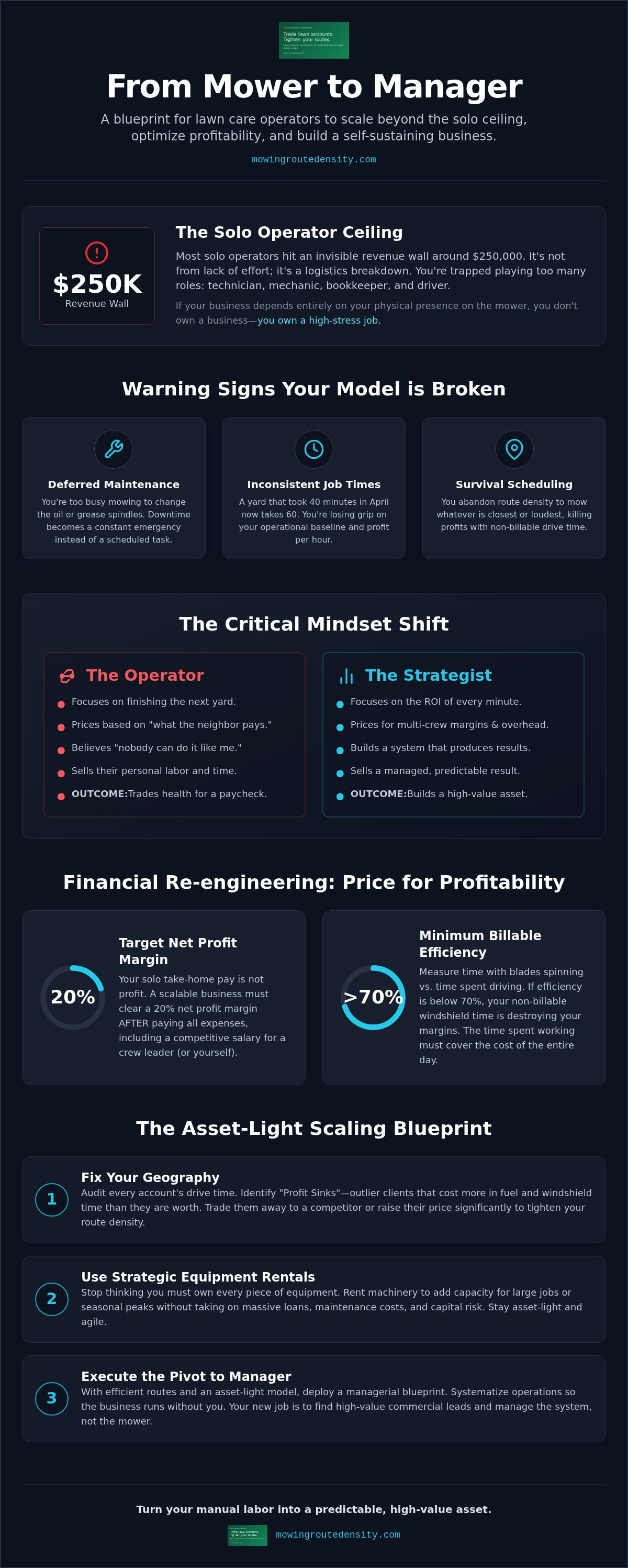
Most solo operators hit a invisible wall around the $250,000 revenue mark. It isn't a lack of effort. It's a lack of daylight. At this level, your logistics break down because you're playing too many roles. You are the lead technician, the head mechanic, the bookkeeper, and the driver. When you're on the mower for ten hours a day, the business stops growing. You've reached the point of diminishing marginal utility. Every extra hour you work produces less value because fatigue leads to mistakes, missed calls, and equipment neglect. The math of exhaustion is simple: you can't outwork a bad business model.
The "Owner-Operator Trap" is the most dangerous stage of growth. You take pride in being the best mower in the county. You think "nobody can do it like me." That mindset is exactly what keeps you small. If the quality of the service depends entirely on your physical presence, you don't own a business. You own a high-stress job. Many sole proprietor operations fail to scale because the owner refuses to delegate the "white glove" touch. In the 2026 labor market, simply "hiring a helper" isn't a strategy. High labor costs and shifting worker expectations mean you need a system that produces results, not a person you have to babysit.
Recognizing the Symptoms of Stalled Growth
Your business will tell you it's failing before the bank account does. Look for these leading indicators of a broken model:
- Deferred maintenance: You're too busy mowing to grease the spindles or change the oil. Downtime becomes an emergency instead of a scheduled task.
- Inconsistent job times: A property that took 40 minutes in April takes 60 minutes in July. You're losing grip on your operational baseline.
- Survival Scheduling: You mow whatever is closest or loudest. You've abandoned route density for the sake of putting out fires.
The Transition Mindset: Operator vs. Strategist
The move from solo lawn operator to business owner requires a total mental reset. An operator thinks about how to finish the next yard. A strategist thinks about the return on investment (ROI) of every minute the blades are spinning. You must stop pricing based on "what the neighbor pays" and start pricing based on a sustainable business model. This means accounting for crew lead wages, fuel surcharges, and equipment replacement cycles. If your current prices don't allow you to pay someone else to do the work while still leaving a 20% profit margin, your model is broken. Transitioning from solo lawn operator to business owner means you stop selling your labor and start selling a managed result.
Financial Re-engineering: Pricing for Multi-Crew Margins
Transitioning from solo lawn operator to business owner requires a total overhaul of your numbers. Your current pricing likely covers your time and some gas. It doesn't cover a crew leader's salary, workers' comp, or the administrative drag of a multi-truck operation. Solo operators often price based on what they need to survive. A business owner prices based on what the enterprise needs to thrive. Pricing for profitability is not about guessing; it's about auditing every non-billable minute spent behind the wheel.
You need a 20% net profit margin buffer after all expenses, including your own salary. Many solo guys skip this. They think their personal take-home is the profit. It's not. If you can't pay a crew leader a competitive wage and still clear 20% for the company, your bids are too low. You're just subsidizing your customers' lawns with your own exhaustion. For a deeper dive into these numbers, check out our Lawn Care Profit Margin Optimization: The No-Nonsense Guide to 2026 Profitability.
Calculating Your New Hourly Minimum
You must account for the "Truck Charge" separately from labor. This includes insurance, depreciation, and maintenance. Then add the "Labor Charge," which includes payroll taxes and workers' comp. Don't forget billable efficiency. Billable efficiency is the percentage of the work day spent with blades spinning rather than driving. If your crew spends three hours a day in traffic, those three hours must be paid for by the five hours spent on the turf. If your efficiency is below 70%, you're losing money every time the truck leaves the shop.
Eliminating Waste Before Adding Labor
Don't scale a leak. Audit your fuel consumption per account immediately. If a client is ten miles away from your core cluster, they are a "Profit Sink." They cost you more in windshield time and fuel than their monthly bill is worth. You have to cut them or raise their price until it hurts. Tightening your geography is the fastest way to find money without adding a single new customer. If you want to fix these margins before you hire your first crew, consider using a route trading marketplace to swap those distant accounts for jobs closer to your home base. High-efficiency equipment only protects your margins if the machine is actually working, not sitting in a trailer on the highway.
Asset-Light Scaling: Strategic Equipment Rental and Leasing
Scaling doesn't mean owning more iron. It means owning more margin. Most contractors think the jump from solo lawn operator to business owner requires a $15,000 mower loan and a shiny new trailer. This is a trap. Debt kills scaling flexibility. If you finance a John Deere Z950M for $12,999, you're committed to that payment for five years regardless of rain, drought, or labor shortages. Heavy debt loads force you to take low-margin work just to feed the bank. You aren't building an asset; you're building a prison.
Smart operators use professional lawn equipment rental to add capacity without capital risk. This is the "Rental Hack." Use a short-term rental to test a second crew for 30 days. If the crew works out, you keep the machine. If they quit or the route isn't dense enough, you return the mower. You've offloaded the liability and kept your cash. Once you prove the revenue is stable, you can compare commercial lawn mower lease options to manage your 2026 fleet with predictable monthly costs that include maintenance support.
Renting vs. Buying: The Strategic Math
The math of ownership often ignores the cost of downtime. When your owned mower breaks on a Tuesday, it sits in the shop while your billable hours vanish. A rental unit stays in the field because the rental company simply swaps it for a fresh machine. You preserve your cash flow for marketing and lead generation instead of sinking it into a depreciating asset. More importantly, you avoid the "Off-Season" payment burden. Financed equipment costs you money in January when the grass isn't growing. Rentals don't.
Standardizing Your Fleet for Crew Success
Your transition from solo lawn operator to business owner depends on your team's ability to execute without you. You need "idiot-proof" durability. Skip the consumer-grade features and focus on stand-on mowers that allow for quick mounting and dismounting. This is a tactical advantage for high-property density. Equipment standardization reduces training time for new hires because every crew member learns one control scheme instead of five. It also simplifies your parts inventory. When every mower uses the same blades and filters, you stop losing time to logistical clutter and start focusing on route optimization.
Fixing Your Geography: Trading Routes for Maximum Density
Windshield time is a silent profit killer. Most solo guys brag about having 50 accounts. They forget to mention those accounts are spread across three zip codes. Ten accounts on a single street are worth more than thirty accounts scattered across the county. Why? Because the street with ten accounts has zero drive time. Your blades are spinning for four hours straight. The scattered route has four hours of drive time and four hours of work. You're paying for gas and wear and tear while earning nothing. The transition from solo lawn operator to business owner requires you to stop chasing every lead and start building clusters.
Use a lawn account trading platform to dump your outlier accounts immediately. These are the jobs that sit twenty minutes away from your core area. Trade them for accounts that fill the gaps in your existing routes. This "Cluster Strategy" ensures your crew spends their day working, not sitting in traffic. If you want to maximize your crew's billable hours, you need a Lawn Care Route Density: The Strategic Guide to 2026 Profitability. Every mile you cut from your route is money straight to your bottom line.
The 5-Step Route Audit
Stop guessing where your money is going. Follow this audit to tighten your operations:
- Map your stops: Use a visual mapping tool to see where your customers actually live.
- Color-code by profit-per-minute: Calculate the total time spent on a property plus the drive time to get there.
- Identify 'Anchor' neighborhoods: Find the 2-3 areas where you have the highest density. These are your profit centers.
- List outlying accounts: Any job that requires more than a 10-minute drive from an anchor neighborhood is an outlier.
- Sell or trade: Post these outliers on a professional marketplace to swap them for closer jobs.
Acquiring Routes for Immediate Scaling
Organic marketing is slow and expensive. Buying an existing route is often the faster path to scale. This gives you a speed-to-market advantage that Google Ads can't match. However, you must perform due diligence before you sign. Look for the "churn rate" of the client list. Are these long-term customers or people who switch providers every season? Check the pricing. If the previous owner was undercharging, you'll lose half the clients when you raise rates to business-owner levels. Transitioning from solo lawn operator to business owner is easier when you acquire density rather than just acquiring names. Once you buy, integrate these accounts into your routing software immediately to ensure your new crew hits the ground running. Optimize your route density today to stop the fuel bleed.
Executing the Pivot: From Mower to Manager
The final step in your evolution is the hardest. You have to fire yourself from the field. Most operators fail here because they can't let go of the trimmer. Transitioning from solo lawn operator to business owner requires a radical shift in your daily schedule. Your new job is sales, logistics, and quality control. If you're still mowing when a high-value commercial lead calls, you're losing money. You must build a "First Crew" blueprint that defines every role from the lead technician to the helper. Accountability starts with clear reporting. If they don't report it, it didn't happen.
To fuel this growth, you need better leads. You can't scale a multi-crew business on $45 residential cuts alone. Use a lawn mowing service provider locator to identify B2B opportunities and commercial contracts that offer higher margins and tighter clusters. This allows you to focus on the numbers while your team focuses on the turf. You should also be thinking about the end from the beginning. Setting up an exit strategy ensures you're building a sellable asset, not just a job you can't leave. A business that depends on your name and your physical labor is worth nothing to a buyer.
Managing People, Not Grass
Your success now depends on Standard Operating Procedures (SOPs). These are the rules of the road for your crew. They cover everything from how to load the trailer to how to handle a gate that won't lock. Don't try to hire your way out of every problem. Use subcontractors to handle seasonal overflow or specialized tasks like aeration. This keeps your fixed overhead low while you test new markets. Implement a digital routing system immediately. You need to see crew efficiency in real-time. If a two-man crew is taking three hours on a one-hour job, you need to know why before the sun goes down.
The 2026 Growth Roadmap
Stop setting revenue goals. Revenue is a vanity metric. Set quarterly density goals instead. Aim to add five new accounts within a two-mile radius of your existing anchors. This is how you protect your profit. Follow the "Rule of Three" for fleet management: don't add a third truck until your first two are consistently hitting 85% billable efficiency. Business ownership is the ability for the business to function for 30 days without the owner's physical presence. If you can't take a month off without the wheels falling off, you're still an operator. Build the system. Trust the system. Get out of the way. Reclaiming your time allows you to explore detailed technical interests, such as the precision model railway kits from Narrow Minded Railworks.
Step Off the Mower and Own Your Future
Scaling a lawn care company isn't about working more hours. It's about building a system that doesn't require your physical presence. You've seen why the solo model fails at the $250,000 revenue mark. You understand that route density is the only way to protect your margins from rising fuel and labor costs. The transition from solo lawn operator to business owner requires you to trade your trimmer for a logistical blueprint. Stop chasing scattered accounts. Stop sinking cash into depreciating equipment. Focus on tightening your geography and managing your team's billable efficiency.
You can start today by offloading the liabilities that hold you back. Access commercial-grade rental mowers to eliminate maintenance downtime. Utilize our national lawn account trading marketplace to optimize your routes for maximum profit. Leverage our B2B contractor network to secure the lead generation your crews need to thrive. The 2026 market demands operational excellence. Build a business that works for you, not the other way around. Scale your business with the Mowing Route Density marketplace and rental fleet today.
Frequently Asked Questions
When is the right time to hire my first lawn care employee?
You should hire your first employee when your billable efficiency consistently exceeds 85% and you are turning away profitable leads in your anchor neighborhoods. Hiring before you have optimized your route density is a mistake. If you can't manage your own time efficiently, you won't be able to manage someone else's. Ensure your pricing already supports a crew leader's wage before you post the job ad.
Is it better to rent or buy a commercial mower when starting a second crew?
Renting is the superior tactical choice for testing new capacity without capital risk. Buying a mower ties you to a long-term debt obligation that persists even if your new crew quits or the route fails. Use a rental to prove the route is profitable over a 30 or 60-day period. Once the revenue is stable and predictable, you can look into leasing or purchasing options with much lower risk.
How much revenue should a solo lawn operator generate before scaling?
Most operators hit a physical and logistical ceiling at $250,000 in annual revenue. However, the transition from solo lawn operator to business owner should start when your margins are high enough to replace yourself. If your current revenue doesn't allow for a 20% net profit after paying a technician and covering overhead, you need to fix your pricing and route density before adding headcount.
What is the best way to increase lawn care route density quickly?
The fastest method is using a route trading platform to swap your "outlier" accounts for jobs closer to your core clusters. Organic marketing through door hangers or digital ads can take months to yield results. Trading allows you to instantly eliminate windshield time and consolidate your stops. This immediate density boost increases your profit per man-hour without requiring a massive marketing budget.
Should I buy an existing lawn care route or grow organically?
Buying an existing route is often more efficient because it provides immediate density and cash flow. Organic growth is slow and often results in a scattered, inefficient route. When buying, you must perform a thorough audit of the client list to check for high churn rates or underpriced accounts. If the numbers hold up, acquisition is the fastest way to add a second truck to your fleet.
How do I price my services when I transition from solo to a crew?
You must move from labor-only pricing to business-model pricing immediately. Your new rate must cover the crew's hourly wage, payroll taxes, workers' comp, and equipment depreciation. Don't forget to build in a 20% profit margin for the company itself. If you continue to price based on what you were willing to accept as a solo operator, your business will bleed cash as it grows.
What are the biggest risks when scaling a lawn care business to multiple trucks?
The primary risks are equipment liability and a lack of standardized quality. As you step away from the field, you lose direct control over how mowers are treated and how gates are closed. Without strict Standard Operating Procedures (SOPs), your repair bills will skyrocket and your customer retention will drop. High debt loads on multiple vehicles can also become a terminal threat during a seasonal drought.
Can I use a residential mower for a professional crew?
No. Residential mowers are not designed for the 40 to 50 hours of weekly use required by a professional crew. The spindles, belts, and engines will fail under the stress of a commercial schedule. The resulting downtime will cost you more in lost billable hours and emergency repairs than the cost of a commercial-grade machine. Professional equipment is a requirement for a scalable business, not an option.


