

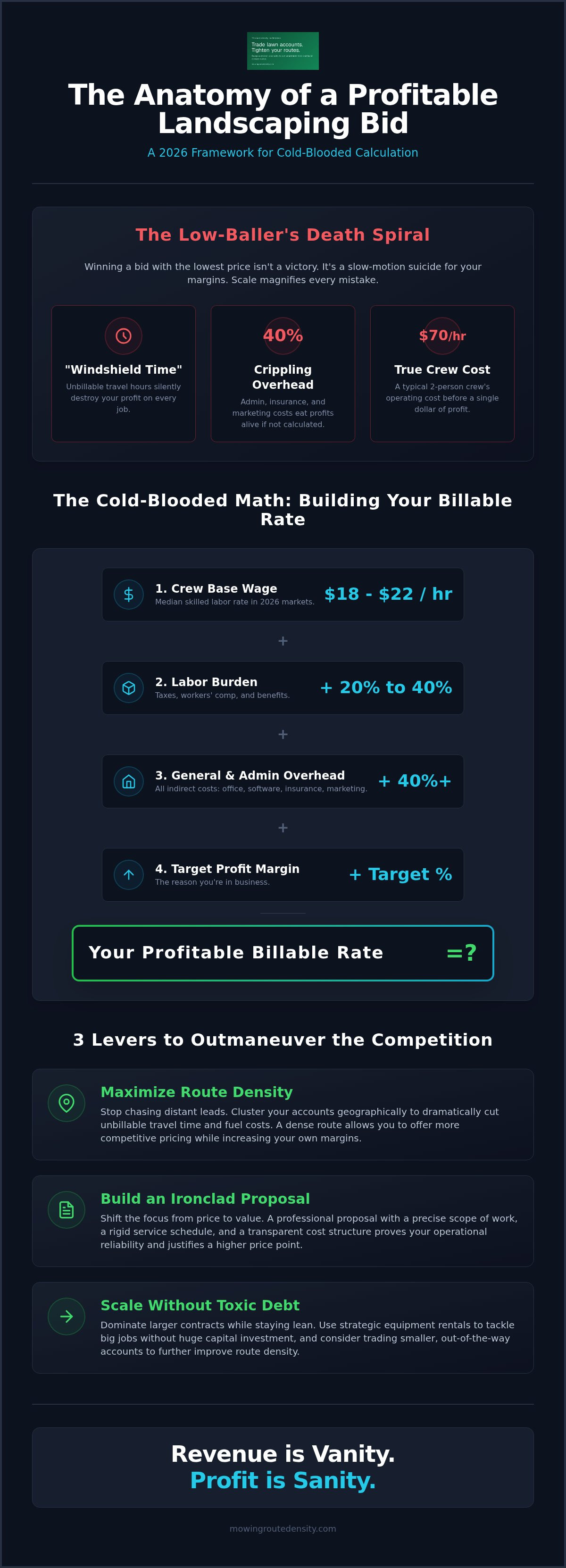
Winning a commercial bid with the lowest price isn't a victory; it's often a slow-motion suicide for your margins. You've seen the low-ballers. They land the account. Then they realize they can't cover their $70 hourly crew costs or the 40% overhead that eats their profit alive. It's frustrating to watch competitors ignore the math while you struggle with travel time that bleeds your billable hours dry. Effective commercial landscaping contract management isn't about being the cheapest guy in the room. It's about being the most calculated.
You know that "gut feeling" bidding is a recipe for disaster. We're here to help you stop guessing and start winning with a cold-blooded calculation of your actual operational costs. This article provides a 2026 framework for building a repeatable bidding template that protects your target margins. We'll break down the exact mechanics of mastering route density and leveraging asset management to outmaneuver the competition. It's time to stop chasing every lead. Start dominating the high-margin accounts that actually grow your bottom line.
Key Takeaways
- Stop guessing and start calculating. Learn why winning a bid based on a "gut feeling" leads to losing money on every site visit.
- Master the cold-blooded math of labor and overhead. We break down how to calculate a fully burdened labor rate to ensure your commercial landscaping contract management remains profitable.
- Eliminate the silent killer of windshield time. Discover how maximizing route density through account clustering lowers operational costs and increases margins.
- Build a professional proposal that prioritizes clarity over price. A detailed scope of work and clear service standards beat low-ballers by proving your operational reliability.
- Scale operations without toxic debt. Learn how strategic equipment rentals and account trading allow you to dominate larger contracts while staying lean.
Why Most Commercial Landscaping Bids Fail Before the Mowers Start
Commercial bidding isn't an art form. It's a cold-blooded logistical calculation. If you're guessing at your numbers, you've already lost. Most contractors approach a commercial RFP with a residential mindset, hoping their "gut feeling" on price will cover the bills. It won't. In the commercial sector, scale magnifies every mistake. A 5% error on a backyard is a rounding error. A 5% error on a 50-acre corporate campus is a financial catastrophe that can sink your company.
The "low-ball" trap is a death sentence for growing firms. You win the contract. You feel the rush of victory. Then, the reality of the 2026 labor market hits. If your bid doesn't account for the $18 to $22 per hour median wage for skilled labor, you're effectively paying for the privilege of cutting someone else's grass. Winning a contract that costs you money to service isn't growth; it's a slow-motion liquidation of your assets. Within the broader Landscape contracting profession, the transition from residential to commercial requires a total overhaul of how you view data.
A commercial bid is more than just a price tag. It's a binding proposal that serves as the legal and operational roadmap for a property. It includes a precise scope of work, a rigid service schedule, and a transparent cost structure. This document is the cornerstone of professional commercial landscaping contract management. If any of these three pillars is weak, your profit will leak out long before the season ends.
The Hidden Cost of Underestimating Overhead
Admin time, insurance premiums, and marketing budgets don't pay for themselves. They must be baked into every man-hour you sell. Most owners fail to account for non-billable hours, such as the time spent on site walkthroughs or equipment maintenance. This is the number one profit killer in the industry. You cannot ignore the cost of the office you sit in or the software you use to track your crews. Overhead is the total of all indirect costs required to keep your business running, including office rent, administrative salaries, and liability insurance.
The Difference Between Price and Profit
Revenue is vanity; profit is sanity. Focus on the bottom line, not the size of the check. Some contracts look great on paper because the top-line number is huge. However, if the travel time between sites and the labor burden eat 90% of that number, the contract is garbage. You need to identify "bad" contracts early and walk away. Protecting your bid means understanding lawn care profit margin optimization before you sign the dotted line. If a contract doesn't hit your target margin after all costs are considered, let your competitor have it. Let them be the ones who go broke while you focus on high-density, high-margin accounts.
The Cold-Blooded Math: How to Calculate Your Base Bid Rate
Bidding is a math problem. If you treat it like a guessing game, your bank account will pay the price. Profitable commercial landscaping contract management requires you to know your numbers down to the penny. You start with labor. You add consumables. You factor in the slow death of your equipment. Only then do you add profit. Revenue is a vanity metric; net profit is the only number that pays the mortgage. If your bid doesn't reflect the reality of your costs, you aren't a business owner. You're a volunteer.
Industry data for 2026 shows that a typical two-person crew has an operating cost of approximately $70 per hour before you even think about profit. This includes the direct wages, the overhead of the truck, and the hidden costs of being in business. If you're bidding based on what the guy down the street charges, you're likely ignoring your own unique overhead structure. You need a formula that works every time, regardless of the property size.
Labor Burden vs. Billable Hours
Your crew costs more than their hourly wage. Much more. Taxes, workers' comp, and benefits add a 20% to 40% burden to every dollar of gross pay. In competitive 2026 metro markets, where wages range from $18 to $22 per hour, your fully burdened cost per man-hour is significantly higher than you think. Now, look at the efficiency factor. A ten-hour shift isn't ten hours of mowing. You have morning prep. You have travel. You have cleanup. If your crew only spends six hours with blades spinning, your billable rate must cover the four hours of waste. When reviewing minimum standards for landscaping contracts, you'll see that transparency in these labor costs is vital for both legal compliance and financial health.
Equipment and Maintenance Reserves
Every hour a mower runs, it moves one step closer to the scrap heap. You must charge for this. Industry standards suggest budgeting $5 to $12 per crew-hour for equipment depreciation and maintenance. This isn't optional. It's a reserve fund for your next machine. If you don't collect this now, you'll be forced into high-interest debt when a mower dies mid-season. To keep these costs predictable and stay lean, many smart operators look at commercial lawn mower lease options to offload the risk of ownership and lock in a fixed monthly cost.
The Final Multiplier
Don't forget the small stuff. Fuel, string, blades, and fertilizer add up. On a large commercial site, these consumables can eat 10% of your revenue if you aren't careful. Once you have your total cost (Labor + Overhead + Equipment + Materials), apply your multiplier. Aim for a net profit margin of 15% to 30%. Anything less leaves no room for error. If the math doesn't work, walk away. If you need to lower your costs to win the bid, don't cut your margin. Instead, trade accounts to improve your route density and cut the travel waste that kills your efficiency.
Leveraging Route Density to Outbid the Competition
Windshield time is profit suicide. You don't get paid to sit in traffic. Every minute your crew spends on the highway is a minute they aren't billing. In the world of commercial landscaping contract management, your biggest competitor isn't the guy with the newest mower. It's the guy who lives next door to the client. Proximity is a weapon. If you can eliminate the travel burden, you can lower your bid price while actually increasing your net margin. This creates a geographic moat that larger, bloated firms cannot cross. Even when looking at official U.S. government contracting opportunities, the logistical cost of reaching the site often determines who wins and who bleeds. High-level commercial landscaping contract management requires you to treat your route as a living asset, not just a list of stops.
The Math of Route Density
Do you know your cost-per-mile? Most owners don't. They look at fuel prices but ignore vehicle depreciation, insurance, and the $70 hourly crew cost sitting in the cab. If a site is 20 miles away, that's 40 miles round trip. At a conservative estimate of $2.50 per mile in total vehicle overhead, you're down $100 before the gate even opens. The "Clustering Principle" dictates that a job next door to an existing account is worth significantly more than a standalone site. You can bid lower than your competitor and still walk away with more profit. It's simple math. To master this, you need a solid lawn care route density framework. Aim for zero-drive-time. Tighten your footprint. Kill the waste.
Trading Routes for Strategic Advantage
Winning a big bid is often about what you're willing to give up. If you have a scattered portfolio, you're fighting an uphill battle against your own logistics. Sometimes the smartest move is to trade away your outliers to a competitor in exchange for accounts in your target zone. Using a lawn account trading platform allows you to swap low-density accounts for high-density ones. This turns logistics into a bidding weapon. You optimize your footprint before the bidding season even begins. When the RFP hits your desk, you aren't guessing. You know you have the lowest travel cost in the market. That's how you outbid the competition without sacrificing your bottom line. It's about being the most efficient operator in a specific zip code, not the busiest operator in the state.
Crafting a Professional Proposal That Wins Contracts
Professionalism wins when price is a tie. It's a hard truth. If your proposal looks like a handwritten grocery list, you won't land a high-value account. A polished, data-driven bid signals that your commercial landscaping contract management is sophisticated and reliable. Property managers aren't just buying grass cutting; they're buying peace of mind. They want to know you won't disappear mid-season or hit them with hidden fees. Use technology to your advantage. High-resolution satellite imagery and precise site measurements prove you aren't guessing. It shows you've calculated the exact square footage of turf and the linear feet of edging required. This level of detail makes it difficult for a low-baller to compete with your logic.
Precision in the Scope of Work
Clearly define what is and is not included in the price. Ambiguity is the birthplace of scope creep. If you don't set boundaries, you'll find your crew performing unbilled debris removal or extra trimming just to keep the client happy. That's a fast way to bleed cash. Your contract should be an operating manual for the relationship. For example, a "Mowing Frequency" clause should state: "Contractor shall perform 28 mowing visits between April 1st and October 31st; any additional visits requested by the client will be billed at the standard hourly rate of $X per man-hour." This protects your schedule and your margins. If you want to connect with more high-value clients, you can use a service provider locator to find vetted commercial opportunities in your area.
Risk Mitigation and Payment Terms
Manage your cash flow with clinical precision. Net-30 is the industry standard, but Net-15 is better for maintaining liquidity during peak season. You are not a bank. Don't let clients use your company as a zero-interest loan. Your proposal must also address insurance requirements. A standard Certificate of Insurance (COI) is non-negotiable for commercial work. It protects you and the property owner from liability. Finally, include a clear termination clause. If a property becomes a logistical nightmare or the client refuses to pay on time, you need a 30-day exit strategy. Walking away from an unprofitable job is often the most profitable move you can make. It frees up your resources to focus on accounts that actually respect your bottom line.
Scaling Your Commercial Portfolio: Asset-Light Growth
Winning a massive commercial bid feels like a victory. It isn't. Not yet. The real test of your commercial landscaping contract management begins the moment your crew unloads the trailers. Many contractors make the fatal mistake of scaling through debt. They see a new 15-acre property and immediately rush to the dealer for another $20,000 zero-turn mower. This is how you go broke during a dry spell. If you own the equipment, you own the payments, the maintenance, and the depreciation, whether the grass is growing or not. Asset-light growth is about maintaining a lean balance sheet while expanding your footprint. It allows you to say "yes" to big opportunities without betting the entire company on a single contract.
Equipment Rental for Peak Capacity
Don't buy a mower for a contract you haven't signed yet. Even after the ink is dry, look at the long-term math. Using professional lawn equipment rental allows you to scale for seasonal peaks without the long-term liability of a loan. If the contract ends or the property owner changes providers, you simply return the machine. You aren't stuck with a monthly payment on a mower that's sitting idle in your shop. This strategy keeps your capital liquid and your overhead predictable. It's the difference between being a fleet manager and being a business strategist.
Strategic Subcontracting and Locators
You don't have to mow every blade of grass yourself. As you scale, your role must shift from field execution to high-level oversight. Strategic subcontracting acts as a tactical bridge for capacity management. When you land a national account or a multi-site portfolio, you can find lawn care subcontractors to handle the overflow in distant zip codes. This is where a lawn mowing service provider locator becomes an essential part of your toolkit. You manage the contract, the quality standards, and the client relationship. Your partners handle the field labor. This model allows you to build a national network without the logistical nightmare of owning trucks in five different states. It's about controlling the revenue without being crushed by the assets.
Secure Your Margins and Dominate Your Market
Profitable bidding is a choice. You can continue chasing every RFP with a hope and a prayer. Or you can commit to a cold-blooded calculation of your costs. We've shown you why the "low-ball" trap is a financial death sentence. You now understand that route density isn't just a buzzword. It's the only way to lower your bid while raising your net profit. Effective commercial landscaping contract management requires you to be as sharp with a spreadsheet as you are with a mower. Don't let windshield time eat your bottom line.
Scaling doesn't have to mean drowning in debt. You can expand your footprint by leveraging rentals and trading away your logistical outliers. It's time to stop fighting your own routes. Start optimizing your operations for maximum density. Optimize your routes and trade accounts on the Mowing Route Density platform today. Our platform is the only marketplace dedicated to lawn care route density. You can access a national network of professional contractors and scale without debt using our commercial equipment rentals. Take control of your logistics and build a business that actually pays you back.
Frequently Asked Questions
How do I calculate the square footage of a commercial property for a bid?
Use satellite measuring software to get exact numbers instead of pacing it out or guessing. You need the precise square footage of turf, linear feet of edging, and a count of all ornamental beds. Guessing leads to underbidding and lost revenue. Accurate data is the foundation of professional commercial landscaping contract management. If you miss 5,000 square feet on your estimate, you're eating that cost for the entire season.
What is a typical profit margin for commercial landscaping jobs in 2026?
Aim for a net profit margin between 15% and 30% to stay healthy in the current market. This is the 2026 industry standard for maintenance firms that understand their overhead. Revenue is a vanity metric. If your margin is under 10%, a single equipment failure or labor spike will put you in the red. Protect your bottom line by calculating your fully burdened labor rate before you ever send a proposal.
Should I charge per mow or per season for commercial accounts?
Charge a flat monthly rate based on a seasonal total to keep your cash flow predictable. Commercial clients prefer fixed budgets they can plan for. Calculate the total number of visits, typically 28 to 32 depending on your region, and divide the cost into equal monthly installments. This protects you during drought periods and prevents disputes over skipped mows. It's about stability for both parties.
How do I compete with larger landscaping companies on price?
Win on route density rather than trying to undercut their hourly rates. Larger firms have massive overhead that you can beat if your travel time is near zero. Cluster your accounts in specific zip codes to eliminate windshield time. When your crew spends 90% of their day with blades spinning, your operational efficiency becomes your greatest weapon in commercial landscaping contract management. Efficiency beats size every time.
What insurance do I need to bid on commercial landscaping jobs?
You need high-limit general liability, workers' compensation, and commercial auto insurance. Most commercial property managers require a $1 million per occurrence and $2 million aggregate limit. Don't try to skimp on coverage. A professional Certificate of Insurance (COI) is often the first thing a manager looks for. If you don't have the right paperwork, your bid goes straight into the trash before they even see your price.
How often should I increase my rates on long-term commercial contracts?
Build a 3% to 5% annual escalator into every multi-year contract to account for rising costs. Labor and fuel prices don't stay flat. If you don't increase your rates, your margins will shrink every single year. Tie these increases to a regional labor index or the Consumer Price Index. This makes the price hike a market reality rather than a personal negotiation. It's just good business.
Can I use residential equipment for commercial landscaping jobs?
Don't use residential gear for commercial contracts if you want to stay profitable. It isn't built for the 40 plus hours of weekly abuse these jobs demand. Residential mowers will break down, causing service delays and killing your profit through constant repair costs. If you lack the capital for commercial-grade machines, use a rental strategy to scale safely without taking on high-interest debt that can sink you.
What is the best way to find commercial landscaping leads?
Target property management firms and HOAs directly to build a high-density portfolio. These entities value reliability and professional communication over the absolute lowest price. You can also use a service provider locator to connect with B2B opportunities. Since these managers often oversee total site health, you might explore Sewer, drain, and septic maintenance and repair to better understand the specialized infrastructure needs they manage alongside landscaping. Focus on building relationships with decision-makers who control multiple sites. One good relationship can fill your entire route for the next three years and keep your crews busy.


