

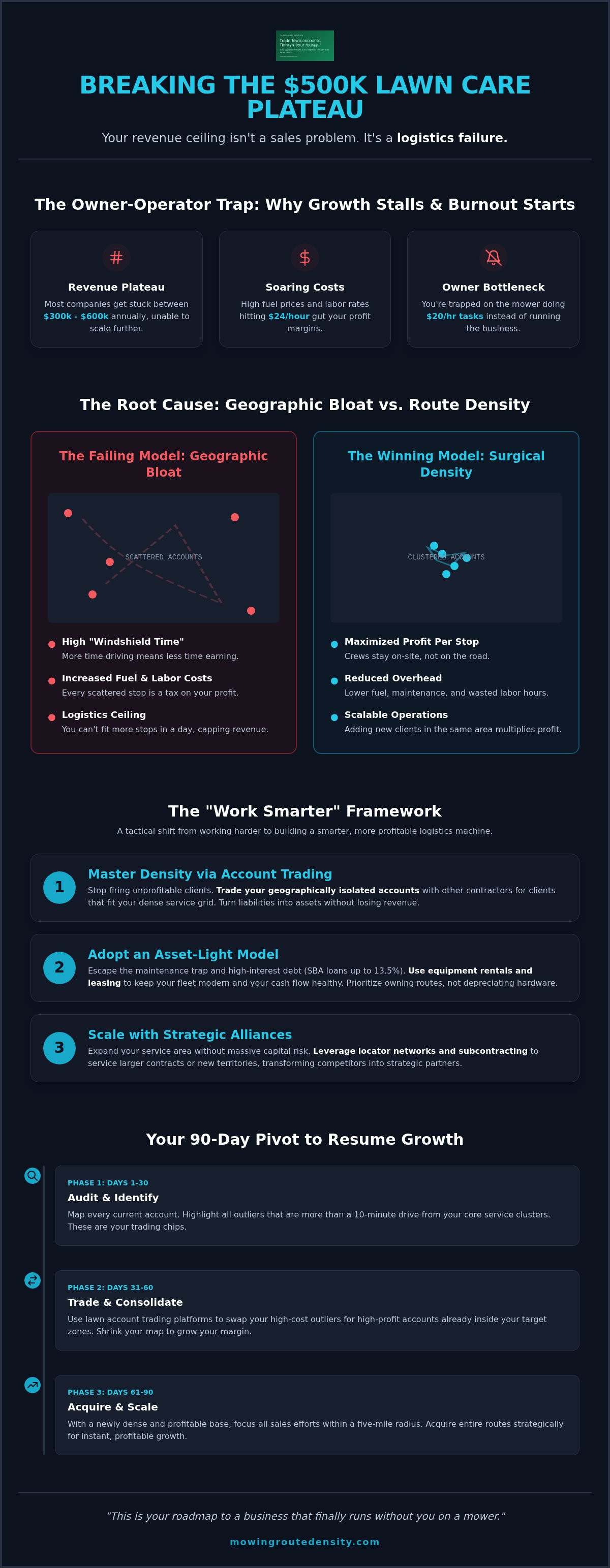
Your $500,000 revenue ceiling isn't a sales problem. It's a logistics failure. Most landscaping companies hit a wall between $300,000 and $600,000 where growth stops and burnout starts. You're likely working harder than ever, yet high fuel costs and labor rates hitting $24 per hour are gutting your margins. You're trapped on a mower because your routes are scattered and your overhead is heavy. It's a cycle of waste that kills profit.
Breaking through lawn care business growth plateaus requires a shift from geographic bloat to surgical route density. This article identifies the invisible bottlenecks strangling your cash flow. You'll learn the tactical logistics required to scale without taking on massive equipment debt or hiring more bodies than you can manage. We're moving past the "work harder" mentality into a "work smarter" framework for August 2026.
We will break down how to increase your profit per stop by tightening your service area. You'll see how to leverage rental models to keep your fleet modern without the anchor of long term debt. This is your roadmap to a business that finally runs without you on a mower.
Key Takeaways
- Identify the owner-operator trap and why geographic bloat is the primary reason most contractors fail to scale past $500k.
- Master the mechanics of account trading to eliminate "windshield time" and maximize your profit per stop.
- Learn how to navigate lawn care business growth plateaus by adopting an asset-light model that prioritizes route ownership over depreciating hardware.
- Discover how to use locator networks and strategic subcontracting to expand your reach without the risk of massive capital expenditure.
- Execute a 90-day operational pivot to audit your current routes and consolidate your service area for maximum efficiency.
Diagnosing the $500k Plateau: Why Your Current Model is Failing
Most contractors in the lawn and landscape industry hit a wall between $300,000 and $600,000 in annual revenue. You're busy. Your crews are out every day. Yet, your bank account remains stagnant. This is the owner-operator trap. It happens when your time is consumed by $20 per hour tasks like equipment repair or basic labor. If you're still the one pulling the string on a trimmer or sitting on a mower, you aren't an owner. You're a technician with a very expensive hobby. Your business cannot grow because you are the primary bottleneck.
The Law of Diminishing Geographic Returns is the silent killer of profit. You think more customers always equal more money. You're wrong. If those new accounts are twenty minutes apart, they're costing you money. This "windshield time" is a massive tax on your labor and fuel budget. With average wages for lawn care workers hovering around $16.85 per hour in 2026, every minute spent driving is a minute spent losing. Traditional marketing often makes this worse. It generates leads, but if they aren't on your existing route, they just add more bloat. You end up buying your way into lawn care business growth plateaus by chasing revenue at the expense of density.
The Hidden Cost of Geographic Bloat
Route density is the only metric that dictates your actual take-home pay. When your accounts are scattered across the county, you hit a logistics ceiling. You can't fit more stops into a day because drive time is fixed. Your overhead, including insurance and truck maintenance, continues to climb. Revenue doesn't keep pace. This is the math of the plateau. When your overhead growth outpaces your revenue growth, your margins vanish. You're working harder for less money every single year.
Asset Debt and the Maintenance Trap
Owning a massive fleet is often a liability, not an asset. In 2026, SBA loan rates for equipment can reach 13.5 percent. That is a heavy burden on your monthly cash flow. Every time a zero-turn mower goes down during peak season, your momentum stops. You're paying for a machine that isn't earning. This creates a maintenance trap where you spend your profit on repairs instead of scaling. The psychological weight of high-interest debt often forces you to take low-margin jobs just to cover the equipment note. It's a cycle that keeps your business small and your stress levels high.
Maximizing Route Density via Strategic Account Trading
Stop firing unprofitable clients. It's an amateur move that ignores your hard earned acquisition costs. Every account on your books represents a marketing investment. If a stop is geographically isolated, it isn't a bad customer. It's a logistical misfit. Instead of walking away from the revenue, trade it for an account that fits your grid. You don't need to lose the income. You need to fix the location.
Focus all sales efforts within a five mile radius. This is the clustering strategy. It limits your exposure to rising fuel costs and keeps your crews mowers-down for more hours in the day. When you're Strategically Scaling A Small Business, you must analyze the marginal utility of every stop. Ask yourself if that account generates enough profit per minute to justify the drive. If the answer is no, it's time to leverage a lawn account trading platform. These tools turn your geographic liabilities into liquid assets you can swap with competitors who are already on that street.
How to Execute a Route Swap
Start by mapping your current stops. Highlight the outliers that sit more than ten minutes away from your core clusters. These are your trading chips. Find local contractors who are already dominant in those outlier zones. You aren't giving away business. You're trading a high cost account for a high profit one. Value these trades based on density. A $50 mow that shares a property line with an existing client is worth more than a $100 mow that requires a highway trip. This is how you shatter lawn care business growth plateaus without spending a dime on new ads.
Scaling Through Strategic Route Acquisition
Waiting for the phone to ring is a losing strategy for 2026. Buying existing lawn care routes allows you to acquire density instantly. It's faster and often cheaper than organic marketing once you factor in the lifetime value of a clustered route. During due diligence, verify the stability of the contracts and the actual drive times between stops. Don't buy a list of names. Buy a geographic footprint. Once acquired, integrate these accounts into your existing logistics framework to maximize your billable hours. If your routes are looking thin, explore our lawn account trading platform to find local clusters that fit your business.
Asset-Light Scaling: Using Rental Equipment to Bypass Capital Constraints
Owning iron doesn't make you rich. Owning the customer does. Many contractors hit lawn care business growth plateaus because they mistake equipment ownership for business success. They take on $50,000 in high-interest debt to buy a fleet that sits in a garage for four months of the year. This is a capital trap. In 2026, with SBA 7(a) fixed rates reaching 13.5%, every dollar tied up in a mower note is a dollar not spent on acquiring high-density routes. You're paying for depreciating hardware while your profit margins bleed out through interest and maintenance.
The "Asset-Light" philosophy prioritizes route ownership over hardware possession. By using commercial lawn mower rental, you scale your fleet to match your actual workload. You pay for the equipment during the eight-month peak and stop paying when the grass stops growing. This model eliminates the off-season cash drain. It also offloads the maintenance headache. When a machine breaks, it's the rental provider's problem, not yours. You get a replacement, and your crew stays on the schedule. Zero downtime. Total efficiency.
Rental vs. Ownership: The 2026 Cost Comparison
Calculate the true cost of a commercial lawn mower lease or rental versus a traditional loan. A new specialized mower can cost nearly $39,000 today. The down payment alone could buy a profitable, pre-clustered route on a trading platform. That's the opportunity cost of ownership. Beyond the sticker price, rental expenses are often fully deductible in the year they occur. Capital depreciation is a slow, multi-year crawl. Rental keeps your cash liquid and your tax strategy aggressive.
Tactical Fleet Management for Field Teams
Don't hire a crew and then hope you find the work to pay for their mower. Add rental units only when your schedule is 100% full. This ensures every piece of equipment is generating maximum billable hours from day one. Use stand-on mower rentals for high-density residential clusters to move faster and reduce operator fatigue. If a machine goes down, a rental replacement guarantee ensures your momentum never stalls. You focus on the strategy of growth while the rental provider handles the logistics of the hardware.
Strategic Subcontracting and Locator Networks for National Expansion
Stop looking for employees. Start looking for partners. Many contractors fail to move past lawn care business growth plateaus because they're obsessed with direct payroll. They think more trucks and more W2 workers equal more success. In reality, it just equals more liability and higher turnover. With industry turnover rates between 30% and 50%, you're spending your time training people who will quit by July. You need to transition from a "doer" who manages crews to a "strategist" who manages networks. This shift allows you to handle overflow without the crushing weight of additional overhead.
Scaling requires a decentralized model. You must learn how to find lawn care subcontractors who already have their own equipment and insurance. This moves the risk off your books. By leveraging a lawn mowing service provider locator, you can identify reliable B2B partners in adjacent territories. This isn't about giving away work. It's about capturing contracts you couldn't service alone and taking a management fee for the logistics. You maintain quality control through strict service level agreements while your partners handle the physical labor.
Building a B2B Contractor Network
Standardization is the key to a decentralized model. Every subcontractor must follow your specific service protocols to ensure a consistent client experience. This allows you to act as a "Master Contractor." You bid on large, multi-site national contracts that require a broad geographic footprint. You provide the strategic oversight; they provide the mowers. Use our locator tool to expand your B2B reach and find partners who fit your quality standards.
Optimizing Profit Margins Through Overhead Control
True profitability comes from shifting fixed costs to variable costs. Instead of paying a salary regardless of the weather, you pay a subcontractor fee only when the work is completed. This is a core pillar of the lawn care profit margin optimization framework. Focus your high-performing in-house team only on your most profitable, high-density clusters. Everything else—the outliers, the seasonal spikes, and the distant commercial lots—should be handled by your subcontractor network. This keeps your internal operations lean and your profit per stop at an all-time high. You're no longer fighting lawn care business growth plateaus; you're bypassing them entirely by staying agile.
Executing the Pivot: Your 90-Day Plan to Resume Growth
Growth doesn't happen by accident. It happens by design. If you're stuck, it's because your current systems have reached their limit. Breaking through lawn care business growth plateaus requires an aggressive, 90-day overhaul of your operations. You must audit your current routes immediately. Identify the 20% of stops that cause 80% of your travel time. These are the profit killers. List these outlier accounts on a trading platform to consolidate your geography. Analyze your equipment fleet to identify units nearing the "maintenance cliff." Shift to an asset-light model for your next expansion to keep your cash liquid and your overhead low.
Phase 1: Geographic Consolidation (Days 1-30)
Map every stop. Calculate your "drive time per dollar" of revenue. If you're spending thirty minutes driving for a $50 mow, you're losing money. Initiate trades for any accounts sitting outside your primary clusters. Tighten your service area until your crews spend more time mowing than driving. Stop all marketing in low-density zip codes today. Focus your sales efforts only on the streets where you already have a presence. This is how you reclaim your margins.
Phase 2: Fleet and Labor Optimization (Days 31-60)
Sell off aging equipment before it breaks. Replace these liabilities with flexible rental units that don't carry long term debt. This protects your cash flow during the off-season. Vet two or three reliable subcontractors to handle your peak-season overflow. This allows you to scale without adding permanent payroll. Implement route management software to track your density in real-time. Data is your best defense against operational waste.
Phase 3: Strategic B2B Expansion (Days 61-90)
Join a provider locator network. This gives you access to higher-tier B2B leads that require a professional, reliable partner. Bid on commercial contracts that fit perfectly within your newly tightened routes. Every new stop should be a logical extension of an existing cluster. Finalize your lawn care business exit strategy by building a liquid, high-density book of business. A business with tight routes and low debt is worth significantly more than a scattered, equipment-heavy operation. You've moved past the lawn care business growth plateaus and built a machine that actually works.
Build a Scalable Machine for 2026
Your current revenue ceiling isn't a permanent limit. It's an indicator that your operational structure needs to evolve. We've mapped the path from technician to strategist. Success in 2026 depends on your ability to tighten routes and lighten your balance sheet. You don't need more crews; you need better density.
Breaking through lawn care business growth plateaus requires a ruthless focus on density over distance. By trading outlier accounts and adopting an asset-light rental model, you reclaim the billable hours lost to windshield time and equipment maintenance. You're building a liquid, high-density book of business that works for you. It's about owning the route, not the depreciating hardware.
Stop letting logistical waste kill your momentum. Take the first step toward a leaner, more profitable operation. Optimize your route density and scale your fleet with Mowing Route Density today. You'll get direct access to high-tier commercial mower rentals, a secure account trading marketplace, and a national network of professional contractors.
The framework is in your hands. Execute the pivot, audit the waste, and start scaling your empire on your own terms.
Frequently Asked Questions
What are the first signs that my lawn care business has hit a growth plateau?
Stagnant net profit despite a growing client list is the primary indicator. You're likely working more hours than ever, but your bank account isn't reflecting the extra effort. Other signs include being unable to step off the mower to manage strategy and seeing your fuel and labor costs climb as a percentage of revenue. If you're "busy" but not "profitable," your current operational model has reached its limit.
How does route density affect my lawn care profit margins?
Route density is the direct multiplier of your hourly billable rate. Every minute spent driving between stops is a minute where you're paying labor and fuel without generating revenue. By tightening your geographic footprint, you convert non-billable "windshield time" into billable "mowing time." High density allows you to service more properties with fewer trucks, less equipment, and lower labor overhead.
Is it better to rent or buy commercial lawn mowers for a growing business?
Renting is the superior choice for contractors looking to scale without the anchor of high-interest debt. With 2026 SBA loan rates reaching 13.5%, the cost of capital is too high for depreciating hardware. Rental models allow you to match your fleet size to your actual seasonal demand. You avoid the "maintenance cliff" and keep your cash liquid for marketing and route acquisition.
How do I find other contractors to trade lawn care accounts with?
The most efficient method is using a dedicated lawn account trading platform. These marketplaces allow you to list your "outlier" accounts—those stops that are too far from your core routes—and swap them for accounts that fit your existing clusters. It turns geographic liabilities into strategic assets. While you can network at local industry events, a digital marketplace offers significantly more security, speed, and volume.
Can I use subcontractors for residential lawn mowing to scale faster?
Strategic subcontracting allows you to expand your reach without the risk of adding fixed payroll or equipment debt. You focus your high-performing in-house crews on your most profitable, high-density clusters while using partners to handle overflow or distant residential stops. This shifts your labor costs from a fixed expense to a variable one. You only pay when the work is successfully completed.
What is the 'owner-operator trap' and how do I get out of it?
The owner-operator trap occurs when you spend your day on $20 per hour tasks instead of $200 per hour strategy. If you're the primary mower, you can't build the systems required to scale past $500k. You get out of it by auditing your time and delegating labor. Use rental equipment and subcontractor networks to remove yourself from the daily logistics so you can focus on route density.
How much revenue should a lawn care business generate per man-hour?
Your target should be maximizing billable efficiency, not just gross revenue. While residential prices in 2026 range from $50 to over $200 per mow, your focus must be on the profit left after labor and fuel. Your man-hour revenue should sit significantly above the national average labor rate of $16.85 per hour. If your travel time exceeds 15% of your day, your man-hour efficiency is failing.
Why is geographic clustering more important than total number of clients?
Clustering is the only way to overcome lawn care business growth plateaus sustainably. One hundred clients in a five-mile radius are significantly more profitable than two hundred clients spread across a county. Clustering reduces wear on vehicles, slashes fuel consumption, and allows your crews to complete more stops per shift. Total client count is a vanity metric; density is the only metric that dictates your actual take-home pay.


