

Why are you still chasing $50 residential mows while your competitors lock in six-figure, multi-year HOA agreements? Residential work is a grind. You're fighting high churn, scattered routes, and the constant headache of inconsistent cash flow. It's exhausting. You know you need bigger contracts, but you're worried your current setup can't handle the scale. Learning how to win HOA landscaping contracts isn't about having the flashiest brochure. It's about proving you have the operational backbone to handle 200 units without a single service failure. Boards don't care about your passion. They care about your uptime, your equipment reliability, and your overhead management.
This strategic framework is your roadmap to mastering the logistical precision required to secure and retain high-margin HOA landscaping contracts. We'll show you how to stabilize your revenue and improve route density using the latest 2026 market data. You'll learn to leverage commercial-grade logistics, navigate regional labor shifts, and build a professional reputation that commands respect from property managers. It's time to stop playing small. Start operating like the commercial-grade contractor you're meant to be by focusing on the logic of the bid rather than the luck of the draw.
Key Takeaways
- Shift from service-based bidding to a Logistics-First approach that emphasizes operational transparency and equipment uptime.
- Discover how to win HOA landscaping contracts by adopting an asset-light strategy that utilizes commercial mower rentals to handle peak demand without the burden of long-term debt.
- Eliminate profit-killing windshield time by building route density around your HOA sites through strategic account trading and B2B networking.
- Protect your multi-year revenue streams by implementing proactive reporting systems that satisfy board fiduciary requirements and prevent customer churn.
The 2026 HOA Landscape: Why Standard Landscaping Bids Fail
Stop thinking like a mower. Start thinking like a logistics manager. Most contractors fail because they treat an HOA like a bigger backyard. It's not. An HOA contract is a complex logistical commitment that requires precise resource allocation. If you want to know how to win HOA landscaping contracts, you must understand the "fiduciary trap." Boards are legally bound to act in the community's best interest. This often leads them to the lowest bid, which usually results in service failure. Your job is to show them why cheap is expensive. By 2026, boards are prioritizing three things: reliability, noise reduction, and absolute visual consistency. They don't want a "service." They want their phone to stop ringing with resident complaints. Focus on solving their operational headaches rather than selling your "passion for lawns."
Understanding the HOA Board Mindset
Boards evaluate risk above all else. A failed contractor reflects poorly on the board members personally. Understanding Homeowner Associations is critical because these organizations operate as mini-governments with strict accountability. Property managers sit at the top of the decision-making hierarchy. They don't care about your fancy logo. They care about their own time. They need a partner who prevents fires, not one who creates them. In the 2026 market, "good enough" mowing leads to immediate termination. Residents are paying high dues and expect perfection. If your crew misses a corner or leaves clippings on a sidewalk, the board hears about it within minutes. Reliability is the only currency that matters.
The Death of the Traditional Marketing Pitch
Glossy brochures and fancy websites are useless in commercial bidding. They don't prove you can manage a 200-unit property during a labor shortage. Property managers have seen it all. They've heard every promise. They want logistical proof over aesthetic fluff. Logistical proof in 2026 is the verifiable data showing your fleet capacity, crew redundancy, and real-time response capability to handle large-scale site demands. Stop selling the "beauty" of the grass. Start proving your operational backbone. Show them your equipment maintenance logs. Show them your backup plan for when a mower goes down. That is how to win HOA landscaping contracts in a crowded market. You win by being the most organized, not the most creative.
Operational Readiness: Preparing Your Fleet for Scale
Scaling kills more businesses than it saves. You land a massive contract, buy five new mowers on credit, and then watch your margins evaporate into monthly payments and maintenance. That's not how to win HOA landscaping contracts; that's how to go bankrupt slowly. Before you bid, you must audit your current equipment capacity against the site's total square footage. Don't guess. Know your production rates per hour. An "Asset-Light" model is the only way to scale safely in 2026. This means you don't own every piece of iron on your trailer. You own the core and rent the rest. Adopting government best practices for service contracts ensures your operational plan is cost-effective and meets high performance standards. Maintenance resilience is your insurance policy. If your primary mower goes down at 10 AM on a Tuesday, your contract shouldn't stop. You need a contingency plan that keeps crews moving without missing a single billable hour.
Scaling Without Capital Debt
Debt is a weight that sinks growing companies. Instead of financing new equipment for a single contract, use professional lawn equipment rental to bridge the gap during onboarding. This keeps your cash flow liquid. The math is simple. Rental costs are a fixed project expense you can bake directly into your bid. Long-term depreciation and interest on owned assets are hidden drains that often exceed the cost of a short-term rental. For long-term fleet stability without the massive down payment, consider commercial lawn mower lease options. These allow you to cycle in fresh, reliable equipment every few seasons. It's about access, not ownership.
Equipment Standardization for Field Teams
Uniformity creates efficiency. If one crew uses a 60-inch zero-turn and another uses a 48-inch stand-on, your results will vary. HOAs demand visual consistency across the entire property. Standardizing your fleet ensures that every operator can jump on any machine and deliver the same cut quality. Stand-on mowers often win on HOA sites due to their smaller footprint and better visibility in tight common areas, but zero-turns are still the kings of open acreage. Pick a platform and stick to it. Standardized maintenance protocols are just as vital. When every machine uses the same filters and blades, your shop time drops. Check out the resources at Mowing Route Density to see how logistics-first contractors are optimizing their fleet for high-volume work. Efficiency isn't an accident; it's a protocol.
Engineering the Winning Bid: A Data-Driven Approach
Bidding is not a guessing game. It is an engineering exercise. If you are still throwing numbers at a wall to see what sticks, you're not a business owner; you're a gambler. A "Logistics-First" bid breaks down every variable into a hard cost. You must quantify labor hours, fuel consumption, and equipment wear with clinical precision. Transparency is your greatest weapon against low-ball competitors. When you show a board exactly why a property requires 42 man-hours per week, you expose the guy who bid for 20. Use site-specific data to justify your price. Show them the square footage, the obstacle count, and the irrigation zones. A clear Scope of Work (SOW) is your primary defense against scope creep. If it isn't in the SOW, it doesn't happen without a change order. This is how to win HOA landscaping contracts that actually remain profitable after the first year.
Quantifying Service Levels (SLAs)
Trust is built on documented expectations. Your proposal must define response times for board inquiries and emergency service requests. Don't just say you'll be there; state that inquiries receive a response within 24 hours. Document your equipment specs and crew sizes directly in the proposal. If you are bringing three 60-inch stand-on units to the site, put it in writing. This proves you have the capacity to meet the production schedule. Service Level Agreements act as a contractual shield, preventing unpaid labor by clearly defining the boundaries of billable work. When everyone knows the standard, there is no room for "he said, she said" disputes that lead to contract termination.
Professional Presentation Standards
PDF attachments are a relic of the past. In 2026, professional property managers expect digital bid presentations or client portals. These tools allow for real-time adjustments and transparent data sharing. Commercial credibility also demands high-level insurance and bonding. If you aren't bonded, you aren't in the game. You can further demonstrate your operational depth by using the lawn mowing service provider locator to showcase your network strength. This proves you have the B2B connections to handle specialized tasks or emergency overflows without service interruptions. Boards want to see a safety net. Show them yours. Learning how to win HOA landscaping contracts means presenting a business that looks, acts, and calculates like a corporate entity. Stop acting like a "lawn guy" and start acting like a service partner.
Maximizing Profitability Through Route Density
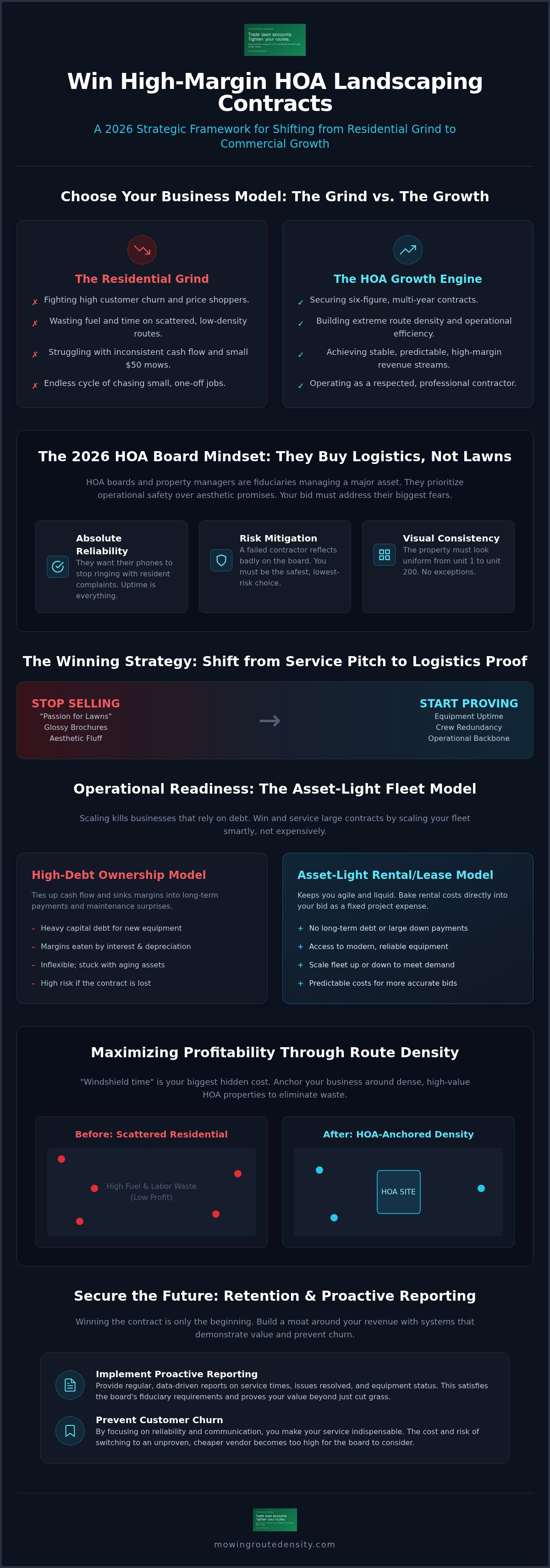
Winning the bid is only half the battle. If your new HOA site sits 40 minutes away from your nearest cluster of accounts, it's a financial anchor. An HOA contract is a liability without lawn care route density. Windshield time is non-billable waste. Every minute your crew spends in traffic is a minute your high-end equipment isn't generating revenue. You need asset clustering. This strategy involves surrounding your large commercial sites with smaller, high-margin accounts to minimize logistical overhead. This isn't just a "good idea." It's a core pillar of how to win HOA landscaping contracts that actually remain profitable over a multi-year term. If you can't get your crews from site to site in under ten minutes, you're losing the game before the first blade is cut.
The Logistics of Account Swapping
Residential clutter kills commercial margins. If you're still servicing 50 scattered residential yards while trying to scale into HOAs, you're bleeding fuel and labor hours. You must identify "dead weight" accounts that hinder your scaling efforts. Use a lawn account trading platform to swap these outliers for accounts adjacent to your HOA contracts. Finding local partners for mutually beneficial route trades allows you to tighten your service area. This reduces fuel consumption and extends equipment longevity by cutting down on unnecessary transport hours. Focus your energy where your machines are already on the ground. Efficiency isn't about working harder; it's about staying in one place longer.
Subcontracting for Capacity Management
You don't need to do everything yourself. Specialized HOA tasks like chemical applications or complex irrigation repairs often require specific licensing and equipment. When you find lawn care subcontractors for these niche services, you maintain your production schedule without overextending your core crew. Quality control is the only metric that matters here. You must vet your partners to ensure their work matches your professional reputation. Subcontractors also allow you to maintain route density while you wait for fleet expansion. They act as a flexible buffer, allowing you to take on more work without the immediate debt-load of new assets. To build a more profitable service network, visit Mowing Route Density and connect with commercial-grade providers today.
Strategic density is the difference between a thriving business and a failing one. You win by being the most efficient operator in the zip code. Don't let a single HOA contract become an isolated expense. Build a fortress of accounts around it and watch your margins grow.
Securing the Future: Retention and Client Liquidity
Winning the contract is just the start. If you want to know how to win HOA landscaping contracts for the long haul, you have to treat every agreement as a liquid asset. An HOA contract isn't just a job; it's a critical component of your company's net worth. Boards often develop "wandering eyes" when they feel ignored or when your service becomes invisible. You stop this churn by implementing proactive reporting that proves your value every single week. In 2026, the industry standard has moved beyond simple visual checks. You need to provide time-stamped photos, GPS logs of every mower path, and detailed soil health data. This level of transparency makes your company unfireable. It proves you aren't just cutting grass; you're managing a biological asset for the community. When you provide this data, you fulfill the board's fiduciary duty to the homeowners, making it nearly impossible for them to justify switching to a cheaper, less-organized competitor.
Proactive Communication Frameworks
Stop waiting for the board to call you with a problem. If they are calling you, you've already lost. Set up monthly "state of the landscape" meetings to review the operational data you've collected. These meetings aren't for small talk. They are for presenting facts about turf health, irrigation efficiency, and upcoming seasonal needs. Use digital transparency to manage homeowner expectations. When residents can see your crew's GPS logs or scheduled service dates online, their anxiety drops. Turn service complaints into retention opportunities. A fast, data-backed response to a resident's concern shows the board that you are a proactive partner rather than a reactive vendor. It's about maintaining control of the narrative before a minor issue turns into a contract-ending disaster.
Maximizing Business Valuation
Recurring commercial revenue is the ultimate goal for any serious contractor. High-margin HOA contracts significantly impact your lawn care business exit strategy. Professional buyers don't care about your brand or your logo. They care about contract longevity and renewal rates. They want to see a business that operates on systems, not on the owner's individual effort. Positioning your business for maximum liquidity in the 2026 market requires documented proof of retention. If you can show five years of consistent renewals backed by logistical data, your valuation will skyrocket. Buyers are looking for predictable cash flow and route density. By securing these contracts and keeping them, you aren't just building a job. You're building a sellable asset that commands a premium price in any market environment.
Operationalizing Your Path to High-Margin Revenue
Winning a commercial bid isn't about marketing fluff. It's about data-driven logistics and route density. You win when you prove you have the fleet capacity and the communication systems to handle large-scale properties without a single service failure. Boards don't want a "lawn guy"; they want a strategic partner who understands their fiduciary duties. Mastering how to win HOA landscaping contracts requires a shift from owning assets to managing them efficiently. Stop letting non-billable windshield time drain your profits. Start building a business that operates with clinical precision. It's time to trade your scattered residential accounts for high-density commercial clusters.
Optimize your route density and scale your fleet with Mowing Route Density. Our platform provides access to commercial-grade mower rentals, a secure marketplace for trading service routes, and a national network of B2B providers for seamless collaboration. Stop playing small with residential churn. Build a business that scales. Build a business that lasts.
Frequently Asked Questions
How do I find out when an HOA contract is up for bid?
You find bid opportunities by building direct relationships with property management firms rather than waiting for public postings. Most HOA boards review their landscaping contracts in the fourth quarter for a spring start. Monitor community websites and public meeting minutes for mentions of contract expiration. Using a service provider locator helps you network with other contractors who may need a partner or subcontractor for larger sites.
What is the typical length of a commercial HOA landscaping contract?
Commercial HOA landscaping contracts typically span one to three years. A one-year term is a trial period that increases your administrative overhead. Aim for a three-year agreement to lock in route density and stabilize your cash flow. Multi-year deals allow you to amortize the cost of specialized equipment over a longer period. Boards prefer this stability because it reduces the frequency of the high-stakes bidding process.
Do I need special insurance to bid on HOA landscaping projects?
Yes, you need higher coverage limits than what is standard for residential work. Most boards require at least $1 million to $2 million in general liability insurance. You also must provide proof of workers' compensation and often an umbrella policy. This protects the board from liability regarding crew injuries or property damage. If you don't have these certificates ready, you'll be disqualified before the bid is even read.
How much should I charge for HOA landscaping per home?
Never charge per home for an HOA contract. This is a logistical error that ignores common areas, irrigation systems, and retention ponds. Instead, calculate your bid based on total square footage and production rates per man-hour. Factor in your overhead, fuel consumption, and equipment wear. A data-driven bid ensures you cover your costs while maintaining a healthy profit margin. Guessing per home is how contractors lose money.
Can I use rental mowers for a commercial HOA contract?
Yes, using rental mowers is a smart asset-light strategy for handling peak seasonal loads or new contract onboarding. It allows you to scale your fleet without taking on long-term capital debt. Commercial mower rentals ensure you have the latest high-production equipment on-site without the burden of depreciation. This flexibility is essential when learning how to win HOA landscaping contracts while maintaining a lean, profitable operation.
How do I deal with a difficult HOA board or property manager?
Deal with difficult boards by shifting the conversation from emotions to data. Provide GPS logs, time-stamped photos, and soil health reports to prove your contract compliance. When a board member complains, reference the agreed-upon Scope of Work. Clear documentation eliminates he said, she said arguments. Professionalism in the face of scrutiny builds your reputation as a commercial-grade contractor who can handle high-pressure environments.
What are the most common reasons HOAs fire their landscapers?
The most common reasons for termination are lack of visual consistency and poor communication. Boards fire landscapers when they have to do the contractor's job for them by pointing out missed spots. Failure to respond to inquiries within 24 hours is another major red flag. If your crew is inconsistent or your equipment is constantly down, the board will look for a more reliable partner during the next bid cycle.
Should I offer a discount for a multi-year HOA contract?
You can offer a small percentage discount for a multi-year commitment, but don't cut into your core margins. Focus on the value of price stability instead. Explain that a multi-year deal protects the HOA from annual labor and material price hikes. This approach secures your route density while giving the board a predictable budget. A discount should only be a tool to close a deal that is already logistically sound.


