
Why are you working for your mower instead of the mower working for you? Most owners believe growth requires more "iron" on the trailer. You see a new contract and immediately sign a five-year finance deal on a $15,000 zero-turn. Then the rain hits. Or the labor quits. The debt remains. This cycle of heavy capital expenditure is a slow death for your margins. The asset-light lawn care business model offers a way out. It prioritizes operational efficiency over the vanity of a shiny, owned fleet. You don't need to own the equipment to own the market.
You're likely tired of crushing monthly payments and maintenance downtime that bleeds your billable hours. We agree that the traditional "buy and pray" strategy is broken. This article teaches you how to decouple your revenue from equipment debt by mastering a lean operational framework. We'll examine how to use strategic rentals to bypass the 2026 gas-equipment bans and how trading routes can fix operational rot. You'll discover how to build a scalable business that's high on profit and low on risk. It's time to stop managing a museum of depreciating assets and start managing a cash-flow machine.
Key Takeaways
- Stop financing depreciating iron and start treating equipment as a variable expense that scales directly with your revenue.
- Master the asset-light lawn care business model to decouple your growth from crushing monthly payments and high maintenance costs.
- Eliminate "operational rot" by trading scattered accounts for high-density routes that maximize your team's billable hours.
- Shift from CapEx to OpEx to gain immediate tax advantages and maintain the liquidity needed to outmaneuver competitors.
- Leverage a B2B rental and trading ecosystem to expand your footprint without the risk of long-term debt or equipment storage.
The Iron Debt Trap: Why Traditional Scaling Fails
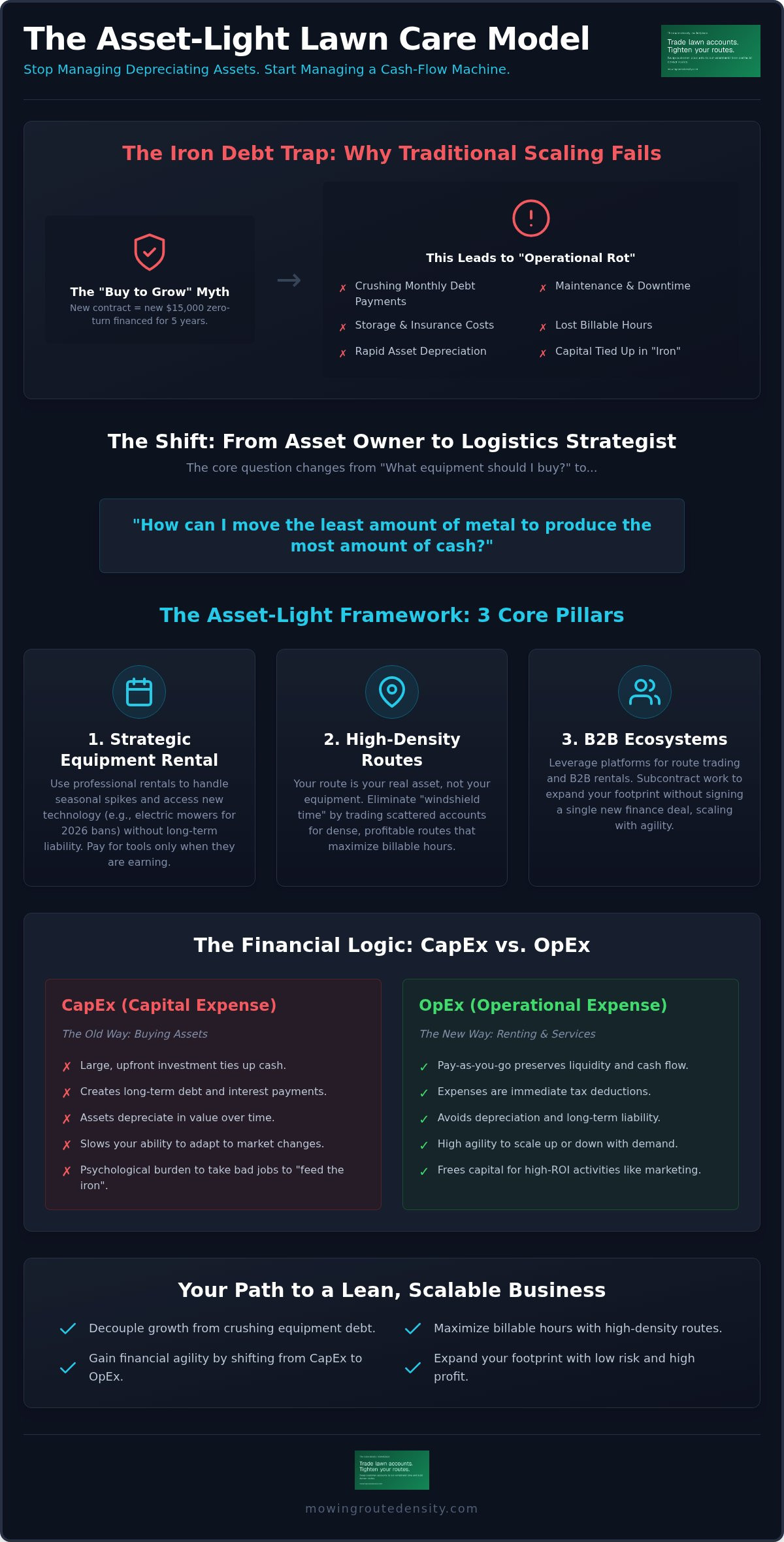
Traditional scaling is a trap. Most owners think adding a new crew requires buying a new truck and a $15,000 zero-turn. This is the "Iron Debt Trap." You finance expensive machinery to service scattered, low-density routes. The math rarely works. You're trading high-interest debt for low-margin revenue. It's an outdated business model that prioritizes asset ownership over actual profit. The asset-light lawn care business model flips this script. It recognizes that "iron" is a liability, not an achievement. You shouldn't be proud of a massive fleet if your net margin is stuck in the single digits.
Ownership carries invisible weights. You pay for storage. You pay for insurance. You pay for the mechanic when the hydraulic lines blow on a Tuesday morning. This is "operational rot." While your machine sits in the shop, your billable hours vanish. Your reputation takes a hit because you're missing schedules. The old "buy to grow" mentality belongs in the pre-digital era. Today, success is about route density and agility, not how many trailers you have parked in a gated lot. If your assets don't produce immediate, high-margin cash flow, they are just expensive lawn ornaments.
The Math of Depreciation and Interest
Think about your financed zero-turn. By the time you add 2026 interest rates and depreciation, that mower costs you a significant amount every hour it's on the trailer, even before you add fuel and labor. If it's not cutting, it's eating your bank account. You're paying for a machine to lose value while it sits in traffic between distant jobs. Iron debt is the capital anchor that prevents rapid pivot or scale. When the market shifts or regulations change, you're stuck with the equipment you bought for yesterday's problems.
Opportunity Cost of Tied-Up Capital
What could you do with a $50,000 down payment? You could dump it into a high-intensity marketing campaign. You could dominate local SEO or hire a top-tier sales manager. Instead, it's tied up in steel that loses 20% of its value the moment you drive it off the lot. Liquidity is your best friend in a fluctuating economy. Leverage is a tool, but too much of it becomes a cage. Feeding the machines every month creates a psychological burden. You take bad, low-paying jobs just to make the equipment payment. You stop being a strategist and start being a slave to your balance sheet.
Defining the Asset-Light Lawn Care Framework
The asset-light lawn care business model is not a shortcut for beginners. It is a precision operating system for veterans who are tired of equipment-induced headaches. You must stop identifying as a "mower owner" and start thinking like a logistics strategist. Your job is to move labor and tools to the job site with surgical precision. If you are obsessed with owning the newest zero-turn, you are building a collection, not a company. A strategist asks a simple question: "How can I move the least amount of metal to produce the most amount of cash?"
This framework rests on three pillars: strategic rental, high-density routes, and subcontracting. Technology makes this possible. Marketplaces and locators allow you to find work and equipment without the traditional overhead. You are no longer limited by the number of trailers in your yard. You are limited only by your ability to coordinate resources. By leveraging a B2B platform for route trading, you can build a massive footprint without signing a single finance deal.
Strategic Equipment Rental
Why carry the cost of a machine that only works six months a year? Use professional lawn equipment rental to handle seasonal spikes without the long-term liability. The SBA confirms that leasing can be a good option for maintaining cash flow and staying agile. Rental eliminates the "winter storage" drain on your balance sheet. It also allows you to access the latest electric technology to meet 2026 regulations without a five-year commitment. You pay for the tool when it is earning; you return it when it is not.
Route Density as the Ultimate Asset
Your route is your real asset. Equipment is just a commodity. A dense route reduces travel time and maximizes billable hours. This is why a lawn care route density strategy is the foundation of the asset-light framework. Profit is lost while wheels are turning on the highway. By condensing your service area, you minimize wear and tear on the few vehicles you do own. You can optimize your footprint through account trading rather than buying more equipment to chase distant, low-margin leads. A tight route is a fortress that competitors cannot easily penetrate.
CapEx vs. OpEx: The Financial Logic of Equipment Rental
Ownership is a capital expenditure (CapEx). It's a long-term bet on a depreciating asset. Rental is an operational expenditure (OpEx). It's a cost directly tied to revenue. In an asset-light lawn care business model, you prefer OpEx every time. You can't eat equity. You need cash flow to survive. When you rent, your costs are predictable. You pay roughly $525 a week for a commercial walk-behind mower. That cost disappears the moment the contract ends or the season stops. You aren't paying for a machine to sit in your garage and collect dust.
Tax advantages are immediate. You don't wait years to depreciate a machine through complex IRS schedules. You deduct the rental fee as a business expense the same month you pay it. This keeps your taxable income lower and your bank account fuller. Then there's the "Zero-Maintenance" factor. When a rented mower breaks, it's not your problem. You call the provider and get a replacement. You don't pay a mechanic. You don't pay for parts. You don't lose sleep over hydraulic leaks. Need a third crew by tomorrow? You don't need a credit application or a bank's permission. You just need a rental agreement.
The Rental vs. Ownership Breakeven Point
You need to analyze commercial lawn mower lease options to find your sweet spot. Daily rates work for small projects, but monthly rentals maximize marginal utility for full-season contracts. Don't forget the "Ghost Costs" of ownership. Owning a fleet requires shop space, specialized tools, and insurance for the facility. Those costs exist even when the machines are idle. In an asset-light model, you outsource the storage and the grease to someone else. You only pay for the iron when it's making you money.
Risk Mitigation in a Volatile Market
Heavy debt kills businesses during economic downturns. If your revenue drops by 30%, your equipment payment doesn't care. It still demands payment. Asset-light businesses survive because they can "right-size" instantly. If you lose a contract, you return the rental. Your overhead vanishes overnight. You also bypass the risk of equipment obsolescence. With municipalities like Portland and San Francisco banning gas equipment in 2026, owning a gas fleet is a liability. Renting allows you to switch to electric the moment the law changes, without taking a massive loss on a trade-in.
Tactical Execution: Optimizing Route Density via Account Trading
Scattered routes are the enemy of the asset-light lawn care business model. If your crews spend 40% of their day behind a windshield, you aren't running a service business; you're running a non-profit transportation company. Every mile between jobs is a leak in your bucket. You pay for fuel. You pay for labor. You pay for wear on the truck. To be truly asset-light, you must consolidate your footprint until your travel time is negligible. You don't achieve this by firing clients. You do it by trading them. Using a lawn account trading platform allows you to swap an outlier for a property right next to your current anchor.
Stop falling in love with your client list. It is a spreadsheet; not a family tree. An account that is ten miles away from your cluster is a "toxic" asset. It drains the profit from the three accounts next to it. Valuing an account requires looking beyond the monthly billable amount. You must calculate the "true margin" after travel costs. When you trade that outlier to a competitor who is already on that street, you both win. You tighten your route. They tighten theirs. Both businesses become leaner and more profitable.
The Logistics of the Swap
Identifying toxic accounts is the first step. Look for the properties that force your trailer onto the highway. These are the ones that ruin your crew's rhythm. Once identified, you need a partner to facilitate the swap. A lawn mowing service provider locator is the essential tool for finding trade partners in specific zip codes. You can negotiate terms based on property size, service frequency, and proximity. It is a professional transaction designed to eliminate waste. If you want to stop bleeding cash on the road, start trading your outliers today.
Building Client Liquidity
High-density routes are your retirement plan. In 2026, buyers don't want your old, depreciating trucks. They want tight clusters of recurring revenue. This is the core of a smart lawn care business exit strategy. While the average net profit margin for the industry sits between 10% and 15%, optimized routes can reach 20% to 25%. That extra margin significantly increases the multiple when you sell. The asset-light lawn care business model turns your client list into a liquid asset. It becomes something you can sell, trade, or leverage without the anchor of equipment debt holding you back.
Scaling the Lean Way: Integrating the Mowing Route Density Ecosystem
Mowing Route Density serves as the central nervous system for the asset-light lawn care business model. It provides the logistical infrastructure you need to stop acting like a fleet manager and start acting like a CEO. Most contractors fail because they lack the tools to execute a lean strategy. They want to rent, but they don't know where to find commercial-grade iron. They want to trade, but they don't have a trusted partner. Our ecosystem bridges that gap. By leveraging the rental marketplace, you eliminate the CapEx bottlenecks that stall growth. You don't wait for a bank's approval to expand into a new territory. You log in, secure the tools, and move.
Optimizing your footprint requires more than just good intentions. It requires a national account trading platform. This tool allows you to swap low-margin outliers for high-density clusters in real-time. It's about surgical precision. When your own crews reach capacity, don't buy another truck and trailer. Instead, use the B2B network to find lawn care subcontractors who are already working in your target zip codes. This is how you scale revenue without adding a single dollar of equipment debt. You are building a network, not a junkyard.
Your 90-Day Asset-Light Transition Plan
Transitioning doesn't happen overnight. It requires a methodical approach to shedding dead weight. Follow this 90-day framework to clean up your balance sheet and tighten your operations:
- Step 1: Audit your current equipment debt and maintenance log. Calculate the true cost of every hour your machines sit idle. If a mower isn't running 30 hours a week, it is a liability.
- Step 2: Identify low-density outliers for potential trading. Use your GPS data to find the accounts that bleed fuel and labor hours. List these properties on the platform to find a trade partner.
- Step 3: Test the rental model for your next crew expansion. Avoid the finance office. Rent the equipment for a full month and compare the net margin to your owned crews.
The Future of Landscaping Logistics
The days of measuring success by the size of your fleet are over. In 2026, the most resilient contractors are those who prioritize liquidity over ownership. You've seen the math. Financing iron to service scattered routes is a mathematical failure. By adopting the asset-light lawn care business model, you transform your equipment from a fixed debt into a variable expense. You trade operational rot for strategic agility. You stop worrying about hydraulic leaks and start focusing on route density.
It's time to stop working for the bank and start working for your bottom line. We provide the infrastructure to make it happen. Access our national B2B equipment rental network to scale instantly. Leverage our secure account trading marketplace to tighten your territory. We maintain a pragmatic focus on contractor profitability because your margin is the only metric that matters. Optimize your fleet and routes with Mowing Route Density. You have the blueprint. Now, go build a business that actually serves you.
Frequently Asked Questions
What is an asset-light business model in lawn care?
An asset-light lawn care business model is a strategic framework that prioritizes revenue and route density over the ownership of heavy equipment. Instead of financing a fleet of mowers that depreciate in value, you leverage rentals, subcontractors, and account trading to service your clients. This approach shifts your focus from being a fleet manager to a logistics strategist, ensuring your capital remains liquid and your overhead stays low.
Is it cheaper to rent or own commercial lawn mowers?
Cheaper is determined by your utilization rate. If a mower isn't running at least 30 hours a week, the hidden costs of ownership like depreciation, interest, and storage often exceed rental fees. Renting is mathematically superior for managing seasonal peaks or testing new territories. It turns a fixed capital cost into a variable operational expense, protecting your balance sheet from the "winter drain" when equipment sits idle.
How does route density affect my profit margins?
Route density is the primary driver of net profitability in this industry. While the national average net profit margin is 10% to 15%, businesses with optimized routes can reach 20% to 25%. Every minute your crew spends behind a windshield is a leak in your bucket. By condensing your service area through account trading, you reduce fuel consumption and labor waste, making every billable hour significantly more profitable.
Can I really scale a lawn care business using only rented equipment?
You can scale faster with rentals because you aren't limited by credit applications or down payments. The asset-light lawn care business model allows you to add a new crew in 24 hours by simply securing a commercial rental. This eliminates the bottleneck of equipment financing and the risk of taking on debt for contracts that haven't started yet. You grow based on real-time demand, not speculative debt.
What are the tax benefits of an asset-light model?
Rental costs are classified as operational expenditures (OpEx), meaning they are generally fully deductible in the tax year they are paid. This provides an immediate reduction in taxable income compared to capital expenditures (CapEx), where you must depreciate equipment over several years. This model keeps more cash in your bank account today, which is essential for maintaining the liquidity needed to outmaneuver heavy-debt competitors.
How do I start trading lawn care accounts with other contractors?
Start by auditing your route to find "toxic" outliers that ruin your density. Once you identify these distant accounts, use a dedicated trading platform to find professional contractors who are already working in those specific neighborhoods. You swap your outliers for properties adjacent to your existing anchors. This formalizes the trade, ensuring both parties gain density and eliminate travel waste without losing total billable revenue.
What happens if a rental mower breaks down in the middle of a job?
You call the rental provider for an immediate replacement. This is the "zero-maintenance" advantage of the asset-light model. When you own the iron, a breakdown means shop fees, mechanic labor, and days of downtime. With a rental, the burden of repair and replacement lies with the provider. Your crew stays productive, and your schedule remains intact without the need for an expensive in-house repair infrastructure.
Is the asset-light model suitable for large commercial landscaping contracts?
It is actually the most efficient way to handle large commercial contracts. These projects often require specialized machinery that you may not need for your standard routes. Renting allows you to bid on diverse, high-value projects without the risk of buying niche equipment. You can right-size your fleet for the duration of the contract and return the units once the work is finished, keeping your overhead lean.


