

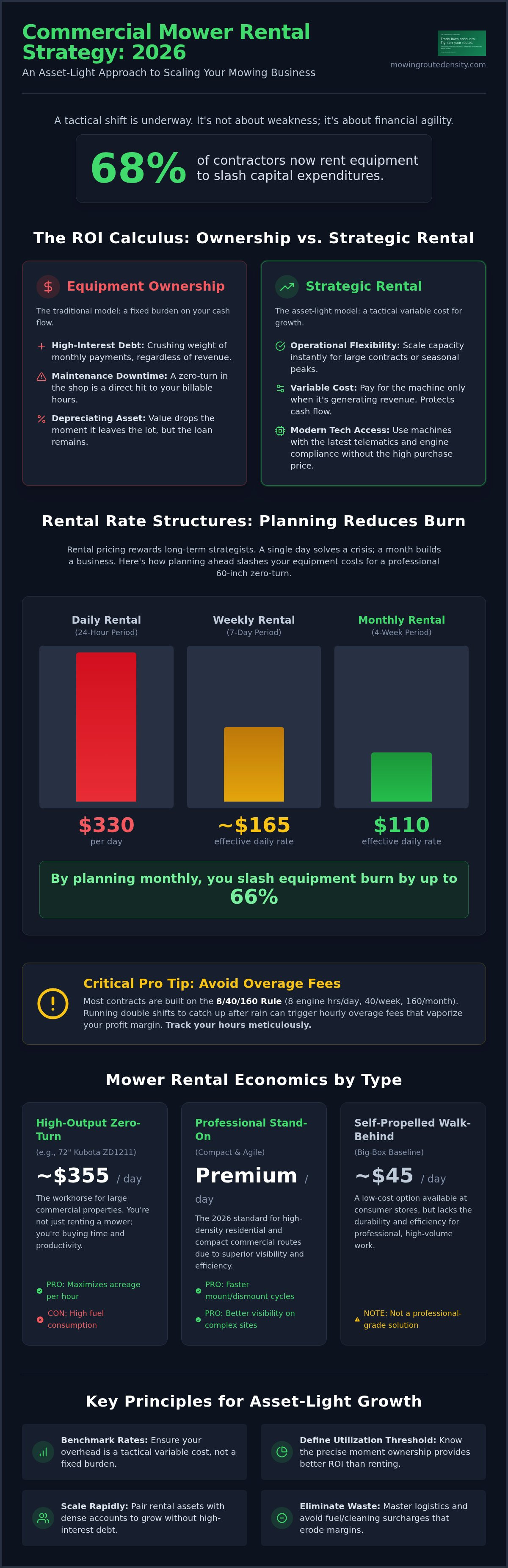
Sixty-eight percent of contractors now rent equipment to slash capital expenditures. That isn't a sign of weakness. It's a tactical move to avoid the crushing weight of high-interest debt. You already know the frustration of a new zero-turn sitting in the shop for two weeks while the bank still demands its monthly cut. It's a waste of capital. Mastering commercial mower rental rates for 2026 is the first step toward building an asset-light business that scales on demand.
You deserve a strategy that prioritizes billable hours over equipment ownership. We'll show you how to trade heavy equipment loans for true operational flexibility. This article provides a clinical breakdown of current market pricing, a hard-nosed rent-vs-buy framework, and proven strategies to use rentals to maximize your route density. Stop letting maintenance downtime and seasonal peaks dictate your growth. Learn to use the rental market to keep your crew moving and your overhead lean.
Key Takeaways
- Benchmark your 2026 operations against current commercial mower rental rates to ensure your equipment overhead remains a tactical variable cost rather than a fixed burden.
- Identify your specific "Utilization Threshold" to determine the precise moment ownership provides a better ROI than professional rental cycles.
- Eliminate operational waste by mastering pickup logistics and avoiding the common fuel and cleaning surcharges that erode project margins.
- Scale your footprint rapidly by pairing rental assets with dense accounts acquired through professional trading platforms, avoiding the trap of high-interest debt.
The 2026 Landscape of Commercial Mower Rental Rates
Owning a massive fleet is often a vanity metric that kills cash flow. In 2026, savvy contractors treat commercial mower rental rates as a tactical operational expense rather than a sign of a small business. It's about liquidity. Every dollar tied up in a depreciating asset is a dollar you can't spend on labor or marketing. Traditional ownership models rely on heavy debt and high-interest financing. The asset-light model relies on precision. You pay for the machine only when it's generating revenue. This shift transforms equipment from a fixed burden into a variable cost that you can toggle based on your current contract load, mirroring the pricing strategy and automation that RateHighway provides to the car rental industry.
Factors Influencing 2026 Rental Pricing
Pricing isn't arbitrary. It's a reflection of the rising complexity in the landscape maintenance industry. Modern units now feature advanced telematics and Tier 4 engine compliance. These systems track fuel consumption and engine health in real time, preventing the "run it until it dies" mentality that ruins owned fleets. Rental providers absorb the high cost of these technical upgrades. You get a machine that won't fail on a high-stakes job site. While national average stability keeps baseline costs predictable, regional demand can cause spikes during peak growth cycles. Professional pricing now frequently includes maintenance-inclusive contracts. This means a breakdown isn't your financial problem. It's the provider's problem.
Don't hunt for the lowest price point. Cheap rentals are a liability. They lead to unexpected downtime and labor waste. If a crew of three sits idle for four hours because a bargain-bin mower won't start, you've lost more in wages than you saved on the daily rate. Reliability is the only metric that matters when your reputation is on the line.
Why Rental is a Growth Lever, Not a Last Resort
High-interest equipment financing is a trap. In 2026, locking yourself into a five-year loan for a mower that might be obsolete or worn out in three is poor strategy. Renting keeps your balance sheet clean. It allows you to maintain the liquidity needed for aggressive route acquisition. When you land a large commercial contract, you don't need a bank's permission to scale. You simply adjust your commercial mower rental rates strategy to add capacity instantly. This is how you outmaneuver competitors who are strangled by monthly equipment payments they can't skip during a dry spell. You can scale capacity for a single season or a single week. This flexibility is the ultimate competitive advantage. It turns your equipment costs into a variable expense that scales directly with your revenue.
Daily, Weekly, and Monthly Rate Structures for Professionals
Rental pricing is a game of duration. You pay for flexibility. A 24-hour rental is the most expensive way to operate a machine, but it solves an immediate crisis. The 2026 standard for commercial mower rental rates rewards the long-term strategist. For example, a professional 60-inch zero-turn might command $330 for a single day. Shift that to a monthly cycle, and the rate drops to approximately $3,300. That's an effective daily cost of $110. You've slashed your equipment burn by 66% just by planning four weeks ahead. While local markets vary, checking the FEMA Schedule of Equipment Rates provides a baseline for professional cost recovery and helps you benchmark your own internal equipment charges.
Don't ignore the fine print on run-time limits. Most rental contracts are built on the 8/40/160 rule. You get 8 engine hours per day, 40 per week, and 160 per month. If your crew is running double shifts to catch up after rain, you'll hit surcharges. These hourly overage fees can instantly vaporize your profit margin. It's a simple equation: track your hours or lose your shirt. Before signing a long-term lease, compare local lawn mower rental options to keep your overhead flexible and aligned with your actual route hours.
Zero-Turn Mower Rental Economics
High-output zero-turns like the Kubota ZD1211 are the workhorses of 2026. You'll see daily rates around $355 for these units. It sounds steep until you calculate the speed. A 72-inch deck allows a single operator to clear more acreage per hour than two men with smaller units. You aren't just renting a mower; you're buying time. However, these units are thirsty. Factor in fuel consumption for high-output diesel engines. If you aren't billing for the increased productivity, the higher rental rate becomes a drain rather than a lever.
Stand-On and Walk-Behind Commercial Rates
Stand-on mowers have become the 2026 standard for high-density residential and compact commercial routes. They offer better visibility and faster mount-dismount cycles than zero-turns. While you might find a basic self-propelled walk-behind for as low as $45 per day at a big-box store, professional-grade stand-ons command a premium. The labor-cost savings are the justification. A crew that doesn't have to fight a 60-inch deck into a tight backyard is a crew that finishes the route an hour early. Efficiency is the only way to protect your margins when labor costs are rising. Use the right tool for the specific gate width, or you're just throwing money at the grass.
The ROI Calculus: Renting vs. Capital Expenditure
Owning equipment is often a liability disguised as an asset. You see the machine in your shop and feel secure. The reality is different. Every owned mower is a silent drain on your cash flow through depreciation, insurance, and the relentless cost of maintenance. In 2026, commercial mower rental rates serve as a benchmark for your operational efficiency. If your cost of ownership exceeds the monthly rental rate, you are paying for the privilege of losing money. This is the foundation of lawn care profit margin optimization. You must treat equipment as a variable cost that earns its keep every single day it's on the trailer.
The "Hidden Cost of Downtime" is the ultimate profit killer. When an owned unit drops a belt or blows a hydraulic line, your crew stops. You pay for the repair, the parts, and the lost billable hours. With a professional rental, that risk is transferred. Most contracts include rapid replacement clauses. If the machine fails, you swap it and keep moving. You aren't just paying for the mower. You are paying for the guarantee that your route stays on schedule. That reliability is worth the premium.
Calculating Your Break-Even Point
The math is blunt. To find your "Utilization Threshold," compare your total monthly ownership cost against the current commercial mower rental rates. Your ownership cost must include the loan payment, insurance premiums, storage fees, and an estimated $150 to $300 per month for wear-and-tear maintenance. Don't ignore the opportunity cost. That $15,000 down payment for a new zero-turn could have funded a marketing blitz that secured twenty new high-density accounts. If you aren't running a machine at least 60% of the working month, you're likely better off renting. Liquidity is your real armor in a volatile market.
The Asset-Light Strategy for Scaling
Use commercial lawn mower lease options and short-term rentals to test new territories before committing capital. Bidding on a massive municipal contract? Don't buy three new units on a hope. Rent them for the first ninety days. This reduces your financial exposure if the contract terms change or the site proves more difficult than estimated. An asset-light fleet allows you to pivot instantly. You can scale up for the spring rush and scale down when the grass goes dormant. This flexibility ensures you survive economic dips that crush competitors burdened by heavy equipment debt.
Minimizing Rental Overhead in Field Operations
Rental costs don't end at the daily rate. Logistics can double your effective price if you're careless. Every minute your crew spends sitting in traffic to reach a rental yard is a billable minute gone forever. It's a failure of planning. To protect your margins, you must treat professional lawn equipment rental as a precision tool. This means having a tactical backup plan ready before your primary mower throws a spindle. Don't wait for a breakdown to find the nearest yard. Map your providers in advance and align them with your high-traffic zones.
Fuel surcharges and cleaning fees are "lazy taxes." Rental yards often charge double or triple the market rate for diesel. If your crew returns a machine caked in wet grass and half-empty, you've just handed over your profit. Train your team to perform a five-minute field check before every return. Check the oil. Blow off the deck. Top the tank. These small habits prevent the "User Error" damage fees that rental companies use to pad their own margins. Efficiency in the field is the only way to keep commercial mower rental rates from eating your bottom line.
Logistical Efficiency and Route Density
The math is blunt. Lawn care route density is the only way to justify high equipment costs. If you use a rental to service fifteen properties in a single neighborhood, the equipment cost per stop is negligible. If you're hauling that machine across the county for three isolated stops, you're working for the rental company, not yourself. Cluster your service days. Schedule your rentals to coincide with your tightest routes. Drive-time is a non-billable drain that destroys rental ROI. Minimize the travel or don't rent the machine.
Contract Fine Print: Avoiding Hidden Costs
Stop paying for damage waivers if your commercial insurance already covers rented equipment. It's a redundant expense. Call your agent and verify your "Hired and Non-Owned" coverage today. If you're renting three or more units for a large project, demand a volume discount. Rental managers have more pricing flexibility than their software suggests. Finally, watch that hour meter. If you're approaching the 8-hour daily limit, swap the machine or adjust your crew's pace. Overage penalties are designed to catch the unorganized contractor. Stay organized or stay broke.
Scale your business without the weight of heavy debt by utilizing the lawn mower rental network to fill gaps in your fleet during peak demand.
Scaling with Mowing Route Density and Rental Assets
Growth is a liability if you fund it with high-interest debt. Most contractors fail because they buy equipment for the work they hope to get, rather than the work they actually have. In 2026, the blueprint for expansion is asset-light. You don't need a massive yard filled with idle machines. You need a strategy. By utilizing a lawn account trading platform, you can acquire dense, profitable routes without the lag of traditional sales cycles. When you land a cluster of accounts, you use professional rentals to service them immediately. No waiting for bank approvals. No six-week lead times for new units. You rent, you mow, and you collect the margin.
This approach turns your equipment into a just-in-time resource. If a contract ends, the machine goes back. If you double your route size, you add another unit. You're no longer paying for steel that isn't moving. Mowing Route Density serves as the strategic partner in this evolution, providing the tools to optimize your footprint while keeping your capital liquid. High commercial mower rental rates are only a problem for contractors with scattered, inefficient routes. For the dense operator, they're a small, predictable cost of doing business. You prioritize the flow of cash over the collection of assets.
Executing the Account-Swap Strategy
Stop chasing outliers. Every property that sits ten miles away from your main cluster is a drain on your profit. Use the lawn mowing service provider locator to identify partners in your region. Trade those distant accounts for properties that sit within your existing high-density zones. This "Account-Swap" strategy justifies the use of high-end rental gear. A dense route allows you to maximize the eight-hour engine limit on a rental unit, ensuring you get every penny of value out of the machine. You're building a "Virtual Fleet" that expands and contracts based on your current billable hours. It's clean. It's fast. It's profitable.
The 2026 Contractor Roadmap
The philosophy is simple: work smarter, not harder. As you prepare for the next season, audit your fleet. Identify the units that cost more in maintenance and downtime than they earn in revenue. Sell the dead weight. Transition to a lean, flexible asset strategy that prioritizes rental for seasonal peaks and high-growth phases. Focus on tightening your routes and cutting logistical waste. Profitability in 2026 isn't about how much equipment you own. It's about how much of your revenue you actually keep. Optimize your routes, rent the best gear, and maximize your profit. Stop being a collector of machines and start being a strategist of margins.
Command Your Margins and Scale Faster
Equipment ownership is a choice, not a requirement. You've seen the data. High commercial mower rental rates are only a burden if your routes are scattered and your planning is sloppy. For the tactical contractor, rental is a growth lever. It provides the flexibility to scale capacity during peak seasons without the long-term poison of high-interest debt. You prioritize billable hours over a yard full of depreciating steel. That's the hallmark of a strategist.
Success in 2026 requires a relentless focus on logistics. Use our national route trading marketplace to swap inefficient properties for dense clusters. Our no-nonsense B2B focus and expertise in landscaping logistics ensure you spend less time driving and more time earning. It's time to stop overpaying for idle assets. Optimize your routes and scale your fleet with Mowing Route Density. You have the framework. You have the pricing data. Now, go build the lean, profitable business you deserve.
Frequently Asked Questions
What is the average daily rate for a commercial zero-turn mower in 2026?
Daily commercial mower rental rates for professional-grade zero-turns vary based on deck size and engine specifications. Market benchmarks for 2026 indicate that high-output diesel units command a higher premium than standard 60-inch models. These rates are typically structured to reward longer durations, with significant discounts available for weekly or monthly commitments. Contractors should evaluate these market averages against their own billable hours to ensure the equipment overhead doesn't exceed their project's profit margin.
Do commercial mower rental rates include insurance and maintenance?
Standard rental rates almost always cover routine maintenance and mechanical repairs as part of the service agreement. You aren't responsible for the cost of oil changes or hydraulic system upkeep. However, insurance is usually handled separately. Most market providers offer an optional Damage Waiver for an additional fee. You can often avoid this extra cost by providing a certificate of insurance that specifically lists coverage for hired equipment, protecting your bottom line from redundant expenses.
Is it cheaper to rent or lease a commercial lawn mower for a full season?
Renting is generally more cost-effective for contractors focused on flexibility and asset-light growth. While a lease might offer a lower monthly payment, it locks you into a fixed debt obligation that persists even during the off-season. Professional rental cycles allow you to return equipment when it isn't generating revenue. This eliminates the long-term burden of depreciation and storage costs. For scaling businesses, the ability to adjust fleet size on demand outweighs the fixed costs of leasing.
What happens if a rental mower breaks down on the job site?
Most commercial rental agreements include a mechanical breakdown guarantee to minimize your downtime. If a machine fails due to normal wear and tear, the provider is typically responsible for a rapid swap or on-site repair. This transfers the risk of equipment failure from your balance sheet to the rental provider. It's a critical advantage over ownership, where a major repair could sideline your crew for weeks. Always confirm the provider's guaranteed response time before signing your contract.
How do fuel costs impact the overall ROI of a commercial rental?
Fuel consumption is a major variable in the total commercial mower rental rates calculation. High-output engines move more grass per hour but consume more fuel, which can erode your margins if not factored into your bidding. Additionally, returning a machine with an empty tank often triggers a high refueling surcharge. This "lazy tax" is significantly higher than market fuel prices. To protect your ROI, always refuel your equipment at a standard station before the rental period ends.
Can I rent specialized equipment like stand-on mowers for specific routes?
Specialized units like stand-on mowers are widely available through commercial rental channels and are becoming the industry standard for high-density routes. These machines offer superior visibility and faster mount-dismount cycles, which directly reduces labor costs per property. While they may carry a different rate structure than standard zero-turns, the efficiency gains usually justify the cost. They are particularly effective for properties with tight gate access where traditional riding mowers cannot operate, allowing you to service more diverse accounts.
What documents do I need to rent commercial landscaping equipment as a contractor?
Contractors typically need a valid driver's license, a business tax ID, and a certificate of insurance to secure professional equipment. The insurance certificate must usually name the provider as an additional insured party to cover potential liability or theft. Some providers may also require a credit application or proof of business registration to qualify for corporate rate structures. Having these documents ready prevents "Dead Time" during the pickup process and ensures your crew gets to the job site faster.
Are there discounts for renting multiple mowers for a large commercial project?
Volume discounts are a standard tactical tool for contractors managing large-scale projects. If you're renting multiple units or committing to a long-term duration, most providers will negotiate a lower per-unit rate. These discounts are designed to reward fleet-level commitments and can significantly improve your project's overall profit margin. Don't settle for the standard retail price when scaling up for a major contract. Position your business as a high-volume partner to secure the most competitive terms available in the market.


