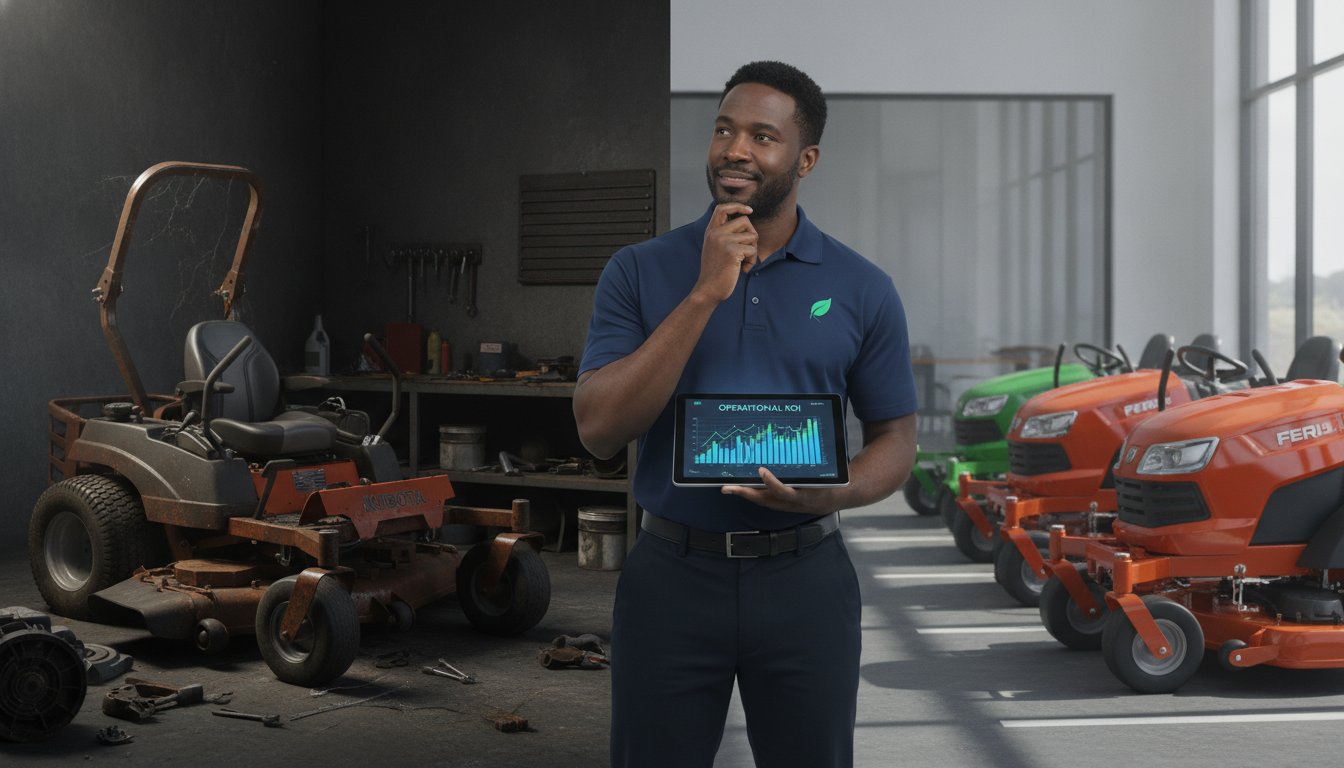
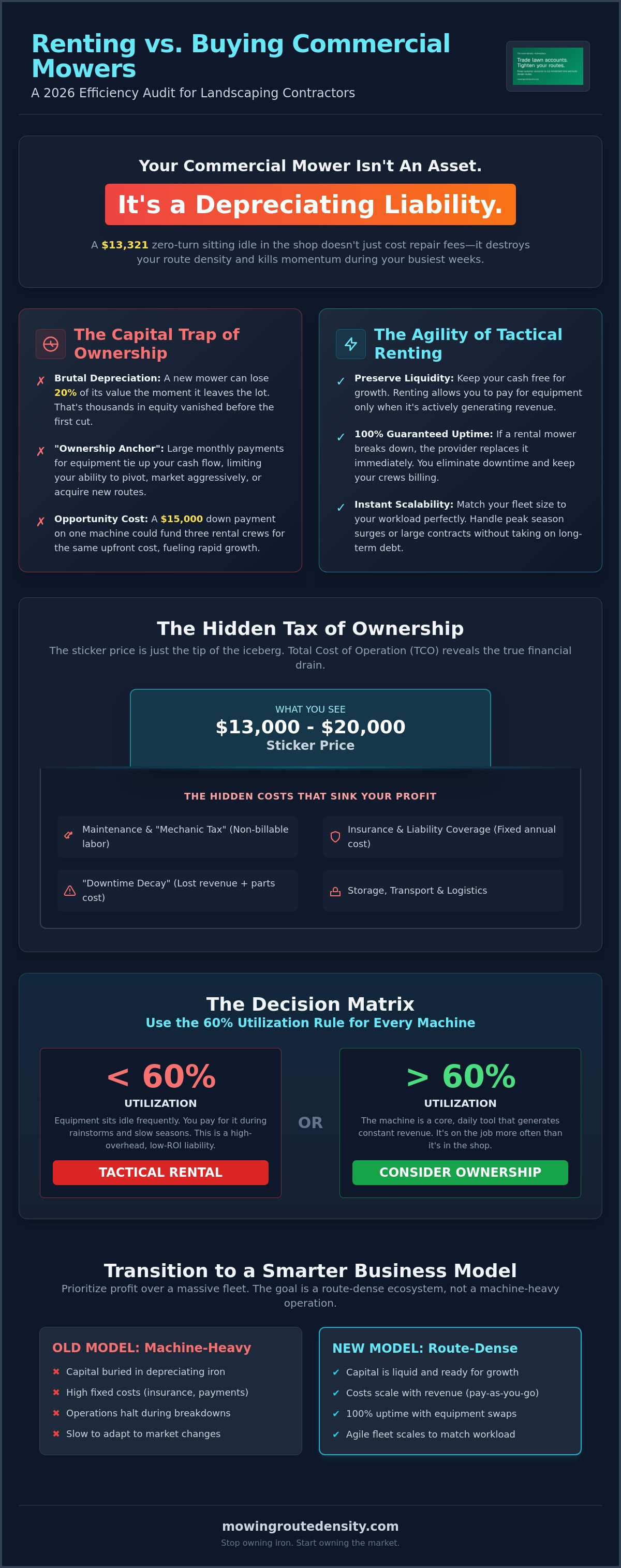
Your commercial mower isn't an asset. It's a depreciating liability that's currently bleeding your cash flow dry. Most contractors think ownership equals stability, but the reality is often the opposite. You've likely felt the sting of a $13,321 zero-turn sitting idle in the shop during your busiest week. Unexpected downtime doesn't just cost you repair fees; it destroys your route density and kills your momentum.
The debate over renting vs buying commercial lawn equipment isn't about pride of ownership. It's about math. You want high liquidity and 100% equipment uptime without the headache of storage logistics or non-billable maintenance hours. We're going to show you how to stop sinking capital into iron that loses value every time the hour meter ticks up. This 2026 efficiency audit breaks down how to scale your fleet to match your actual workload. You'll learn to choose the equipment model that protects your bottom line and ensures you never turn down a lucrative contract because of a broken belt or a lack of transport space.
Key Takeaways
- Stop burying your liquidity in the mud by identifying the "Mechanic Tax" and other hidden costs of asset ownership.
- Learn how to use tactical rentals to handle peak season surges without the burden of year-round debt payments.
- Use the 60% Utilization Rule to settle the renting vs buying commercial lawn equipment debate for every piece of gear in your trailer.
- Transition from a machine-heavy operation to a route-dense ecosystem that prioritizes profit over a massive fleet.
- Discover how to scale your business with agility by matching your equipment capacity to your actual billable hours.
The Capital Trap: Why Ownership Can Anchor Your Growth
Stop treating your fleet like a collection of trophies. In the high-speed 2026 market, equipment is a tool for generating billable hours, nothing more. Many contractors view a row of shiny, owned mowers as a sign of success. It isn't. It's often a sign of stagnant capital. Capital is the lifeblood of your landscaping business. If you bury it in the mud of depreciating assets, you lose the ability to pivot when the market shifts. The "Ownership Anchor" is real. Large monthly payments for a $19,999 battery-powered zero-turn or a $13,321 John Deere Z930M limit your movement. They tie you to specific routes and old technology. This "buy and hold" strategy is failing. With rapid advancements in robotic mowers and battery density, today's top-tier machine is tomorrow's boat anchor.
Depreciation vs. Liquidity
Ownership is a race to the bottom. A commercial mower can lose 20% of its value the moment it leaves the dealer lot. That is thousands of dollars in equity vanishing before the first blade of grass is cut. By prioritizing understanding lease agreements and rental structures, you keep your cash liquid. Liquidity is power. It allows you to fund aggressive marketing or acquire a competitor's route without begging a bank for a loan. When you analyze renting vs buying commercial lawn equipment, you must account for this lost flexibility. Cash reserves protect you from seasonal volatility. Debt does not.
The Opportunity Cost of Locked Capital
Consider the math of scaling. A $15,000 down payment on a single high-end mower is a massive commitment. What could that same capital do if invested in a professional lawn equipment rental strategy? Instead of one machine, you could potentially put three crews on the ground for the same upfront cost. You are trading rigid equipment debt for growth-focused lawn account trading platform opportunities.
- Renting: You pay for the hours the machine actually works.
- Buying: You pay for the machine while it sits in your shop during a rainstorm.
- Scaling: Renting allows you to match your fleet size to your current contract load instantly.
The choice between renting vs buying commercial lawn equipment comes down to one question. Do you want to own iron, or do you want to own the market? Locked capital cannot buy new accounts. It cannot hire better foremen. It just sits in the trailer, losing value every hour. Keep your business lean. Keep your capital moving.
The Hidden Tax: Calculating the True Cost of Ownership
Ownership isn't a one-time transaction. It's a recurring expense that bleeds your margin every month. When you analyze renting vs buying commercial lawn equipment, the sticker price is just the tip of the iceberg. Total Cost of Operation (TCO) includes insurance, liability coverage, and the inevitable "Mechanic Tax." Every hour you or your crew spends wrenching on a broken hydraulic line is an hour you aren't billing. You're losing revenue while simultaneously paying for parts. It's a double hit to your profit. Beyond the shop, insurance premiums for an owned fleet are fixed. They don't care if it's raining or if your route is light. You pay regardless. Understanding the financial factors in leasing vs. buying is critical to seeing these invisible drains on your capital.
While renting shifts this burden, owners can mitigate the "Mechanic Tax" by partnering with expert mobile repair services. For instance, Ms. Hydraulics LLC provides specialized support for heavy equipment, helping operators manage hydraulic systems and minimize downtime through expert guidance and mobile repair.
Commercial zero-turns in 2026 follow a brutal depreciation curve. A high-end machine like the Greenworks OptimusZ might cost $19,999, but its resale value drops the second the hour meter starts ticking. Most commercial units are rated for 2,000 hours. If you're buying, you're essentially pre-paying for those hours and betting that the machine won't fail prematurely. It's a high-stakes gamble with your company's liquidity.
Maintenance and Mechanical Downtime
Downtime Decay is the compound loss of billable revenue plus the direct cost of specialized parts and labor. In the current economy, the cost of specialized tools and electronic diagnostics has skyrocketed. Keeping a spare mower in the shop "just in case" is an expensive mistake. Rental units shift this burden. If a rental mower fails, it's the provider's problem. Your crew gets a replacement and stays in the field. You maintain 100% equipment uptime while your competitors are stuck waiting for backordered parts. This reliability is how you build a more profitable service network without the overhead of a full-time mechanic.
Storage, Transport, and Off-Season Waste
Owned assets are greedy. They demand climate-controlled square footage for four months of the year while generating zero dollars. This is off-season waste. You're paying for the real estate to house "dead assets." There's also the hidden cost of trailer wear and tear. Hauling heavy, owned machines across town increases fuel consumption and degrades your towing setup. Why carry that weight all year? Renting allows you to eliminate the storage headache and the transport tax. You scale your fleet up for the spring rush and scale it back down when the grass stops growing. This lean approach ensures you only pay for the equipment when it's actively putting money in your pocket. Don't let your yard become a graveyard for idle iron.
Efficiency isn't limited to the machines on the turf; it also applies to how you organize your mobile workshop. If you are looking to optimize your trailer storage with custom-cut dividers or composite panels, you can find out more about professional CNC services that streamline your setup.
Tactical Renting: When Agility Beats Equity
Stop listening to social media gurus who claim renting is only for startups. High-level contractors use renting as a surgical tool for growth. It isn't about a lack of capital. It's about the strategic deployment of it. In the 2026 audit of renting vs buying commercial lawn equipment, agility wins every time. Equity in a machine doesn't pay your bills; billable hours do. Renting acts as a scalpel, allowing you to cut into new markets without the heavy scarring of long-term debt. You can scale your fleet up for a specific six-month contract and return the units the day the contract ends. This isn't just "borrowing" gear. It's a zero-risk trial. You can test a 60-inch zero-turn on a specific hilly terrain before you ever consider a purchase. If the machine underperforms, it goes back to the yard. You aren't stuck with a five-year loan on a machine that can't handle your route.
Seasonal Peaks and Equipment Failure
The spring rush is a meat grinder for machinery. Using rentals as a "bridge fleet" during these peaks protects your primary assets from over-utilization. It also provides a massive operational advantage: the 24-hour replacement. If your owned mower throws a spindle, you're at the mercy of the dealer's repair schedule. If a rental unit fails, you get a replacement immediately. Your crew stays on the schedule. This reliability is a core component of lawn care profit margin optimization. You're trading a predictable rental fee for the unpredictable, catastrophic cost of a stalled route.
Testing New Routes Before Asset Commitment
Expanding your territory is a gamble. Why double down by purchasing new equipment for unproven routes? Smart operators use a lawn mowing service provider locator to identify and acquire accounts, then fulfill that work with rented gear. This keeps your costs strictly variable. You can identify the exact deck size needed for a new cluster of properties without the risk of buying the wrong machine.
- Match Specs: Rent a 48-inch walk-behind for tight gated communities today.
- Pivot Fast: Switch to a 72-inch rider for a commercial park tomorrow.
- Minimize Risk: Keep your equipment costs tied directly to active revenue.
By keeping your fleet flexible, you ensure that every machine on your trailer is perfectly suited for the day's work. You stop managing a static inventory of machines and start managing a dynamic flow of profit. Agility is your competitive edge.
The Decision Matrix: Renting vs. Buying Calculation
Stop making equipment decisions based on gut feelings or dealer promotions. You need a data-driven framework. When weighing renting vs buying commercial lawn equipment, the most critical metric is your utilization rate. Ownership is a commitment to a specific machine and a specific debt load. Renting is a tactical choice to maintain liquidity. To choose correctly, you must run the numbers against your current route density and projected growth. If you can't justify the asset, don't buy the asset. It is that simple.
The Utilization Audit
Calculate your total billable hours per machine per season. Apply the 60% Utilization Rule. If a mower sits idle for 40% of your billable week, it's a financial drain on your operation. A $13,321 John Deere Z930M that only runs 15 hours a week is costing you more in depreciation and opportunity cost than a rental ever would. Factoring in the cost of lawn care route density is essential here. High density allows for high utilization. If your accounts are scattered, your machines spend more time on the trailer than on the turf. In those cases, keeping your equipment costs variable through rentals protects your margins.
Financial Comparison Table
The following table breaks down the core differences between these two models in the 2026 economy. Use this to identify the "sweet spot" for your business's current stage.
| Metric | Buying (Ownership) | Renting (Tactical) |
|---|---|---|
| Upfront Cost | High ($4,000 to $20,000+) | Zero (Pay-as-you-go) |
| Maintenance | Owner's burden (labor + parts) | Provider's burden (100% uptime) |
| Flexibility | Low (Stuck with the asset) | High (Swap or return anytime) |
| Tax Treatment | Section 179 ($2.56M limit) | 100% Deductible OpEx |
While Section 179 allows for significant deductions on equipment placed in service by December 31, 2026, it requires you to have the profit and capital to support the purchase. Renting, or exploring long-term commercial lawn mower lease options, allows for asset-light growth. This is the "Exit Strategy" factor. If you lose a major contract or decide to pivot your service area, a rented fleet is easy to wind down. An owned fleet becomes a fire sale. Optimize your equipment strategy today to ensure your fleet size always matches your route requirements.
Scaling Lean: The Mowing Route Density Ecosystem
Stop managing machines. Start managing routes. The most successful contractors in 2026 have realized that a fleet is just a cost center. The real value of your business lies in the density of your client list. When you obsess over the "iron" in your trailer, you lose sight of the map. A "Just-in-Time" fleet model allows your equipment capacity to expand and contract in perfect sync with your route requirements. You don't need a yard full of idle mowers. You need the right tools on the ground exactly when the contract starts. This asset-light approach is the future of the industry. It prioritizes profit over perceived stature.
The debate of renting vs buying commercial lawn equipment takes on a new dimension when you look at it through the lens of route density. Ownership creates a rigid ceiling. If you own three mowers, you have a hard cap on your growth unless you take on more debt. Renting removes that ceiling entirely. It allows you to focus your energy on tightening your service clusters rather than worrying about hydraulic leaks or tire pressure.
Asset-Light Expansion
Growth should be fast and surgical. Instead of waiting years for organic word-of-mouth, smart operators use marketplaces to buy lawn care routes that are already clustered. Once you acquire a new territory, you scale your equipment via rental to meet the demand instantly. There is no waiting for financing or dealer inventory. You get the machines, you cut the grass, and you collect the revenue. This strategy also simplifies your eventual exit. When the time comes for selling a landscaping business, buyers want to see high-margin recurring revenue. They don't want to pay a premium for a fleet of depreciating assets that they have to maintain. A lean, rental-based operation is more attractive and easier to liquidate.
Optimizing Density through Account Trading
Density is the only way to lower your "per-hour" cost on rented gear. If your accounts are ten miles apart, you are paying for a rental to sit on a trailer. That is waste. Use account trading to swap your outlier properties for accounts that sit within your existing clusters. The more yards you can cut per hour, the more you dilute the rental fee. If you hit a surge that your core team can't handle, connect with lawn care subcontractors to manage the overflow. This allows you to fulfill contracts without the long-term burden of buying new gear for a temporary peak.
- Trade for Proximity: Lower travel time to increase machine utilization.
- Variable Scaling: Use rentals to bridge the gap between your current capacity and a new route acquisition.
- Focus on Margin: Every decision should move you toward an asset-light, profit-heavy model.
The 2026 market doesn't reward the person with the most mowers. It rewards the person with the tightest routes and the most liquid capital. Stop bleeding your profit into the dirt. Build an ecosystem that scales with your ambition, not your debt load.
Build Your Asset-Light Profit Machine
The days of measuring success by the size of your fleet are over. In 2026, the only metric that matters is your bottom-line profit. You've seen how the capital trap and the mechanic tax can anchor your growth. Every hour spent wrenching on an owned machine is an hour of lost billable revenue. By applying the 60% utilization rule, you can finally settle the debate of renting vs buying commercial lawn equipment for your specific operation. Focus on tightening your clusters and maintaining high liquidity. This strategic shift allows you to pivot when the market changes and scale without the burden of depreciating debt.
It's time to stop managing iron and start managing density. Our national network provides the strategic framework you need for equipment and route trading. We prioritize your profitability through a lean, results-driven model. Optimize your fleet and scale your routes today with Mowing Route Density. You have the tools to build a smarter, more agile business. Go out and own the route, not the machine.
Frequently Asked Questions
Is renting commercial lawn equipment tax-deductible for contractors?
Rental payments are 100% deductible as a business operating expense. Unlike purchasing, where you must manage complex depreciation schedules, rental costs are a direct "above-the-line" deduction. This keeps your tax math simple and your cash flow predictable. You get the full tax benefit in the same year you spend the money, which is often more efficient than waiting for long-term depreciation cycles.
What is the 60% utilization rule in landscaping equipment?
The 60% utilization rule states that you should only own a machine if it is billable for at least 60% of your work week. If a mower sits in your shop or on your trailer for more than 40% of the time, it is a financial drain. Renting is the logical choice for any equipment that doesn't meet this threshold. This prevents you from burying capital in assets that aren't actively generating revenue.
How does renting mowers help with landscaping route density?
Renting allows you to match your equipment specs to your specific route requirements on the fly. If you acquire a dense cluster of small residential lots, you can rent a fleet of 48-inch walk-behinds to maximize efficiency. When you analyze renting vs buying commercial lawn equipment, remember that renting provides the agility to scale your fleet size up or down as your route density changes throughout the season.
Can I rent specialized equipment like stand-on mowers for a single season?
Tactical renting is designed specifically for seasonal surges. You can rent stand-on mowers, aerators, or skid steers for your peak months and return them the moment the workload drops. This strategy eliminates the cost of housing and maintaining specialized gear during the off-season. You only pay for the equipment when the grass is growing and the checks are coming in.
Does renting equipment include maintenance and repair costs?
Most commercial rental agreements shift the burden of maintenance and repairs to the provider. If a spindle breaks or a hydraulic line leaks, the rental company handles the fix. This eliminates the "Mechanic Tax" on your billable time. You stop paying for spare parts and specialized tools, and you ensure your crews stay in the field with functional machinery at all times.
Is it better to lease or rent commercial mowers for a growing business?
Renting provides the maximum agility required for a rapidly scaling business. While leasing is a middle ground, it still often involves long-term contracts that can anchor your growth. Renting allows you to swap machines as your routes evolve. It is the ultimate asset-light strategy for contractors who want to prioritize liquidity and profit over the pride of owning a fleet of iron.
What happens if a rented commercial mower breaks down on the job?
Breakdowns are the provider's problem, not yours. Most rental contracts include a 24-hour replacement guarantee to ensure 100% equipment uptime. If a machine fails, you get a swap immediately. Your crew stays on schedule and your route density remains intact. This reliability is a massive competitive advantage over contractors who lose days or weeks waiting for dealer repairs on owned assets.
How does equipment ownership affect the valuation of my lawn care business?
High equipment ownership can actually lower your business valuation if it is tied to significant debt. Buyers are looking for high-margin recurring revenue and tight route clusters. A lean, rental-based model demonstrates that your profit comes from your operational efficiency, not from a pile of depreciating assets. This makes your business more attractive to investors who want an agile, cash-flow-heavy acquisition.


