
Are you buying a profitable business or just paying for the privilege of driving a truck across town for free? Most buyers look at top-line revenue and stop there. That's a mistake. It kills margins before the first mower hits the grass. Knowing how to value a lawn care route requires looking past the gross numbers and into the logistical reality of the schedule. If you don't account for churn and windshield time, you're not investing; you're gambling. Density is the only metric that truly dictates your take-home pay. Efficiency is profit.
It's frustrating to deal with sellers who provide "creative" revenue reporting or hide the fact that their customers are scattered across three counties. You want a fair deal that reflects the actual work being done. This guide provides the exact 2026 market formulas, from SDE multiples of 2x to 4.5x for owner-operated routes to EBITDA benchmarks for larger platforms. We'll break down how to audit route density, verify asset quality, and run the due diligence necessary to ensure your profit is protected from day one. You'll gain a clear formula for valuation and the confidence to walk away from a bad deal.
Key Takeaways
- Stop treating a route purchase like a hobby. It's a strategic trade of recurring revenue and logistical positioning that requires a clinical eye for profit.
- Revenue is a vanity metric that often hides operational waste. High-density routes command a premium because they slash fuel consumption and non-billable drive time.
- Master the exact 2026 formulas for how to value a lawn care route using SDE and EBITDA multiples adjusted for churn and asset quality.
- Protect your capital by auditing payment histories and customer retention rates. Don't pay full price for "slow-pay" accounts or routes with high turnover.
- Learn how to optimize your portfolio by swapping scattered accounts for high-density clusters using specialized account trading platforms.
What is Lawn Care Route Valuation?
Route valuation is the process of calculating the fair market price for a cluster of service accounts. It isn't just about totaling up what customers pay each month. It's about auditing the efficiency of the work itself. Unlike a full Business valuation, which might include real estate or a brand name, route valuation focuses on trading recurring revenue and logistical positioning. In the 2026 market, these rates are driven by two brutal realities: labor availability and fuel efficiency. If a route requires too much of either for too little return, its value drops to zero. Route valuation is the capitalized value of future net profits within a specific geographic cluster.
The Difference Between a List and a Route
A list is a collection of names. A route is a logistical asset. Beginners often mistake a spreadsheet of 50 customers for a business. If those 50 customers are spread across three separate zip codes, you don't have a route; you have a logistics nightmare. Scattered accounts are a liability. They drain fuel. They waste billable hours. They increase wear on equipment. A high-value route is tight. It minimizes non-productive time between stops. Service contracts further secure this value. Without a contract, you're buying a hope. With a contract, you're buying a predictable cash flow. Understanding this distinction is the first step in learning how to value a lawn care route effectively. Density is king. Profit lives in the seconds saved between driveways.
Why Valuation Matters for Scaling
You can't fix what you can't measure. Accurate valuation allows you to identify underperforming clusters that drag down your bottom line. If a specific neighborhood has a low profit per stop, it's time to cut it loose. This precision facilitates faster lawn account trading. Instead of holding onto inefficient stops, you can swap them for accounts that fit your existing footprint. This is how you scale without adding unnecessary overhead. Knowing how to value a lawn care route also prepares your business for an eventual exit. Buyers don't pay for your hard work. They pay for systems that generate profit without the owner's constant intervention. A well-valued, dense route is the most liquid asset in the green industry. It's a machine designed to generate cash with minimal waste.
Gross Revenue vs. Route Density: The Real Value Drivers
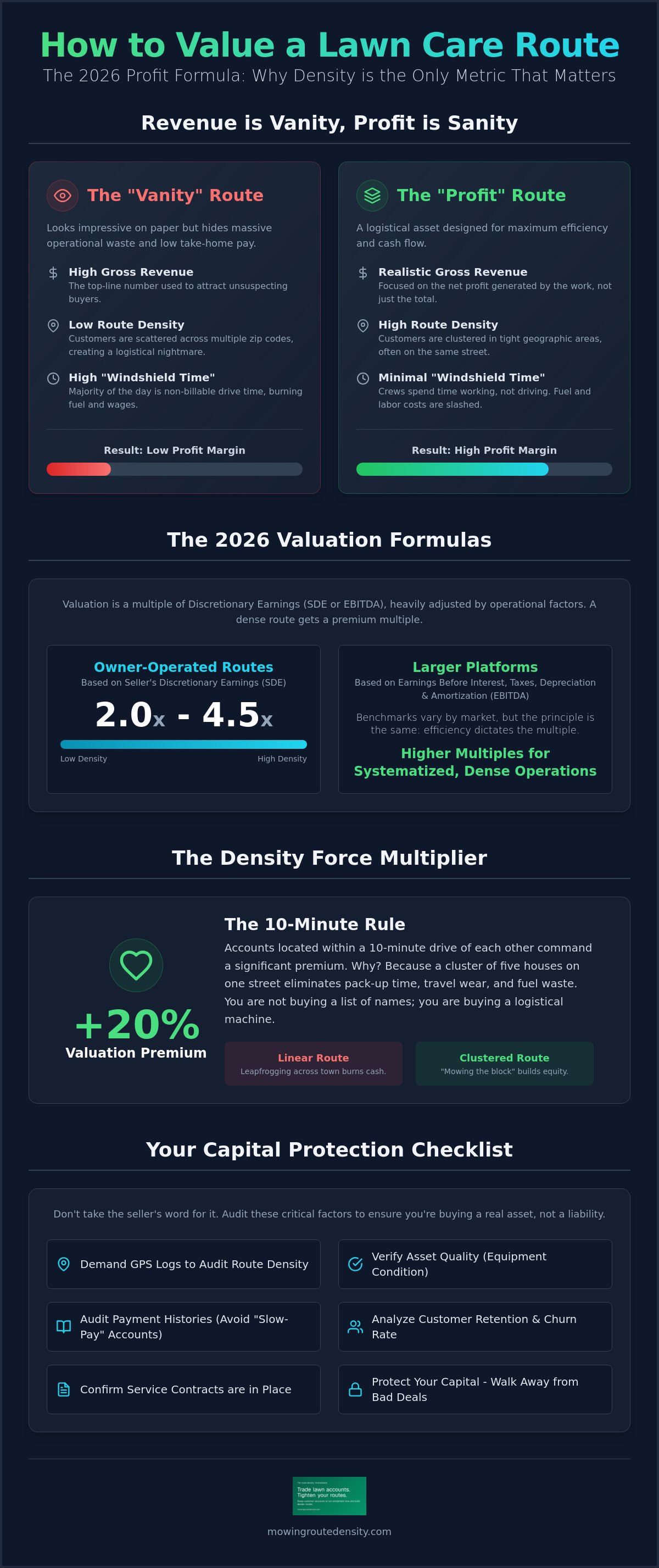
Revenue is a vanity metric. It looks impressive on a balance sheet but tells you nothing about the health of the operation. Profit is the only thing that buys new mowers or pays for repairs. When learning how to value a lawn care route, you must ignore the top-line numbers until you see the map. High-density routes command a premium because they slash overhead. Every minute your crew spends behind the windshield is a minute they aren't billing. This "Windshield Time" tax devalues an account list faster than equipment depreciation. If you're paying for a route where stops are 15 minutes apart, you're buying a logistics problem, not a business.
Calculating the "Profit per Stop" is the primary valuation multiplier. You need to know the net margin after fuel, labor, and travel time are subtracted. A route with $80 stops that are 2 miles apart is worth significantly more than a route with $100 stops that are 10 miles apart. One builds equity; the other burns cash. Before you sign any purchase agreement, demand a GPS log of the current service path. If the seller can't provide it, assume the route is inefficient. You are buying the density, not the names on the list.
The Density Multiplier Explained
Strategic lawn care route density acts as a force multiplier for valuation. Consider the 10-minute rule. Accounts located within 10 minutes of each other are generally worth 20% more than isolated properties. This isn't a random guess. It's math. A cluster of five houses on one street eliminates pack-up time and travel wear. You can mow more yards with less effort. Visualizing cluster value vs. linear route value shows where the money is hidden. Linear routes involve "leapfrogging" across town. Clusters allow for "mowing the block." If you want to build a truly profitable portfolio, you should audit your current route density before adding more volume.
Operational Efficiency and Overhead
Fuel consumption is a major de-valuation factor. With 2026 fuel prices, every extra mile driven eats into your SDE. Labor waste is even more toxic. You pay for the crew's time regardless of whether the blades are spinning. In low-density acquisitions, you're often paying for hours of unproductive travel. A $40k dense route is more valuable than a $60k scattered route. One provides a lean, high-margin income stream. The other provides a high-stress, high-overhead headache. Stop chasing gross revenue. Start chasing profit density. This is the only way to ensure you don't overpay for someone else's inefficient mess. Knowing how to value a lawn care route means knowing how to spot the difference between a gold mine and a money pit.
Due Diligence: Auditing the Route Before You Buy
Never take a seller's word for the health of their accounts. They're selling for a reason. You need to determine if that reason is a legitimate exit or a desperate attempt to offload a failing operation. When you are learning how to value a lawn care route, the audit phase is where you prevent expensive mistakes. If you don't look at the history, you're just subsidizing the seller's past failures. Start with the churn rate. You need to see exactly how many customers left in the last 24 months. A churn rate higher than 15% suggests either poor service quality or a neighborhood that's difficult to retain. You aren't just buying revenue; you're buying a relationship. If that relationship is toxic, the route is worth less.
Audit the payment history with clinical precision. A $60 account is worthless if it takes 90 days to collect the cash. "Slow-pay" and "no-pay" accounts kill your cash flow and increase your administrative overhead. You want a route filled with customers on autopay or those who settle within seven days. Validate the service frequency as well. Weekly accounts are the backbone of a profitable route. Bi-weekly accounts often take 80% of the time of a weekly mow but only generate 50% of the revenue. They clog up your schedule and reduce your overall route density. If a route is heavy on bi-weekly "haircuts," its market value should be discounted accordingly.
Financial and Contractual Audits
Demand at least three years of Profit & Loss statements specifically for the route in question. General business financials aren't enough. You need to see the direct costs associated with these specific stops. Look for hidden costs. Does one property require a specialized 36-inch mower because of a narrow gate? That's a logistical bottleneck. Ensure every contract is legally transferable to a new owner. If the customers can walk away the moment the truck changes colors, you're buying a list of names, not a business asset. Verify that pricing is current. You don't want to inherit "legacy prices" that haven't been raised since 2020.
Asset Evaluation: Rental vs. Ownership
Inspect the equipment included in the deal, but don't let it inflate the price. Use asset depreciation schedules to find the real value of the fleet. Sellers often try to bundle beat-up gear to make the deal look bigger. In many cases, opting for commercial lawn mower rental is a smarter tactical move than buying a seller's old equipment. It allows for an asset-light acquisition. You get modern, reliable gear without the immediate capital hit or the maintenance headaches of an aging fleet. Focus your capital on buying the recurring revenue and the density. You can always rent the tools to service them. This approach is fundamental to understanding how to value a lawn care route in a high-interest environment. Keep your operation lean and your cash flexible.
The Valuation Formula: Multiples and Margins
Stop guessing what your business is worth. Valuation is a clinical calculation; it is not a feeling. To master how to value a lawn care route, you must follow a rigid four step process. First, calculate the Annual Gross Revenue. This is your starting point, but it is also the most deceptive number. Second, subtract all direct costs. This includes fuel, labor, and chemicals. You must also account for commercial lawn mower lease options that keep your fleet operational without draining your cash reserves. Third, determine the EBITDA. This number represents the actual cash your business generates before accounting for taxes and interest. This is the truth of your operation. Finally, apply the density multiplier. A tight cluster of accounts can command a multiplier of 1.5x of annual net profit. A scattered list might only fetch 0.5x. Efficiency equals equity.
You need to be cold-blooded when running these numbers. If the math doesn't work, walk away. Every dollar of waste in your operation is a dollar subtracted from your eventual sale price. Buyers in 2026 aren't looking for a "project." They are looking for a turnkey profit machine. If your route is a logistical mess, you will be penalized at the closing table. Tighten your operations before you seek a valuation.
Common Multiples in 2026
Residential routes typically trade at lower multiples than commercial contracts. Residential customers are flighty; they cancel when the weather changes or the economy dips. Commercial contracts offer multi-year stability. This stability is worth a premium. In 2026, many buyers use the "Asset-Plus" method. This values the recurring revenue and then adds the fair market value of the equipment. If you are selling, ensure your equipment is well-maintained. If you are buying, don't pay a premium for junk. Some smaller operators still use a "Weekly Multiple," often 4x to 6x the weekly gross, but this is a "back of the napkin" approach that ignores profit margins. Stick to annual EBITDA for a professional valuation.
The Intangibles: Brand and Reputation
Reputation has a price tag. High Google Review ratings and a long community presence add a premium to your valuation. A smooth "Handoff Period" is also essential. If you disappear the day after the sale, customers will follow. A three-month transition period increases buyer confidence and the final sale price. Beware of "Owner-Dependent" routes. If the customers only stay because they like you personally, the route is fragile. Fragile assets are worth less. To ensure you aren't overpaying for a fragile list, use our route locator tools to verify the market footprint before you commit capital. A business that relies on a single personality is just a job; a business that relies on a dense route is an investment.
Maximizing Route Value via Strategic Trading
Stop trying to serve everyone. Generalists in this industry go broke chasing leads across three counties. You want to dominate specific zip codes. Density is the only defense against rising fuel costs and labor shortages. If you have a scattered route, your valuation is suffering. Strategic trading allows you to fix your footprint without losing revenue. It is the fastest way to turn a low-margin headache into a high-value asset. When you understand how to value a lawn care route, you realize that a smaller, tighter route is often worth more than a larger, sprawling one. Efficiency is the ultimate multiplier.
Consider the "Fix and Flip" strategy for lawn care routes. Many operators sell routes cheaply because they are logistical nightmares. They look at the gross revenue and ignore the waste. You can buy these inefficient routes, use a lawn account trading platform to swap the outliers for local accounts, and instantly boost the profit margin. By tightening the route, you increase its EBITDA and its market multiple. You are essentially manufacturing equity through logistical optimization. This is how sophisticated players scale in 2026.
Swapping for Density
The math of density is simple but brutal. You should gladly trade a $50 profit stop that is ten miles away for a $40 profit stop that is next door to your current anchor. You lose $10 in gross profit but gain 20 minutes of billable time and save on fuel and equipment wear. Use the lawn mowing service provider locator to find partners in your area who are facing the same logistical hurdles. Swapping accounts reduces your overhead instantly. This reduction goes straight to your bottom line, which is the most important factor when determining how to value a lawn care route during a sale. Tight routes sell fast. Scattered routes sit on the market.
Preparing for the Sale
If you plan to exit, you need to clean up your operation six months in advance. Buyers want to see perfect records. They want to see consistent service levels across every property. Standardize your pricing and your contracts. If half your customers are on "handshake deals," your valuation will take a hit. Professionalize the portfolio. Make it easy for a new owner to step in and keep the mowers moving. When your books are tight and your routes are dense, you command the highest market rates. Ready to trade? Join the Mowing Route Density marketplace to optimize your accounts today.
Build a Lean, High-Value Portfolio
Valuing a route isn't about guesswork; it's about cold, hard math. You now have the framework for how to value a lawn care route by focusing on density and net profit rather than vanity revenue metrics. Remember that a tight cluster of accounts is a scalable asset, while a scattered list is just a logistical drain on your fuel and labor. By auditing your churn rates and standardizing your contracts, you protect your bottom line and set the stage for a profitable exit. Efficiency is the only way to survive in the 2026 market.
Don't let inefficient stops eat your margins. Use our national B2B trading network to swap your outliers for local accounts that fit your existing footprint. Our professional equipment rental integration and specialized route density optimization tools are designed to help you cut waste and maximize billable hours. It's time to stop working harder and start working smarter. Every minute saved behind the windshield is a minute added to your profit margin.
Optimize your route density and trade accounts on our secure B2B platform.
You have the formulas and the strategy to dominate your local market. Now, take the lead and build the profitable business you deserve.
Common Questions About Route Valuation
How much is a lawn care customer list worth?
A customer list is worth only as much as the recurring profit it generates. Don't pay for names; pay for density. Typically, a list of accounts might trade for 4 to 6 weeks of gross revenue, but a professional valuation looks at net margins. If the list is scattered across a large area, it's a liability rather than an asset.
What is a typical multiple for a lawn care business in 2026?
Typical multiples in 2026 range from 2x to 4.5x Seller's Discretionary Earnings (SDE) for smaller, owner-operated routes. Larger companies with over $1M in earnings often see 3x to 8x EBITDA. Understanding how to value a lawn care route means knowing which multiple applies to your specific revenue tier and management structure. High-density routes always command the higher end of these ranges.
Should I include equipment in the route sale?
Including equipment is common but should be treated as a separate line item. Use the "Asset-Plus" method where you value the recurring revenue stream and then add the current fair market value of the gear. This prevents you from overpaying for aging mowers that might need immediate replacement. If the gear is junk, don't let it inflate the sale price.
How do I calculate the density of my current route?
Calculate density by dividing your total billable revenue by the total hours the truck is away from the shop. If you're earning $60 per man-hour but spending 20 minutes driving between stops, your real density is low. You want to see high revenue per mile to maximize your route's market value. Efficiency is the only metric that truly matters to a serious buyer.
What is the biggest mistake people make when buying a route?
The biggest mistake is buying gross revenue without auditing the "Windshield Time" tax. Buyers often see a high-revenue route and fail to notice that 30% of the labor cost is spent driving. You aren't buying a business; you're buying a logistics nightmare. Always verify the GPS logs and route maps before you commit your capital.
Can I sell a route if I don't have long-term contracts?
You can sell without contracts, but expect a significant discount on the multiple. Buyers pay for certainty. Without contracts, you're selling a "goodwill" list that could evaporate if the new owner makes a mistake. Transition periods and high retention records can help offset the lack of formal paper, but they won't replace the security of a signed agreement.
How does drive time affect my business valuation?
Drive time is a silent killer of valuation because it directly reduces your net profit. Since valuation is based on multiples of earnings, every extra hour spent driving instead of mowing lowers the final sale price. Tightening your route is the fastest way to increase your business's worth without adding a single new customer. It's about billable hours, not miles driven.
Is it better to buy a route or grow organically?
Buying a route provides immediate cash flow but requires significant capital and intense due diligence. Organic growth is slower but allows you to hand-pick dense clusters, which is often more profitable in the long run. If you choose to buy, use it as a platform to trade away scattered accounts and build the density required for a high-margin operation.


