
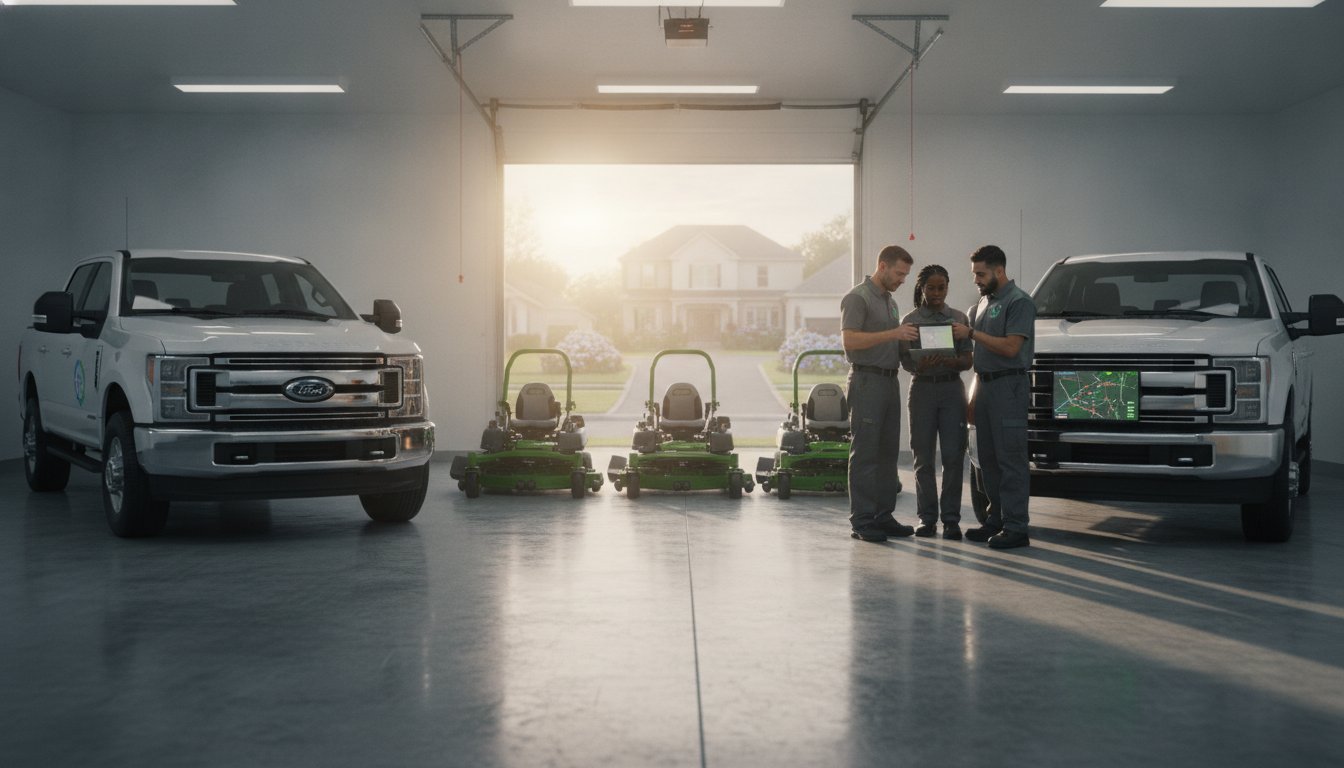
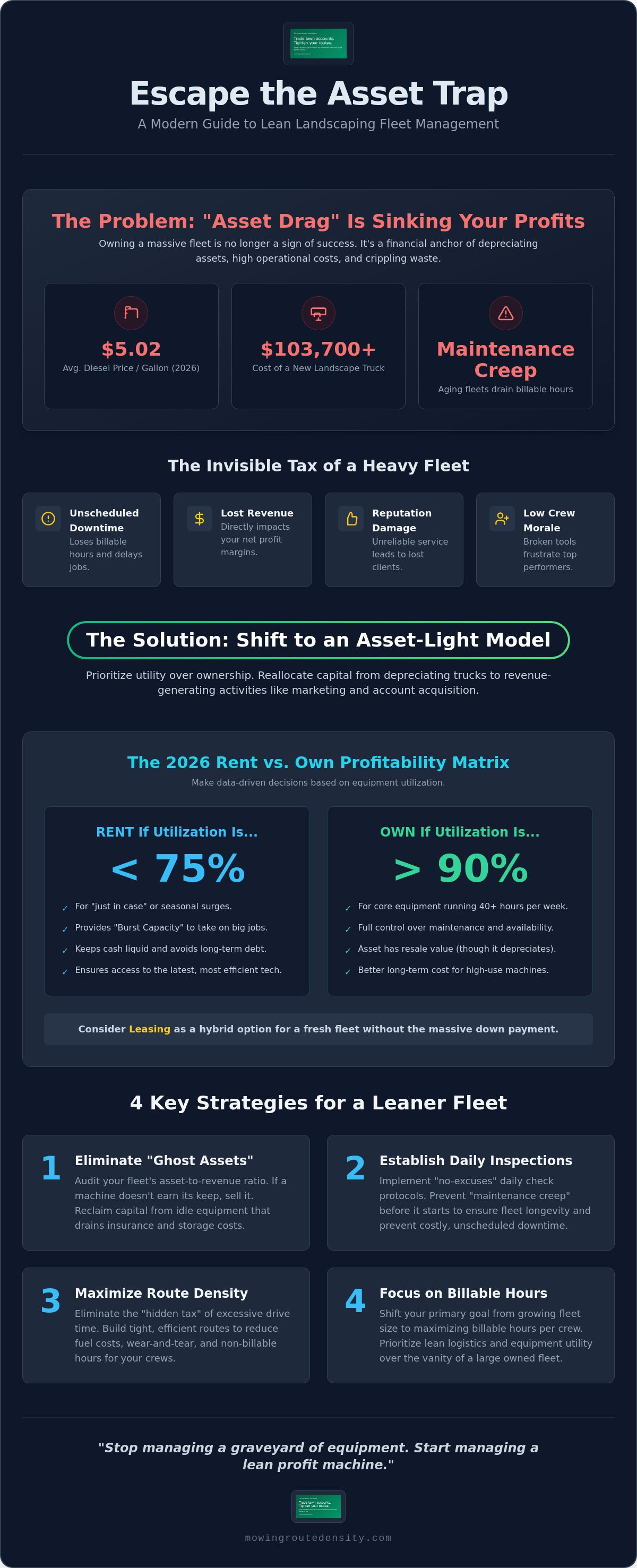
Owning a massive fleet of landscaping equipment isn't a sign of growth. It's a financial anchor. With 2026 diesel prices averaging $5.02 per gallon and new spray trucks costing over $103,700, your capital is suffocating in depreciating assets. You see the problem every morning. Aging mowers cause unscheduled downtime. High fuel costs eat your margins. Finding the right landscaping fleet management tips is no longer optional; it's a survival tactic for a heavy, inefficient business model.
You want a leaner operation that prioritizes billable hours over asset ownership. This guide will show you how to eliminate asset drag and maximize profitability. We'll explore how to shift from traditional ownership to a high-density, asset-light model that keeps your costs predictable. You'll learn to leverage mower rentals for seasonal surges and implement data-driven logistics to cut waste. It's time to stop managing a graveyard of equipment and start managing a lean profit machine.
Key Takeaways
- Identify and eliminate "asset drag" to stop sinking capital into underutilized equipment that drains your monthly margins.
- Transition to an asset-light model by using professional mower rentals to handle seasonal peaks without the burden of long-term debt.
- Establish "no-excuses" daily inspection protocols to ensure fleet longevity and prevent the "maintenance creep" that kills profitability.
- Apply these landscaping fleet management tips to build high route density, effectively eliminating the "hidden tax" of excessive drive time.
- Focus on maximizing billable hours per crew by prioritizing lean logistics and equipment utility over the size of your owned fleet.
The Asset Trap: Why Traditional Landscaping Fleet Management Fails
Owning a fleet used to be a badge of honor. In 2026, it's often a financial anchor. Traditional fleet management focuses on keeping trucks moving, but it ignores the heavy weight of the machines they carry. We call this Asset Drag. It's the hidden cost of owning underutilized or aging equipment that sits idle while your bank account leaks. If your equipment isn't earning, it's costing. There is no middle ground.
The "paid-off" mower is a psychological trap. You think it's free because there isn't a monthly note. You're wrong. If that machine spends two days a month in the shop, it's a parasite. This leads to maintenance creep. It starts with a minor repair. Then a hydraulic leak. Soon, you're losing billable hours and paying a crew to stand around. These landscaping fleet management tips are designed to stop that bleed. Fleet overhead directly erodes your net profit margins. In an industry where a few percentage points determine your survival, you can't afford to carry dead weight.
Asset drag also complicates your logistics. Every extra machine requires storage, insurance, and tracking. It clutters your shop and distracts your mechanic. To keep your facility lean and organized, you can visit StripeGuys Warhouse Line Striping for professional floor marking that enhances safety and workflow. By shifting your perspective from ownership to utility, you can reclaim your cash flow. You don't need a yard full of iron. You need a fleet that matches your current revenue, not your future aspirations.
The Hidden Costs of Aging Equipment
Downtime is an invisible tax. The repair bill is just the tip of the iceberg. You have to account for the lost revenue from a missed day of service. You have to account for the damage to your reputation when a crew arrives late. Unreliable equipment kills crew morale. High-performing workers don't stay at companies that give them broken tools. Total Cost of Ownership for a commercial zero-turn mower is the sum of the initial purchase price, all maintenance and fuel expenses, and the cost of lost productivity over its lifespan, minus its eventual resale value.
Identifying Operational Waste in Your Fleet
Hunt for "ghost assets" in your yard. These are the trimmers that might work or the backup truck that hasn't moved since last season. They still require insurance. They still take up storage. They still drain your focus. Audit your current fleet for asset-to-revenue ratios. List every asset and track the revenue each machine generated last month. Sell anything that didn't earn its keep. Mismatched equipment is another form of waste. A crew using a 60-inch deck on a property designed for a 36-inch walk-behind is wasting labor. Match the tool to the route or lose the margin. To avoid these mismatches on large commercial properties, leveraging aerial intelligence from DroneWorksIQ can help you determine the exact equipment mix needed before the crew even arrives.
Transitioning to an Asset-Light Fleet Model
Stop being an equipment collector. Start being a logistics expert. Transitioning to an asset-light model means you prioritize utility over ownership. If a mower sits in your yard for three months, it's a liability, not an asset. By leveraging professional lawn equipment rental, you handle the June rush without the December debt. This is one of the most effective landscaping fleet management tips for 2026. You pay for the machine when it's cutting grass. You stop paying when the season ends. It's a simple, pragmatic shift that keeps your cash liquid.
Capital is finite. Every dollar spent on a depreciating truck is a dollar not spent on marketing or account acquisition. A 2026 Isuzu NPR-HD Landscape Truck costs roughly $103,700 and loses value the moment it hits the road. Use that capital to buy a competing book of business instead. Accounts generate recurring revenue. Trucks generate bills. High-efficiency machinery should be a tool you use, not a weight you carry. When you rent, you're always running the latest tech. You get the benefits of 2026 fuel efficiency without the burden of a long-term loan.
Renting vs. Owning: The 2026 Profitability Matrix
Ownership is for the core. If a mower runs 40 hours a week, every week, own it. If it’s for "just in case" scenarios or seasonal surges, rent it. The 2026 profitability matrix is blunt. Is your utilization under 75 percent? Rent. Is it over 90 percent? Own. For long-term stability without the massive down payment, explore commercial lawn mower lease options. This keeps your fleet fresh and your balance sheet clean. Standardizing your fleet helps, but flexibility is what saves your margins during a downturn.
Scaling Capacity Without Capital Expenditure
Bid on the big jobs. Don't worry about your current fleet size. Rental fleets provide what we call "Burst Capacity." You secure the contract first. You rent the gear second. This allows you to scale during peak growth months without permanent overhead. During the off-season, you return the keys. No storage fees. No winter maintenance. You achieve data-driven route optimization by matching the exact equipment needed to the specific job site requirements. If you have a three-month contract for a large municipality, don't buy wide-area mowers. Rent them. The project pays for the rental. Your profit stays in your pocket. If you're ready to stop the bleeding, it's time to rethink your fleet strategy and focus on what actually builds wealth: route density and customer retention.
Standard Operating Procedures for Fleet Longevity
Discipline is the only thing standing between a profitable fleet and a yard full of junk. Most equipment failures aren't bad luck. They're a result of laziness. If your crews treat machines like disposable toys, your margins will vanish. You need a "no-excuses" daily inspection protocol. Every crew leader must complete a 5-minute morning walk-around before the truck leaves the yard. No check, no keys. It's that simple.
The 5-minute walk-around isn't a formality. It's a survival tactic. Crews must verify fluid levels, tire pressure, belt tension, and grease points. Catching a loose belt in the shop takes ten minutes. Replacing a snapped belt in the field takes two hours of billable time plus travel. These landscaping fleet management tips only work if you enforce them with clinical precision. Standardize tool accountability to stop the "lost" equipment tax. Etch serial numbers into every blower and trimmer. Assign specific tools to specific crews. When a crew leader is personally responsible for their gear, things stop disappearing.
Centralize your maintenance data. Stop using greasy notebooks or fading whiteboards. Use a digital log to track engine hours across every asset. Data allows you to predict failures before they happen. It turns chaos into a schedule. When you know exactly when a machine needs service, you can swap it for a rental before it breaks down on a job site.
Predictive vs. Reactive Maintenance Schedules
Fixing it when it breaks is the most expensive way to run a business. It ruins your schedule and frustrates your clients. Establish hard hour-meter benchmarks. Sharpen blades every 8 hours. Change oil every 50 hours. Replace belts every 200 hours. Don't wait for smoke or strange noises. Implementing a predictive maintenance strategy reduces the Total Cost of Ownership for commercial mowing equipment by 15-20% through extended asset life and reduced emergency repair costs.
Driver Safety and Fuel Management
With diesel prices hitting $5.02 per gallon in 2026, fuel waste is a direct hit to your bottom line. Monitor idle time. A truck idling at a gas station or in a client's driveway is burning your cash. Speed controls and telematics aren't just for safety; they preserve engines and tires. Driver behavior is the biggest variable in equipment longevity. Hard braking and aggressive turns destroy suspensions and increase maintenance creep. Implement simple rewards. Give a monthly bonus to the crew with the lowest fuel consumption and zero equipment damage. Competition breeds efficiency.
Leveraging Route Density to Reduce Fleet Overhead
Stop treating your trucks like luxury tour buses. If your crews spend more time behind the steering wheel than behind a mower, you don't have a landscaping business. You have an unpaid courier service. The fundamental law of profitable operations is simple: fleet efficiency is a direct byproduct of lawn care route density. Every mile on the odometer is a mile closer to the scrap yard. Drive time acts as a hidden tax on your equipment, your fuel, and your labor. It's a non-billable expense that erodes your margins with every turn of the key.
The "tight radius" rule is your primary defense against overhead. A 5-mile route with 50 stops beats a 50-mile route with 50 stops every single time. Why? Because the 5-mile route requires fewer trucks and trailers to generate the same revenue. It puts less strain on your transmissions. It burns less diesel. Most importantly, it keeps your assets in the "earning zone" for more hours per day. One of the most overlooked landscaping fleet management tips is to stop chasing every lead and start dominating specific neighborhoods. If a job is ten miles away from your core cluster, it better pay a massive premium. Otherwise, it's a parasite.
Trading Accounts to Tighten Your Service Radius
Fixing a broken route doesn't require a better GPS. It requires a better portfolio. If you have "outlier" clients that force your trucks into long transit times, get rid of them. Use a lawn account trading platform to swap those distant clients for local ones. This is tactical landscaping. You trade a $50 lawn that's 20 minutes away for a $45 lawn that's next door to your current stop. You lose $5 in gross revenue but gain $15 in saved labor and fuel. This math of "Stop Density" allows you to maximize billable hours per gallon. You can generate more revenue with three tight routes than with five scattered ones.
Asset-to-Route Matching
Sending a 72-inch zero-turn to a residential cluster with gated backyards is a logistical failure. You're paying for the fuel and maintenance of a machine that can't do the job. Asset clustering means matching specific mower types to specific route clusters. Standardize your fleet to match your dominant route type. If 80 percent of your work is residential, your fleet should reflect that. This standardization reduces your parts inventory. You only need one type of belt, one type of blade, and one type of filter. It simplifies maintenance and reduces the "maintenance creep" discussed earlier. If you want to stop the bleed and start scaling, you need to optimize your route density today.
- Density reduces wear: Fewer miles means fewer oil changes and longer tire life.
- Clustering saves labor: More time cutting, less time sitting in traffic.
- Standardization cuts costs: Bulk buying parts for a single model is cheaper than managing a mixed fleet.
Scaling with Mowing Route Density: The 2026 Fleet Solution
Success in 2026 isn't about the size of your yard. It's about the speed of your cash flow. Mowing Route Density provides the tools for an asset-light, high-margin business. We've identified the systemic flaw in the industry: most owners are over-leveraged and under-optimized. You don't need a million dollars in debt to run a million-dollar business. You need access to professional-grade equipment without the burden of long-term loans. Our platform allows you to pivot from a traditional ownership model to a lean, utility-based operation. You stop being a mechanic. You start being a strategist.
Sometimes the best fleet is the one you don't own at all. Use our platform to find lawn care subcontractors who already have the equipment. Let them carry the insurance and the depreciation. You focus on account acquisition and route optimization. This is the ultimate application of our landscaping fleet management tips. You scale your capacity instantly. You avoid the "maintenance creep" that kills smaller operators. You maintain a high-density footprint while keeping your overhead at a minimum. It’s a pragmatic approach to growth that prioritizes your bottom line over your ego.
Tactical Equipment Rental for Peak Season
Our lawn mower rental program allows for rapid deployment. When the spring rush hits, you don't go to the bank. You go to your dashboard. You add a crew, rent the mowers, and start billing. It's maintenance-free growth. If a machine breaks, it isn't your headache. We handle the repairs while you keep cutting. This model provides predictable monthly costs. You can forecast your margins with clinical precision because you aren't waiting for a surprise $4,000 repair bill. You pay for the utility of the machine during the months it earns you money. You return it when the grass stops growing.
Optimizing Your Territory via Account Trading
Use our account trading platform to build the dense routes that make fleet management easy. Stop driving past your competitors' clients. Trade your outliers for their neighbors. This marketplace allows you to tighten your service radius until your drive time is negligible. Density does more than save fuel; it builds massive business equity. When you decide to exit, you can sell a landscaping route for a premium. Buyers want tight, profitable clusters, not a scattered list of addresses. Start optimizing your overhead today. Focus on the mowing. Let us handle the asset logistics.
Build a Lean, High-Margin Fleet for 2026
The era of the equipment collector is over. Every idle mower in your shop is a leak in your balance sheet. By applying these landscaping fleet management tips, you shift your focus from owning iron to owning the market. You've seen the math. Route density isn't just a fuel-saving tactic; it's the foundation of a fleet that requires fewer trucks to hit higher revenue goals. High-density clusters combined with an asset-light strategy create a business that is agile, resilient, and ready for 2026.
Mowing Route Density provides the infrastructure to make this transition. Our national equipment rental network and secure lawn account trading marketplace are built for professional B2B logistics. We offer the support you need to scale your capacity without the anchor of long-term debt. Stop wasting money on idle assets; rent your commercial fleet from Mowing Route Density today. Your business deserves a lean future. You have the strategy. Now it's time to execute.
Frequently Asked Questions
How do I calculate the real cost of landscaping fleet downtime?
You calculate the cost of downtime by adding the repair bill to the lost billable revenue and idle labor costs. Using these landscaping fleet management tips helps you see the true drain on your margins. If a crew is standing around for four hours, you are paying them to do nothing while missing out on hundreds in service fees. It is a double hit. Track every minute a machine is out of service.
Is it better to lease or rent commercial lawn mowers for a growing business?
You should rent for seasonal peaks and lease for core equipment with high utilization rates. Renting provides burst capacity during the June rush without the burden of off-season storage or debt. Leasing is better for the machines you run 40 hours a week. For a growing business, keeping capital liquid is more important than owning a yard full of depreciating iron. Pay for the utility, not the metal.
What are the most important daily maintenance tasks for commercial mowers?
The most important daily tasks are checking fluid levels, tire pressure, belt tension, and grease points. A 5-minute morning walk-around is mandatory for every crew leader. Catching a loose belt in the shop costs you ten minutes. Snapping that same belt in the field costs you two hours of billable time plus travel. Discipline in the yard prevents chaos on the job site. No check, no keys.
How can I reduce fuel costs in my landscaping business without buying new trucks?
You reduce fuel costs by tightening route density and monitoring vehicle idle time. With diesel prices at $5.02 per gallon in 2026, every minute of idling is a direct hit to your net profit. Use telematics to track speed and stop times. Reducing non-billable drive time is more effective than buying a more efficient truck. If an account is not in your cluster, it is costing you money.
What is the ideal route density for a profitable lawn care crew?
The ideal route density keeps drive time under 10 percent of the total workday. You want a tight radius where crews spend 50 minutes cutting for every 10 minutes driving. A route with 50 stops within 5 miles is significantly more profitable than 50 stops spread over 50 miles. High density reduces the number of trucks needed for the same revenue. It is the fundamental law of lean operations.
How does account trading help with fleet management efficiency?
Account trading allows you to swap distant outliers for local clients to build tighter service clusters. It is a tactical move to eliminate parasite accounts that sit outside your core territory. You might trade a high-paying distant lawn for a lower-paying neighboring one. The math always wins. You gain more in saved labor and fuel than you lose in gross revenue. Trading is the fastest way to fix a broken route.
What fleet management software is best for small to mid-sized landscaping companies?
Simply Fleet is excellent for small operations with 5 to 20 trucks, while Fleetio handles mixed assets like mowers and trailers. These tools provide the digital tracking you need for engine hours and maintenance schedules. Simply Fleet costs roughly $5 to $7 per vehicle per month. Stop using whiteboards or greasy notebooks. Use data to predict failures before they kill your schedule and your reputation.
Can I really scale a landscaping business using only rental equipment?
You can scale a landscaping business using only rental equipment by matching machines to specific contracts. This asset-light model allows you to add crews during peak months without taking on long-term debt. You return the gear in the off-season to eliminate storage and maintenance costs. It keeps your business agile. Focus on acquiring accounts and let rental partners handle the logistics. This is the ultimate landscaping fleet management tips strategy for 2026.


