

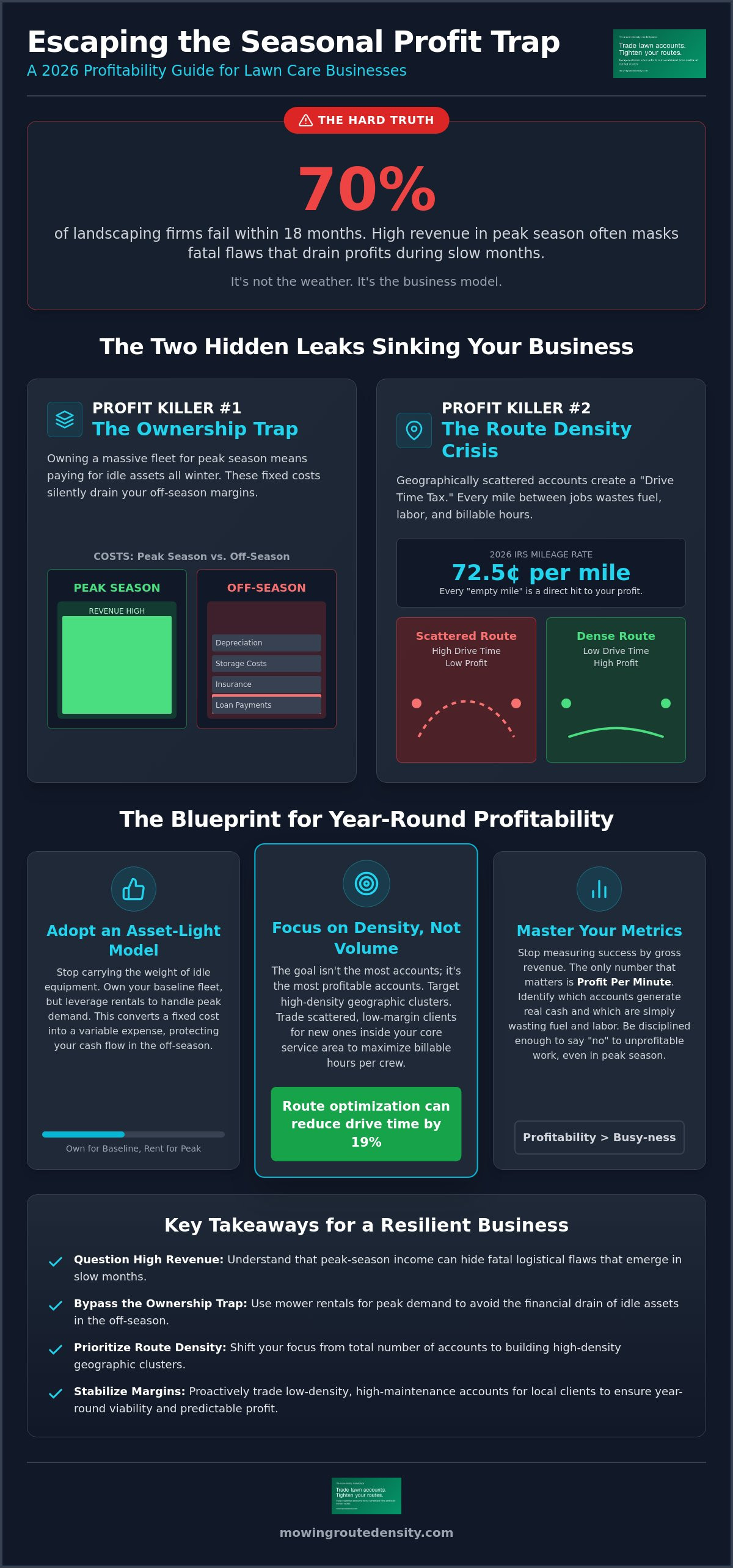
Why does your profit disappear during the shoulder seasons despite a full schedule? It's a question that keeps owners awake at night. You're working harder than ever. Your bank account doesn't reflect the effort. Most people blame the weather for their financial stress. They're wrong. Seasonal failure isn't caused by the climate. It's caused by rigid asset ownership and geographically scattered routes. With the IRS mileage rate sitting at 72.5 cents per mile in 2026, driving is your biggest expense. These seasonal lawn care business challenges, such as high maintenance, idle assets, and fuel waste, are exactly why 70% of landscaping firms fail within 18 months. You know the frustration of watching peak-season revenue dissolve into winter overhead. It's a cycle of waste that ends today.
It is time to stop the bleed. You deserve a business that rewards your labor with actual profit, not just a busier calendar. This guide will show you how to master logistical volatility by optimizing route density and adopting asset-light equipment strategies. We'll examine the tactical shifts needed to ensure predictable margins and maximum billable hours per crew, regardless of the month on the calendar. We are moving past the "work harder" mentality and focusing on the math that drives 2026 profitability.
Key Takeaways
- Understand why high peak-season revenue often masks terminal logistical flaws that drain your bank account during slow months.
- Learn to bypass the ownership trap by leveraging mower rentals to handle peak demand without carrying the weight of idle assets in the off-season.
- Discover how to solve seasonal lawn care business challenges by shifting your focus from total account volume to high-density geographic clusters.
- Master the Profit Per Minute metric to identify which accounts are generating real cash and which are simply wasting fuel and labor.
- Explore how trading low-density accounts for local clusters can stabilize your margins and ensure year-round business viability.
The Seasonal Volatility Trap: Why Revenue Doesn't Equal Profit
The 2026 lawn care market is a game of extremes. We call it the "Feast or Famine" cycle. In June, your phone rings off the hook. Your crews are working 12 hour days. The bank balance looks healthy. But this surge is often a mask for terminal logistical flaws. High revenue doesn't mean your business is healthy. It often just means you're moving fast enough to outrun your overhead, for now. This disconnect is at the heart of The Seasonal Volatility Trap. When the grass stops growing, the revenue vanishes, but the bills for your equipment, shop space, and insurance remain. If you haven't built a lean operation, the "famine" of the shoulder season will devour the "feast" of the spring.
To mitigate this seasonal dip, some contractors look to indoor horticultural projects as a way to keep their business active year-round. You can explore LED Grow Lights to see how modern hydroponic technology creates opportunities for revenue even when the ground is frozen.
Stop measuring success by the number of accounts on your roster. Busy-ness is not profitability. Every mile your trucks travel between jobs is a "Drive Time Tax" that eats your margin. To survive the seasonal lawn care business challenges that sink 70% of firms within their first two years, you must stabilize the three pillars of your operation: assets, density, and labor. If any of these pillars are bloated or inefficient, your profit will evaporate the moment the growth slows down.
The Math of the Shoulder Season
Fixed overhead is the silent killer. When your growth slows in the autumn, your mower payments and warehouse rent don't decrease. This is where "Marginal Utility" becomes critical. Every new account must be evaluated by how much profit it adds relative to the cost of servicing it. Taking "any" customer just to fill a schedule is a strategic blunder. If a client is 15 miles away from your core route, they aren't a customer. They're a financial drain. During peak season, you must be disciplined enough to say no to high-maintenance, low-density accounts that will crush your margins when the weather turns.
The Hidden Cost of Geographic Dispersion
Route density is the only metric that guarantees long-term survival. In 2026, the IRS standard mileage rate is 72.5 cents per mile. Every "empty mile" driven between jobs is pure waste. Scattered accounts increase fuel consumption. They accelerate vehicle wear. They lead to labor burnout. When your crews spend 30% of their day behind a windshield instead of behind a mower, you are losing billable hours you can never recover. Research shows that route optimization can reduce drive time by 19%. That's not just a small gain. It's the difference between a business that scales and one that collapses under its own weight. Inefficient routes also take a psychological toll. Field crews want to work, not sit in traffic. High-density routes keep them productive and engaged, reducing the labor churn that plagues the industry.
Equipment Overhead: The Silent Killer of Off-Season Margins
Ownership is a weight. Most contractors believe a massive fleet signals success. It doesn't. It signals high fixed costs. In the peak of June, those mowers are assets. In the dead of January, they're liabilities. This is the "Ownership Trap." Every piece of equipment you own carries a hidden invoice. You pay for depreciation. You pay for climate-controlled storage. You pay for insurance. These costs don't stop when the grass stops growing. They continue to eat your profit while the machines sit idle. Why pay for a machine you aren't using?
Calculate the burn. A mower sitting in a trailer for four months isn't free. It's losing value every hour. The Producer Price Index for lawn and garden equipment rose 2.8% in early 2026. New gear is getting more expensive. Owning it means you're locked into that cost regardless of your revenue. This is one of the primary challenges of a seasonal business. You need peak capacity for 100 days but pay for it for 365. It's a fundamental mismatch that creates seasonal lawn care business challenges for even the most experienced owners. You can't afford to carry dead weight into the winter.
Renting vs. Buying: A 2026 Cost Analysis
Pragmatic owners are moving to an asset-light model. Why buy a fifth mower for your busiest three months? Rent it instead. Renting allows you to scale up labor and throughput without long-term debt. It keeps your balance sheet lean. There are also significant tax advantages. Rental payments are often fully deductible as operating expenses. This simplifies your accounting and preserves cash when you need it most. To see how this works in practice, review these commercial lawn mower lease options. It's about paying for what you use, not what you store.
Fleet Scalability Without the Debt
Scaling into a new service area is risky. Don't buy a new truck and trailer set until the route is dense enough to justify the debt. Use professional lawn equipment rental to bridge the gap. It allows you to maintain professional standards without the maintenance liability. When the season ends, you return the gear. No storage costs. No off-season maintenance. You only pay for the equipment when it's making you money. If you're looking to tighten your operations, exploring a lawn mower rental strategy is a common-sense move for the 2026 season.
The Route Density Crisis: Why Scattered Accounts Are Costing You Your Business
Revenue is a vanity metric. Density is a sanity metric. If you have 100 accounts spread across the county, you aren't just a lawn care professional. You're a logistics manager running an inefficient trucking company. Every minute your crew spends on the highway is a minute they aren't billing. This geographic dispersion is one of the most overlooked seasonal lawn care business challenges. You might feel successful because the schedule is full, but the "windshield time" is quietly draining your bank account. In 2026, with fuel prices averaging $3.83 per gallon, you cannot afford to drive for free.
Stop looking at the total invoice. Start measuring your "Profit Per Minute." This metric tracks the actual cash generated from the moment the blades engage to the moment the trailer gate closes. If a job pays well but requires a 20 minute drive, your Profit Per Minute collapses. You're better off with 50 accounts in a single ZIP code than 100 accounts scattered across three towns. Efficiency is found in the tightest possible radius. If your route looks like a spiderweb on a map, your business is in trouble. The fastest way to fix a broken route is through strategic account trading. Using a lawn account trading platform allows you to swap those far-flung, low-margin leads for customers that actually fit your core service area.
The Logistics of Route Optimization
Audit your route for "dead zones." These are the long stretches of road where you have zero billable activity. Tactical account swapping is the remedy. Trade your outlier clients to a competitor who is already working that street. In return, take their accounts that neighbor your existing stops. This isn't giving up revenue. It's tightening your grip on profit. Increasing lawn care route density also has a massive impact on crew morale. Your team wants to work, not sit in traffic. High-density routes reduce the 19% drive-time average, allowing crews to complete up to 20% more jobs per day without working longer hours.
Market Dynamics of Account Trading
Valuing a lawn care account for a swap requires a cold, hard look at the data. Don't just trade dollar-for-dollar. Consider the location value. An account that is two doors down from your current biggest client is worth more than a higher-paying job five miles away. Perform due diligence on any new route. Check the service history and the site conditions. Your goal is to build a "tight" route that is geographically impenetrable. When your travel time is near zero, you can offer more competitive pricing while maintaining higher margins than any competitor who has to drive across town to reach the same neighborhood.
Tactical Resource Allocation for Peak and Off-Peak Performance
Managing seasonal lawn care business challenges requires a two-speed operational model. Most owners try to maintain a steady state all year. This is a mistake. During the "Feast" months, your goal is maximum throughput. You need to push as many billable hours through your crews as possible without hitting a quality ceiling. During the "Famine" months, your focus must shift entirely. This is the time for aggressive lawn care profit margin optimization. You shed every ounce of non-essential weight. If a process doesn't directly protect your cash flow, cut it. Your operational rulebook should be lean. No fluff. No wasted motion. Only the essentials survive the off-season.
Labor is your most volatile expense. It typically accounts for 25% to 40% of your total revenue. Hiring full-time staff to handle a three-month peak is a recipe for a winter layoff. Instead, leverage subcontractors to handle the overflow. This allows you to scale your capacity without increasing your permanent overhead. You maintain the contract. You control the quality. You avoid the long-term liability of a bloated payroll. This strategy ensures you never pay for a hand that isn't holding a trimmer.
Strategic Capacity Management
Stop trying to be everything to everyone. Your capacity is a finite resource. Use a lawn mowing service provider locator to find vetted partners who can take the jobs that fall outside your high-density zones. If a new contract is more than five minutes from your existing route, say no. It's not a missed opportunity. It's a saved margin. Manage your client expectations by being transparent about your service limits. A tight, reliable route is better than a wide, unreliable one. If you need to expand your reach without the overhead, locate a service partner to handle your overflow accounts today.
Maximizing Billable Hours in the Field
Every second spent at the shop is unbilled time. Improve your staging and logistics so crews are on the road within ten minutes of arrival. This includes outsourcing secondary tasks so your facility remains a staging ground, not a laundry room; you can discover Laundry Breeze to handle your commercial uniform needs efficiently. Equipment choice is also a factor in speed. Stand-on mowers often provide better visibility and faster mounting/dismounting than walk-behinds, increasing total daily throughput. Train your crews to spot high-margin upsell opportunities while they are already on-site. Aeration or overseeding don't require extra drive time. They turn a standard stop into a high-profit visit. When you maximize the billable hours per stop, your seasonal lawn care business challenges become much easier to manage.
Building an Asset-Light, High-Density Lawn Care Business
The days of the "owner-operator" grinding eighty hours a week are over. That's not a business. It's a job. In 2026, the Modern Contractor model is lean, dense, and agile. You move away from heavy ownership and toward strategic management. You stop being the person on the mower. You become the strategist who manages the routes. This shift is the only way to truly overcome seasonal lawn care business challenges. Density is your moat. If you own the block, no competitor can touch your prices. If you rent your peak capacity, no off-season can drain your bank account. You're building a machine that generates profit, not just a schedule that generates exhaustion.
The 2026 outlook is clear. Inflation and labor shortages will continue to squeeze margins. The average net profit margin for this industry sits between 10% and 15%. Highly optimized businesses reach 25%. That gap is closed through efficiency, not effort. A strategic manager looks at every truck, every mower, and every mile as a cost to be justified. If an asset isn't earning its keep, it goes. If a route isn't dense, it's traded. This is the "work smarter" philosophy in action. It's about organized calm and strategic foresight.
The Path to Maximum Liquidity
A business you can't sell is a liability. Buyers don't want a collection of aging trailers and scattered leads. They want predictable, high-margin cash flow. Dense routes sell for significantly higher multiples because they are easier to manage and more profitable. You must standardize your operations to make the business "turn-key." A buyer should be able to step in and run your routes without your constant presence. This requires clear systems for everything from maintenance to account trading. For a deep dive on preparing your firm for a clean break, review this lawn care business exit strategy. Liquidity is the ultimate reward for your operational discipline.
Next Steps for Your Operation
Stop guessing about your profitability. Start auditing your map today. Identify the outliers that are costing you more in fuel than they pay in revenue. Check your rental options for the upcoming peak season to avoid unnecessary debt. Use a B2B network to optimize your account list by trading away your "empty miles." If you're ready to stop the financial bleed and secure your margins, use our lawn account trading platform to find local clusters that fit your core route. Tighten your operations. Cut the waste. Secure your future.
Own Your Route, Don't Let It Own You
Revenue is a distraction. Profit is the only score that matters. To survive the 2026 season, you must stop chasing total account volume and start obsessing over geographic density. Every empty mile you drive is a direct theft from your bottom line. Addressing these seasonal lawn care business challenges requires more than just a longer workday. It requires a fundamental shift in how you view your assets and your map. Stop carrying the weight of idle equipment into the winter. Stop driving across three towns for a single job. The Modern Contractor model is built on agility, not ownership.
It is time to tighten your operation. Leverage a national marketplace for route trading to swap your outliers for local clusters. Use a commercial-grade equipment rental network to handle peak demand without taking on long-term debt. Our B2B focus is designed for professional contractors who prioritize efficiency over ego. Optimize your route and rent professional gear at Mowing Route Density. The 2026 season belongs to the strategist. Build the business you deserve.
Frequently Asked Questions
What are the biggest challenges for a lawn care business in 2026?
The primary seasonal lawn care business challenges in 2026 center on rising operational costs and tightening regulations. Labor rates have climbed toward $20 per hour while equipment prices saw a 2.8% increase in early 2026. You also face the California ban on new gas-powered equipment sales. Survival now depends on shifting from a high-ownership model to a lean, tech-driven strategy that prioritizes geographic clusters over total client volume.
How can I reduce my lawn care business overhead during the winter?
Cut winter overhead by returning rental equipment and liquidating low-density accounts that aren't worth the storage space. If you aren't using a mower, it shouldn't be on your balance sheet. Use the off-season to audit your "Profit Per Minute" and trade away outliers. This ensures you enter the spring with a lean, profitable core rather than carrying the weight of idle assets through the snow.
Is it better to rent or buy commercial lawn mowers for a growing business?
Rent commercial mowers to handle seasonal spikes and buy only the core fleet used for your year-round baseline. Renting keeps your balance sheet clean and allows you to deduct payments as operating expenses. It eliminates the cost of storing and maintaining idle machines during the four months they aren't in the field. This asset-light approach preserves your cash flow for marketing and labor when you need it most.
How do I calculate the route density of my current mowing accounts?
Calculate route density by dividing your total billable hours by the sum of your mowing time and drive time. A healthy route should minimize the "windshield time" between stops. If your crew spends more than 15% of their day driving, your density is too low. Aim for clusters where the next job is less than five minutes away. This metric tells you if you're running a business or a taxi service.
Can I swap lawn care accounts with other contractors safely?
You can swap accounts safely by using a professional trading platform that handles the vetting process. Don't just trade on revenue. Trade for location. Ensure you review the site's historical service requirements and the client's payment reliability before finalizing any swap. It's a tactical move to tighten your service radius and eliminate the "empty miles" that are currently draining your profit margins.
How does route density affect fuel costs and vehicle maintenance?
High route density drastically lowers fuel consumption and extends vehicle longevity by reducing total miles driven. With the IRS mileage rate at 72.5 cents in 2026, every mile saved is pure profit. Fewer miles also mean fewer oil changes, tire replacements, and brake repairs. This keeps your trucks in the field longer and reduces the long-term capital required to replace your rolling stock.
What is an asset-light business model for landscaping?
An asset-light model prioritizes agility by minimizing fixed costs like equipment debt and large warehouse leases. You leverage rentals for peak demand and use subcontractors for overflow work. This strategy allows you to scale up in the spring and scale down in the winter without carrying the financial weight of idle assets. It moves your business from a rigid ownership structure to a flexible, management-focused operation.
How do I find reliable lawn care subcontractors for peak season overflow?
Locate reliable subcontractors by using a dedicated service provider locator that focuses on B2B partnerships. Look for established contractors who already have high density in your overflow areas. These partners are more reliable because they are already on-site, which reduces the risk of no-shows. It allows you to maintain your service standards while avoiding the headache of hiring and training seasonal staff for short-term spikes.


