

Ownership is a liability disguised as an asset. Every hour your crew spends wrenching on a mower is an hour they aren't billing. High upfront costs for zero-turn mowers and the constant drag of maintenance logistics don't just eat your margins; they kill your momentum. You didn't get into this industry to manage a repair shop. You got into it to scale. Utilizing professional lawn equipment rental is the tactical pivot that separates the struggling owner-operator from the high-growth contractor.
You already know that downtime is the silent killer of profitability. It's frustrating to watch a route fall apart because a primary deck is out of commission. This article provides a framework to eliminate that risk entirely. You'll discover how to leverage rental models to maintain an asset-light business while maximizing your route density in 2026. We'll explore the logistics of ensuring your crews always have high-performance gear without the debt. We're moving past the old way of doing things. It's time to trade your maintenance headaches for a leaner, more profitable operation.
Key Takeaways
- Identify the hidden costs of "dead iron" and why excessive equipment ownership often acts as a logistical anchor rather than a growth asset.
- Master the "Cluster and Rent" strategy to prioritize account acquisition and use professional lawn equipment rental to scale gear only when the route density justifies it.
- Conduct a clinical financial audit to determine whether a commercial lease or a short-term rental provides the best tax advantages and cash flow for your operation.
- Understand the non-negotiable performance standards of commercial-grade gear and why consumer-grade substitutes fail in high-density service environments.
- Leverage an asset-light framework that integrates equipment access with route trading to maximize billable hours and eliminate maintenance-related downtime.
The Ownership Trap: Why Buying Equipment Can Stifle Route Growth
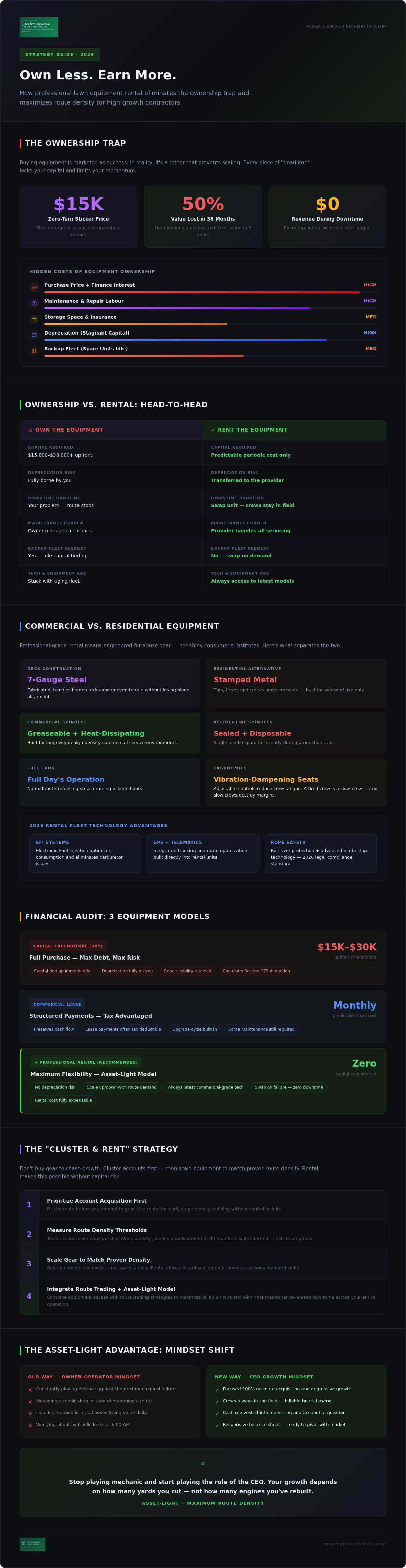
Ownership is often marketed as the ultimate sign of a successful contracting business. In reality, it's frequently a tether that prevents rapid scaling. Every piece of equipment sitting in your shop represents stagnant capital and mounting overhead. When you buy a $15,000 zero-turn mower, you aren't just paying the sticker price. You're paying for the floor space to store it, the premiums to insure it, and the relentless decay of its market value. This "dead iron" is the primary obstacle to lawn care profit margin optimization. Instead of reinvesting cash into route acquisition or aggressive marketing, your liquidity is trapped in a metal box that loses value every time the sun rises. The psychological burden is just as heavy. When you own the fleet, you're constantly playing defense against the next mechanical failure. A strategist shouldn't be worried about a hydraulic leak at 6:00 AM.
Depreciation and the Vanishing Asset
Commercial mowers are high-wear assets. They lose a staggering percentage of their value the moment they leave the dealer lot. Over a typical 36 month window, a hard-working unit can lose half its original purchase price. The resale market for used commercial gear is a losing game for the seller. Buyers look for reasons to lowball your price based on hour-meter readings and deck wear. By shifting to a professional lawn equipment rental model, you move that depreciation risk entirely to the provider. Your balance sheet remains lean. You pay for the utility of the machine during its peak performance years, not the burden of its inevitable decline. This keeps your business responsive and ready to pivot when market conditions change.
Maintenance as a Growth Bottleneck
Every hour your crew spends on mechanical repairs is an hour of zero revenue. If you're the one turning the wrench, the cost is even higher. Your time is worth more than a mechanic's hourly rate. Managing a repair schedule is a massive distraction from managing a route. Ownership forces you into a "spare mower" strategy. You keep extra units just to hedge against downtime. That's more capital gathering dust in the trailer. Utilizing professional lawn equipment rental eliminates the need for a backup fleet. If a unit fails, you swap it for a functional one. You keep the crews in the field. You keep the billable hours flowing. Stop playing mechanic and start playing the role of the CEO. Your growth depends on how many yards you cut, not how many engines you've rebuilt.
Decoding Professional-Grade Rental: Performance Standards for Commercial Crews
Don't confuse a shiny coat of paint with commercial capability. Professional-grade equipment is engineered for 40+ hours of weekly abuse. Consumer-grade substitutes are built for weekend hobbyists. When you engage in professional lawn equipment rental, you're paying for structural resilience. For high-density routes, zero-turn maneuverability is non-negotiable. If your machine can't pivot on a dime, your crew is wasting minutes on every property. Those minutes aggregate into lost accounts. Reliability starts with Tier 1 engines. You need powerplants that start every time, regardless of heat or humidity. In 2026, safety compliance is also a legal necessity. Roll-over protection systems (ROPS) and advanced blade-stop technology protect your most valuable asset: your people.
Commercial vs. Residential Equipment
Residential mowers use thin, stamped metal decks that flex and crack under pressure. Commercial units feature fabricated 7-gauge steel. They handle hidden rocks and uneven terrain without losing blade alignment. Spindle durability is another silent killer of productivity. Professional spindles are greaseable and heat-dissipating; residential ones are sealed and disposable. Consider fuel logistics. A commercial tank holds enough for a full day's operation. Stopping for fuel mid-route is a logistical failure that drains billable hours. Finally, don't ignore ergonomics. Vibration-dampening seats and adjustable controls reduce crew fatigue. A tired crew is a slow crew. Slow crews destroy your margins.
The Technology Edge in 2026 Rentals
Modern rental fleets offer a massive technological advantage. You get access to Electronic Fuel Injection (EFI) systems that optimize fuel consumption and eliminate carburetor headaches. Integrated GPS and telematics are now standard. These tools allow you to track fleet location and monitor engine hours in real-time. This data is critical for refining your route density and ensuring your gear is actually working. By choosing professional lawn equipment rental, you bypass the steep cost of tech adoption. You run the latest, most efficient hardware without the long-term debt of a purchase. This allows you to access high-performance gear while keeping your capital liquid for route growth.
Accessing the right hardware is only half the battle. You must ensure that the gear you deploy matches the specific demands of the accounts you've secured. If you're running a 72-inch deck on a route full of gated backyards, you've already lost the efficiency game. Professional rental allows you to match the mower to the mission. It gives you the flexibility to swap units as your route profile evolves. This is how you maintain a lean, responsive operation that can outmaneuver larger, asset-heavy competitors.
Financial Audit: Comparing Rental, Leasing, and Capital Expenditure
Cash is the oxygen of your business. When you dump $60,000 into a fleet of mowers, you're holding your breath. Capital expenditure (CAPEX) locks your wealth into depreciating metal. While some contractors chase Section 179 deductions to slash their tax bill, they often ignore the impact on liquidity. A tax break is useless if you can't meet payroll during a dry spell. Transitioning to professional lawn equipment rental shifts your gear from a debt-heavy asset to a nimble operating expense (OPEX). This keeps your credit lines open and your cash ready for marketing or route acquisition. If a drought hits or a major contract falls through, you simply return the units. You can't "return" a bank loan.
Comparing commercial lawn mower lease options to short-term rental reveals a clear tactical divide. Leasing often requires a multi-year commitment. It's better than buying, but it still carries the weight of a long-term liability. Rental offers pure agility. You pay for the machine only when it's producing revenue. This allows you to match your expenses directly to your seasonal income. It's a clinical approach to profit. You stop playing bank and start playing the role of a strategist.
The Asset-Light Scaling Model
Scaling a crew from two to ten shouldn't require a massive loan application. With an asset-light model, you use professional lawn equipment rental to test new service areas without the risk of ownership. If the new zip code doesn't produce the density you need, you pull back without being stuck with "dead iron" in the shop. This flexibility allows you to be aggressive. You can bid on larger commercial contracts knowing you can acquire the necessary gear in 24 hours. When the job is done or the route is consolidated, the equipment goes back. Your overhead shrinks instantly. That's how you maintain a lean, high-margin operation.
Calculating Your Real Hourly Cost
Most contractors lie to themselves about their costs. They look at the monthly payment and stop there. They forget the hidden drains: the $800 set of spindles, the $200 in hydraulic oil, the constant belt replacements, and the insurance premiums. When you own, these costs are erratic and unpredictable. Rental simplifies the math. You get an "all-in" rate that covers the machine's utility. Total Cost of Operation (TCO) is the sum of acquisition, maintenance, insurance, and downtime divided by the actual billable hours the machine generates. When you run the numbers honestly, the rental model often wins on pure efficiency. You get predictable margins and zero mechanical surprises.
Tactical Deployment: Using Rental to Optimize Route Density
Density is the only metric that matters. If your crews are driving thirty minutes between stops, your business is a transport company, not a landscaping firm. High lawn care route density dictates exactly what gear you need on the trailer. The "Cluster and Rent" strategy flips the traditional model on its head. Instead of buying a mower and hunting for work, you use a lawn account trading platform to acquire a tight cluster of accounts first. Once the density is secured, you utilize professional lawn equipment rental to deploy the specific machine required for that neighborhood. This ensures your capital is never ahead of your revenue.
Coordinating equipment drops with route trading is the hallmark of a sophisticated operation. Why own a specialized wide-area mower for one large commercial contract when you can rent it for the duration of the service agreement? This tactical flexibility allows you to bid on diverse jobs, such as those requiring specialized mowing gear or a roll-off container from Book Your Dumpster USA for site cleanup, without the fear of under-utilizing expensive hardware. You scale your gear to the route, not the other way around. It's about surgical precision in your field operations. You stop guessing and start executing with data-driven confidence.
Strategic Route Clustering
Efficiency dies in the driveway. To maximize profit, you must match mower width to the specific lot sizes of your clusters. Renting a 36-inch stand-on for gated residential routes and a 72-inch zero-turn for industrial parks keeps your crews moving at peak speed. You can also leverage a lawn mowing service provider locator to identify sub-contracting opportunities in areas where you already have equipment on the ground. This creates a feedback loop of growth. More density justifies more rental units; more rental units allow for even tighter routing. It is a lean cycle of continuous optimization.
Managing Peak Season Demand
The "May Rush" breaks most contractors. They buy extra equipment to handle the spring growth spurt, only to watch those machines sit idle during the summer dormancy. This is a massive drain on profitability. Professional lawn equipment rental allows you to scale your fleet up for the peak and scale back the moment the grass slows down. You protect your margins by only paying for capacity when the demand exists. This eliminates the "winter storage" drain. You don't pay to house, insure, or maintain gear that isn't cutting. If you're ready to stop the waste, explore our rental options and start scaling your route today.
Scaling with Mowing Route Density: The Asset-Light Advantage
Traditional scaling is a trap. Most contractors think growth requires more trucks, more mechanics, and more bank loans. This is a linear way of thinking that leads to a debt-heavy operation. Mowing Route Density offers a different path. It bridges the critical gap between hardware access and account growth. By utilizing professional lawn equipment rental, you keep your operation lean and your capital liquid. You don't need a massive warehouse to house a fleet that sits idle half the year. You need a platform that connects you to high-performance tools exactly when your route demands them.
The Integrated Contractor Marketplace
Efficiency is found in the overlap of logistics and labor. Our platform allows you to trade low-density, high-travel accounts for clusters that make sense for your crew. This isn't just about moving dots on a map. It's about reducing fuel consumption and increasing billable minutes. While you optimize your routes, you can also find lawn care subcontractors to handle overflow without increasing your permanent payroll liability. The integrated locator tool then connects your optimized fleet with paying clients in your target clusters. You're not just cutting grass. You're orchestrating a profitable system that runs on logic, not sweat.
This lean approach also secures your future. A buyer doesn't want to purchase a graveyard of aging zero-turns and a mountain of equipment debt. They want to buy a high-margin, predictable cash flow with minimal overhead. A clean, asset-light balance sheet is the foundation of a successful lawn care business exit strategy. By prioritizing operational expenses over capital expenditures, you make your business more attractive to serious investors. You become liquid. You become scalable. You become an exit-ready enterprise that isn't tethered to a physical shop.
Taking the Next Step
Start by auditing your current fleet. Identify the "dead iron" that hasn't left the shop in two weeks. That's wasted capital that could be working for you elsewhere. Sell the junk and sign up for the Mowing Route Density marketplace. Use professional lawn equipment rental to back your next expansion instead of a high-interest loan. Execute your first equipment-backed route expansion in a new territory and watch your margins grow. It's time to stop buying problems and start renting solutions. Your bottom line will thank you for the discipline. The tools are ready. The routes are waiting. The only thing missing is your strategic move.
Pivot Toward a Leaner, More Profitable Future
Stop letting "dead iron" dictate your growth. Ownership isn't a badge of honor; it's a drain on your liquidity and a distraction from route density. You've seen the math. By shifting to professional lawn equipment rental, you move maintenance risks to the provider and keep your cash ready for acquisition. It's time to treat your fleet as a tool for surgical execution rather than a mounting debt obligation. You can't scale a business while you're stuck in the shop.
Accessing specialized commercial gear through a national contractor network ensures your crews stay in the field. Eliminate maintenance downtime and focus on the clusters that drive real profit. Optimize your fleet and scale your routes with Mowing Route Density today. Stop managing mowers. Start managing your empire. The road to a high-value exit begins with an asset-light mindset. You have the framework. Now, go execute.
Frequently Asked Questions
Is professional lawn equipment rental more expensive than buying in the long run?
Rental is often cheaper when you audit the Total Cost of Operation (TCO). While the daily rate seems higher, you're avoiding the 50% depreciation hit over three years. Ownership also traps your capital in "dead iron" that requires storage and insurance. Using professional lawn equipment rental turns a massive capital liability into a nimble operating expense that only exists when your crew is actually billing. Stop looking at the monthly payment and start looking at the total drain on your liquidity.
What happens if a rental mower breaks down in the middle of a route?
You swap the unit for a functional one immediately. Most commercial rental agreements prioritize uptime because they understand that a downed machine is a revenue killer. Instead of waiting two weeks for a local shop to find a part, you get your crew back on the route in hours. This reliability is the primary reason high-growth contractors move away from aging owned fleets. You don't pay for repairs; you pay for a machine that works.
Can I rent specialized equipment like stand-on mowers for specific contracts?
Yes, specialized gear is a core benefit of the rental model. You shouldn't use a 72-inch deck for a route full of gated backyards. Rental allows you to secure the contract first, then acquire the specific stand-on or walk-behind unit required for that job. This flexibility ensures you aren't trying to force a "one size fits all" equipment strategy onto diverse accounts. It's about matching the tool to the mission every single time.
How does renting equipment help improve my lawn care route density?
It allows you to execute the "Cluster and Rent" strategy. By utilizing professional lawn equipment rental, you can deploy hardware specifically within a high-density zone without the logistics of hauling it from a central warehouse. You match your equipment capacity to your account volume in real-time. This keeps your travel time low and your profit margins high. You scale your gear only when the route density justifies the additional unit.
Do rental companies provide maintenance for long-term commercial rentals?
Maintenance is almost always the provider's responsibility. They handle the oil changes, belt replacements, and blade sharpening that usually distract you from managing your routes. This removes the need for an in-house mechanic or a "spare mower" strategy. You pay for a machine that works, and the provider ensures it stays that way through regular service intervals. It's a clean hand-off that lets you focus on growth rather than grease fittings.
Is insurance included in professional landscaping equipment rentals?
Coverage options depend on the provider, but damage waivers are standard. These protect you from the financial hit of major mechanical failures or accidental damage during operation. You should always verify if theft or general liability is covered in your specific agreement. Don't assume your current business policy covers rented assets. Check the contract to ensure your operation is protected against field mishaps before the crew hits the site.
Can I use rented equipment to scale my business for a national contract?
Rental is the fastest way to fulfill large-scale service agreements. National contracts often require a sudden surge in equipment capacity that would bankrupt a contractor relying on bank loans. By renting, you can scale from one crew to ten in a single week. Once the contract ends or the season slows down, you return the units and eliminate the overhead. This agility allows you to bid on contracts that your asset-heavy competitors can't touch.
What are the tax benefits of renting vs. owning commercial mowers in 2026?
Rental expenses are 100% deductible as an operating cost in the year they occur. Ownership requires you to navigate complex depreciation schedules or gamble on Section 179 limits. In 2026, keeping your balance sheet lean is a tactical advantage for any scaling business. Rental simplifies your tax preparation and keeps your cash liquid for route acquisition. You're trading a long-term debt liability for a clean, deductible business expense that drives revenue.


