
Why are you paying $18,000 for a depreciating asset that loses value the moment it hits the turf? Ownership isn't a badge of honor. Often, it's a financial anchor. You need Tier-1 equipment to stay competitive. However, tying up six figures in a fleet leaves you with zero liquidity to acquire new routes. Stop thinking like a mechanic. Start thinking like a strategist.
You already know that maintenance on an aging fleet is a silent profit killer. We agree that downtime destroys route density. This guide shows you how to leverage specific commercial lawn mower lease options to scale your business without the weight of ownership. You'll learn how to keep your crews on the latest high-efficiency tech while utilizing 2026 tax advantages like the Section 179 deduction. We will break down the shift toward asset-light growth and explain how predictable monthly overhead lets you focus on expansion instead of repair bills.
Key Takeaways
- Stop treating equipment as an investment. Leasing converts massive upfront costs into predictable overhead, preserving the liquidity you need to acquire new routes.
- Evaluate your commercial lawn mower lease options based on your exit strategy. Use Fair Market Value (FMV) leases for rapid fleet rotation or $1 Buyout structures for tax-advantaged ownership.
- Match your machinery to your map. High-capacity leased mowers are financial drains on low-density routes; align your equipment choices with your actual billable hours.
- Adopt a hybrid "Lease-Rent-Trade" model. Optimize your bottom line by offloading accounts that don't fit your fleet's capabilities and using rentals for specialized, short-term needs.
- Eliminate the hidden cost of downtime. Leasing ensures your crews are always running the latest high-efficiency tech, shifting the burden of obsolescence and major repairs back to the dealer.
What is a Commercial Lawn Mower Lease? Defining the Asset-Light Strategy
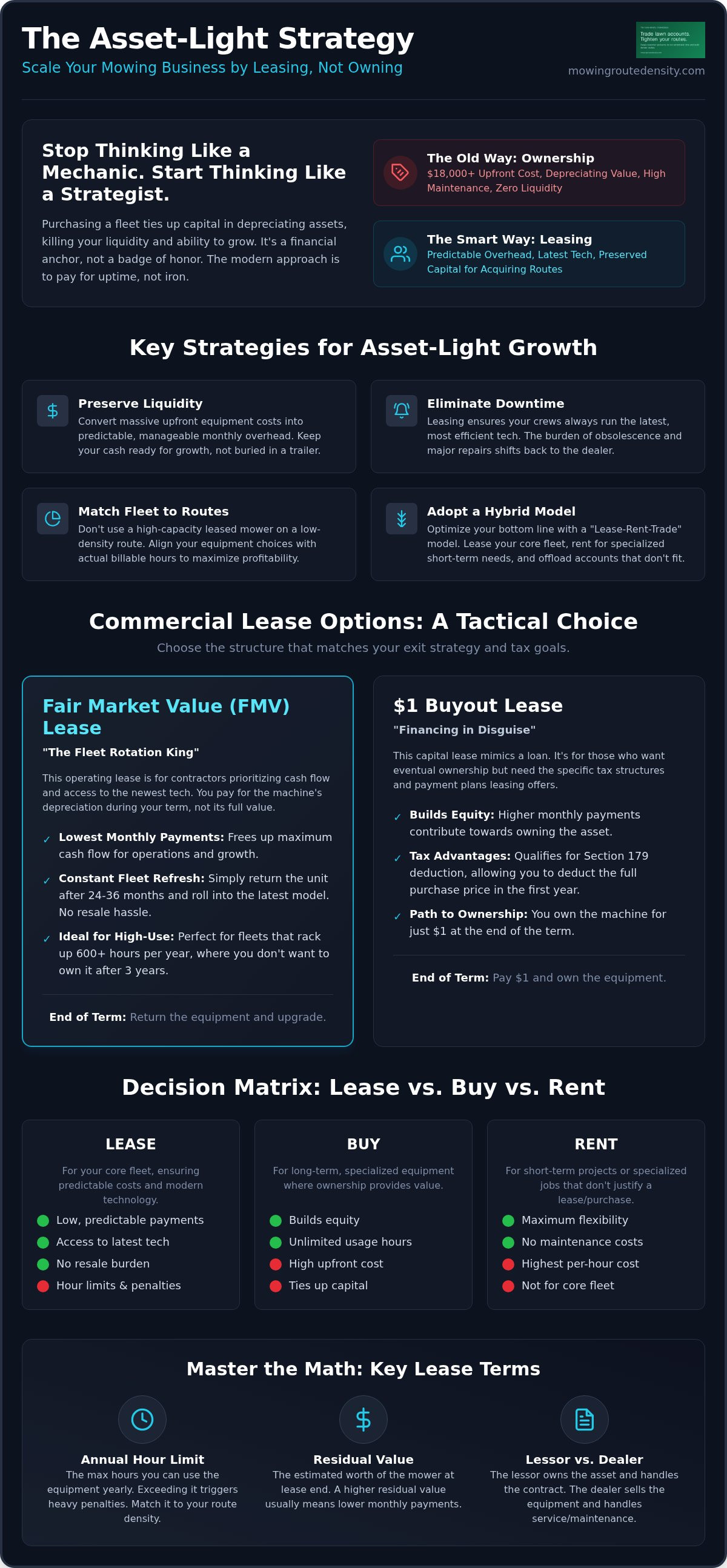
A commercial mower lease isn't a retail financing plan. It's a strategic move. What is a Commercial Lawn Mower Lease? At its core, it is a contractual agreement that grants you professional use of high-tier equipment for a fixed term and a predictable monthly fee. Unlike consumer financing, these contracts are built for the rigors of the service industry. They focus on hour limits and specific business tax treatments that protect your cash flow. A commercial lease is a tactical exchange of equity for operational liquidity. You stop trying to own iron and start paying for uptime.
In 2026, the industry is shifting. Smart contractors are moving away from heavy equipment ownership. Why? Because owning a $15,000 zero-turn that loses 30% of its value the moment it leaves the lot is a poor trade. It ties up your capital. It limits your "dry powder" for buying out a competitor's route. By exploring the right commercial lawn mower lease options, you pivot from managing depreciating assets to managing billable hours. You keep your capital ready for growth, not buried in a trailer.
The Shift from Ownership to Access
Ownership can stifle your ability to scale. Every dollar stuck in a machine you "own" is a dollar you can't use to acquire new accounts or hire talent. Technological obsolescence is also accelerating. Tier-1 equipment from two years ago is already less efficient than 2026 models. If you own the machine, you're stuck with the old tech and a tanking resale value. Leasing provides access. It ensures your crews use the fastest, most fuel-efficient tools available. You maintain the flexibility to rotate your fleet before maintenance costs spike and resale values crater.
Key Terminology: Hours, Terms, and Residuals
You need to master the math before signing. Commercial agreements live or die by the annual hour limit. When comparing commercial lawn mower lease options, you'll see tiers like 400, 600, or 1,200 hours. Exceeding these limits triggers heavy penalties. Choose your limit based on your actual route density. You also need to understand the residual value. This is the estimated worth of the mower at the end of the lease. A higher residual value usually leads to lower monthly payments. Finally, differentiate between the lessor and the dealer. The dealer handles the blades and belts; the lessor handles the paper. Knowing who controls the asset is vital for managing your contract effectively.
Commercial Mower Lease Options: FMV vs. $1 Buyout
Choosing a lease structure is a tactical decision. It’s not just about the monthly payment; it’s about how that payment impacts your balance sheet and your ability to pivot. Most contractors get stuck in the "ownership" mindset. They want to see a title at the end. That impulse can be expensive. You need to distinguish between operating leases and capital leases to keep your operation lean. FMV leases are for contractors who prioritize cash flow over equipment equity. They treat the mower as a consumable tool, not a long-term investment. On the other hand, the $1 buyout lease is essentially a loan dressed in a lease's clothing. It’s a tool for those who eventually want the asset but need the specific tax structures leasing provides. Understanding the nuances of Commercial Mower Lease Options: FMV vs. $1 Buyout helps you avoid tying up credit lines meant for business expansion.
Fair Market Value (FMV) Leases: The Fleet Rotation King
The FMV lease is the ultimate tool for high-density route management. It typically offers the lowest monthly payments because you aren't paying for the full value of the machine. You're paying for the depreciation that occurs during your term. This is an operating lease. It’s built for high-use fleets that rack up hours quickly. If you're putting 600 or more hours a year on a zero-turn, you don't want to own it in three years. You want to walk away. At the end of a 24 or 36-month term, you simply return the unit. No trade-in headaches. No selling on the used market. You just roll into the latest high-efficiency tech. If you need even more flexibility for short-term growth, you can rent mowers through our platform to bridge the gap between lease cycles.
The $1 Buyout Lease: Financing in Disguise
A $1 buyout lease is a capital lease. It mimics traditional financing. You pay a higher monthly premium, but at the end of the term, you own the machine for a single dollar. Why do this instead of a bank loan? Tax treatment. Under Section 179, you can often deduct the full purchase price in the first year, even if you’re leasing. This structure is ideal for secondary equipment. If you have a backup mower that only sees 200 hours a year, it will still have plenty of life left after the lease ends. Ownership makes sense here. However, when you compare the total cost of ownership (TCO), these often cost more than FMV leases due to the higher interest baked into the payments. Don't buy the iron unless the hours justify the equity. Explore your commercial lawn mower lease options carefully to ensure you aren't overpaying for assets that don't generate enough billable hours.
Lease vs. Buy vs. Rent: A Strategic Decision Matrix
Stop guessing. Equipment acquisition is a math problem, not a status symbol. You need a framework to decide which path fuels your growth without draining your reserves. Buying makes sense only for high-capital businesses with stable, long-term routes and in-house mechanics who can keep old iron running profitably. However, for most, ownership is a trap. Rapidly scaling businesses choose commercial lawn mower lease options because they provide predictable overhead and the latest tech. When you face seasonal spikes or want to test a new territory, use professional lawn equipment rental. This gives you short-term flexibility without the long-term commitment of a contract.
The Cash Flow Test
Analyze your debt-to-income ratio before you sign. A massive equipment loan is a heavy liability that can freeze your credit. If your goal is to buy lawn care routes, you need a clean balance sheet. Outright purchasing a $50,000 fleet carries a high opportunity cost. That capital could have been used to acquire high-density accounts that generate immediate cash flow. This is the essence of Defining the Asset-Light Strategy. You trade equipment equity for operational liquidity. It's about staying nimble enough to pounce on a competitor's exit.
Maintenance and Warranty Coverage
Uptime is the only metric that dictates your success. Every hour a mower sits in a repair bay is an hour of lost billable revenue. Leased equipment stays under warranty, providing "budget certainty." You eliminate the risk of a $2,500 hydraulic pump failure ruining your monthly margins. Comparing your commercial lawn mower lease options reveals that the newest units offer the best warranty protection. Compare your internal shop costs; parts, labor, and storage; against the premium paid for a lease. Most contractors find that leasing leads to better lawn care profit margin optimization. You pay for the cutting time, not the repair time. It’s a pragmatic choice for those who value results over title papers.
Tactical Asset Management: Matching Equipment to Route Density
Signing a contract is only half the battle. If you don't align your equipment with your map, you're bleeding profit. Your choice of commercial lawn mower lease options must be dictated by your service area. For example, a 72-inch zero-turn is a high-capacity beast. Deploying it on a low-density residential route is a financial disaster. You're paying for a wide deck that can't fit through gates and a high-speed engine that spends its life idling in traffic. Every minute that mower isn't cutting grass, you're losing money. Drive time is "unbillable hour waste" that eats into your lease hour limits. You must treat every hour on that meter as a finite resource.
Maximizing Billable Hours per Leased Asset
Asset clustering is the only way to protect your margins. You should deploy your leased fleet only in high-margin zones where lawn care route density is maximized. This strategy ensures that every hour on the clock is a revenue-generating hour. Consider these tactics to protect your leased assets:
- Prioritize accounts within a 5-mile radius to minimize travel time.
- Use smaller, owned equipment for tight residential gates.
- Reserve leased high-capacity mowers for wide-open commercial properties.
"Dead miles" are the enemy of an asset-light strategy. They waste the limited life of your leased equipment without adding a cent to your bottom line. If you have accounts that are outliers, don't waste your high-value leased equipment on them. Instead, use the lawn mowing service provider locator to find local contractors who can handle those low-density stops. This keeps your primary fleet focused on the high-density clusters where they perform best.
The "Hour Forgiveness" Trap
Stop relying on "hour forgiveness" or excess hour waivers as a safety net. Relying on these credits is a clear sign of poor route planning. You should be auditing your fleet usage monthly. If you are consistently hitting overages, your routing is inefficient. You are paying a premium for hours that aren't producing maximum billable work. There is a tactical advantage to swapping routes between crews to align with fleet capacity. If one crew is nearing their limit, move them to a higher-density, lower-travel route. This isn't just about avoiding fees. It's about optimizing the commercial lawn mower lease options you've already paid for. To truly master this, you need to trade your low-density accounts for high-margin routes that fit your fleet's capabilities.
Scaling with Mowing Route Density: The Asset-Light Conclusion
Iron doesn't make you money. Efficiency does. In 2026, the most successful contractors focus on route density first and iron second. They understand that a mower is a depreciating tool, not a trophy. By utilizing a hybrid "Lease-Rent-Trade" model, you maintain a lean, high-margin operation that can pivot as the market shifts. You use commercial lawn mower lease options to secure your primary fleet with predictable monthly costs. You use rentals to handle seasonal surges or specialized projects. Finally, you use our marketplace to offload accounts that don't fit your leased equipment’s capabilities. This isn't just about cutting grass. It's about tactical scaling. If a route requires two hours of drive time for thirty minutes of cutting, it’s a cancer on your profit margin. Cut it out. Sell it to someone already in that neighborhood.
Liquidity for the Long Game
An asset-light balance sheet is your best friend during a lawn care business exit strategy. Prospective buyers aren't looking for a yard full of old mowers with high maintenance costs. They want dense, profitable routes that require minimal overhead to service. When you lease, you keep your capital liquid. You avoid the "dead equity" trap of ownership. This makes your business more attractive to investors and competitors alike. They see a streamlined machine ready for acquisition, not a logistical nightmare of aging assets. Your debt-to-income ratio stays healthy. Your credit lines remain open for strategic acquisitions. Focus on the route. Rent the rest.
Getting Started with Mowing Route Density
Success requires the right network. Use our platform to find professional equipment for short-term tactical needs without the burden of a long-term contract. Whether you need a specialized unit for a new commercial contract or a backup during a peak week, we provide the flexibility you need. Connect with our contractor network to optimize your national footprint. Use our trading platform to swap low-margin outliers for high-density clusters. Stop letting equipment dictate your growth. Take control of your margins. Don't let your fleet become your ceiling. It is time to trade equity for execution. Optimize your route density and scale your business today.
Stop Owning Depreciation and Start Scaling Density
Ownership is a liability in a fast-moving market. Every dollar you sink into a mower deck is a dollar you can't spend on route acquisition. You've seen how the right commercial lawn mower lease options provide the liquidity needed to outpace competitors. Focus on billable hours. Let the dealers worry about obsolescence and major repairs. By matching your equipment to high-margin zones, you ensure that every hour on the clock generates maximum revenue. This isn't just about cutting grass; it's about tactical logistics.
Our B2B focused marketplace and national network provide the specialized tools you need to stay lean. We offer a platform for route trading and equipment rental that keeps your operation agile. Stop letting aging iron dictate your growth potential. It is time to pivot toward an asset-light future where you prioritize route density over equipment equity. Maximize your profit margins by optimizing your route density today. Your business deserves a strategist, not just a mechanic. Build a fleet that serves your map, not a yard that drains your cash.
Frequently Asked Questions
Is it better to lease or buy a commercial lawn mower in 2026?
Leasing is the superior choice for contractors prioritizing liquidity and rapid scaling. While promotional rates like 0% for 48 months exist for purchases, buying ties up your capital in a depreciating asset. Leasing allows you to rotate your fleet every 24 to 36 months. This ensures your crews always operate high-efficiency tech without the burden of long-term equipment debt.
What happens if I exceed the hour limit on my commercial mower lease?
You will pay per-hour penalties defined in your original contract. These fees are often steep and can quickly erase the profit margins of a route. Monitor your meters monthly to avoid surprises. If you are consistently hitting overages, it is a clear sign that your route planning is inefficient or your density is too low for your fleet size.
Can I trade in a leased mower for a newer model before the term ends?
Early trades are possible but usually require a lease buyout or early termination fee. Some dealers offer lease loyalty programs that waive certain fees if you upgrade within the same brand. Always calculate the remaining liability on your current contract before swapping. It is a tactical move to ensure you aren't stuck with obsolete tech as 2027 models arrive.
Are commercial lawn mower lease payments tax-deductible for my business?
Yes, operating lease payments are generally treated as a fully deductible rental expense. This reduces your taxable income directly. For capital leases, the 2026 IRS Section 179 deduction allows you to write off up to $1,220,000 of qualifying equipment purchases. Consult your tax professional to determine which structure offers the best bottom-line advantage for your specific situation.
How does route density affect my decision to lease equipment?
Density dictates your return on investment for every hour on the engine clock. High-density routes ensure that every leased hour is spent cutting grass rather than driving between stops. Evaluating commercial lawn mower lease options requires a deep understanding of your service map. If your drive time is high, you are essentially paying lease penalties for "dead miles" that generate zero revenue.
What is the difference between an FMV lease and a $1 buyout lease?
An FMV lease is a true rental where you return the unit at the end of the term. It offers the lowest monthly overhead and is ideal for high-use equipment. A $1 buyout lease is a capital lease where you own the machine for one dollar after the final payment. Choose FMV for fleet rotation and $1 buyout for secondary, low-hour backup units.
Do I need a high credit score to qualify for a commercial mower lease?
You generally need a minimum FICO score between 600 and 650 to qualify for standard commercial terms. Scores above 700 unlock the best rates, zero-down options, and higher financing limits up to $75,000. Lenders also evaluate your business's time in operation and cash flow consistency. If your credit is lower, expect to provide a larger down payment to offset the risk.
What are the typical maintenance requirements for a leased commercial mower?
You must adhere strictly to the manufacturer’s service schedule to avoid excessive wear charges at the end of the term. This includes documented oil changes, belt inspections, and blade sharpening. While commercial lawn mower lease options keep you under warranty for major failures, daily upkeep remains your responsibility. Documenting your maintenance prevents disputes when you return the unit to the dealer.


