

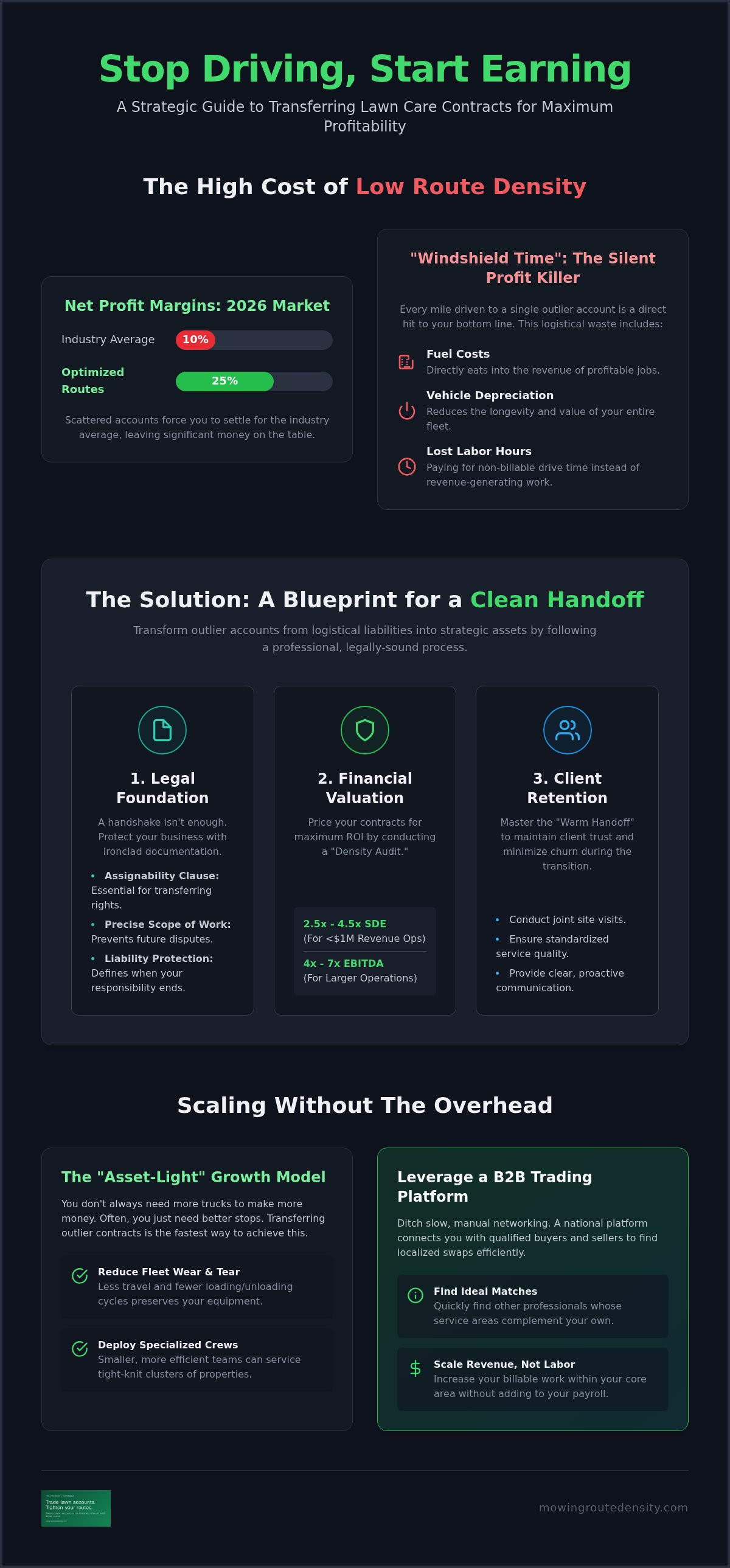
Every mile your crew spends behind a windshield is a silent profit killer. If you're driving twenty minutes to service a single "legacy" account, you aren't just losing fuel; you're burning your most valuable asset: time. In a 2026 market where optimized routes boast net margins of 25 percent, settling for the industry average of 10 percent is a choice to leave money on the table. You know the frustration of chasing thin margins across three different zip codes. It's exhausting. It's unnecessary. Strategic growth often means transferring lawn care contracts that no longer fit your footprint to someone who can service them profitably.
Success in this industry requires a ruthless focus on route density. You can prune the logistical rot from your schedule and concentrate your resources where they actually generate cash. This guide provides the blueprint for executing a clean, legal handoff that protects your reputation while tightening your operations. We'll break down the valuation of your accounts, the current legal landscape of non-compete agreements, and the exact steps to trade your outliers for high-density clusters. It's time to stop driving and start earning.
Key Takeaways
- Stop bleeding cash on travel time by identifying accounts that don't fit your core service area. Learn why transferring lawn care contracts is a strategic asset move rather than just a sale.
- Protect your business by ensuring every service agreement includes an assignability clause. Discover the essential documentation required for a professional, legally sound B2B account transfer.
- Learn how to conduct a "Density Audit" to price your contracts for maximum ROI. Audit revenue stability and payment history to ensure you get top dollar for your outlying accounts.
- Master the "warm handoff" strategy to maintain client trust and minimize churn during the transition. Use joint site visits and standardized service quality to prevent new provider shock.
- Ditch slow manual networking and leverage a national B2B trading platform to find localized swaps. Scale your operations without adding equipment overhead or increasing your labor burden.
Beyond the Handshake: Why Transferring Contracts is a Strategic Asset Play
Transferring lawn care contracts isn't just a business exit strategy. It's a logistical scalpel. In professional terms, this process relies on the legal principle of assignment. You are legally shifting the rights and obligations of a service agreement to a third party. If your route looks like a spiderweb across the county, you aren't running a business; you're running a delivery service that doesn't charge for shipping. A scattered client list isn't an asset. It's a logistical liability that drags down your average hourly rate. By utilizing the strategic clustering of accounts, you increase the marginal utility of every gallon of fuel and every hour of labor.
The High Cost of Logistical Waste
Windshield time is the silent profit killer of the 2026 landscaping market. Every minute your crew spends sitting in traffic is a minute you're paying for labor without generating a dime of revenue. When you calculate the true cost of an outlier, you must include fuel, vehicle depreciation, and the labor hours lost. One client located fifteen miles from your core cluster can effectively erase the profit margins of three dense accounts. You're trading high-value billable hours for low-value travel hours. In the context of 2026 labor management, route density is the ratio of billable stops to total miles driven that determines your operational overhead.
Transferring as a Tool for Fleet Scalability
Trading accounts allows you to deploy smaller, more specialized crews. When your stops are grouped within a tight radius, your equipment stays on the ground longer. This directly reduces mechanical wear and tear on your commercial mowers. Less loading and unloading means fewer broken ramps and less strain on your trailers. It preserves the longevity of your fleet. Optimizing through lawn care route density allows for an "asset-light" growth model. You don't always need more trucks to make more money. Often, you just need better stops. Transferring lawn care contracts that sit outside your primary service area is the fastest way to tighten your operations and reclaim your bottom line.
The Logistics of a Clean Break: Legal and Financial Mechanics
Handshakes don't hold up in a valuation audit. If you're treating the process of transferring lawn care contracts as an informal favor, you're inviting a legal nightmare. Professionalism in 2026 requires a paper trail that protects both the buyer and the seller. The foundation of this transaction is the "Assignability Clause." If your current service agreements don't explicitly allow you to assign the contract to a third party, your client list isn't an asset; it's a collection of month-to-month permissions that can vanish the moment you try to move them. You must ensure your contracts are transferable by default to maintain their market value.
Essential Clauses for Transferable Contracts
Your contracts should include language that allows for assignment without requiring prior written consent from the client for every individual transfer. This prevents a single difficult customer from blocking a strategic route optimization. Be precise about the scope of work. If the new provider doesn't know exactly where the property line ends or which hedges are included, "scope creep" will eat their margins and sour the relationship. Finally, ensure liability protections remain in place. You don't want to be held responsible for an insurance claim that occurs after the "Notice of Assignment" has been served and the new provider has taken over the site.
Financial Valuation of a Client List
In the 2026 market, valuation multiples are driven by the quality of recurring revenue. For owner-operated businesses with under $1M in revenue, expect a multiple between 2.5x and 4.5x Seller's Discretionary Earnings (SDE). Larger operations typically see 4x to 7x EBITDA. However, these numbers are not fixed. Route density adds a significant premium to the contract price because it reduces the buyer's overhead from day one. While gross revenue is the total dollar amount on the invoice, "dense profit" is the actual take-home pay after subtracting the specific travel costs and non-billable hours associated with that stop. High-density clusters always command the highest multiples.
Settling the transaction can take several forms. Cash buyouts provide immediate liquidity, but account swaps are often more tax-efficient for contractors looking to tighten their footprint. If you're looking to offload outlying stops while gaining ground in your core territory, you can list your accounts on a B2B marketplace to find a partner interested in a strategic trade. This approach turns your logistical waste into a growth engine without the need for a massive capital injection.
Valuation and Density Audits: Pricing the Transfer for ROI
Valuation is not a guessing game. If you're pricing your portfolio based on a flat multiple of monthly revenue, you're likely leaving money on the table or scaring away qualified buyers. You must conduct a "Density Audit" before ever listing your accounts. This audit measures the specific profitability of a cluster by calculating the travel time between stops. High-density routes are more valuable because they minimize non-billable labor. When transferring lawn care contracts, you are selling more than just a list of names; you are selling a pre-optimized logistical machine.
Analyze revenue stability and payment history with clinical precision. A contract is only worth its weight in actual cash flow. If a client has a history of late payments or constant re-negotiations, they are a liability that lowers the transfer price. You also need to factor in equipment requirements. Does the property require a 72 inch zero turn or a specialized walk behind for gated access? If the new provider has to buy new gear just to service your old accounts, the deal is dead. Buying an existing route is often 30 to 50 percent cheaper than organic customer acquisition when you factor in marketing spend and the slow burn of building route density from scratch.
Analyzing the Route Density Factor
Proximity is the primary driver of value. A contract located within five miles of a buyer's existing route is worth 15 to 20 percent more than a standalone account. This is the logic behind "Asset-Light Growth." You can expand your footprint without the massive overhead of purchasing new trucks or hiring additional crew leads. By using a lawn account trading platform, you can identify partners in specific ZIP codes who are looking to swap their outliers for your dense clusters. This isn't just trading clients; it's trading miles for minutes.
Due Diligence for the Buyer
Vetting is non-negotiable. Verify the service history and specific equipment access for every account in the portfolio. Hidden "problem clients" who spike labor hours through excessive communication or unreasonable expectations will destroy the ROI of a transfer. You should cross-reference the lawn mowing service provider locator to vet potential partners before signing an agreement. Ensure the person taking over your contracts has the crew capacity and the professional reputation to maintain the account. When transferring lawn care contracts, your reputation is the collateral that ensures the client stays on the books.
The Handoff: Ensuring Client Retention During Migration
Retention is the single metric that validates your valuation. If the buyer loses 20 percent of the accounts in the first month, your deal structure might trigger a clawback or damage your professional reputation. You must execute a "Warm Handoff." This isn't just an email. It's a strategy. Perform joint site visits for your top-tier commercial accounts. Introduce the new provider in person. Vouch for their team. This physical presence bridges the trust gap that digital communication can't touch. When you are transferring lawn care contracts, the first 30 days are the danger zone. Monitor retention metrics weekly to ensure the transition sticks.
Prevent "New Provider Shock" by aligning service standards before the first mow. If the client sees a different stripe pattern or a gate left unlatched, they'll churn. You have to sell the change. Explain that transferring lawn care contracts is a move toward better local reliability. Tell them the new provider has a denser route in their neighborhood. This means more consistent service windows. It means crews that aren't exhausted from a two-hour drive. Frame the transfer as an upgrade in service, not an abandonment of the relationship.
Communication Timelines
Follow the 14-day rule. Send your notification exactly two weeks before the transition. This gives the client time to process the change without giving them enough time to go shopping for competitors. A "Welcome Letter" from the new provider should follow within 48 hours. This letter must be professional. It should outline their contact info and billing process. When a client objects because they "only want you," remind them that your brand's quality is why you hand-picked this successor.
Operational Continuity
Efficiency dies in the details. Don't let the new crew get locked out or bitten by a dog you forgot to mention. Share every gate code. Document every pet warning. Detail the property quirks, such as that one soft spot near the drainage ditch that sinks a heavy zero-turn. Transfer digital records and billing history seamlessly so the client doesn't have to re-enter credit card data. If the new provider needs to match your high-end finish, they can leverage professional lawn equipment rental to maintain operational standards during their growth phase. To find the right partner for your next handoff, browse our account marketplace.
Scaling Without the Overhead: Leveraging a Trading Platform
Manual networking is a relic. Relying on local coffee shop chats or unvetted social media groups is a strategy built on luck. You don't have time for luck. Modern fleet management requires a centralized, data-driven hub to execute swaps that move the needle on your bottom line. Transferring lawn care contracts through a dedicated B2B marketplace allows you to find partners who are as serious about operational efficiency as you are. It turns a months-long negotiation into a streamlined transaction. You can identify specific ZIP codes where you want to grow and find contractors looking to exit those same areas without the friction of cold-calling competitors.
The Advantage of a Specialized Marketplace
Social media leads are a minefield. You deal with unvetted operators who don't understand the value of recurring revenue or the logistics of a professional handoff. A specialized marketplace provides a secure environment with standardized documentation and secure payment processing. This level of professional rigor is essential for a successful lawn care business exit strategy. You aren't just selling a list; you're liquidating a verified asset. This platform ensures the buyer is qualified and the transition is legally sound, protecting your reputation and your cash flow.
Building Your 2026 Growth Strategy
Rapid scaling used to require a massive capital injection for new trucks, trailers, and specialized gear. In 2026, that's a choice, not a requirement. By combining strategic account acquisition with commercial lawn mower lease options, you can expand your footprint without bloating your balance sheet. Focus your energy on high-margin clusters. Stop chasing every lead that calls your office. Instead, use the marketplace to buy the accounts that sit right next to your existing stops. This asset-light model ensures your crews stay on the ground and your equipment longevity stays high. Transferring lawn care contracts that fall outside your primary service area is the only way to reclaim your margins. Don't let logistical waste dictate your paycheck. Explore the Mowing Route Density marketplace today and start building a denser, more profitable route.
Stop Driving and Start Scaling
Your business is only as strong as your densest route. Chasing scattered accounts across the county isn't growth; it's a slow drain on your equipment and your sanity. By strategically transferring lawn care contracts that sit outside your core territory, you reclaim the billable hours lost to windshield time. You've learned the importance of the assignability clause, the 14-day notification rule, and the power of a warm handoff. Now it's time to execute. In a 2026 market that rewards efficiency over sheer volume, those who tighten their footprint are the ones who survive the labor shortage and rising fuel costs.
Stop settling for the industry average profit margin. Use a national B2B marketplace to swap your outliers for high-density clusters. You can leverage integrated equipment rental solutions to bridge the gap during rapid expansion without bloating your balance sheet. It's time to build a leaner, more profitable operation. Optimize your route density on the national trading platform today and turn your logistical waste into liquid cash. Your crews deserve better routes, and your bottom line deserves better margins.
Frequently Asked Questions
Can I legally transfer my lawn care contracts without client permission?
Legally, you can transfer contracts without explicit permission only if your service agreement contains an assignability clause that doesn't require prior written consent. Without this specific language, you risk breaching the original agreement. Most state contract laws allow for the assignment of rights and duties unless the contract specifically prohibits it. Always verify your existing contract language before initiating a transfer to avoid legal disputes.
How much is a single lawn care account worth in a transfer?
A single account's value is determined by its recurring revenue and its contribution to route density. In 2026, smaller owner-operated businesses typically sell for 2.5x to 4.5x Seller's Discretionary Earnings (SDE). For individual account transfers, buyers often pay a multiple of the monthly billing, typically ranging from three to six months of revenue. Accounts located near a buyer's existing stops command the highest premiums.
What is an assignability clause and why do I need one?
An assignability clause is a provision in your service agreement that allows you to transfer your rights and obligations to another provider. You need this to turn your client list into a liquid asset. Without it, you cannot legally sell or trade your route without renegotiating every single agreement. It ensures your business remains scalable and attractive to potential buyers or trade partners looking for a clean transition.
How do I ensure clients don’t cancel when I sell my route?
Client retention depends on a "warm handoff" and consistent service quality. Notify clients at least 14 days before the transition and introduce the new provider personally if possible. Frame the change as a strategic upgrade that ensures more reliable scheduling and better equipment access. If the client sees no drop in quality during the first 30 days, the risk of churn drops significantly for the new owner.
Is it better to sell my client list or swap accounts for density?
Selling provides immediate liquid cash, but swapping accounts is often the superior move for long-term profitability. When you trade an outlying account for one closer to your core route, you permanently reduce your non-billable drive time. This "Asset-Light" approach increases your net margins without requiring more trucks or labor. Swapping is a tactical maneuver to tighten your footprint and eliminate the logistical waste that kills your bottom line.
What documents are required for a professional contract transfer?
A professional transfer requires a formal Asset Purchase Agreement, a signed Notice of Assignment for each client, and a complete service history. You must also provide digital records of billing cycles, property quirks, and gate codes. Providing a clear trail of payment history and equipment requirements helps the buyer conduct proper due diligence. Organized documentation prevents post-sale disputes and ensures a clean break from the specific accounts being moved.
How does transferring accounts improve my profit margins?
The process of transferring lawn care contracts directly improves margins by eliminating "windshield time." Every mile you stop driving is a mile you aren't paying for fuel, vehicle wear, and non-productive labor. By concentrating your stops in a tighter radius, your crews spend more time mowing and less time sitting in traffic. This optimization can push net profit margins from the industry average of 10 percent toward 25 percent.
Can I transfer commercial contracts differently than residential ones?
Commercial contracts involve higher stakes and more formal legal review. These agreements often have specific performance standards and longer termination notice periods than residential ones. When transferring commercial accounts, the "warm handoff" is mandatory. You must ensure the new provider meets the client's specific insurance requirements and has the heavy-duty fleet capacity to handle large-scale acreage without a lapse in service quality or reliability.


