Your truck isn't a mobile office. It's a depreciating asset that bleeds cash every second it moves without a mower hitting the turf. If your crew spends more time staring at taillights than trimming edges, your business is subsidizing the oil companies. With diesel averaging $5.21 per gallon this June, every mile of windshield time is a direct hit to your bottom line. You need a lawn care route density calculator to stop the bleeding and prove exactly where your logistics are failing.
It's frustrating to watch profitable mornings vanish into non-billable travel hours. You've likely felt the sting of equipment wear and tear from hauling heavy trailers across town for a single, isolated account. We're going to fix that. This article provides a mathematical framework to audit your current operations, eliminate logistical waste, and maximize your billable hours. You'll learn how to generate a clear density score and implement a plan to tighten your routes for maximum profit per man-hour.
Key Takeaways
- Establish your "Stop-to-Drive" ratio using a lawn care route density calculator. Aim for a 4:1 ratio to ensure your crews spend four hours working for every hour they spend driving.
- Audit your route leakage to stop the drain on your margins. Paying a two-man crew to sit in traffic is a direct hit to your profitability that builds up over time.
- Apply the 80/20 rule to your service area. You'll likely find that a small fraction of your accounts causes the vast majority of your travel time and fuel waste.
- Focus on asset clustering to scale your operations efficiently. Dense routes let you share equipment between crews and reduce the need for extra trucks and trailers.
- Trade your isolated accounts for clusters that fit your existing territory. Use a trading platform to swap your outliers for more profitable, nearby work.
The Lawn Care Route Density Formula: Calculating Your Profitability Baseline
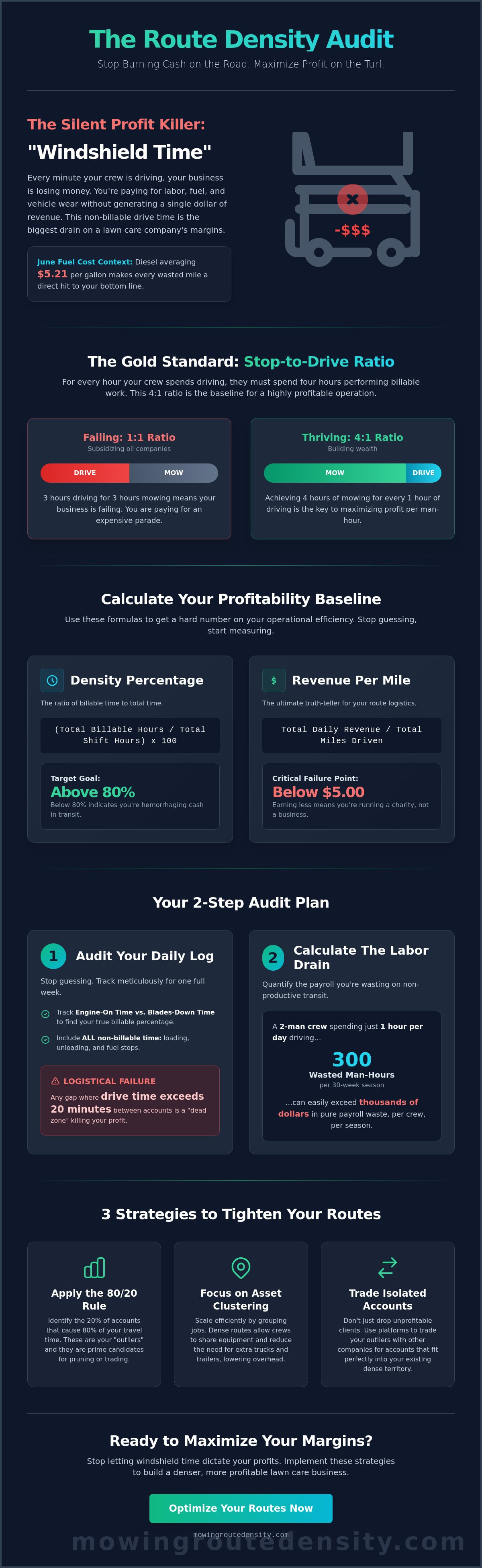
Route density isn't a vague goal for your operations manager. It's a binary metric of survival. In the service industry, density is defined as the ratio of billable service time to total transit time. If your crews spend three hours driving for every three hours of mowing, your business is failing. You are essentially paying for a very expensive, slow moving parade. Think of your internal data as a manual lawn care route density calculator that determines whether you're building wealth or just burning diesel.
The gold standard for a profitable operation is the "Stop-to-Drive" ratio. Your target is a 4:1 ratio. This means for every hour spent in the truck, your crew must spend four hours with blades down on the turf. Achieving this requires a clinical look at three variables: total daily man-hours, total drive time, and the number of stops per square mile. In the logistics world, this is a version of the Vehicle Routing Problem, a mathematical challenge that determines the most efficient way to service a set of customers. To find your baseline, use this formula: (Total Billable Hours / Total Shift Hours) x 100. This number is your Density Percentage. If it's below 80%, you're hemorrhaging cash in transit.
Step 1: Auditing Your Daily Log
Stop guessing about your crew's productivity. You need to track engine-on time versus blades-down time for one full week. Be meticulous. Your non-billable time must include loading, unloading, and fuel stops. These minutes feel small, but they compound into hours of lost revenue. Identify your "dead zones" immediately. Any gap where drive time exceeds 20 minutes between accounts is a logistical failure. These gaps are often the result of taking "one more job" that's just a little too far away. That job isn't an opportunity; it's a trap.
Step 2: Calculating Revenue Per Mile
Revenue per mile is the ultimate truth-teller for your route logistics. Divide your total daily revenue by the total miles driven by that truck. Then, compare this against your per-mile vehicle operating cost. This includes fuel, insurance, maintenance, and depreciation. Many industry professionals report that a score below $5.00 per mile indicates a critical density failure. If you're earning less than that, you aren't running a business; you're running a charity for your customers' lawns. Every mile you shave off your route is a direct injection of profit into your pocket. Use your lawn care route density calculator results to prune the outliers that are dragging your averages down.
The Cost of Windshield Time: Auditing Your Route Leakage
Windshield time is the silent killer of landscaping profit margins. It's the period where you're paying for labor, fuel, and insurance but generating zero revenue. Every 15 minutes your truck spends idling in traffic or cruising between zip codes is 15 minutes of lost billable service. You aren't just losing the wages. You're losing the opportunity to be on the next property. This is why a lawn care route density calculator is essential for any owner who actually wants to keep their money. If you can't measure the leak, you can't plug it.
Think about the physical reality of a scattered route. Your equipment is bouncing on a trailer. Your crew is checking their phones. Your fuel is burning. None of this adds value to the customer. It only adds cost to your ledger. Many owners ignore this because it's "just part of the job." It isn't. It's a logistical failure that separates profitable companies from those barely breaking even.
The Labor Drain
Do the math on your crew's transit time. If you have a two-man crew and they spend just one hour per day driving, you're paying for ten man-hours of non-productive labor every week. Over a 30-week season, that's 300 man-hours of pure payroll waste. At 2026 labor rates, this leakage can easily exceed several thousand dollars per crew, per season. Real lawn care profit margin optimization depends on cutting these non-productive hours to the bone. Route leakage is the percentage of your total payroll spent on non-billable transit. If that number is climbing, your business is subsidizing your employees' commutes between jobs instead of growing your equity.
Vehicle Depreciation and Fuel Waste
Your trucks and trailers aren't built for sightseeing. Stop-and-go traffic is brutal on commercial mower transport systems. It increases transmission wear and kills fuel efficiency. With diesel prices sitting at $5.21 per gallon this June, a scattered route is a financial death sentence. By leveraging technical route optimization services, you can visualize the exact cost of your geographical spread. High density reduces your carbon footprint and your fuel spend simultaneously. It also slashes the "wear-and-tear" tax. Fewer miles mean longer intervals between oil changes, tire replacements, and brake jobs. Scattered growth is an expensive ego trip. Density is a strategy. If your map looks like a shotgun blast, it's time to tighten your service area before the overhead swallows your remaining margin.
Using Your Density Score to Optimize Service Logistics
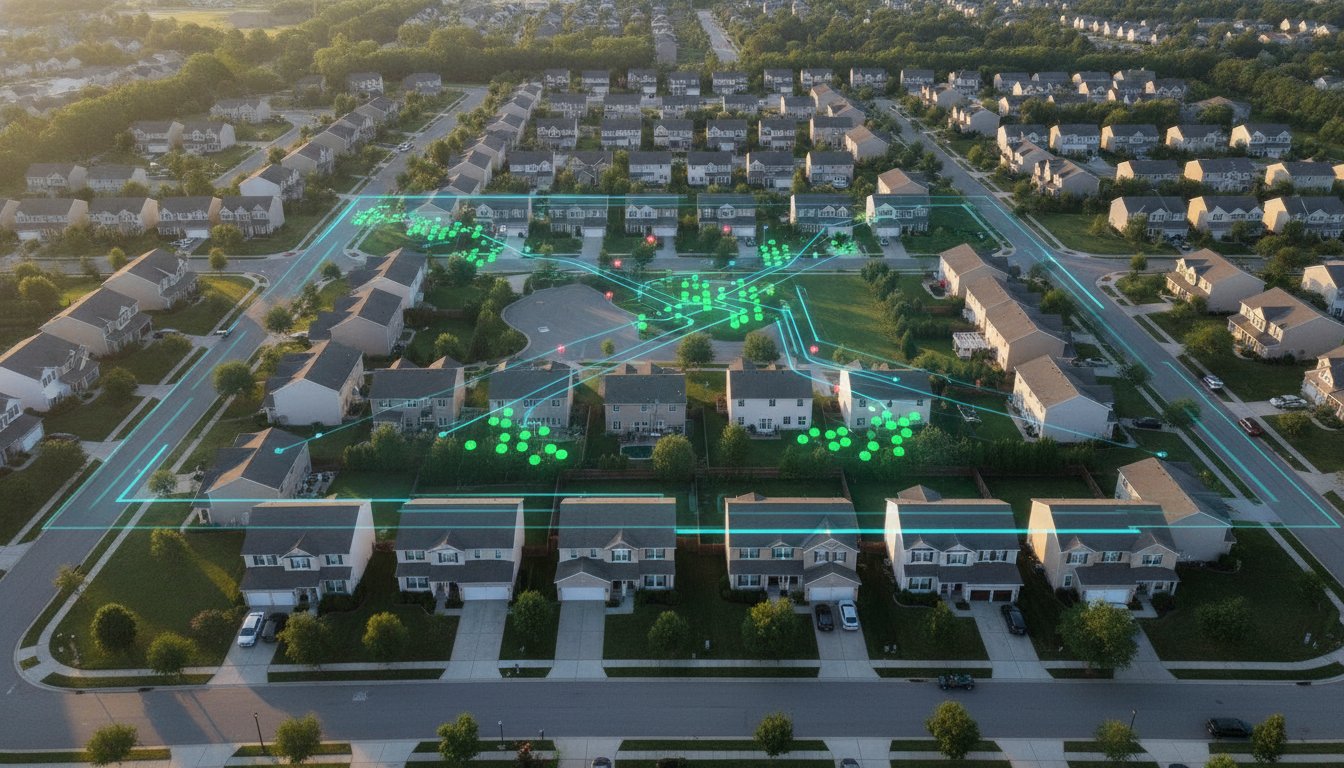
Your density score is more than a metric. It's a diagnostic scalpel. Once you've used a lawn care route density calculator to identify your baseline, you must act on the data. High revenue doesn't matter if the geography of your accounts is working against you. If your map shows a scattering of isolated dots across the city, you aren't growing. You're overextending. You must use these scores to decide which accounts to keep, which to upcharge, and which to cut loose entirely.
The 80/20 rule applies to landscaping with brutal efficiency. Often, 20% of your accounts cause 80% of your total drive time. These are your "outliers." They might be high-paying residential properties, but the transit time required to service them eats the profit before your crew even unloads the trailer. Your goal is to identify "Cluster Candidates." These are properties located within a tight radius of your most profitable anchor accounts. If an account doesn't fit into a cluster, it's a candidate for removal.
Establish a "Hard Boundary" for your business. Based on your calculator results, define a specific geographic limit for new account acquisition. If a lead falls outside this line, you say no. Turning down work feels counterintuitive to a hungry business owner. However, every account outside your boundary lowers your overall density and increases your overhead. It's better to own a single neighborhood than to have a presence across the entire county.
Pruning Unprofitable Accounts
Firing a client is a strategic move. If an account kills your route density, it's a liability. You can fire these clients without losing net profit by simply replacing them with work that fits your existing clusters. If you aren't ready to cut them, raise their prices. Implement an "outlier surcharge" to compensate for the windshield time. Use the math to show them why the price is increasing. If they leave, you've freed up time. If they stay, they're finally paying for the logistics they require. The math is simple: replacing one distant account with two nearby accounts doubles your billable efficiency while reducing fuel spend.
Strategic Account Clustering
Focus your marketing where you already have a footprint. Neighborhood saturation beats city-wide presence every time. When you land an anchor account, your next five sales should be on that same street. This level of lawn care logistics management ensures long-term territory control. It allows you to share equipment between nearby crews and reduces the need for multiple trailers in the same zip code. Use your lawn care route density calculator to prove the value of these clusters. When your crew can walk the mower from one backyard to the next, you've achieved peak operational efficiency.
Asset Clustering vs. Scattered Growth: Which Scales Faster?
Scattered growth is an amateur's mistake. It looks like expansion. It feels like progress. In reality, it's just adding overhead. Every new account outside your core territory requires more trucks, more trailers, and more fuel. It's high-risk scaling that relies on hope rather than math. Asset clustering is the professional alternative. It allows you to share equipment between crews working in the same neighborhood. This isn't just about saving fuel. It's about maximizing the utility of every engine you own. Use your lawn care route density calculator to see the difference in equipment ROI between a clustered route and a scattered one. The results will likely prove that your "big" company is actually just a bloated one.
The "Asset-Light" model is the future of profitable landscaping. Instead of taking on massive long-term debt to buy a fleet of mowers, you rent the capacity you need. This strategy allows you to service dense clusters during peak season without the burden of year-round payments. Debt is a weight. Density is a lever. When you combine the two, you can scale your operations with clinical precision and minimal risk.
The Role of Commercial Mower Rental
Using professional lawn equipment rental is the smartest way to handle seasonal density surges. Why buy a $15,000 mower for a three-month peak? Renting allows you to test new geographic clusters without committing to a five-year loan. You can deploy rented assets directly into a dense logistical zone and leave them there. This reduces transport costs because the equipment stays within a tight route radius. With diesel prices at $5.21 per gallon this June, every mile you don't haul a heavy trailer is a win for your margin. Renting keeps your fleet flexible and your balance sheet clean.
Scalability without Overhead
Scaling with density is faster because it requires fewer support vehicles. One supervisor can effectively manage three crews if they're all within the same four-block radius. If those crews are ten miles apart, you're paying that supervisor to be a professional driver. Asset clustering is the concentrated deployment of equipment within a specific logistical zone. It turns your gear from a liability into a high-yield asset. A high-volume scattered route might generate revenue, but the logistics of moving the gear will swallow the profit. Clustered routes keep the blades moving on the grass, not the tires moving on the highway. Find the right equipment rental options to dominate your next cluster today.
Tightening Your Territory: Trading Accounts for Maximum Density
Organic growth is a slow, expensive grind. You can't wait three years for door hangers to eventually create a cluster. In 2026, the market is too competitive and labor is too scarce to rely on hope. You need density today. Account trading is the immediate shortcut to a profitable route. It allows you to treat your customer list like a professional portfolio rather than a collection of names. If an account doesn't fit your core territory, it's a liability. Stop being sentimental about your service area. Trade it.
Your lawn care route density calculator isn't just a tool for internal audits. It's a valuation engine for the secondary market. A scattered client list is worth significantly less than a dense, clustered route. Why? Because the buyer of a dense route inherits immediate margin. They aren't buying just the revenue; they're buying the efficiency. Use the Mowing Route Density platform to identify the outliers that are killing your scores. What represents a logistical "leak" for you might be the perfect "anchor" for a competitor across town. Swapping these accounts is the fastest way to tighten your territory without spending a dime on marketing.
The Logistics of the Account Swap
Finding local contractors with overlapping territories used to be a matter of chance. Now, it's a strategic maneuver. Look for operators who are already servicing the neighborhoods where your outliers live. When you value an account, look beyond the monthly bill. Value it based on its proximity to your existing route. If swapping a distant property for one next door saves you 30 minutes of drive time, you've just gained a massive spike in profit per man-hour. This is the "Win-Win" math. Both companies reduce their fuel spend, save their equipment from unnecessary miles, and increase their net margins simultaneously. It's a common-sense solution to a systemic industry flaw.
Acquiring Pre-Clustered Routes
Buying existing routes is the most effective way to instantly establish a dense presence in a new area. Instead of fighting for one lawn at a time, you acquire an entire logistical zone. However, you must perform due diligence. Use your lawn care route density calculator to vet any potential route before you sign the contract. If the seller's density score is low, use that data to negotiate the price. You are buying the work, but you are also inheriting the drive time. Don't pay a premium for a scattered route that will require you to buy more trucks and trailers just to keep up. Sign up for our account trading platform to start optimizing your territory and trading your way to a more profitable 2026 today.
Stop Driving and Start Dominating Your Territory
You can't outwork a bad route. High fuel costs and non-billable labor hours will eventually bankrupt even the most dedicated crews. By implementing a lawn care route density calculator, you've taken the first step toward reclaiming your margins. You've audited the leakage. You've identified the outliers. Now, it's time to execute the strategy and prune the waste. Real growth doesn't mean driving further; it means densifying exactly where you already stand.
Strategic success in 2026 requires a clinical focus on operational efficiency. Use asset clustering to maximize equipment utility and account trading to eliminate geographical outliers. Stop running an expensive parade across town. Start building a logistical fortress that protects your profit per man-hour. We provide the professional tools to make this transition seamless. Our national marketplace for lawn account trading and commercial-grade mower rentals are designed specifically for scaling contractors who value math over hope.
Optimize your routes and trade your way to higher margins on the Mowing Route Density platform. It's time to work smarter and keep more of what you earn.
Frequently Asked Questions
What is a good route density score for a lawn care business?
A density score of 80% or higher is the benchmark for a healthy, profitable operation. This means 80% of your total shift hours are spent performing billable work rather than driving. Aim for a 4:1 stop-to-drive ratio. If your score falls below 70%, you're likely spending too much on fuel and non-productive labor to remain competitive in the 2026 market.
How do I calculate windshield time accurately without expensive software?
Track "engine-on" versus "blades-down" time for five consecutive days using a simple manual log. Record the exact minute your crew leaves the shop and the exact minute they begin mowing at each property. Subtract lunch breaks and equipment maintenance. The remaining gap is your windshield time. It's a blunt, honest way to see exactly how much profit you're losing to traffic and distance.
Can I improve route density without losing my current customers?
Yes, you can improve density by filling the geographical gaps between your existing accounts. Use a lawn care route density calculator to identify your most profitable clusters. Then, focus all your marketing efforts on the properties immediately adjacent to those stops. You don't have to fire everyone. You just need to stop adding "outliers" and start saturating the neighborhoods where you already have a footprint.
How much does drive time actually cost my business per year?
Drive time costs you the sum of wages, fuel, and accelerated depreciation. If a two-man crew spends just one hour per day driving, you're losing roughly 300 man-hours of billable potential per season. With diesel prices averaging $5.21 per gallon in June 2026, the fuel waste alone can reach thousands of dollars. It's a massive leak that compounds every day your trucks are on the road.
Is it better to have 100 scattered clients or 50 clustered clients?
50 clustered clients are almost always more profitable than 100 scattered ones. Revenue is vanity; profit is sanity. Clustered growth reduces the need for additional support vehicles and heavy equipment transport. It allows your crews to spend more time with blades on the grass. 100 scattered accounts might look good on paper, but the logistical overhead will eventually swallow your margins.
What is the difference between route optimization and route density?
Optimization is about the path. Density is about the destination. Route optimization finds the most efficient way to drive between your existing accounts. Route density is the geographical closeness of those accounts to each other. You can optimize a bad route, but you can't fix a lack of density without changing your account geography. Density is the foundation of true operational efficiency.
How does account trading help with route density?
Account trading allows you to swap your "leakage" for someone else's "anchor." You trade your distant outliers to a competitor who is already working in that neighborhood. In return, you take their accounts that are near your existing clusters. It's the fastest way to tighten your territory without spending a dime on ads. Both businesses win by reducing drive time and increasing their net margins.
Should I charge a travel fee for accounts outside my dense clusters?
Absolutely. If a property requires a lawn care route density calculator audit to prove it's a drain, you must bill for the transit. Implement an outlier surcharge to protect your margins from the high cost of windshield time. If a customer won't pay for the logistics required to reach them, they're effectively asking you to subsidize their service. Don't let your profitable neighbors pay for your distant accounts.


