If your crews spend more than fifteen percent of their shift behind a windshield, you aren't running a landscaping business; you're running an accidental logistics company. Every mile driven at the June 2026 national average of $3.97 per gallon is a direct hit to your bottom line. You know the frustration of watching high-value labor sit idle in traffic while your overhead climbs. To fix this, you must improve landscaping route efficiency by treating your service map as a strategic asset rather than a suggestion. It's time to stop the profit hemorrhage.
We agree that "windshield time" is the single greatest threat to your 2026 margins. This article provides a tactical framework for aggressive route densification and asset-light growth. You'll learn how to audit your current accounts, trade for better density, and increase billable hours per crew. We're moving beyond basic scheduling to a system that keeps your equipment on the turf and your trucks off the highway.
Key Takeaways
- Identify "windshield time" as your primary profit-killer and learn why reducing it is the fastest way to jump from a 10% to a 30% margin.
- Establish strict "No-Fly Zones" around your anchor clusters to improve landscaping route efficiency and slash fuel overhead.
- Leverage account trading to swap outlier properties for a competitor’s local ones, building aggressive density without wasting money on marketing.
- Adopt an asset-light model by utilizing equipment rentals to eliminate maintenance downtime and keep your capital liquid.
- Implement a 30-day tactical roadmap to shift your focus from manual labor to high-level route strategy.
Auditing the Hidden Tax of Windshield Time
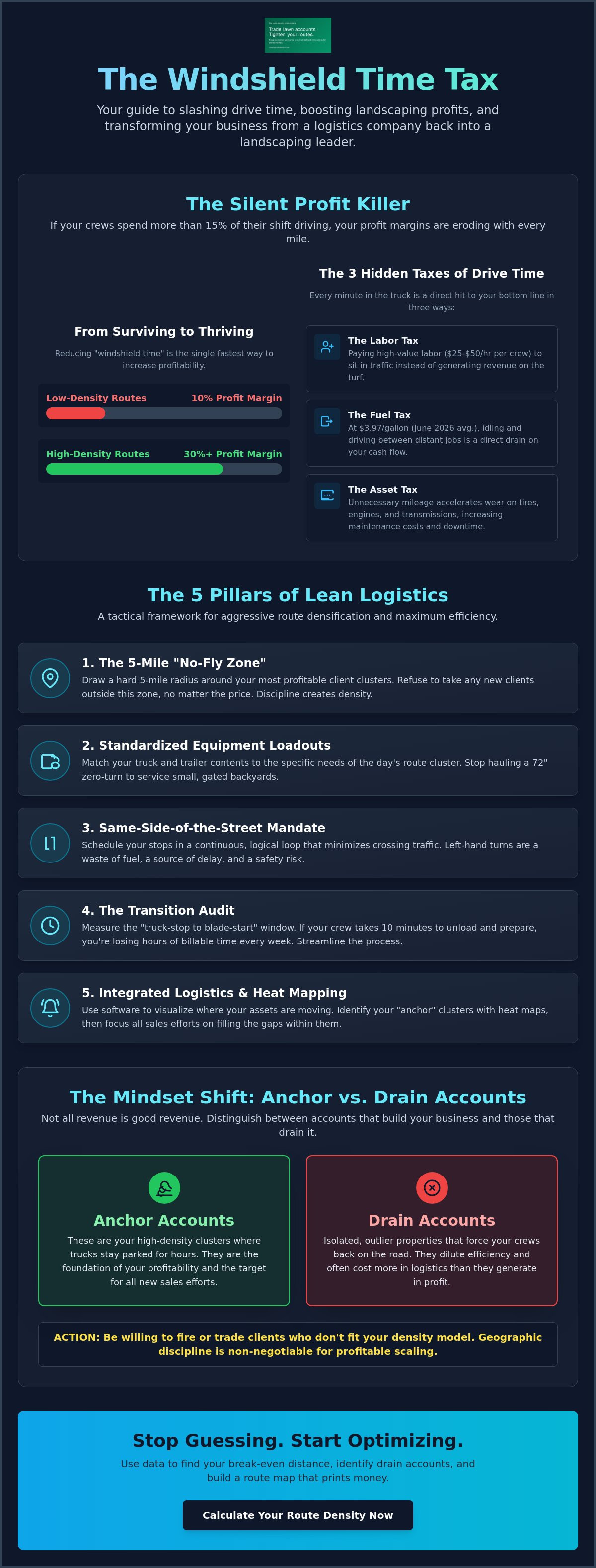
Windshield time is the primary profit-killer in landscaping logistics. It is the silent thief that robs your company of its most valuable resource: billable labor hours. Every minute your crew spends sitting in a truck is a minute they aren't generating revenue on the turf. In the high-overhead environment of 2026, you cannot afford to ignore this drain. To improve landscaping route efficiency, you must first acknowledge that your truck is a cost center, not a profit center. The difference between a struggling 10% margin and a healthy 30% margin often comes down to how much time you spend driving versus how much time you spend mowing.
Think of drive time as a "Logistics Tax." This tax is paid in three ways. First, you pay the labor tax; you're paying crews $25 to $50 per hour to look at a dashboard. Second, you pay the fuel tax; with national averages hitting $3.97 per gallon in June 2026, idling in traffic is a direct transfer of your wealth to the pump. Third, you pay the asset tax; every mile adds wear to tires, engines, and transmissions. Profitability in 2026 requires a "tough love" audit of every single stop on your map. If a property doesn't fit your density model, it's a liability, not an asset.
Calculating Your Real Non-Billable Logistics Waste
Stop guessing about your profitability. You need to know the exact hourly cost of a crew in transit. This includes the combined hourly wages of the crew, the fuel burn rate of the truck, and the per-mile depreciation of the equipment. Solving the Vehicle Routing Problem is the foundation of your survival. You can use the lawn care route density calculator to find your specific "break-even" distance for any given account. In the context of a mowing stop, marginal utility is the net profit generated after subtracting the total logistics cost required to reach and service that property. If the drive time eats the margin, the utility is zero.
The Psychology of Saying No to Outliers
The "one more stop" mentality is a trap. Adding a client ten miles away from your current cluster doesn't grow your business; it dilutes your efficiency. You must distinguish between "anchor accounts" and "drain accounts." Anchor accounts are the high-density clusters where your truck stays parked for hours. Drain accounts are the isolated outliers that force your crews back onto the road. Geographic discipline is the only way to scale nationally without losing your shirt. You must be willing to fire clients who don't fit your route density. If they are outside your five-mile "No-Fly Zone," they are costing you more than they are paying you. Discipline today leads to profit tomorrow.
The Route Density Checklist: 5 Pillars of Lean Logistics
Software won't save a broken business model. If you want to improve landscaping route efficiency, you need a logistical framework that prioritizes proximity over volume. However, once your model is sound, the right tools are essential; for instance, those in the outdoor blind industry can discover Patio Link to optimize their business management. Most contractors chase every lead that hits their inbox. This is a mistake. You're building a network, not a collection of random dots on a map. These five pillars form the foundation of a lean operation that maximizes every drop of fuel and every minute of labor.
- The 5-Mile No-Fly Zone: Draw a hard circle around your anchor clusters. If a new lead falls outside that 5-mile radius, you don't take it. Period.
- Standardized Equipment Loadouts: Don't haul a 72-inch zero-turn to a neighborhood of gated backyards. Match your trailer's contents to the specific needs of the cluster.
- Same-Side-of-the-Street Mandate: Left-hand turns are a waste of time and a safety risk. Schedule your stops so the truck moves in a continuous, logical loop that minimizes crossing traffic.
- The Transition Audit: Measure the "truck-stop to blade-start" window. If your crew takes ten minutes to unload, you're losing hours every week. Tighten the flow.
- Integrated Logistics: Use lawn care logistics management to visualize where your assets are actually moving and eliminate redundant travel.
Geographic Asset Mapping and Clustering
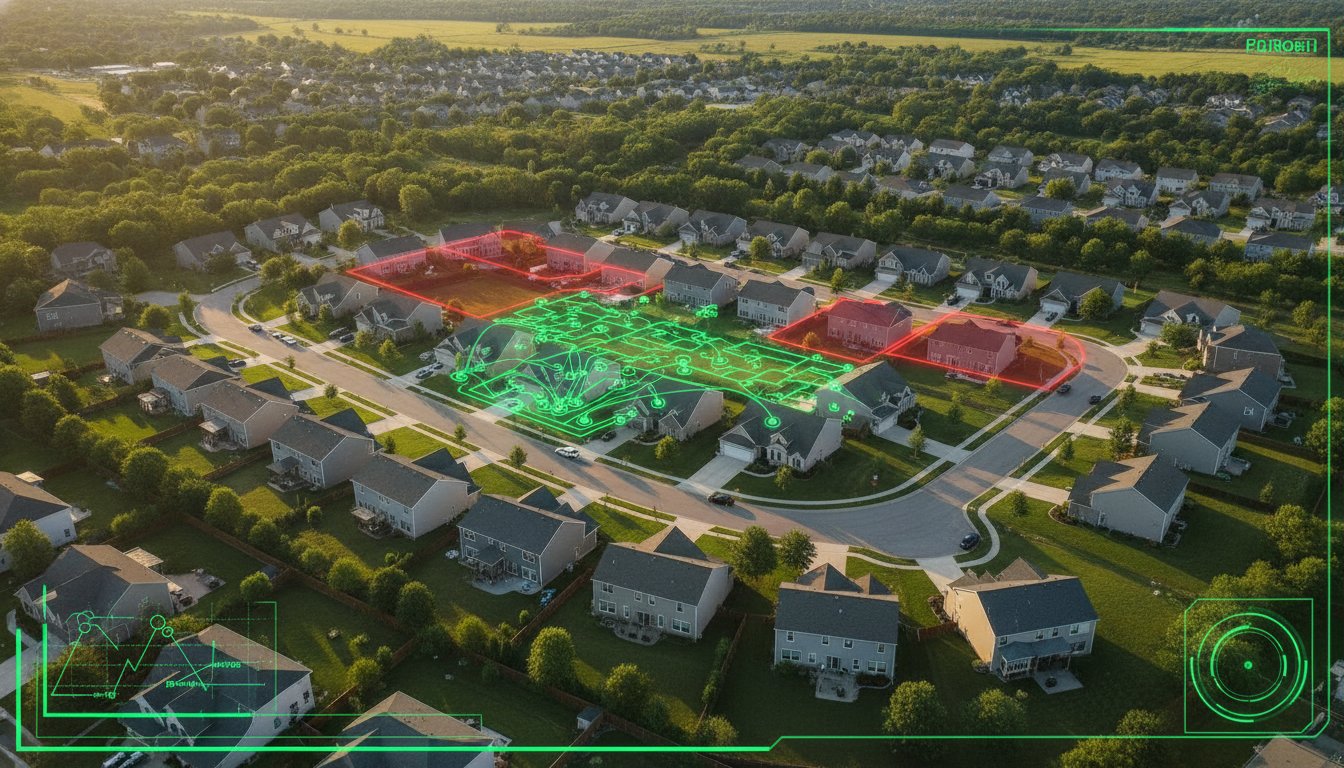
Visualizing your route is the first step toward true optimization. Use heat maps to identify where your most profitable accounts are concentrated. These are your anchors. The "Anchor and Fill" strategy involves focusing all marketing and sales efforts solely on the gaps within these existing clusters. You can reduce drive time in lawn care by 20% simply by refusing to service properties that require a highway exit to reach. It's about dominating a zip code, not a county.
Standardizing On-Site Operational Flow
Standardized equipment is a force multiplier. If every crew uses the same stand-on mowers and handhelds, you eliminate decision fatigue. Your team knows exactly where every tool sits on the trailer. This consistency speeds up the route flow and simplifies training. Proactive maintenance is equally critical; a broken belt in the field is a route-killing event that ripples through your entire week. For those looking to scale without the headache of ownership, exploring professional lawn equipment rental can keep your operations lean and your equipment modern while you focus on density.
Improve Landscaping Route Efficiency via Account Trading
Marketing for density is a slow game. It takes years to win a neighborhood door-by-door through traditional sales. If you want to improve landscaping route efficiency today, you need to stop chasing leads and start trading assets. Most contractors view their client list as a permanent possession. This is a mistake. Your client list is a portfolio. Like any portfolio, it requires active management to remain profitable. Account trading is the fast track to a dense, high-margin route.
The "Strategic Swap" is your most powerful tool for 2026. You likely have three accounts in a neighborhood ten miles away that eat your profit in fuel and labor. Your competitor likely has three accounts in your primary cluster that do the same to them. Neither of you is winning. By executing a 1:1 account swap, you both eliminate the "windshield tax" and reclaim your margins. The math is simple; a well-executed trade can increase net profit by 15% without adding a single dollar of top-line revenue. You aren't working more; you're just driving less. Using a lawn account trading platform creates the liquidity you need to make these moves happen quickly.
Buying Routes to Force Immediate Efficiency
Stop spending your entire budget on digital ads that bring in scattered leads. Shift your focus to the "Acquisition for Density" model. When you buy a competitor’s route, you aren't just buying revenue; you're buying geographic dominance. Perform rigorous due diligence on the "tightness" of any client list before you sign. A list of fifty accounts spread across three counties is a liability. A list of twenty accounts on two adjacent streets is a goldmine. The goal is to integrate these new stops into your existing clusters without adding a new crew or a second truck. That's how you scale without bloat.
The Secondary Market: Selling Your Outliers
Every account outside your five-mile "No-Fly Zone" is a drain on your resources. Sell them. Turning these low-margin outliers into cash allows you to fund density growth in your core areas. Don't value these routes based on revenue alone. Value them based on how much drive time they cost you. A lawn mowing service provider locator is an essential tool for finding trade partners who are already working in those outlier zones. To them, your "bad" account is a high-density "anchor" account because they are already next door. Sell the waste and keep the profit.
Leveraging Asset-Light Equipment Rentals for Field Efficiency
Ownership is often a trap. In 2026, the most profitable contractors are shifting toward an asset-light model. You don't need a massive yard full of depreciating steel to scale your business. You need access to the right tools at the right time. To improve landscaping route efficiency, you must align your fleet with your current route density. Owning a static fleet means you're paying for maintenance and storage on machines that may not fit your next cluster. Access beats ownership every time.
Utilizing professional lawn equipment rental allows you to scale your fleet based on real-time demand. This is the "Seasonal Flex" strategy. You only pay for the capacity you're actually using on the turf. Why carry the overhead of five mowers in the off-season when you only need three? Tighten your operations. Keep your capital liquid. Don't let your equipment dictate your growth; let your route density dictate your equipment.
Eliminating Downtime with Commercial Mower Rentals
A mower down in the field isn't just a repair bill. It's a logistical disaster. When a machine breaks, your high-density route grinds to a halt. Your labor costs continue while your revenue stops. This is where commercial lawn mower lease options provide a critical safety net. You trade the headache of maintenance for the certainty of uptime. Rental units are typically newer and better maintained. If a rental breaks, it's the provider's problem to replace it, not yours to fix it. This shift from Capital Expenditure (CapEx) to Operating Expense (OpEx) keeps your business lean and responsive.
Matching Equipment to the Route
Efficiency dies when you use the wrong tool for the job. A 72-inch zero-turn is useless in a neighborhood of tight, fenced-in backyards. Conversely, a 36-inch walk-behind wastes time on a wide-open commercial acre. You must match mower capacity to the specific needs of your clusters. Using stand-on rentals for gated communities and wide-area zero-turns for open turf maximizes your square footage per hour. Equipment agility directly impacts your daily billable hours. If your crew isn't fighting the terrain with the wrong machine, they're finishing the job faster. Faster finishes mean more stops. More stops mean higher margins.
Ready to stop burning cash on maintenance and start scaling? Explore our lawn mower rental solutions to keep your fleet as lean as your routes.
Executing the 2026 Efficiency Strategy
Success in this industry isn't about how well you cut grass. It's about how well you move your assets. To improve landscaping route efficiency, you must kill the "Owner-Operator" mindset. You are no longer just a landscaper; you are a route strategist. The contractors who will dominate 2026 are those who master logistics and treat their service map like a high-stakes puzzle. If you aren't optimizing, you're subsidizing your customers' drive time with your own retirement fund. Tighten your routes or lose your margin. The choice is that simple.
Execution requires a disciplined schedule. Follow this 30-day tactical plan to reclaim your profitability:
- Days 1-7 (Audit): Run every account through a density calculator. Identify every stop that falls outside your profitable "break-even" distance.
- Days 8-14 (Cluster): Draw your five-mile "No-Fly Zones" around your highest-performing anchor accounts. Map out the gaps where you need more density.
- Days 15-21 (Trade): List your outlier accounts on a trading platform. Reach out to competitors to execute "Strategic Swaps" for accounts inside your zones.
- Days 22-30 (Scale): Offload your underperforming owned equipment. Secure commercial rentals to fill seasonal gaps and match your new, denser route requirements.
Scaling Your Fleet Without the Debt Load
Debt is a weight that sinks companies when the market shifts. You can scale your fleet without the heavy burden of high-interest loans. By using a marketplace to find both trade partners and equipment simultaneously, you keep your business agile. This is the core of a lawn care profit margin optimization strategy. You focus on the math of the route while the marketplace handles the liquidity of the assets. Remember the checklist: audit your waste, cluster your stops, trade your outliers, and rent for flexibility. This is how you build a lean, recession-proof operation.
Next Steps: Joining the Mowing Route Density Marketplace
The tools for your transformation are already available. You don't need to wait for a better economy to see better margins. You just need better density. Stop driving past profitable neighborhoods to reach a single "legacy" client who lives twenty minutes away. List your outlier accounts for trade today and find a partner who is already there. Use high-quality commercial rentals to handle peak-season surges without committing to a five-year note. It's time to work smarter. Audit your route density and start trading accounts today.
Master Your Logistics or Lose Your Business
Windshield time isn't an unavoidable cost of doing business; it's a choice to bleed profit. You now have the tactical framework to stop the hemorrhage. By enforcing a strict five-mile "No-Fly Zone" and utilizing strategic account trading, you reclaim the billable hours previously lost to traffic. To improve landscaping route efficiency, you must transition from a laborer's mindset to a strategist's mindset. Every mile saved is a direct deposit into your bottom line.
Professional transportation providers understand the value of every mile better than anyone; if you want to see how a luxury fleet manages its operational standards and efficiency, click here.
The asset-light model is your path to sustainable growth in 2026. Don't let heavy debt and maintenance downtime anchor your company. Use commercial rentals to flex with your route density and keep your capital liquid. The tools for this transformation are ready and waiting for you to use them. Our specialized B2B marketplace focuses on no-nonsense logistics and asset-light scaling for serious contractors.
Maximize your margins: Rent mowers or trade accounts on the Mowing Route Density marketplace.
Take control of your map today. Your future margins depend on the geographic discipline you show right now. You've got the plan; now go execute it.
Frequently Asked Questions
How much drive time is considered "efficient" for a lawn care route?
Drive time should ideally account for less than 15% of your crew's total shift. If your team is in the truck for more than 75 minutes of an 8-hour day, you have a density problem. High-efficiency routes aim for clusters where travel between stops is under five minutes. Anything higher suggests you're paying a Logistics Tax that eats your profit before you even start the mower.
Can I really swap accounts with a competitor safely?
Yes, account trading is a standard B2B strategy to improve landscaping route efficiency. Using a dedicated trading platform ensures that the exchange is documented and fair. You aren't losing customers; you're trading low-margin outliers for high-density local accounts. It's a strategic move that benefits both parties by reducing fuel overhead and increasing billable hours per day.
What happens if I have a high-value client that is an outlier?
High-revenue accounts aren't always high-profit accounts. If an outlier's logistics cost exceeds its margin, it's a liability. You should either raise the price to cover the Logistics Tax or trade the account to a contractor already working in that zone. Don't let a single prestige account ruin the profitability of an entire crew's day. Be pragmatic about the math.
Is it better to buy a route or grow organically to improve density?
Buying a route is the fast track to density, while organic growth is often geographically scattered. Purchasing a competitor’s local cluster allows you to dominate a zip code instantly. This Acquisition for Density model ensures your trucks stay in one neighborhood all day. Organic marketing often brings in leads that fall outside your No-Fly Zone, creating more waste and travel time.
How does commercial mower rental improve my bottom line compared to owning?
Rental eliminates the hidden costs of ownership, including maintenance downtime, storage, and depreciation. An asset-light model allows you to scale your fleet to match your current route density without taking on long-term debt. If a machine breaks, you get a replacement immediately. This keeps your crews working and protects your margins from unexpected repair bills that kill your cash flow.
What are the best tools for measuring route density in 2026?
Use heat mapping software and route optimization platforms to visualize your account clusters. These tools identify where your anchor accounts are and where you have gaps. You should also utilize a route density calculator to determine the exact profitability of each stop. Measuring the distance between accounts is the only way to verify if your logistics strategy is actually working.
What is the "Logistics Tax" and how do I calculate it for my business?
The Logistics Tax is the total cost of non-billable transit time, including labor wages, fuel consumption, and equipment wear. To calculate it, add your crew's hourly pay to your truck's operating cost per mile. Multiply this by the total hours spent driving. If this number exceeds 20% of your daily revenue, your routes need an immediate audit to save your margin.
How often should I audit my landscaping route efficiency?
You should perform a full route audit at least once every 30 days. Markets change and clients churn, which can create holes in your density map. Regular audits allow you to identify new outliers before they become a permanent drain on your resources. Constant tightening is the only way to improve landscaping route efficiency and maintain a 30% margin in a high-overhead environment.


