Your crews aren't paid to sit in traffic. Every minute a truck spends idling on a congested highway is a minute you aren't billing for. With fuel prices climbing above $4 per gallon and labor rates hitting up to $90 per hour, drive time isn't just a nuisance. It's a financial crisis. If your accounts are scattered across three counties, you aren't running a lawn care business; you're running a logistics company that happens to cut grass. You need a strategy to reduce drive time lawn care before your overhead swallows your margins whole.
We agree that the old model of chasing every lead, regardless of location, is broken. It leads to employee fatigue and accelerated fleet wear that cuts deep into your bottom line. This article promises a tactical shift. You'll learn the exact logistical framework to tighten your service area and maximize your billable hours through route density. We will examine how to cluster your assets, trade inefficient accounts, and use data to build a territory that actually works for your bank account.
Key Takeaways
- Audit your "Dead Time" to uncover the true cost of every non-billable mile. Stop guessing and start quantifying the impact of fuel, labor, and depreciation on your bottom line.
- Master a five-step reorganization process to reduce drive time lawn care by building tight, high-density account clusters within a five-mile radius.
- Implement the "Drop and Mow" strategy to optimize multi-crew logistics and slash the overhead associated with heavy equipment transport.
- Leverage lawn account trading platforms to offload distant outliers and swap them for profitable, local contracts that fit your core service area.
- Apply a strict "Radius Rule" to all future marketing and lead generation to ensure your growth increases route density rather than scattering your fleet.
The Dead Time Audit: Quantifying the Cost of Every Mile
If your crews are in the truck, they aren't making you money. It's that simple. We call this "Dead Time." It is every non-billable minute spent in transit between jobs. Most owners view driving as an unavoidable cost of doing business. They're wrong. Driving is a logistical failure that bleeds your bank account dry. To effectively reduce drive time lawn care, you must first quantify the damage. This process is a localized application of the Vehicle Routing Problem; you are solving for the most efficient path to deliver service while minimizing total distance and time.
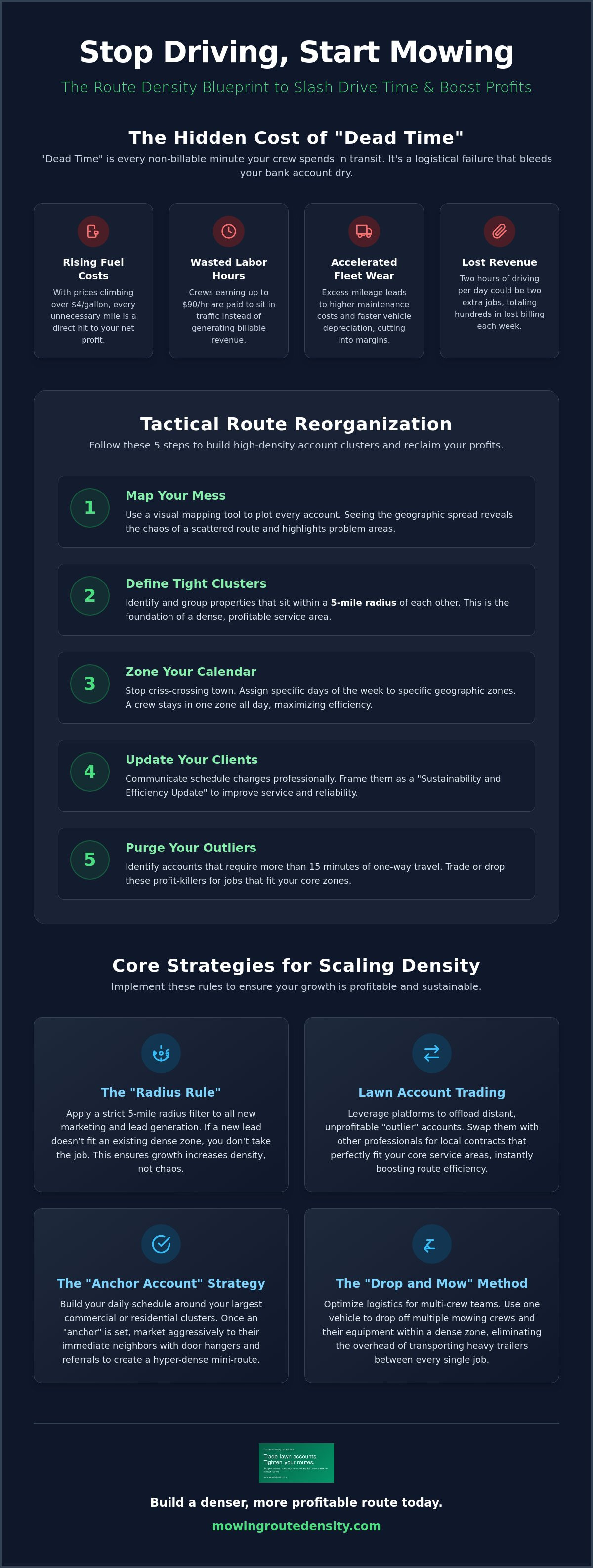
The true cost of driving isn't just the number on the gas pump. You must calculate the combined weight of fuel, labor, and vehicle depreciation. When you add these up, a twenty-minute drive isn't just a break for your crew; it's a direct hit to your net profit. You need to establish a "Density Threshold." This is the maximum distance allowed between stops before a job becomes a financial liability. If a stop exceeds this threshold, it's a leak. Use this lawn care route density calculator to find exactly where your cash is disappearing.
Calculating Your Hourly Overhead Leakage
Combine your crew's total hourly wage with your average fuel burn per mile. Don't forget to factor in the opportunity cost of lost mow-time. If your crew spends two hours a day driving, that's two hours they aren't generating revenue. At a national average of $50 to $85 per residential visit, that's hundreds of dollars in lost billing every week. Overhead Leakage is the gap between gross revenue and potential revenue if transit were zero.
Identifying High-Cost "Outlier" Accounts
Flag any account that requires more than 15 minutes of one-way travel. These are your "Outliers." They are the silent killers of your margin. Look at the numbers. Does a standard residential mow justify a 30-minute round trip? Usually, it doesn't. If you cannot cluster these accounts with new neighbors within a few months, they don't belong on your schedule. You have two choices: find a way to densify that neighborhood or trade those accounts for properties that fit your core territory. Stop chasing every lead. Focus on the ones that actually pay for the time they consume.
Tactical Route Reorganization: 5 Steps to Tighten Your Schedule
Reorganizing your route is the fastest way to reduce drive time lawn care without losing revenue. Mapping your mess is the first step toward sanity. Use a visual GIS or route-mapping tool to plot every account you currently service. Seeing the pins on a map reveals the chaos of a scattered route. Once visualized, you must group these accounts into "Tight Clusters" that sit within a five-mile radius. This isn't a suggestion. It's a requirement to reduce drive time lawn care and protect your margins. Follow these five steps to regain control.
- Map existing accounts: Use visual software to see the geographic spread of your clients.
- Define clusters: Identify groups of properties that sit within 5 miles of each other.
- Zone the calendar: Assign specific days of the week to specific geographic regions.
- Update clients: Frame schedule shifts as a "Sustainability and Efficiency Update" to maintain professional trust.
- Purge outliers: Trade or drop accounts that sit outside your newly defined core strike zones.
Zone-Based Scheduling for Maximum Density
Stop criss-crossing your service area. It's a waste of fuel. It's a drain on your crew. Lock your teams into one specific zone per day. This strategy prioritizes high-density neighborhoods over high-ticket individual accounts that sit in isolation. A $60 mow that's 10 miles away is worth less than two $45 mows on the same street. Every new lead must be vetted against these zone boundaries. If the lead doesn't fit the zone, don't take the job. If you need more accounts in a specific area to make a zone viable, you can find local partners to trade with and fill the gaps.
The "Anchor Account" Strategy
Your schedule should revolve around your largest commercial or residential clusters. These are your "Anchor Accounts." They provide the volume that justifies the initial drive. Once an anchor is established, market aggressively to their immediate neighbors. Door hangers and referral programs in these specific pockets are high-ROI moves. Use lawn care logistics management to refine these clusters and ensure your marketing spend only targets high-density growth. This isn't just about cutting grass. It's about owning the block. Every neighbor you sign reduces the average transit time for that entire cluster.
Asset Clustering: Reducing Transit via Equipment Strategy
Your equipment is a logistical liability. Every time you load a 1,200-pound zero-turn onto a trailer, you increase your fuel burn and slow your transit speed. To reduce drive time lawn care, you must stop viewing your mowers as static tools. They are mobile assets that dictate your route's profitability. If you're hauling heavy iron across town for a single acre, you're losing money before the blades even spin. High-density operations use the "Drop and Mow" method. This involves dropping a crew and their gear in a tight cluster of properties and letting them work the entire block on foot or via mower transit. The truck doesn't move. The engine doesn't idle. The profit stays in your pocket.
Mower width also plays a critical role in property-to-property speed. A deck that is too wide for standard gates forces your crew to manually push-mow or backtrack to the trailer for different gear. This creates micro-transit delays that add up to hours of lost productivity over a week. Every piece of equipment on your trailer must be optimized for the specific density of the zone you are servicing. If the gear doesn't match the geography, your route density is an illusion.
Renting Mowers for Temporary Density Spikes
Seasonal surges can wreck your route density. If you land a massive cluster forty miles from your shop, don't waste labor hours hauling a fleet back and forth every day. Use professional lawn equipment rental to stage machines near your high-density zones. This allows your crew to commute in a smaller, fuel-efficient vehicle rather than a heavy-duty truck pulling a loaded trailer. Compare the daily rental rate against the combined cost of fuel, trailer maintenance, and the hourly wages paid for transit. Often, the rental is the cheaper logistical move. It allows you to scale a cluster without the drag of a massive fleet transport.
Stand-On Mowers vs. Zero-Turns for Transit Efficiency
Equipment choice is a logistical decision, not just a mechanical one. Stand-on mowers are the superior choice for high-density routes. They have a shorter footprint. This allows you to fit more units on a smaller trailer. Faster deployment means less time spent at the curb. If your crew can shave two minutes off every unload and load cycle across twenty stops, you've gained forty minutes of billable time. Select equipment based on the specific density requirements of the zone. Tighten your gear to match your geography and watch your non-billable hours vanish.
Route Trading: The Fastest Way to Eliminate Drive Time
Stop being sentimental about your client list. A scattered route is a failing route. If you have an account that forces a twenty-minute detour, you aren't providing service; you're donating labor. Route trading is the most aggressive way to reduce drive time lawn care. It allows you to surgically remove the outliers that bleed your margins and replace them with properties that sit directly between your existing stops. This isn't about giving up on customers. It's about recognizing that a different contractor can service that property more efficiently because they are already on that block.
Peer-to-peer trading turns your logistical liabilities into assets. By using a dedicated lawn account trading platform, you can find reputable partners who have the exact opposite problem. They might have a single account in your "Power Zone" while you have one in theirs. Swapping these accounts is a zero-sum move for your gross revenue but a massive win for your net profit. You eliminate the non-billable transit time and immediately increase your billable-to-non-billable ratio. When labor rates are hitting $90 per hour, every mile you cut is a direct deposit into your business.
The Mechanics of an Account Swap
Don't value accounts based solely on gross revenue. A $50 mow that is thirty minutes away is a loser. A $45 mow that is next door to an existing client is a goldmine. Value your accounts based on their density potential. When preparing for a trade, draft simple handoff agreements to ensure the client feels secure during the transition. Verify the reputation of the contractor you're dealing with. Your brand is still on the line. Standardize your service quality so the handoff feels seamless to the homeowner. If the stripes look the same, the client won't care who is behind the mower.
Acquiring Pre-Built Routes for Instant Density
Marketing is expensive. Buying density is often cheaper. Acquiring a pre-clustered route from a retiring owner or a contractor downsizing their territory provides instant scale. Before you sign, audit the route density of the client list. If the properties aren't within your established zones, the acquisition will only increase your fatigue. Integrate these new accounts into your zone-based schedule immediately. The goal is to own the neighborhood. If you can't be the dominant provider on a specific street, you shouldn't be there at all. Use trading to reduce drive time lawn care and build a territory that defends itself against rising fuel costs.
Scaling Without Scattering: Maintaining Density as You Grow
Growth is a trap for the undisciplined owner. If you scale by grabbing every lead in the county, you aren't growing; you're just buying more traffic. You need a "Radius Rule." This is a hard limit on where you accept new business. If a lead isn't within two miles of an existing cluster, the answer is no. This discipline is the only way to reduce drive time lawn care as you expand. Without it, your fleet will be spread too thin. Your profits will evaporate in transit. Your crews will burn out. Stick to your zones or watch your margins die.
Your crew leads are your best scouts. Train them to identify "fill-in" accounts while they are on-site. If the neighbor's lawn is overgrown or serviced by a competitor on a different day, that's a prime target. Give your leads the authority to leave a door hanger or offer a same-day quote. Adding a property next door adds zero minutes of drive time. It is pure profit. You must also regularly re-audit your routes to prevent "Density Decay." Customers move. They cancel service. Neighborhoods change. If you don't prune your route every quarter, the gaps will naturally widen. Stay aggressive about keeping your clusters tight.
Hyper-Local Marketing for Fill-In Growth
Stop wasting marketing dollars on broad zip codes. Use door hangers and targeted digital ads within a one-mile radius of your current jobs. Offer "Neighborhood Discounts" to homeowners on the same street. It's better to give a 5 percent discount to five neighbors than to pay for the fuel to reach five separate neighborhoods. Focus on the "billable hour per square mile" metric. This number tells the real story of your efficiency. If your revenue is up but your billable hours per mile are down, you're failing. Target the gaps between your current stops to reduce drive time lawn care and dominate specific blocks.
Leveraging Subcontractors for Distant Leads
Sometimes you get a high-value lead that sits ten miles outside your core zone. Don't send your truck. If a lead is too far, find lawn care subcontractors to service it for you. This allows you to maintain your brand presence and capture the lead without the transit waste. You keep a management fee. You keep the customer relationship. You lose the fuel cost and the labor fatigue. Subcontracting is a strategic tool for testing new markets before you commit a full crew and equipment cluster to the area. Work smarter. Keep your assets where they are most profitable and offload the outliers to partners who are already there.
Stop Driving and Start Dominating Your Market
You've done the math. You know exactly how much "dead time" is costing your business every week. High fuel prices and rising labor rates mean you can no longer afford to ignore the miles between stops. By reorganizing your zones, trading away outlier accounts, and clustering your equipment assets, you can finally reduce drive time lawn care and reclaim your margins. Density isn't just a metric. It's your competitive advantage in a crowded industry. Your trucks should be tools for production, not mobile lounges for your crew.
You don't have to build a dense route alone. Use a secure lawn account trading platform to swap your logistical liabilities for profitable clusters. Whether you need to find local partners through a national contractor network or explore commercial-grade equipment rental options to stage gear near your target zones, the tools are ready. Optimize your routes today on the Mowing Route Density marketplace. It's time to stop bleeding cash on the highway and start building the lean, efficient operation your hard work deserves.
Frequently Asked Questions
How do I calculate the actual cost of drive time for my crew?
Calculate your cost by combining the total hourly wage of the crew with the average fuel burn per mile. You must also factor in vehicle depreciation and maintenance costs per mile. If a three-man crew costing $75 per hour spends 20 minutes driving to an outlier, you've lost $25 in labor before the engine even stops. This doesn't even account for the $50 or more in gross revenue they could've generated if they were mowing instead of sitting in traffic.
Is it better to charge a travel fee or just drop far-away accounts?
Trading or dropping accounts is the superior long-term strategy. A travel fee might cover your fuel, but it doesn't solve the problem of employee fatigue or the opportunity cost of lost billable hours. Fees are a band-aid for a broken route. To truly reduce drive time lawn care, you need to eliminate the distance entirely. Focus on building a territory where you own the block rather than chasing thin margins across the county.
What is the ideal route density for a lawn care business in 2026?
The gold standard is "Neighborhood Ownership," where your stops are less than three minutes apart. In the current economic climate, a profitable density threshold means keeping all accounts within a five-mile radius of a primary anchor property. If your crew can move from one job to the next without loading the mower back onto the trailer, you've achieved peak efficiency. Anything less is just leaving money on the pavement.
Can I legally trade lawn care accounts with another company?
Yes. Trading accounts is a standard business practice. You are essentially selling the lead or the contract to another provider. You should use a formal handoff agreement to protect your brand and ensure the client receives a seamless transition. Most service contracts are transferable, but you should always verify your specific terms. Trading is a proactive tool for optimization; it's not just for when you're ready to quit the business.
How do I tell a long-term customer I am dropping them due to route density?
Be blunt but professional. Frame the conversation as a "Service Area Optimization" to ensure all clients receive the highest quality of care. Tell them that their property no longer fits your logistical footprint. Always provide a direct referral to a reputable contractor who is already working on their street. Most customers will understand that rising fuel and labor costs require you to tighten your operations to stay in business.
What software is best for reducing drive time in a landscaping business?
Choose software that features AI-powered route optimization. Modern platforms can reduce drive time lawn care by 25 percent to 35 percent compared to manual planning. Look for tools that allow for "what-if" scenarios, such as seeing how a new lead impacts your existing route density before you accept the job. Real-time traffic integration is also a requirement for maintaining efficiency in growing urban markets.
Does equipment rental actually help with route efficiency?
Equipment rental is a secret weapon for asset-light density. By staging rental mowers near a high-density cluster, your crew can commute in a smaller, fuel-efficient vehicle instead of a heavy-duty truck pulling a loaded trailer. This strategy slashes your fuel consumption and reduces the wear and tear on your primary fleet. It's a pragmatic way to handle seasonal surges without the permanent overhead of a new machine.
How much drive time is considered "normal" in the lawn care industry?
Many struggling companies lose 20 percent of their day to transit. This is "normal" but it isn't profitable. High-performance operations target a non-billable transit ratio of 10 percent or less. If your crew works an eight-hour shift and spends more than 45 minutes total in the truck, your route is too scattered. You need to aggressively prune your outliers until your billable-to-non-billable ratio reflects a lean, efficient business model.


