

Your biggest competitor isn't the guy down the street with a bigger trailer. It's the odometer on your own trucks. Every mile driven between jobs is a leak in your bucket. It's wasted labor. It's wasted fuel. With national diesel prices averaging $5.35 per gallon, you can't afford a loose schedule. If your crews spend more time behind a steering wheel than behind a mower, you're losing. Effective lawn care logistics management is the only way to stop the bleed and protect your bottom line.
You've felt the sting of a scattered route. You know that more customers shouldn't always mean more problems, yet scaling often feels like a trap of rising debt and falling efficiency. We're going to fix your margins. This guide will show you how to tighten your operations through aggressive route density and asset-light scaling. You'll learn to trade low-density accounts for high-profit clusters and build a model for national growth that doesn't rely on a fleet of new trucks. Stop wasting profit on the road and start reclaiming your billable hours.
Key Takeaways
- Stop paying crews to sit in traffic. Windshield time is a profit killer. It drains your fuel budget and burns out your best workers.
- Master lawn care logistics management by ditching the scattered hub-and-spoke model. Focus on building high-density geographic clusters. More stops in less space equals more profit.
- Scale your fleet without the weight of long-term debt. Use mower rentals as a tactical tool to handle seasonal peaks. Keep your operation lean and your balance sheet clean.
- Fix your broken routes by trading isolated accounts. Use an account trading platform to swap distance for density. Stop driving and start mowing.
- Prioritize revenue per hour over your total customer count. A tight route is more profitable than a sprawling territory. Work smarter, not harder.
The Hidden Cost of Inefficient Lawn Care Logistics
Growth is a trap. Most owners think adding customers is the only way to scale. They chase every lead, even if it's three towns over. This is a mistake. If you add ten new accounts but scatter them across the map, you haven't grown your business. You've grown your overhead. You've added logistical bloat. Poor lawn care logistics management turns a high-revenue day into a high-expense nightmare. Every non-billable mile driven is a direct hit to your net profit.
Windshield Time: The Silent Profit Killer
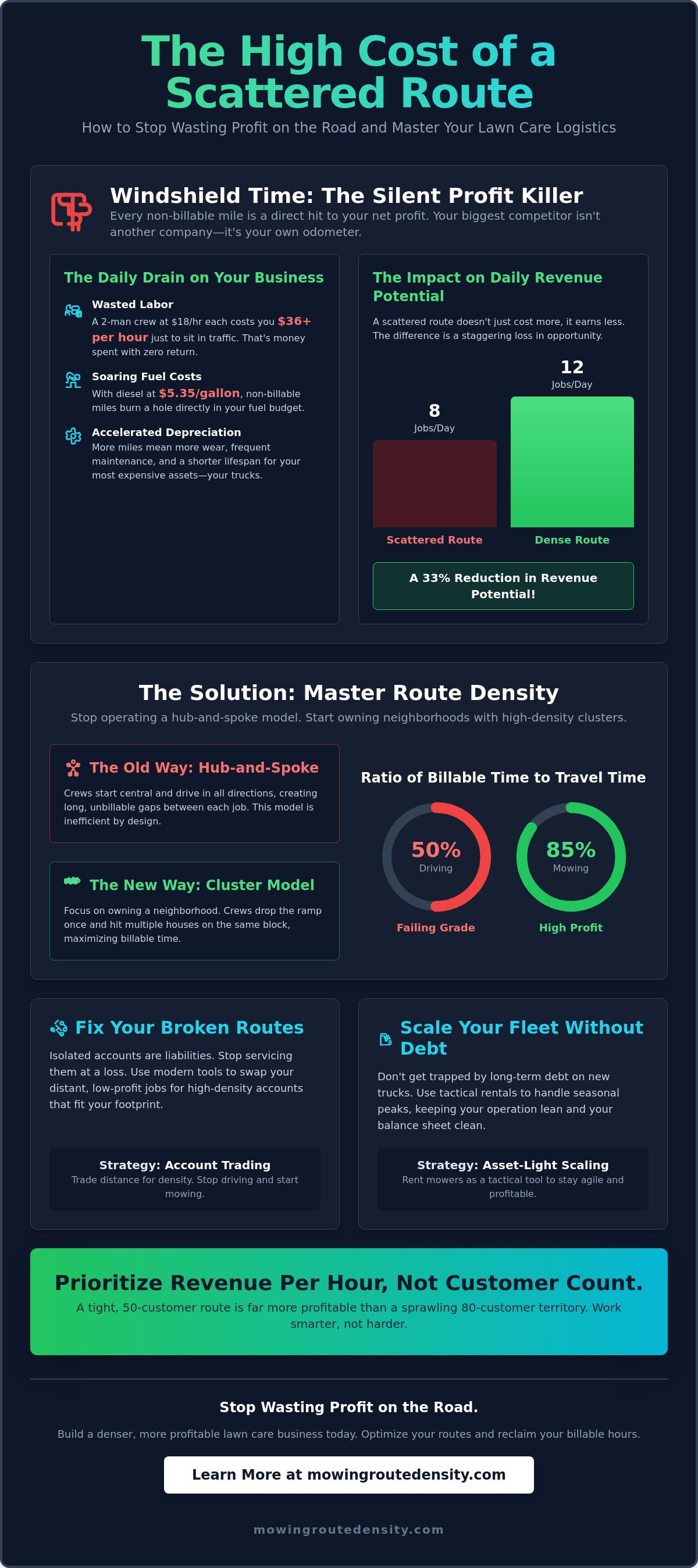
Windshield time is a cancer on your margins. Think about the math. If you pay a two-man crew $18 per hour each, every hour they spend in traffic costs you $36 in raw labor. Add in taxes, insurance, and benefits. That's a massive expense before a single mower hits the turf. Excessive drive time doesn't just cost money; it steals opportunity. A crew on a dense route can hit twelve properties in a day. A scattered crew might only manage eight. That's a 33% reduction in your daily revenue potential.
The cost isn't just financial. It's psychological. Field teams want to be productive. They want to see results. Sitting in a hot truck for two hours a day leads to fatigue and burnout. When your best workers spend more time staring at taillights than finishing jobs, they lose their edge. Productivity drops. Turnover rises. You can't build a stable business on a frustrated workforce.
The Compounding Effect of Fleet Depreciation
Your trucks are your most expensive assets. Every mile you put on them brings them closer to the scrapyard. When you ignore the vehicle routing problem, you accelerate your equipment replacement cycle. It's a simple equation. More miles mean more oil changes. More miles mean more tires and brakes. More miles mean more frequent breakdowns that pull your crews off the field.
High-mileage fleets require a complex, expensive maintenance schedule. This adds another layer of management "noise" to your day. By tightening your geographic footprint, you reduce vehicle wear and tear. You keep your equipment in the field longer. You lower your capital expenditure. Effective lawn care logistics management isn't just about saving fuel; it's about protecting your assets.
- Fuel Waste: Non-billable miles burn through your fuel budget with zero ROI.
- Maintenance Spikes: High-mileage routes lead to unpredictable repair costs.
- Asset Life: Dense routes can extend the life of a truck by two or three years.
Stop pretending that all revenue is equal. A $50 lawn in a dense cluster is worth significantly more than a $70 lawn that's twenty minutes away. Tighten the map. Cut the waste. Protect your profit.
Defining Route Density: The Core of Logistics Management
Most lawn care owners operate on a hub-and-spoke model. They start at a central shop and send crews out in every direction like spokes on a wheel. This is a logistical failure. It creates long, unbillable gaps between jobs. True lawn care logistics management requires a shift to the cluster model. In this framework, you don't service a city; you own a neighborhood. You want your trucks parked, not moving. Every minute spent in transit is a minute where your revenue per hour is exactly zero. As your service radius expands, your marginal utility decreases. You're spending more on fuel and wear to earn the same dollar.
The Mathematics of a Tight Route
Route density is the mathematical ratio of billable service time to non-billable travel time within a standard workday. If your crew spends four hours mowing and four hours driving, your density is 50%. That's a failing grade. To fix this, you must identify dead zones on your map. These are the stretches of road where you have no accounts but high travel costs. Set a maximum travel threshold between jobs. If a potential new account is more than five minutes away from an existing cluster, it's a liability. Reject it. Or, better yet, use a tool like mowingroutedensity.com to find accounts that actually fit your footprint.
Asset Clustering for Maximum Efficiency
Neighborhood grouping is the goal. You want your crews to drop the ramp once and hit three or four houses on the same block. This minimizes the equipment offloading cycle, which is a massive hidden time-sink. When you achieve high-density clusters, you can even coordinate multiple crews in the same zone. One specialized crew handles the heavy mowing while a second crew follows for precision trimming and blowing. This factory-line approach is only possible when your logistics are tight.
This level of coordination is a key component of Fleet Management and Logistics. It allows you to maximize the utility of every mower and every man-hour. If you're looking to scale without the burden of heavy debt, consider how this fits into a Professional Lawn Equipment Rental: A Strategic Framework for Scaling Contractors. By clustering your assets, you reduce the number of trucks needed to hit your revenue targets.
Stop measuring success by your total number of customers. Start measuring it by your revenue per mile. If your truck earns $100 but drives 50 miles to do it, you're losing money. If it stays within a three-mile radius, you're winning. Tighten the map. Increase the density. Protect the profit.
Asset Logistics: Balancing Equipment Rental and Ownership
Ownership is a vanity metric. Many owners brag about the size of their fleet, but a yard full of equipment is often just a yard full of depreciating debt. Real lawn care logistics management treats equipment as a tool for production, not a status symbol. If your machines aren't moving, they're costing you money. The goal is to maximize billable hours while minimizing capital expenditure (CapEx). This is where an asset-light growth model becomes your competitive advantage. By balancing owned core equipment with tactical rentals, you keep your balance sheet lean and your operations flexible.
Scaling Capacity Without Capital Risk
Winning a high-density contract is a victory, but it shouldn't be a financial gamble. When you land a new HOA cluster or a large commercial account, the impulse is to buy more gear. Don't do it. Use lawn mower rental to bridge the gap. Renting allows you to scale up instantly without taking on five-year equipment loans. If the contract ends or the season shifts, you simply return the machine.
This approach eliminates the "storage logistics" nightmare. You don't have to worry about finding space for idle mowers during the off-season. You also avoid the cost of winterizing and maintaining equipment that isn't earning. Matching specific mower types to the terrain of a new route is another logistical win. If a new neighborhood has narrow gates, rent a fleet of 36-inch walk-behinds. If it's a wide-open commercial site, rent a 72-inch zero-turn. Don't force your owned equipment into jobs where it's inefficient.
Strategic Rental for Peak Seasonal Demand
The spring rush is a logistical gauntlet. It's the time of year when your equipment takes the most abuse. By offloading peak-season wear to a rental fleet, you extend the longevity of your owned assets. Use your owned machines for the steady, year-round work and bring in rentals to handle the high-growth months. This strategy keeps your maintenance overhead predictable and your core fleet in better condition for the long haul.
- Immediate Replacement: A breakdown during peak season can kill your route density. Immediate rental replacements keep your crews moving while your primary machine is in the shop.
- Variable Costing: Renting turns a fixed monthly debt payment into a variable expense that only exists when you have the work to support it.
- Maintenance Savings: Every hour put on a rental mower is an hour of wear and tear you don't have to pay for in future repairs.
Stop collecting iron and start collecting profit. A lean fleet is a fast fleet. By mastering the logistics of equipment usage, you ensure that every machine on your trailer is there to maximize your revenue per hour, not just to fill space.
Optimizing Logistics Through Account Trading and Swapping
Organic growth is often messy. You pick up a customer here and another one there. Before you know it, your route looks like a shotgun blast on a map. This is a logistical failure. Aggressive lawn care logistics management requires you to be ruthless with your service area. If an account is an outlier, it's a liability. It doesn't matter how much they pay if the drive time eats the margin. You need to stop thinking about territory and start thinking about density.
How to Swap Accounts for Better Density
The "Route Swap" is a professional strategy for fixing fractured routes. Identify your outliers. These are the jobs that sit ten miles away from your nearest cluster. Somewhere, another owner is driving right past those houses to reach their own outliers near your shop. Ego keeps owners from talking to competitors. Profit should drive you to talk to them. Find a local partner and execute a geographic swap. You give them your distant accounts; they give you theirs. You both win. Standardize your service agreements beforehand to ensure the handoff is seamless for the customer.
Don't rely on informal social media groups for these trades. You need a secure, professional environment to value and exchange accounts. You can trade accounts on our platform to instantly tighten your service footprint and eliminate dead miles.
Buying Routes as a Logistics Shortcut
Marketing is slow. Buying a cluster is fast. If you want to expand into a new neighborhood, don't wait for the phone to ring. Buy an existing route. This is a logistics shortcut that bypasses months of organic effort. However, you must perform due diligence. Don't just look at the total revenue. Evaluate the stop-to-stop distance. A list of twenty homes is worthless if they're spread across five zip codes. You want a tight cluster where the truck stays parked for hours.
- Analyze the Map: Plot every potential new account before you sign.
- Check the Margins: High-density routes have lower fuel and labor costs per stop.
- Software Integration: Ensure the new accounts can be plugged into your existing logistics management software without friction.
Strategic route acquisition is the fastest path to scaling. It allows you to build a dense, profitable operation without the waste of a scattered start. Stop chasing every lead. Start buying the right ones.
Implementing a Lean Logistics Strategy for 2026
Growth isn't just about addition. It's about subtraction. To achieve a lean operation in 2026, you must be willing to cut the accounts that drain your resources. Transitioning from a scattered route to a dense one requires a methodical audit of your current service map. Start by plotting every stop. Identify the clusters. Identify the outliers. If a property requires a twenty-minute drive for a thirty-minute mow, it has to go. This is the foundation of modern lawn care logistics management. You aren't just cutting grass; you're optimizing a supply chain of labor and equipment. Every non-billable mile is a failure of strategy.
The Mowing Route Density Advantage
You don't have to simply abandon your outlier accounts. Use our platform to liquidate them. By selling geographically fractured accounts to owners who are already in those neighborhoods, you turn a logistical liability into immediate capital. Reinvest that cash into acquiring accounts within your existing clusters. This is how you build density without the high cost of traditional marketing. It's a faster, cleaner way to grow.
Leveraging a service provider locator is the second half of this strategy. When you receive leads that fall outside your maximum travel threshold, don't ignore them. Use the locator tool to find high-value partners who can service those leads. This keeps your brand presence strong while maintaining your asset-light, high-margin business model. You stay lean. You stay profitable. You keep your crews focused on the work that actually pays. Stop trying to be everywhere. Start being exactly where the profit is.
Moving Toward Operational Excellence
The most successful owners in this industry have made a mental shift. They've stopped working in the business and started managing the logistics. This requires a commitment to quarterly audits. You must review your route density and revenue per mile every three months. If the numbers are slipping, tighten the map. If a cluster is weakening, bolster it with targeted acquisitions. If your equipment is sitting idle, sell it and switch to a lawn mower rental model for peak demand.
Use this checklist to audit your current lawn care logistics management:
- Map Analysis: Are more than 80% of your accounts located within three primary geographic clusters?
- Drive Time Ratio: Is your non-billable travel time less than 15% of your total daily labor hours?
- Asset Utility: Are you offloading peak-season wear to rental fleets instead of carrying year-round debt?
- Account Health: Have you traded or sold every outlier account that sits more than ten minutes from a cluster?
Operational excellence isn't a destination; it's a habit. It's the daily pursuit of efficiency. It's the refusal to accept waste as a "cost of doing business." Join the Mowing Route Density marketplace to start optimizing your routes and reclaiming your profit today.
Take Command of Your Route Density
The road is a cost center. Your crews are an investment. When you bridge the gap between the two with aggressive lawn care logistics management, you stop the bleeding and start building real wealth. Density isn't just a buzzword; it's the difference between a struggling local outfit and a scalable national operation. You've learned how to identify logistical bloat, trade away inefficient accounts, and use tactical rentals to stay lean. Now it's time to execute.
Stop chasing every lead that calls. Start building clusters that pay. You can access our national marketplace for account trading to swap your outliers for local gold. Need to scale for a new contract? Use our high-quality commercial mower rentals to grow without the debt. If you have leads you can't reach, our B2B service provider locator keeps your brand growing through strategic partnerships. It's time to work smarter, not harder.
Scale your business with the Mowing Route Density marketplace and take control of your margins today. You have the map. Now drive the profit.
Frequently Asked Questions
What is the most efficient way to manage lawn care logistics?
The most efficient way is to prioritize route density over your total customer count. You want a cluster of accounts in one neighborhood rather than a scattered list across the city. This minimizes non-billable travel time and maximizes the revenue generated per truck hour. Tightening your geographic footprint is the only way to scale without bloated overhead. Effective lawn care logistics management treats time as your most limited resource.
How much drive time is acceptable between lawn care jobs?
Aim for less than five minutes of travel time between stops. If your crew spends more than ten minutes driving between accounts, the labor and fuel costs begin to cannibalize your profit margin. Every minute on the road is a minute you aren't billing. If an account is too far from your core cluster, it's a liability. You should trade it or drop it to protect your margins.
Can I really swap lawn care accounts with other contractors?
You can and should swap accounts to fix geographically fractured routes. Professional owners use account trading platforms to exchange distant outlier jobs for ones closer to their existing clusters. This creates a win-win scenario where both contractors reduce their drive time and increase their density. It's a strategic move that treats your client list as a liquid asset rather than a permanent burden.
Is it better to rent or buy commercial lawn mowers for a new route?
Renting is the smarter move when testing new routes or handling seasonal surges. Buying equipment requires long-term debt and constant maintenance, which can be a trap if the route density isn't yet established. Use lawn mower rental to scale your capacity without capital risk. Once a route proves its long-term profitability and density, you can then evaluate a permanent purchase for the fleet.
How does route density affect my lawn care profit margins?
Route density is the primary driver of your net profit margin. High density reduces fuel consumption, lowers vehicle wear, and increases billable hours per crew. When you minimize the distance between jobs, you're effectively cutting your two largest expenses: labor and fuel. A dense route can often be twice as profitable as a scattered one, even if they generate the same total revenue.
What should I look for when buying an existing lawn care route?
Prioritize geographic clustering over the total revenue number. A route with high revenue spread across three zip codes is a logistical nightmare. Look for tight routes where multiple stops are on the same street or in the same neighborhood. Evaluate the historical revenue per mile to ensure the purchase actually strengthens your lawn care logistics management instead of just adding more windshield time.
How can I reduce fuel costs in my landscaping business?
The most effective way to cut fuel costs is to reduce non-billable miles. With diesel prices hitting high averages across the country, you can't afford to wander. Tightening your route density through account swapping and refusing distant leads is the only permanent solution. Stop looking for cheaper gas; start looking for shorter routes. If the truck isn't moving, it isn't burning your profit.
What tools are available for lawn care logistics management?
Modern operations rely on platforms that support asset-light growth. Use account trading platforms to optimize your geographic footprint and service provider locators to handle leads outside your core area. Additionally, tactical mower rental services allow you to scale your fleet during peak demand without the burden of permanent overhead. These tools allow you to manage the logistics of growth without the weight of massive equipment debt.


